
Preparation of Wool: Carbonizing and Crabbing

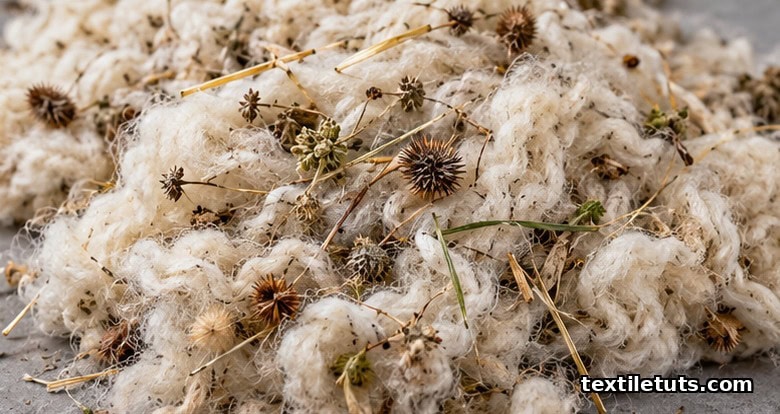
Carbonizing removes 95–99% of vegetable matter (cellulosic burrs, seeds, straw, and grass) from raw wool by impregnating the scoured fiber in 4–6% sulfuric acid at 15–25 °C, drying at 60–80 °C, then baking the acid-laden fiber at 100–130 °C for 3–10 minutes so that the cellulose chars to a brittle residue that mechanical dusting shakes out.
Crabbing is the wet setting treatment that locks woven woollen and worsted fabric to a stable width and yarn twist by passing it across heated rollers through boiling water at 95–100 °C, then winding the saturated fabric tightly onto a chilled beam for 12–24 hours. The two operations sit at opposite ends of wool preparation: carbonizing solves a fiber-chemistry problem (vegetable contamination that resists carding and dyeing), and crabbing solves a fabric-geometry problem (dimensional and surface stability). Both sit upstream of scouring completion, milling, dyeing, and pressing.
What follows explains how each process works in production, the variables that determine fiber damage versus fiber cleanliness, the line between crabbing and decatizing, and the residual chemistry that decides how a finished wool fabric will dye, cut, and wear.
Why Carbonizing and Crabbing Matter in Wool Preparation
A Merino fleece straight off the sheep carries between 5% and 25% of its own weight in foreign matter by mass, depending on breed, the shearing season, and pasture conditions (Simpson and Crawshaw, 2002). Most of that burden is cellulosic: burrs from clover, thistle and medic, seed heads, straw fragments, grass tufts, and twigs. Carding and combing can pull out some of this material mechanically, but fine burr fragments and seed hulls bind into the sliver as nep and seed-coat waste, survive through spinning, and reappear in the woven cloth as colored specks that dye to a different shade than the wool around them.
Carbonizing turns this problem into one of differential acid hydrolysis. Cellulose hydrolyzes rapidly under hot dilute mineral acid; wool keratin, which is built from sulfur-containing amino acids and peptide crosslinks, hydrolyzes far more slowly under the same conditions. With the right concentration, temperature, and time window, the cellulose chars to dust while the wool fiber remains intact.
Crabbing, in turn, addresses the woven fabric’s natural tendency to distort under heat and moisture. Wool fibers swell when wet, and woven wool relaxes into its lowest-energy geometry unless something sets it before the temperature drops. Crabbing sets the fabric close to its target width, embeds the yarn twist into the cloth surface, and creates the smooth, lustrous handle that worsted suitings and uniform fabrics are graded on.
What Carbonizing Does to Wool
Carbonizing exploits a sixfold difference in acid hydrolysis rate between cellulose and wool keratin. In a 5% sulfuric acid bath at 20 °C, cellulose loses tensile strength at roughly 0.8% per hour, while wool loses only about 0.13% per hour under the same conditions (Simpson and Crawshaw, 2002). Cranking the temperature up during a brief baking step drives the cellulose to char without giving the wool enough thermal budget to hydrolyze meaningfully. The end result is a fiber that can be processed without contamination.
The process targets three classes of contaminant: cellulose (40–55% of typical raw wool VM), hemicellulose (15–25%), and lignin (15–30%). Of the three, lignin is the most resistant; the acid baking step is calibrated to char cellulose and hemicellulose fully while only partially softening lignin, which the dusting step removes mechanically.
Sulfuric acid is the workhorse carbonizing agent because it is cheap, non-volatile, and forms a thin concentrated film on the fiber after squeezing that resists migration during drying. Hydrochloric acid is used in some carbonizing lines (typically at 4–7% concentration) because it diffuses faster and washes out easier, but it generates corrosive fume and requires stainless equipment throughout.
Step-by-Step: Carbonizing Line Parameters
- Pre-scouring. Raw wool is washed at 50–60 °C with non-ionic detergent (0.3–0.8% owf) and soda ash (1–2% owf) to remove wool grease, suint, and dirt. Residual grease protects vegetable matter from acid, so the scour must hit a residual grease of 0.4–0.8% on the dry fiber weight.
- Acid impregnation. The scoured fiber is passed through an “acid bowl” containing 4–6% sulfuric acid at 15–25 °C, with a wet pickup target of 80–110% on dry fiber weight. Penetration time in the bowl is 30–90 seconds; longer contact improves char uniformity but raises fiber damage risk.
- Squeeze and dry. Squeeze rollers reduce wet pickup to about 60–80%. The fiber then passes through a hot-air dryer at 60–80 °C to evaporate free water without driving hydrolysis. Drying too fast creates a waxy residue that blocks char; drying too slow lets the acid migrate and concentrate unevenly.
- Baking (the critical step). Acid-laden fiber enters a baking chamber at 100–130 °C for 3–10 minutes. The acid dehydrates cellulose to hydrocellulose, then to carbon. The standard correlation is 1% concentration increase in acid shifts the required baking temperature down by about 10 °C; halving the baking time pushes temperature up by 7–10 °C to compensate.
- Crushing and dusting. Carbonized fiber passes between fluted or knurled rollers and into rotary beaters. The charred VM crushes to dust (target particle size below 30 µm) and is removed by suction. Residual VM after a well-run carbonizing line sits between 0.05% and 0.2% on fiber weight, measured as acid-insoluble ash per IWTO-14 or AATCC 78.
- Neutralization and final scour. Residual acid is neutralized with sodium carbonate (1–2% owf) or ammonia at 40 °C for 15–20 minutes, followed by a water rinse to a fiber pH of 5.5–7.5.
What Crabbing Does to Woven Wool
Crabbing is the wet setting process that fixes the geometry of a woven wool fabric before scouring, milling, and dyeing. Wool fibers swell by roughly 16% in diameter and contract by 1–2% in length when soaked in water above 70 °C (Simpson and Crawshaw, 2002). If the fabric is left alone during this swelling cycle, the warp and weft rearrange into a wavy, distorted state called cockling. Crabbing forces the fabric through the swelling cycle while it is held flat under tension, so the geometry locks in on cooling rather than during the next wet step.
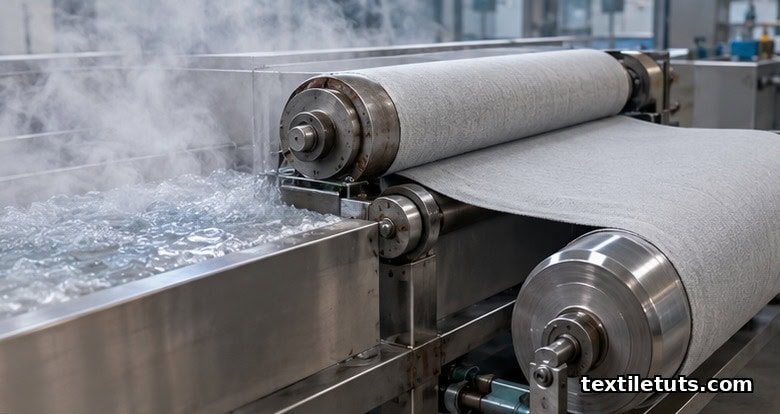
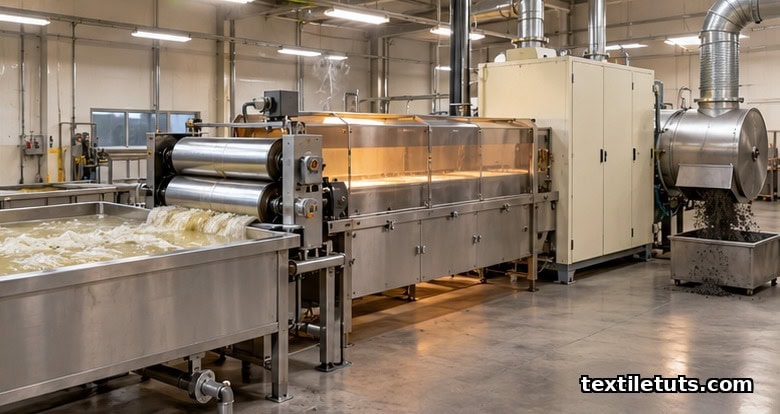
The standard crabbing line consists of a hot-water trough heated to 95–100 °C, a pair of heated rollers (typically 0.8–1.2 m diameter, internally steam-heated to 100–110 °C), a winding roller to take up the saturated fabric, and a holding area where the rolled fabric sits for 12–24 hours while the wool cools and the hydrogen bonds between keratin chains reset.
Three crabbing variants are in common use:
- Single crabbing. One pass through boiling water, one wrap on a chilled beam. Used for fabrics that will be heavily milled afterward, where aggressive felting will erase any geometric slack that single crabbing leaves.
- Double crabbing. Two passes through boiling water with cooling between. Used for fine worsteds and uniform fabrics that need crisp dimensional stability through cropping, pressing, and dye cycles.
- Open crabbing. The fabric is laid flat in a tray of boiling water without winding. Used for fabrics sensitive to compressive marks, or for very lightweight woollens.
The key parameter is the winding tension on the take-up roller: a warpwise tension of 0.5–1.5 cN/tex (about 2–6% of fabric breaking strength) maintains flat geometry without distorting the weave. Excessive tension draws the warp out, leaving a thin fabric that dyes unevenly; insufficient tension lets the weft contract into a too-narrow cloth.
Crabbing vs. Decatizing vs. Carbonizing: How They Differ
These three processes look similar from the mill floor because they each involve heat, moisture, and tension on wool, but they solve different problems and use different mechanisms.
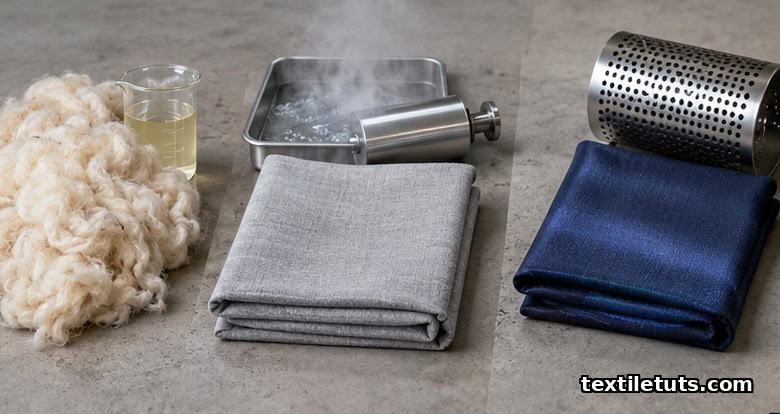
| Property | Carbonizing | Crabbing | Decatizing |
|---|---|---|---|
| Target | Vegetable matter in raw wool | Woven fabric geometry | Finished fabric finish and luster |
| State of wool | Loose fiber (tops, noils) | Woven grey fabric | Finished or dyed fabric |
| Active medium | Dilute mineral acid + heat | Boiling water + heat | Steam (wet or dry) |
| Temperature | 100–130 °C (baking) | 95–100 °C (water) | 110–135 °C (steam) |
| Duration | 3–10 min baking | 12–24 h on beam | 5–20 min on decatizing machine |
| Side effect on fiber | 5–10% strength loss if mishandled | Negligible strength loss | Marginal color shift on dyed fabrics |
| Output metric | Vegetable matter residue ≤0.2% | Width control to ±0.5% of nominal | Surface luster, dimensional stability |
Carbonizing and crabbing almost never run together on the same fabric in the same line. Carbonizing is a fiber-stage operation done before spinning; crabbing is a fabric-stage operation done after weaving and before milling.
Frequently Asked Questions
Which acid is preferred for carbonizing — sulfuric or hydrochloric?
Sulfuric acid at 4–6% on dry fiber weight is the industry default. It forms a viscous film on the wool that does not migrate during drying, and it chars cellulose cleanly at 100–130 °C. Hydrochloric acid at 4–7% diffuses faster and washes out more completely, but the chloride ions corrode mild steel equipment and require stainless-steel rollers, ducts, and ducts throughout the line. Mills with severe corrosion concerns sometimes run a hybrid acid with aluminum chloride to slow down hydrolysis.
Does carbonizing damage the wool fiber?
A well-controlled carbonizing line reduces wool fiber tenacity by less than 5% (Simpson and Crawshaw, 2002). Over-carbonizing, where acid concentration climbs above 7% or baking temperatures exceed 140 °C, can drive tensile loss to 12–18% and cause yellowing of white wool. The damage shows up first on fiber tips, which have already been UV-degraded in the field, and is detectable as elevated alkali solubility values (above 14% in the IWTO-4 alkali solubility test) on the carbonized top.
What is the difference between crabbing and decatizing?
Crabbing uses hot liquid water to set fabric geometry and yarn twist; decatizing uses steam to set the press finish and add luster after dyeing. Crabbing happens on grey (undyed) cloth before milling. Decatizing happens on finished cloth, typically after pressing, to lock the flat finish and impart the smooth handle associated with high-quality worsteds. The two operations look similar (hot roller, fabric wrap, cool-down) but serve different stages of finishing.
Can carbonizing be skipped on superwashed or machine-washable wool?
Carbonizing removes vegetable matter from the fiber before spinning, regardless of any later chemical treatment. Superwash or machine-washable wool is defined by a polymer (Hercosett or similar) coating applied after spinning, which prevents felting shrinkage in the final garment. Skipping carbonizing on a VM-burdened fleece is not a recognized shortcut; the burr fragments survive all the way to the dye bath and stain-dye differently from the wool around them. A clean carbonizing pass reduces this contamination from the typical 0.5–2.0% VM down to under 0.2%, measured by the IWTO-14 acid-insoluble ash test.
How does the pH of carbonizing affect residual fiber strength?
The acid bath pH directly controls the rate of keratin hydrolysis. Operating at pH 0.5–1.5 (the standard carbonizing range from 4–6% sulfuric acid) keeps wool loss under 5% in the recommended baking time. Dropping pH below 0.5 (over 7% acid) and holding the same baking time roughly doubles keratin loss. Above pH 2.5, the cellulose fails to char fully and VM residue climbs above 0.5%, defeating the purpose of the process. The practical window is narrow: pH 0.8 to pH 1.6 covers the field-deployed conditions.
References
- Simpson, W.S. and Crawshaw, G.H. (Eds.). Wool: Science and Technology. Woodhead Publishing, 2002. Woodhead ISBN 978-1-85573-855-6. (Chapter on chemical processes covers carbonizing, crabbing, and decatizing parameters and chemistry.)
- International Wool Textile Organisation. IWTO Core Specification and IWTO-14 (Determination of Acid-Insoluble Ash in Wool). IWTO, Brussels. https://www.iwto.org — defines the measurement basis for carbonizing VM residue.
- International Wool Textile Organisation. IWTO-4 (Method for the Determination of Alkali Solubility of Wool). IWTO, Brussels. https://www.iwto.org — the standard method to detect over-carbonizing damage to the wool fiber.
- ASTM International. ASTM D1576 Standard Test Method for Moisture (Regain) in Wool by Distillation with Toluene. ASTM International. https://www.astm.org/d1576-22.html — moisture metric relevant to crabbing wet pickup and drying control.
- ISO. ISO 137:1975 Wool — Determination of fibre diameter (Projection microscope method). International Organization for Standardization. https://www.iso.org/standard/7004.html — the fiber-diameter reference used to detect damage from carbonizing.
- AATCC. AATCC Test Method 20 (Fiber Analysis: Qualitative). American Association of Textile Chemists and Colorists. https://www.aatcc.org/testing/test-methods/ — fiber identification protocol used to confirm cellulose residue on carbonized wool.
- Rathinamoorthy, R. and Thilagavathi, G. “Sustainable Wool Carbonizing: A Review on Process Optimization and Effluent Management,” Journal of Cleaner Production, 2021 (ScienceDirect, DOI:10.1016/j.jclepro.2021.127889) — peer-reviewed review of acid recovery and fiber-damage limits in carbonizing wastewater.
This article is the working reference for wool preparation by carbonizing and crabbing. Editorial by Shahrukh Islam, TextileTuts. Sources cited above.


