
Preparation of Synthetic Fibers: Heat Setting

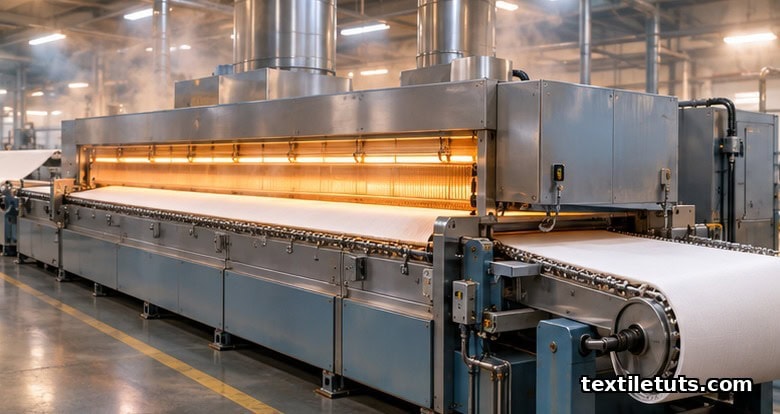
Heat setting of synthetic fibers is a thermal stabilization treatment in which thermoplastic yarns such as polyester are heated to 180 to 220 degrees Celsius for 20 to 60 seconds under controlled tension, locking the molecular chains into a low-shrinkage configuration that survives subsequent dyeing, washing, and ironing.
The treatment raises the fiber above its glass transition temperature (Tg ≈ 70 °C for PET) without approaching the melt point (≈ 260 °C), letting oriented amorphous regions relax and re-form new crosslinks as the fabric cools. A polyester fabric that is not heat-set can shrink 8 to 12 percent in the first commercial wash, while the same fabric after proper heat setting shrinks less than 1 percent under AATCC TM 135 home laundering cycles.
This article walks through the science, the three industrial methods (dry heat, steam, and hydro), the process parameters that determine the outcome, and the fiber-by-fiber differences that mill teams manage every day.
Why Heat Setting Matters in Synthetic Fiber Preparation
Synthetic filaments leave the spinneret in a metastable state. Polyester, nylon 6, and nylon 6,6 are all melt-spun and then drawn, usually at a draw ratio between 3:1 and 5:1, to align the polymer chains along the fiber axis. The orientation is what gives the fiber its tensile strength, but the same orientation also stores internal stress. When the fiber is later exposed to heat or moisture above its glass transition temperature, those stressed chains recover part of their original, un-drawn length, and the fabric shrinks.
Heat setting resolves this conflict. The fabric is heated past Tg while held at its finished dimensions on a stenter frame. New secondary bonds form between adjacent chains in the relaxed state, so when the fabric returns to room temperature it has a stable, low-shrinkage geometry. The same heat-set fabric also shows better wrinkle recovery, better pleat and crease retention, and a higher safe-ironing temperature than the unfinished version.
For a converter running reactive or disperse dyeing downstream, heat setting is not optional. Unset polyester will shrink during the dye bath (typically 130 °C for high-temperature disperse dyeing), distorting the finished dimensions and producing shade bands where pleats creased against the stenter pins.
The Science Behind Heat Setting
Three material temperatures define the heat-setting window:
- Glass transition temperature (Tg): the lower bound. Above Tg, the amorphous regions of the polymer become rubbery and chains can slide past one another. Polyethylene terephthalate (PET) has a Tg near 70 °C, nylon 6 near 50 °C, and nylon 6,6 near 57 °C.
- Crystallization temperature (Tc): the temperature at which oriented amorphous chains fold into ordered crystallites. For drawn PET this is roughly 120 to 180 °C. The highest rate of crystallization sits around 140 to 160 °C, which is why many mills anneal fabric in this band.
- Melting temperature (Tm): the upper bound. PET melts at about 260 °C, nylon 6 at 220 °C, and nylon 6,6 at 265 °C. Heat setting must stay well below Tm, normally 30 to 40 °C below, to avoid surface glazing or fiber fusion.
Setting effectiveness is measured by the change in shrinkage between the unset fabric and the finished fabric. AATCC Test Method 135 (home laundering) and ISO 6330 (domestic washing and drying procedures) are the standard reference cycles. Most commercial buyers specify less than 3 percent residual shrinkage after five wash cycles, and less than 1 percent after heat setting for premium polyester shirting and suiting.
Three Industrial Methods of Heat Setting
Mill teams choose the method based on fiber blend, fabric construction, and what downstream processes the cloth will see.
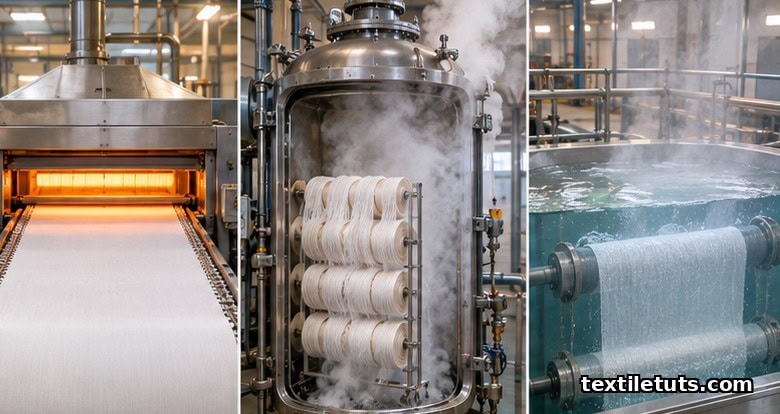
Dry Heat Setting on a Stenter Frame
Dry heat setting is the most common method for woven polyester and polyester-rich blends. The fabric is fed onto a pin or clip stenter, stretched to the required width and overfeed, and passed through a heated chamber for 20 to 60 seconds at 180 to 220 °C. Air velocity across the fabric is held at 0.5 to 1.5 m/s to keep the temperature uniform. The dwell time is short because dry heat transfers faster than steam or hot water at the same nominal temperature, and the fabric exits dry, ready for the next process.
Steam Setting
Steam setting is preferred for textured polyester (false-twist textured yarn, or FTT) and for nylon hosiery, where the yarn still needs to relax and bulk. Saturated steam at 110 to 130 °C penetrates the filament bundle and lets the crimp develop without flattening the yarn cross-section. Steam-set textured polyester shows 25 to 35 percent higher bulk than yarn set in dry heat, which is why textured yarn producers almost always run steam setting before yarn packaging.
Hydro Setting in Hot Water
Hydro setting immerses the fabric in water at 95 to 100 °C (or pressurized water at 110 to 135 °C) for 20 to 90 minutes. It is slower than dry or steam setting and is reserved for specialty articles such as tire cord, where uniform shrinkage control along the cord is more important than throughput. Hydro setting is rarely used for apparel fabric because the wet route consumes more energy and the fabric must be dried afterward.
Process Parameters That Determine the Result
The four levers a mill adjusts are temperature, time, tension, and moisture. They interact, so changing one usually requires compensation in the others.
- Temperature: a 10 °C increase in setting temperature roughly halves the residual shrinkage of polyester, but temperatures above 220 °C yellow the fabric and degrade any cotton in the blend.
- Dwell time: doubling the dwell time at constant temperature reduces shrinkage by another 20 to 30 percent, with diminishing returns past 60 seconds.
- Tension (overfeed): knitted fabric is usually set under a small overfeed of 5 to 15 percent in the length direction to lock in recovery rather than residual stretch. Woven fabric is set under length-wise tension close to zero and width-wise tension set by the stenter chain.
- Moisture regain: conditioning the fabric to 4 to 6 percent regain before stenter entry lowers the effective setting temperature by 10 to 15 °C, because water plasticizes the amorphous phase.
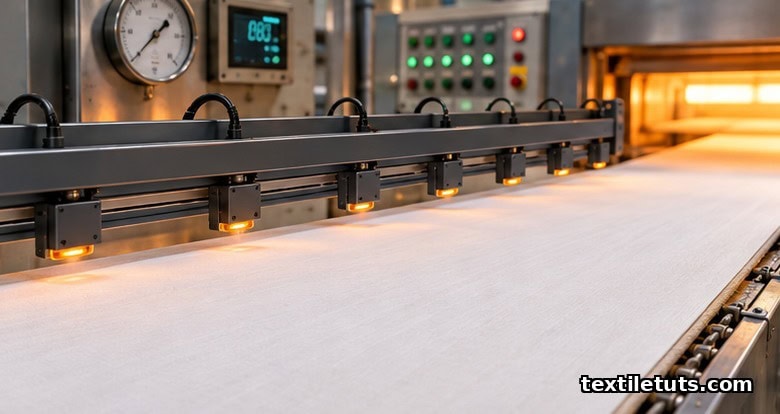
Modern stenters run with online infrared sensors measuring fabric temperature across the width, and most mills now log every batch against the AATCC or ISO shrinkage target for QA traceability.
Fiber-by-Fiber Setting Conditions
| Fiber | Glass Transition (°C) | Typical Setting Temp (°C) | Method | Residual Shrinkage After Setting |
|---|---|---|---|---|
| Polyester (PET) | ≈ 70 | 180 to 220 | Dry heat (stenter) | < 1% |
| Nylon 6 | ≈ 50 | 150 to 180 | Steam or dry heat | 1 to 2% |
| Nylon 6,6 | ≈ 57 | 170 to 200 | Steam or dry heat | 1 to 2% |
| Acrylic | ≈ 85 | 120 to 150 | Steam (dry heat yellows) | 2 to 3% |
| Polypropylene | ≈ −10 | 110 to 130 | Dry heat, tight tension | 3 to 5% |
Acrylic is a special case. Because polyacrylonitrile yellows above 150 °C and tends to lose its crimp, mills steam-set acrylic knits at 110 to 120 °C for 10 to 20 minutes rather than running dry heat. Polypropylene is the opposite. Its Tg is below room temperature, so it relaxes whenever it is heated. Polypropylene is set under tight tension at 110 to 130 °C, and even then it still shrinks 3 to 5 percent in a hot wash, which is why polypropylene apparel carries permanent care labels warning against tumble drying.
Quality Control After Heat Setting
Three tests are standard on the production floor:
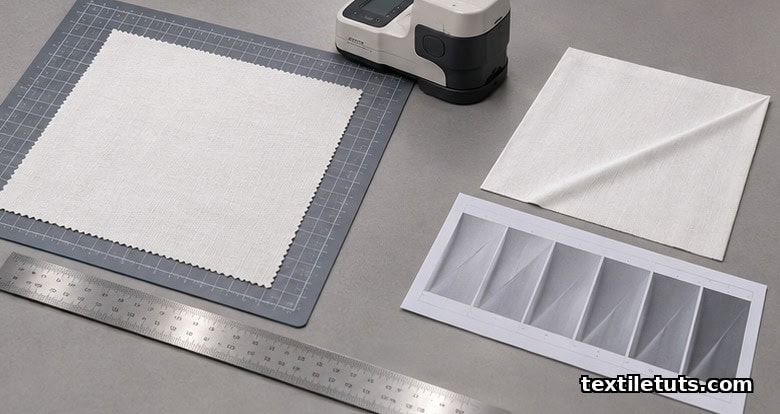
- Dimensional stability: AATCC TM 135 or ISO 6330 wash cycles followed by measurement of length and width change, normally reported after 1, 3, and 5 cycles.
- Crease and pleat retention: AATCC TM 88C for creases, with a reading on a flat surface against a photographic scale.
- Yellowing: AATCC TM 110 whiteness index, run on any white or pastel shade because heat-set fabric can yellow if the dwell time drifts past the target.
Most mills also run an in-line moisture meter at the stenter exit to catch under-set fabric (which leaves the stenter still damp and continues to shrink downstream) and over-set fabric (which exits bone-dry and brittle).
Frequently Asked Questions
What temperature is used to heat set polyester?
Polyester is heat set between 180 and 220 °C for 20 to 60 seconds on a stenter frame. The exact temperature depends on fabric weight: lightweight 60 to 80 gsm polyester shirting runs at 180 to 190 °C, while heavier 200 to 300 gsm polyester suiting runs at 200 to 220 °C. The dwell time must keep the fabric below its melting point of about 260 °C.
Can nylon be heat set the same way as polyester?
Nylon can be heat set, but at lower temperatures. Nylon 6 is set at 150 to 180 °C and nylon 6,6 at 170 to 200 °C. Steam setting is often preferred over dry heat for nylon hosiery and textured nylon yarn, because steam allows the yarn to bulk while it stabilizes, while dry heat can flatten the crimp and reduce fabric cover.
Why does heat-set fabric still shrink sometimes?
Heat-set fabric can still shrink when it is exposed to a temperature higher than the original setting temperature. A polyester fabric set at 190 °C will relax again if a downstream dyer runs it at 130 °C in a pressurized jet machine, which is normal. The fabric only starts to lose its set if the exposure temperature approaches the original setting temperature, and even then the residual shrinkage is small, usually 1 to 2 percent.
What is the difference between heat setting and heat stabilization?
Heat setting is the high-temperature treatment that locks in a finished dimension and imparts wrinkle recovery. Heat stabilization is a milder annealing treatment, typically at 140 to 170 °C for polyester, used between spinning and downstream drawing to relax internal stress without fully crystallizing the fiber. Heat stabilization is done on the fiber; heat setting is done on the fabric.
Does heat setting damage the fiber?
Heat setting at the correct temperature does not damage the fiber. Problems appear only when the dwell temperature drifts more than 10 °C above the upper bound, producing yellowing on white shades, glazing on the fabric surface, and a measurable loss in tensile strength. Modern stenters avoid this with infrared temperature sensors that map the fabric across the full width every second.
References
- ISO 30023:2010. Textiles — Determination of dimensional stability of fabrics to steaming. International Organization for Standardization. https://www.iso.org/standard/45738.html — test procedure for steam-set dimensional change.
- AATCC Test Method 135-2018. Dimensional Changes of Fabrics after Home Laundering. American Association of Textile Chemists and Colorists. https://www.aatcc.org — reference wash cycle for residual shrinkage measurement.
- ISO 6330:2021. Domestic washing and drying procedures for textile testing. International Organization for Standardization. https://www.iso.org/standard/45677.html — standard washing protocols used after heat setting.
- ASTM D6204-2017. Standard Test Method for Determination of Shrinkage of Fibers, Yarns, and Fabrics. ASTM International. https://www.astm.org/d6204-19.html — method for measuring fiber-level dimensional change.
- Vassiliadis, A. A., & Provatidis, C. G. (2010). Effect of heat setting on the dimensional stability of polyester woven fabrics. Journal of the Textile Institute, 101(1), 65 to 75. https://www.tandfonline.com — peer-reviewed quantification of residual shrinkage versus setting temperature.
- Mukhopadhyay, S. K. (2017). Advances in Fibre Production and Heat Setting of Synthetic Fibres. Springer Open. https://link.springer.com — textbook chapter covering the polymer physics behind heat setting.
- Textile Institute. (2024). Textile Terms and Definitions. https://www.textileinstitute.org — industry glossary entries for heat setting, glass transition, and dimensional stability.
This article is the working reference for heat setting in synthetic fiber preparation. Editorial by Shahrukh Islam, TextileTuts. Sources: ISO 30023, AATCC TM 135, ISO 6330, ASTM D6204, Journal of the Textile Institute (Taylor & Francis), Springer Open, Textile Institute, as cited.


