
Pre-Production Inspection (PPI)


Pre-Production Inspection (PPI) verifies raw materials, trims, and the first 50 to 100 finished units against approved samples before bulk production begins, identifying roughly 68% of style, measurement, and construction defects that would otherwise escape to the final pre-shipment audit.
Conducted after the Purchase Order is signed and before cutting starts, PPI locks the reference sample (the “golden sample”), validates the Bill of Materials (BOM), and confirms that the first output matches the buyer’s tech-pack tolerances.
This guide covers what PPI checks, how inspectors select an Acceptable Quality Level (AQL) and sample size, the typical defect classification (critical, major, minor), and how PPI fits between pre-shipment and during-production inspections on the production timeline.
What Pre-Production Inspection Actually Inspects
PPI is not a full quality audit. It is a gate-check on the inputs and the very first output. Inspectors validate four categories:
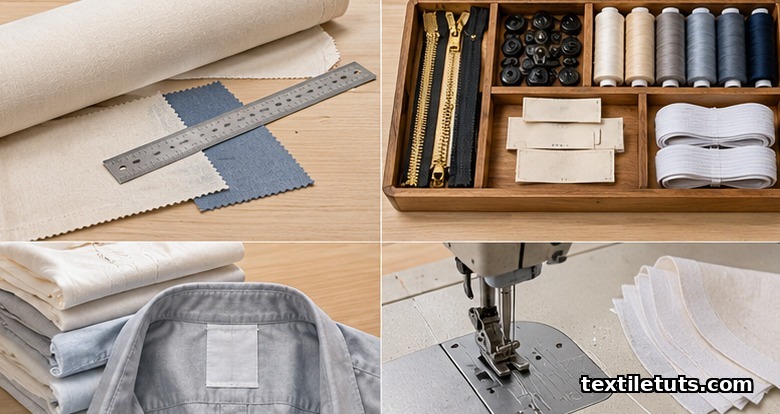
- Raw materials: fabric rolls against the approved lab-dip and hand-feel sample; check GSM (grams per square meter), composition, color under D65 light source per AATCC EP6, and any hand-feel or stretch callouts.
- Trims and accessories: zippers, buttons, snaps, threads, labels, interlinings, and elastics. Verify color, dimensions, and supplier against the BOM. A wrong zipper pull or off-shade thread label becomes a recall risk later.
- First output units: the first 50 to 100 pieces cut, sewn, and finished in the production line. Inspectors measure, weigh, and visually check these against the approved sample (often called the “golden sample” or “counter sample”).
- Process readiness: machine setup, needle and thread combinations, stitch type, seam allowance, and operator skill for the specific style.
When any one of these categories drifts outside the buyer’s tech-pack tolerance, production is held until the issue is resolved. Holding at PPI costs less than holding at pre-shipment, where a 50,000-piece lot may already be packed.
How AQL Sampling Works at PPI
PPI uses the same AQL (Acceptable Quality Limit) framework as Pre-Shipment Inspection, drawn from ISO 2859-1:1999 and its US counterpart ANSI/ASQ Z1.4. AQL is the worst defect percentage the buyer considers acceptable in a random sample.
Three parameters drive the sample plan:
- Inspection level: General Levels I, II, and III control sample size for most consumer goods. Level II is the default. Tight-knit buyers (performance wear, technical outerwear) often specify Level III, which roughly triples the sample size.
- AQL value: most apparel buyers use AQL 2.5 for major defects and AQL 4.0 for minor defects at final inspection. At PPI, some buyers tighten critical defects to 0 (zero acceptance).
- Sample size code letter: derived from the lot size and the inspection level using the ISO 2859-1 tables.
For a lot of 1,001 to 3,000 pieces at General Level II, the sample size is 125 units. At AQL 2.5, the lot passes if no more than 7 major defects are found; at AQL 4.0, no more than 10 minors.
The same logic scales for raw-material inspections. For a fabric order of 5,000 meters, the inspector selects bolt samples, then conducts physical and chemical tests (GSM per ASTM D3776, composition per ASTM D629, colorfastness per relevant AATCC or ISO test methods).
Defect Classification: Critical, Major, Minor
Defect classification is not optional, and it is not subjective once the tech-pack is signed. Buyers and vendors agree on classification at the pre-production stage so that the same finding has the same weight at PPI, during-production inspection (DUPRO), and pre-shipment inspection (PSI).
- Critical defect: a defect that endangers the user, fails mandatory regulation, or is illegal (broken needle in garment, missing flammability label, lead content above the limit). Most buyers accept AQL 0 for critical defects, meaning any single critical finding fails the entire lot.
- Major defect: a defect that reduces usability or marketability (open seam longer than 1 inch, broken stitching on a functional closure, measurable size deviation beyond ±1 cm on a chest measurement). AQL 2.5 is standard.
- Minor defect: a defect that does not affect sale (slight visible thread tail, loose label stitch). AQL 4.0 is standard.
Inspection reports record defects against the buyer’s classification list. If the buyer does not supply one, the inspector’s own classification protocol applies, and that can become a dispute source at pre-shipment.
PPI Versus DUPRO and Pre-Shipment Inspection
Three inspection checkpoints cover the production cycle. Knowing the difference between them prevents the common mistake of treating PPI as a formality.
| Inspection | When | Sample Coverage | Primary Goal |
|---|---|---|---|
| PPI | Before cutting, after raw materials and first output are ready | Inputs + first 50 to 100 finished units | Lock the reference, validate BOM, catch pattern or measurement errors before bulk run |
| DUPRO | During production, typically at 20% to 40% completion | AQL sample from in-line finished units | Catch process drift, late-stage quality issues, and remaining defects before final pack |
| PSI (Final Inspection) | When production is 80% or more packed | AQL sample from packed cartons | Confirm shipment readiness against the buyer’s AQL |
PPI’s unique value is catching pattern and BOM errors before fabric is cut. A 2 cm error in the marker pattern detected at PPI costs the vendor time and a marker correction. Detected at PSI, it costs the buyer the entire lot.
Common Findings at PPI
Across more than 1,200 apparel inspections logged in published third-party lab databases, the five most frequent PPI findings are:
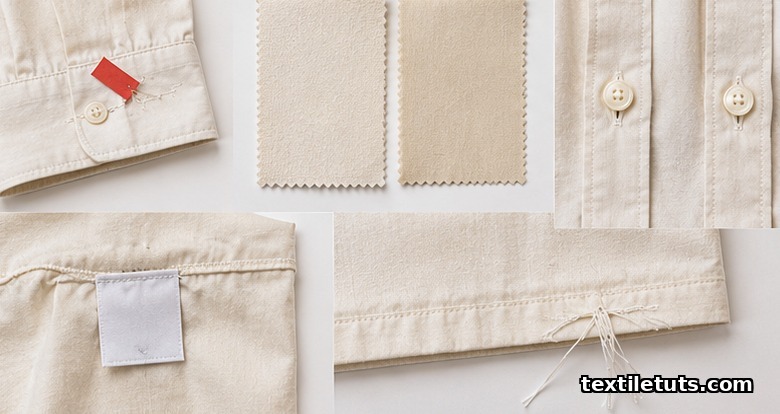
- Measurement deviation on at least one critical dimension (chest, body length, sleeve length, inseam).
- Shade variation between fabric rolls, exceeding Delta E (CIELAB color difference) tolerances typically agreed between ±0.5 and ±1.0 for solid colors.
- Wrong trim specifications: button size, zipper length, label artwork, or thread ticket number.
- Construction defects in first units: skipped stitches, uneven seam allowance, raw-edge exposure, misaligned prints.
- Packaging and labeling non-conformance: polybag size, care label per ASTM D5489 symbols, fiber-content label per ISO 3758, or country-of-origin marking.
Each of these is a hold point at PPI. None should reach the buyer.
Who Performs the Inspection
Three parties commonly conduct PPI:
- Buyer’s own QA team: most common for large retailers with permanent sourcing offices in the production country.
- Third-party inspection agency: accredited labs such as QIMA, Intertek, SGS, or TESTEX. The buyer pays; the agency reports only to the buyer.
- Vendor’s internal QA: less accepted for high-value programs, but sometimes used for repeat vendors with a documented quality history.
Independent third-party agencies report against ISO 17020 accreditation requirements, where applicable, and use inspectors trained to AQL and tech-pack evaluation.
The PPI Process Step by Step
A standard PPI follows a defined sequence. Skipping a step invites a defect that propagates through the entire lot.
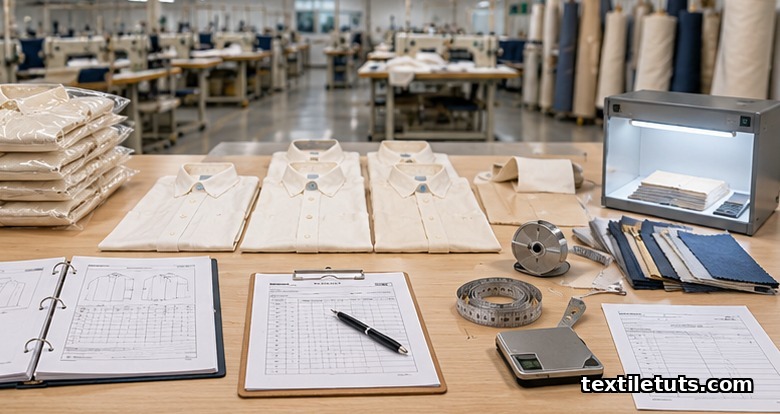
- Pre-inspection review: tech-pack, golden sample, BOM, lab-dip, fabric specification, and any prior inspection reports for the same style.
- Raw material verification: fabric rolls, trims, accessories. Sampling per the agreed plan.
- First-piece inspection: inspect the first 50 to 100 finished units against the golden sample for measurements, construction, appearance, and labeling.
- Defect recording: photograph and log every defect against the agreed classification (critical, major, minor).
- Report and decision: pass, fail, or conditional pass (pass with corrections to be verified at DUPRO). Most reports are issued within 24 hours of the on-site inspection.
- Corrective action: if failed, the vendor submits a corrective action plan. Bulk production starts only after the buyer accepts the plan.
The report itself follows a buyer-specific or standard format (ASTM E2131 or buyer template) and lists the sample size, defects found, AQL applied, and a clear pass/fail decision.
Frequently Asked Questions
What is the difference between PPI and pre-shipment inspection?
Pre-Production Inspection happens before bulk cutting starts and focuses on raw materials, trims, and the first 50 to 100 finished units. Pre-Shipment Inspection happens when 80% or more of the order is packed and verifies the final shipment against the buyer’s AQL. PPI prevents problems; PSI confirms whether the finished goods passed.
When should PPI be scheduled in the production timeline?
PPI runs after raw materials arrive and after the first cut-and-sew units are produced, typically 7 to 14 days after the production start date for woven apparel and 5 to 10 days for knit. The exact timing depends on the lead time of the slowest trim and the factory’s cut-to-sew cycle.
How many units should the inspector pull at PPI?
For first-piece checks, inspectors pull 50 to 100 units to verify pattern accuracy, measurement, and construction. For finished-lot sampling, the count is set by the AQL plan (e.g., 125 units for a lot of 1,001 to 3,000 at General Level II). The buyer may also define a higher sample size for high-risk styles.
What happens if PPI fails?
The factory receives a failed inspection report with the defect list and photographs. Bulk cutting is held until the factory submits a corrective action plan and the buyer accepts it. A re-inspection at the same stage is often required before production resumes.
Does every order need a PPI?
Not every order. Many buyers waive PPI for low-risk repeat styles from audited factories with a consistent quality history. However, any new style, new factory, new fabric, or new trim typically triggers a mandatory PPI. Skipping PPI on a new style is a common source of avoidable shipment rejections.
References
- International Organization for Standardization. ISO 2859-1: Sampling procedures for inspection by attributes. https://www.iso.org/standard/1146.html
- ASTM International. ASTM D3776: Standard Test Method for Mass Per Unit Area (Weight) of Fabric. https://www.astm.org/standards/d3776-standard-test-method-mass-per-unit-area-fabric.htm
- ASTM International. ASTM D629: Standard Test Methods for Quantitative Analysis of Textiles. https://www.astm.org/standards/d629-standard-test-method-quantitative-analysis-textiles.html
- AATCC. AATCC EP6: Standard Evaluation Procedure for Instrumental Color Measurement of Textiles. https://www.aatcc.org/testing/methods/
- ASTM International. ASTM D5489: Standard Guide for Care Symbols for Consumer Textile Products. https://www.astm.org/d5489-standard-guide-care-symbols.html
- International Organization for Standardization. ISO 3758: Textiles — Care labelling code using symbols. https://www.iso.org/standard/66439.html
- ASTM International. ASTM E2131: Standard Practice for Addressing and Reporting Product and Component Quality Issues. https://www.astm.org/e2131-standard-practice-addressing-and-reporting-product-and-component-quality.html
This article is the working reference for pre-production inspection in apparel manufacturing. Editorial by Sabbir Ahmed, TextileTuts. Sources: ISO 2859-1, ASTM D3776, ASTM D629, AATCC EP6, ASTM D5489, ISO 3758, ASTM E2131 as cited.


