
During Production Inspection (DPI)


During Production Inspection (DPI) is an inline quality-control checkpoint performed when a garment order is roughly 15–30% complete, in which a third-party or in-line inspector pulls a statistically valid sample under ISO 2859-1 at AQL 2.5 for major defects and AQL 4.0 for minor defects so that sewing, measurement, and fabric faults are caught and corrected before the lot reaches final audit. The procedure exists because a defect found at final inspection costs three to four times more to rework than the same defect caught on the sewing line, and a defect that reaches the buyer can trigger 100% inspection, chargeback, or order cancellation.
This article explains how DPI is scheduled, what inspectors actually check on the line, which standards govern the sampling plan, and how the results translate into an accept, reject, or rework decision for a textile or garment factory.
What “During Production Inspection” Actually Means
DPI sits between two other checkpoints in a typical garment order: the Initial Production Check (IPC), which is run when the first 10–20 pieces come off the line, and the Final Random Inspection (FRI), which is run on a finished, packed lot ready for shipment. The “during production” window is therefore the bulk-manufacturing phase, after the line has stabilized but before the lot is closed.
Most buying houses trigger DPI when 15–30% of the order quantity is sewn and the buyer wants confirmation that the factory’s process is under control before too much inventory is built up. The TextileTuts quality team recommends scheduling DPI no later than the 30% mark for any order above 5,000 pieces; below that, inline spot checks during production are usually sufficient.
The Inspection Window: When and How Long DPI Runs
A standard DPI visit takes 4 to 8 hours on the shop floor, depending on lot size and the number of styles. The inspector arrives without warning to the cutting or sewing area, requests the production report for the lot, and pulls a random sample from the line based on the AQL sampling table corresponding to the lot size.
For a lot of 1,201 to 3,200 pieces at General Inspection Level II under ISO 2859-1, the single-sampling plan requires 125 pieces for a normal inspection, with an acceptance number of 7 for major defects at AQL 2.5. That same lot under AQL 4.0 for minors accepts up to 10 defects before rejection. The numbers scale upward: a 10,001–35,000-piece lot demands 315 samples for Level II normal inspection.
Defect Classification: Critical, Major, and Minor
Textile and garment defects are sorted into three severity classes, and each class carries its own AQL limit.
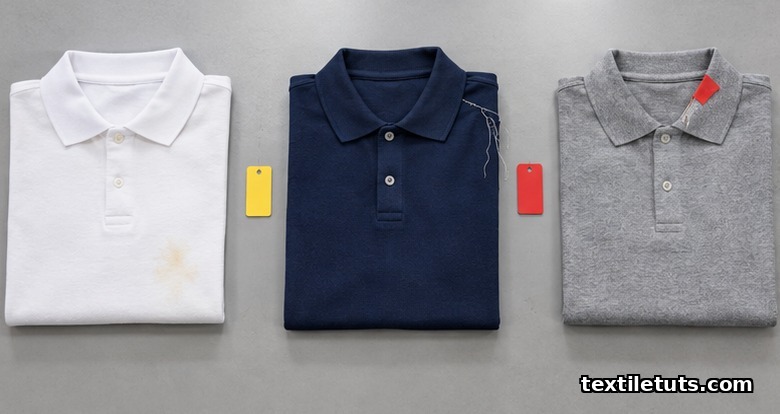
- Critical defects are unsafe, illegal, or contract-breaking: sharp metal fragments left inside a garment, exposed zipper teeth that could cut the wearer, or failure to meet restricted-substance limits. These are typically governed by AQL 0 (zero acceptance) and a single critical defect rejects the entire lot.
- Major defects affect saleability or function: a missed buttonhole, a broken stitch longer than 2.5 cm, measurement deviation beyond the tolerance on the spec sheet, or a visible stain larger than 1 cm². AQL 2.5 is the apparel-industry default for majors.
- Minor defects are cosmetic and do not affect use: loose threads under 2.5 cm, slight shade variation within the approved lab-dip range, or a needle mark on a hem. AQL 4.0 is the standard ceiling for minors.
What Inspectors Check on the Line
A DPI pass covers six categories in sequence. The inspector moves through the line, observes the work in progress, and pulls finished pieces for measurement and visual checks.
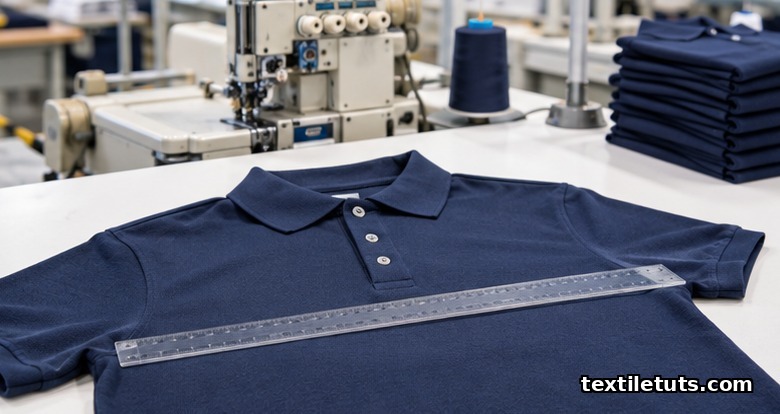
- Inline observation: The inspector watches operators handle fabric, checks tension on overlock machines, and notes whether the line is following the approved construction sheet.
- Workmanship: Stitch type, SPI (stitches per inch), seam position, and trim placement are compared against the tech pack. Skip stitches, broken stitches, and uneven SPI are recorded as workmanship defects.
- Measurement: A minimum of 5 sample pieces per size are measured against the spec sheet tolerance, usually ±0.5 cm on body width and ±1.0 cm on length for woven garments.
- Fabric inspection: The fabric used is graded under a 4-point or 10-point system per ASTM D5430, where the point count accumulates by defect size: defects up to 7.5 cm score 1 point; 7.5–15 cm score 2; 15–22.5 cm score 3; over 22.5 cm score 4. A roll exceeding 40 points per 100 linear yards is typically rejected.
- Trims and accessories: Buttons, zippers, snaps, and labels are checked against the approved trim card. A wrong zipper pull or mismatched thread shade is logged as a defect.
- Packing and carton marking: Even mid-production, the inspector confirms that poly-bag size, fold method, and inner-carton markings match the buyer’s packing instructions, because redoing a poly-bag on a finished lot is expensive.
AQL Sampling Under ISO 2859-1
The sampling tables in ISO 2859-1 (also published as ANSI/ASQ Z1.4 in the United States) determine how many pieces to pull for a given lot size at a chosen inspection level. General Inspection Levels I, II, and III cover most apparel applications; Level II is the default. Special Levels S-1 through S-4 are used for destructive testing or expensive items.
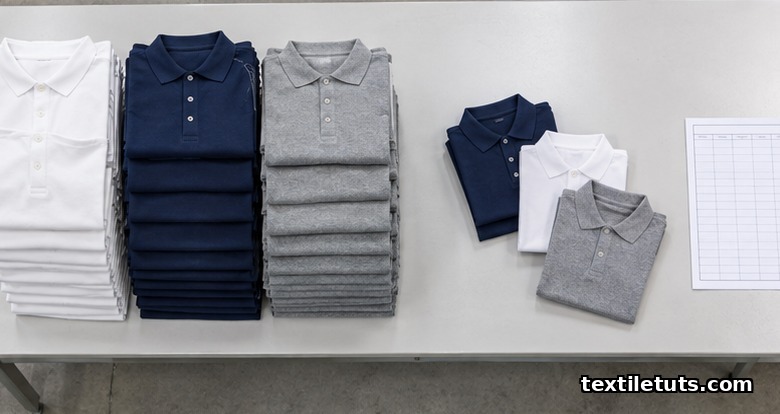
The lot size maps to a code letter (A through R), and the code letter combined with the desired AQL gives the sample size and acceptance number. For example, a lot of 3,200 pieces at Level II becomes code letter K, requiring a 125-piece sample. At AQL 2.5 normal inspection, the acceptance number is 7 (Ac=7, Re=8); finding 8 or more major defects rejects the lot.
Switching between normal, reduced, and tightened inspection depends on the history of the factory. A supplier with 10 consecutive accepted lots can move to reduced inspection, while a rejected lot triggers tightened inspection for the next five lots, per the switching rules in ISO 2859-1.
How DPI Results Translate Into Action
The inspection report lists every defect found, classifies it by severity, attaches photographs, and calculates the lot’s acceptance status against the AQL. Three outcomes are possible.
- Accepted: The lot has fewer defects than the acceptance number. Production continues, and the next DPI is scheduled according to the buyer’s audit plan.
- Pending / Rework: The lot has more defects than the acceptance number but the buyer agrees to a rework window. The factory re-inspects 100% of the lot, repairs or rejects defective pieces, and re-presents the lot for final inspection.
- Rejected: The lot exceeds the rejection number. The buyer may require a new inspection at the factory’s cost, downgrade the lot to a cheaper buyer, or scrap it entirely.
A typical industry benchmark is that 5–10% of inspected lots fail DPI on the first pass, and most failures trace back to three root causes: inaccurate measurement specs, unapproved fabric substitution, and rushed operator training on a new style.
DPI vs. FRI: Why Mid-Production Checks Matter
Final Random Inspection happens on packed cartons, often just days before shipment. At that point, the only options are rework, downgrade, or delay, all of which erode margin. DPI gives the factory a window to fix the process while there is still time and inventory to absorb a correction.
Research on quality-cost relationships in apparel manufacturing, summarized in MDPI’s 2021 review on textile quality management, places the cost of preventing a defect at roughly 1 unit, the cost of catching it at inspection at 10 units, and the cost of catching it after shipment at 100 units. DPI is the operational mechanism that shifts defects from the third category into the second.
Frequently Asked Questions
What AQL level should I use for a garment order?
The default apparel-industry AQL is 2.5 for major defects and 4.0 for minor defects, with zero acceptance for critical defects. Buyers of premium or safety-sensitive garments (children’s wear, flame-resistant workwear) often tighten major-defect AQL to 1.5 or 1.0, while discount retailers may allow major AQL 4.0.
How many pieces are pulled during DPI?
Sample size depends on lot size and inspection level. For a 2,000-piece lot at General Inspection Level II, 125 pieces are pulled. For a 10,000-piece lot at the same level, 315 pieces are pulled. Smaller lots use Level I (smaller samples); riskier or higher-value orders use Level III (larger samples).
Can DPI replace Final Random Inspection?
No. DPI and FRI are complementary. DPI validates the manufacturing process while the lot is still open; FRI validates the finished, packed goods before shipment. A lot can pass DPI and still fail FRI if packing, labeling, or final finishing goes wrong in the remaining 70% of production.
What is the 4-point fabric inspection system?
The 4-point system, formalized in ASTM D5430, assigns 1 to 4 penalty points per defect based on length: defects up to 7.5 cm score 1 point, 7.5–15 cm score 2 points, 15–22.5 cm score 3 points, and defects over 22.5 cm score 4 points. A roll scoring more than 40 points per 100 linear yards is generally rejected for first-quality use.
What happens if my lot fails DPI?
A failed DPI does not automatically mean the order is cancelled. Most buyers issue a rework authorization, the factory performs 100% sorting, repairs or rejects defective pieces, and re-presents the corrected lot for a follow-up inspection. Time lost is the main consequence, which is why scheduling DPI at the 15–30% mark is critical.
References
- International Organization for Standardization. ISO 2859-1: Sampling procedures for inspection by attributes — Part 1: Sampling schemes indexed by acceptance quality limit (AQL) for lot-by-lot inspection. iso.org — defines the AQL sampling tables and switching rules used in every DPI pass.
- ASTM International. ASTM D5430: Standard Test Methods for Visually Inspecting and Manufacturing Fabric. astm.org — covers the 4-point and 10-point fabric inspection systems applied during inline fabric checks.
- American Association of Textile Chemists and Colorists. AATCC EP6: Standard Practice for Visual Evaluation of Fabric Appearance. aatcc.org — reference for grading fabric appearance defects during production.
- Mdpi.com. Quality Management in Textile and Apparel Industry: A Review. mdpi.com — peer-reviewed summary of quality-cost relationships and DPI economics.
- ISO. ISO 9001:2015 Quality management systems — Requirements. iso.org — the umbrella standard most factories cite when documenting their DPI and inspection procedures.
- Intertek. During Production Inspection (DPI) Service Overview. intertek.com — accredited third-party lab describing the standard DPI workflow and reporting format.
This article is the working reference for During Production Inspection (DPI). Editorial by Sabbir Ahmed, TextileTuts. Sources: ISO 2859-1, ASTM D5430, AATCC EP6, MDPI 2021, ISO 9001:2015, Intertek DPI service overview as cited.


