
Common Fabric Defects Classification

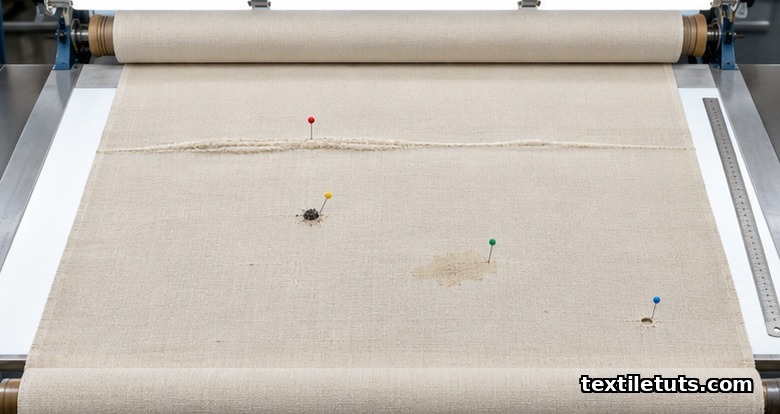
Fabric defects are classified into roughly 70 distinct defect types across woven, knitted, and finished textiles, and modern mills grade each defect using the ASTM D5430 four-point system, which assigns points based on a defect’s length and caps the total defect score per 100 linear yards at 40 points for first-quality fabric.
This classification matters because textile buyers reject an average of 15 to 20% of inspected yardage at the mill gate, and most of that rejection traces back to one of four root-cause groups: yarn irregularities, construction faults, dyeing or finishing errors, and contamination. Once you know which group a defect belongs to, you can usually trace it back to a specific machine, process step, or operator action and prevent it from happening again.
The guide below walks through each defect class, names the most common individual defect types inside it, and shows how the standard severity-grading systems convert those defects into a numeric score that mills and buyers use to settle acceptance.
Why fabric defects are classified at all
Textile inspectors at a woven or knit mill typically inspect 8,000 to 12,000 meters of fabric per shift by passing the cloth over a lighted inspection table at 15 to 20 meters per minute. Without a shared classification language, an inspector’s call of “defect” means nothing comparable across shifts, factories, or buyers. The classification system exists to do three jobs: name the defect consistently, measure its severity on a numeric scale, and roll the per-defect scores up into an acceptance verdict (first-quality, seconds, or rejection) at the lot level.
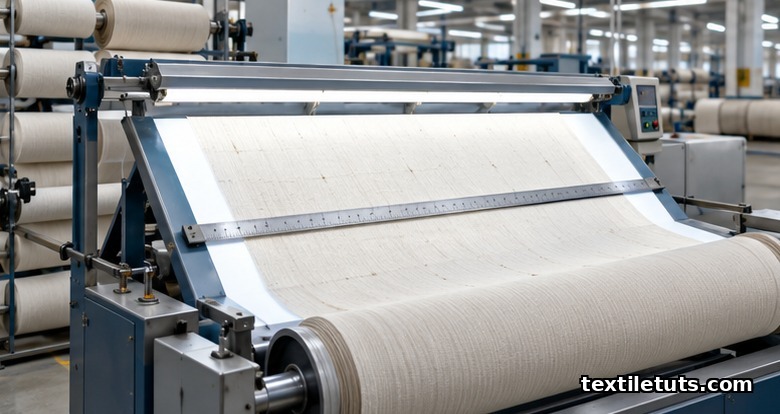
Buyers also rely on defect classification to compare mills. A mill running 8 first-quality defects per 100 linear meters against a buyer-specified limit of 12 will pass, while a mill running 25 will be flagged. The numbers come from the four-point and ten-point systems published in ASTM D5430 and the U.S. garment industry’s voluntary standards, both of which assign each defect a point value based on its measured length or intensity.
The four root-cause defect categories
Almost every named fabric defect rolls up into one of these four groups. Most modern inspection guides use the same four-fold structure for woven and knitted fabric alike, and ASTM D5430 grades across all of them with the same scoring method.
Yarn irregularities (fiber and yarn-stage defects)
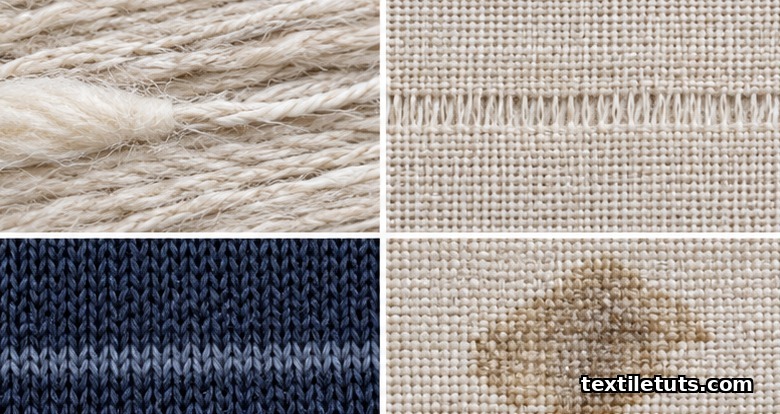
Yarn irregularities originate before weaving or knitting, at spinning or yarn preparation. They include:
- Slub: an unintended thick place in the yarn caused by fiber clustering or drafting faults. Visible as a thickened band running across a woven fabric or down a knitted course.
- Nep: a small tangled cluster of fibers that escapes carding or combing. Often visible as tiny light dots on dyed fabric, especially in dark shades.
- Fly: loose fiber fragments spun into the yarn surface, giving a fuzzy or hairy appearance.
- Thick and thin places: localized diameter variations caused by uneven drafting or improper roving tension.
- Count variation: yarns spun to a slightly different linear density than specified, producing visible bars or streaks in the finished fabric.
Yarn irregularities are estimated to drive roughly 12 to 15% of mill-rejected yardage in cotton weaving and around 8% in knitting, based on industry surveys of root-cause loss.
Construction defects (weaving and knitting errors)
Construction defects appear on the loom or knitting machine and are usually traced to a mechanical fault or a yarn-feed interruption. Common types include:
- Mis-pick (weft bar): a band across the fabric where weft yarns are missing, doubled, or off-color.
- Hole: a complete yarn break that leaves an open perforation. Scored as a major defect even when small.
- Dropped stitch (knit): a missing needle loop that produces a vertical ladder or run.
- Tear or scuff: surface damage where yarns are abraded but not yet broken.
- Wrong draw or float: yarns that skip over the intersections they should form, producing long floats in woven fabric or holes in knit.
- End out: a missing warp end that leaves a thin vertical stripe across the fabric width.
Construction defects are the dominant rejection category by volume, typically accounting for 50 to 60% of all first-quality defects logged during final inspection.
Dyeing and finishing defects
Dyeing and finishing defects appear after the greige fabric leaves the loom. Common types include:
- Barre: horizontal bands of color variation in knit fabric caused by uneven yarn uptake or dye-liquor flow.
- Shade variation: a fabric piece dyed off-color relative to the standard. Measured against an AATCC Gray Scale for Color Change under D65 light.
- Pilling: formation of small fiber balls on the fabric surface, typically from finishing abrasion. Formally graded against ISO 12945-1 or ASTM D4970.
- Skew and bow: weft or knit courses running off true 90 degrees to the selvedge. Quantified as a percentage of fabric width per ASTM D3882.
- Uneven finish: inconsistent hand or surface caused by uneven impregnation with softener, water-repellent, or starch.
Dyeing and finishing defects account for roughly 25 to 30% of rejections at the wet-processing stage and are sometimes only caught after the fabric is cut into garments.
Contamination and stain defects
Contamination defects are foreign materials or substances that should not be in the fabric:
- Oil stains: from machine oil or yarn size, usually appearing as dark, irregular patches.
- Foreign fibers: cotton or polyester fibers from another lot that get mixed in during carding or spinning, showing up as contrasting specks.
- Rust stains: from machine parts or water pipes.
- Dirt and grease: deposits picked up during handling or transport.
- Size spots: undissolved sizing agent that survived desizing and shows up as stiff patches after dyeing.
Contamination defects are often scored as major because they are usually not repairable and frequently render the affected yardage unsellable.
Severity grading: the four-point and ten-point systems
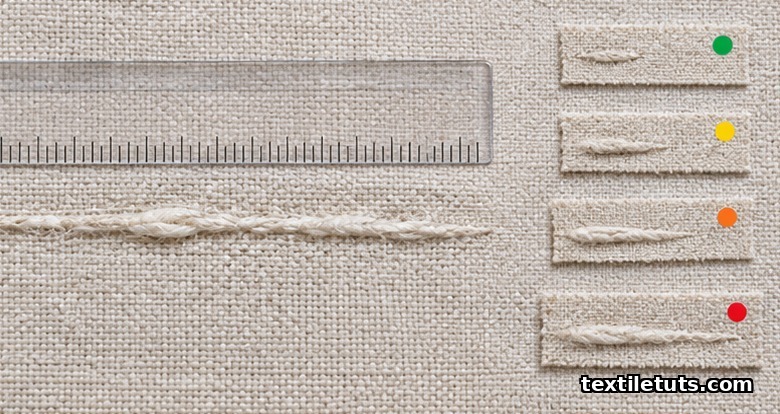
The defect class alone does not decide acceptance. Inspectors also assign a severity score, and the two dominant scoring systems worldwide are the four-point system and the ten-point system. ASTM D5430 documents the four-point method formally, while the ten-point system is the voluntary standard used in many U.S. garment supplier programs and a large share of Asian apparel mills.
| Defect size per linear yard | Four-point score | Ten-point score |
|---|---|---|
| Up to 3 in (76 mm) | 1 point | 1 point |
| 3 to 6 in (76 to 152 mm) | 2 points | 2 to 3 points (depending on prominence) |
| 6 to 9 in (152 to 228 mm) | 3 points | 4 to 5 points |
| Over 9 in (228 mm) | 4 points | 6 to 10 points (depending on severity) |
| Any major defect (hole, severe stain, slub seam) | 4 points | 8 to 10 points |
| Maximum points per 100 linear yards (four-point) | 40 points | not applicable |
A fabric that scores 40 points or fewer per 100 linear yards under the four-point system is normally classified as first-quality. Anything above that threshold is graded as seconds, and lots above roughly 60 points per 100 yards are typically rejected outright. The exact cut-offs are buyer-specific, but these are the standard ranges used at the mill gate.
Sampling and acceptance: ISO 2859-1 AQL
Inspection does not score every yard of every lot. Both the four-point and ten-point systems rely on a sampling plan to decide which rolls get inspected at what intensity, and the most widely cited sampling standard in textile inspection is ISO 2859-1, which uses Acceptable Quality Levels (AQL) ranging from 1.0 to 6.5 depending on defect criticality. Critical defects (holes, dangerous contamination) are usually inspected at AQL 1.0, while minor defects (slight nep count, light fly) are often accepted at AQL 4.0. The AQL framework is statistically derived, so an AQL of 2.5 means roughly 2.5% of the sampled units are expected to contain a defect at the boundary of acceptability.
Buyers typically specify both the grading system (four-point or ten-point) and the AQL in the purchase contract, and the mill inspects to that combination during final audit. A lot that fails the agreed combination can be reworked, downgraded, or rejected depending on contract terms.
Prevention: how classification drives root-cause analysis
Modern mills map each rejected defect type back to a specific process step using a cause-and-effect diagram formalized in ISO 9001 quality management. Yarn irregularities trace back to the spinning line, often a drafting fault or contaminated carding web. Construction faults point at the loom or knitting machine, often a yarn break, missing needle, or weft-feeder fault. Dyeing and finishing faults trace back to the dye house, typically uneven temperature, pH drift, or pad-bath contamination. Contamination points at handling, oil leaks, or housekeeping on the production floor.
This mapping is what makes classification worth doing. Without a consistent name and severity score per defect, root-cause analysis collapses into guesswork, and the same defect tends to recur shift after shift.
Frequently Asked Questions
How many fabric defects are there?
Most published defect catalogues list between 60 and 80 named fabric defects across woven, knitted, and finished fabric. ASTM D5430 groups defects by construction and finishing stage rather than listing individual defect types, but the commonly cited total in mill inspection manuals is approximately 70 defect types.
What is the four-point system in fabric inspection?
The four-point system is a severity-grading method documented in ASTM D5430. Each defect is scored 1 to 4 points based on its measured length, with 1 point for defects up to 3 inches, 2 points for 3 to 6 inches, 3 points for 6 to 9 inches, and 4 points for anything over 9 inches or for any major defect. A fabric scoring 40 points or fewer per 100 linear yards is generally accepted as first quality.
What is the difference between the four-point and ten-point systems?
Both systems score defects by length, but the four-point system caps each defect at 4 points and uses a per-100-yard total for acceptance, while the ten-point system allows up to 10 points per defect and totals them per garment or per piece. The four-point system is more common in fabric mills; the ten-point system dominates in garment final inspection.
What is the most common fabric defect?
Across the largest published industry surveys, the most consistently reported common fabric defect is the slub or yarn irregularity in woven fabric, with barre and shade variation close behind in knit. Construction defects (mis-picks, holes, dropped stitches) lead by total rejection volume because each one tends to score the maximum 4 points.
Can fabric defects be repaired?
Minor yarn irregularities and small slubs can sometimes be removed by mending or by brushing, and shade-correctable defects may be masked by overdyeing. Major defects (holes, oil stains, large barre bands, large slub areas) are usually not repairable to first-quality standard, and the affected yardage is either sold as seconds or scrapped.
References
- ASTM International. ASTM D5430-13(2019): Standard Test Methods for Visually Inspecting and Grading Fabrics. ASTM International, West Conshohocken, PA. Covers the four-point grading system used by mills worldwide.
- ASTM International. ASTM D3882-08(2020): Standard Test Method for Bow and Skew in Woven and Knitted Fabrics. Method for quantifying skew and bow defects per unit width.
- ASTM International. ASTM D4970-22: Standard Test Method for Pilling Resistance and Other Related Surface Changes of Textile Fabrics (Martindale Tester). Method for grading pilling defects.
- International Organization for Standardization. ISO 2859-1:1999 Sampling Procedures for Inspection by Attributes, Part 1: Sampling Plans Indexed by Acceptable Quality Level (AQL) for Lot-by-Lot Inspection. AQL sampling framework used in fabric inspection.
- International Organization for Standardization. ISO 12945-1:2020 Textiles, Determination of Fabric Propensity to Surface Fuzzing and to Pilling, Part 1: Pilling Box Method. Method for grading pilling propensity.
- AATCC. AATCC Test Method 1, Gray Scale for Color Change. Reference scale for shade-variation assessment.
- Ngan, H. Y. T., Pang, G. K. H., and Yung, N. H. C. (2011). Automated fabric defect detection: A review. Image and Vision Computing, 29(7), 442 to 458. Peer-reviewed survey of fabric defect classification and detection.
Editorial by Sabbir Ahmed, TextileTuts. Sources: ASTM D5430, ASTM D3882, ASTM D4970, ISO 2859-1, ISO 12945-1, AATCC Gray Scale, and Ngan et al. (2011) as cited.


