
Diapers: Construction and Absorbency

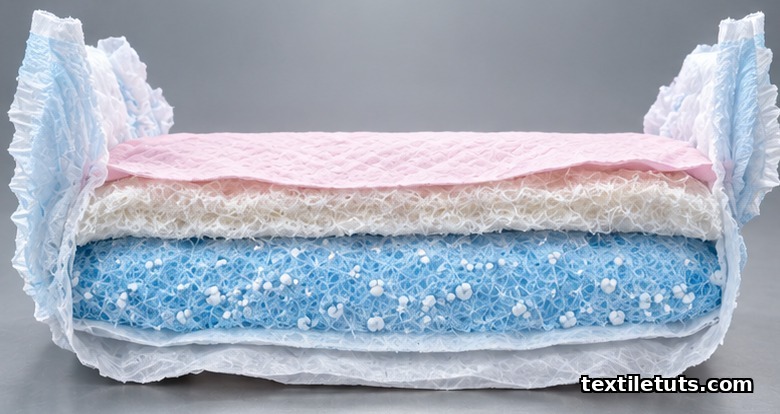
A modern disposable diaper is a four-layer laminate in which a sodium polyacrylate superabsorbent polymer (SAP) absorbs 15 to 30 times its own weight in saline, holding fluid inside a hydrogel network that resists rewet back to the skin.
The functional core of a diaper is a nonwoven composite, not a woven textile. Top sheet, acquisition and distribution layer, absorbent core, and back sheet each carry out a separate fluid-handling job, and the standards that grade their performance, including ISO 17190, AATCC TM 79, and the EDANA Worldwide Strategic Partners (WSP) methods, set specific numeric limits for each layer.
What follows is a layer-by-layer breakdown of how a disposable diaper is built, why the absorbent core behaves the way it does, and which test numbers separate a high-performance diaper from a leaky one.
The Four Functional Layers of a Disposable Diaper
A baby diaper is built from the skin side outward. Fluid enters the top sheet, is spread by the acquisition layer, is trapped in the absorbent core, and is blocked from leaving by the back sheet. Every layer is a separate nonwoven or film, and the standards they must pass differ layer by layer.
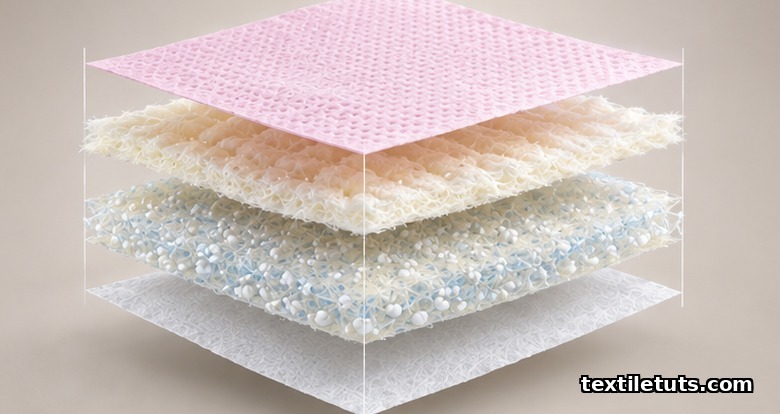
1. Top sheet (skin-side layer): A hydrophobic-finished polypropylene spunbond or SMS (spunbond-meltblown-spunbond) nonwoven, typically 15 to 25 g/m². The fibers are treated with a surfactant so fluid passes through quickly, but the surface still feels dry to the touch. ISO 9073-11 governs its liquid strike-through, and most quality programs specify a value below 3 seconds for the first insult.
2. Acquisition and distribution layer (ADL): A lofty, through-air-bonded nonwoven that pulls fluid sideways away from the insult point and feeds it down into the core. ADL grammage is usually 40 to 80 g/m², sometimes dual-layer for premium products. Its function is to prevent pooling and to improve rewet performance under load.
3. Absorbent core: A blend of fluff pulp (cellulose fiber from Southern pine kraft) and superabsorbent polymer granules, sandwiched between wet-strength tissue layers or wrapped in a nonwoven. SAP loadings range from 10 to 50% of the core by mass. A size-4 diaper typically contains 8 to 14 g of SAP, and that SAP alone can lock up 250 to 400 mL of saline before reaching free-swelling saturation.
4. Back sheet (outer layer): A polyethylene film or breathable microporous film laminated to a nonwoven for a cloth-like feel. It blocks liquid strike-through outward while permitting water vapor to escape, which lowers skin wetness and reduces rash. Hydrohead ratings above 50 mbar are standard.
Barrier leg cuffs are cut from hydrophobic SMS or spunlace nonwovens and elasticized so they lift and channel fluid back into the core rather than letting it escape.
How Superabsorbent Polymer Locks Fluid Away
The superabsorbent polymer used in diapers is sodium polyacrylate, a cross-linked copolymer of acrylic acid and sodium acrylate. In dry form it is a white granular powder with particle sizes between 100 and 800 µm. The polymer chains are covalently cross-linked so they cannot dissolve, while their carboxylate groups (-COO⁻Na⁺) attract water strongly.
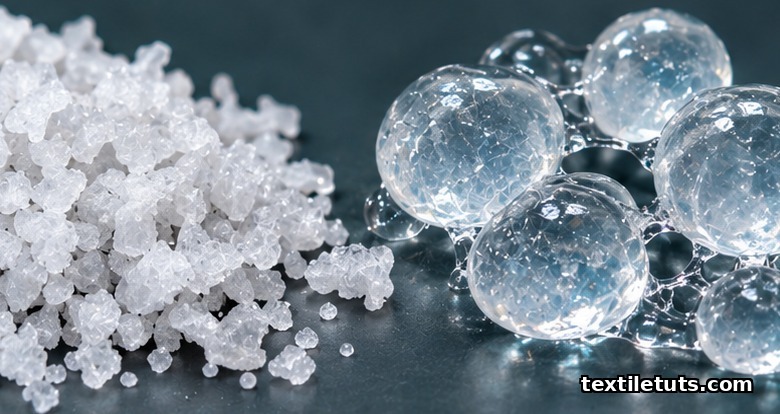
When urine contacts a granule, water moves in by osmosis. Sodium ions hydrate, and the carboxylate groups ionize, which draws still more water in. The polymer network swells into a soft hydrogel that can hold 15 to 30 g of saline per gram of dry polymer. The cross-links prevent the chain from dissolving into a free liquid, so water stays locked inside the gel and does not run back out under pressure.
Two test results dominate the spec sheet for diaper-grade SAP:
- Free swell capacity (FSC): how much saline the dry SAP can hold under no load. Premium diaper SAPs rate 30 to 45 g/g.
- Absorption under load (AUL): how much saline the SAP holds when pressed by a 0.3 psi weight, which simulates a sitting infant. AUL is the more relevant diaper number because the baby is on the diaper. Top diaper-grade SAPs retain 20 to 28 g/g under that load.
- Centrifuge retention capacity (CRC): the fluid remaining in the swollen gel after spinning. High CRC means low rewet when the baby moves.
ISO 17190-5 specifies the test method for polyacrylate superabsorbent powders used in urine-absorbing aids, and most diaper manufacturers buy to a custom internal specification built on ISO 17190 plus EDANA WSP 241.3 retention.
Why Fluff Pulp Is Still in the Core
Even “max SAP” diapers still contain fluff pulp, and the pulp is not filler. Southern pine kraft fluff has hollow, ribbon-like fibers that wick fluid rapidly along the core, distributing it across many SAP granules before any one granule is overwhelmed. Without pulp, urine would pool above a single SAP layer and rewet the skin as soon as the baby moved.
Modern cores run a pulp-to-SAP ratio between 50:50 and 70:30 by mass. Higher SAP ratios give thinner cores but higher rewet, which is why premium thin diapers use a two-layer core: a low-SAP upper acquisition layer that distributes fast, and a high-SAP lower storage layer that locks fluid away. The two layers can have SAP contents of 20% and 60% respectively.
Pulp fibers themselves are tested for pH, conductivity, and extractables per ISO 17190-3. Divalent cations (Ca²⁺ and Mg²⁺) cross-link the SAP prematurely and reduce capacity, so pulp mills supplying diaper-grade fluff run purified water through their lines and keep ionic contamination in the parts-per-million range.
Absorbency and Rewet Test Standards
Diapers are tested at three levels: material, component, and finished product. Standards span ISO, AATCC, and EDANA.
- ISO 17190-5 (2001): Polyacrylate superabsorbent powders, free swell capacity test in urine-absorbing aids.
- AATCC TM 79: Absorbency of textiles by water drop disappearance. Used on the top sheet to confirm rapid intake.
- AATCC TM 150: Dimensional change after home laundering, applied to reusable cloth diaper components.
- EDANA WSP 0.1: Rewet of absorbent hygiene materials after multiple insults.
- EDANA WSP 70.7: Acquisition time for finished hygiene products.
- ISO 10993-5 and ISO 10993-10: Biological evaluation of medical devices, cytotoxicity and skin irritation. Required because diapers are worn against infant skin for hours at a time.
- ASTM F1671: Penetration by bloodborne pathogens, sometimes cited for back sheet integrity in medical-grade diapers.
A passing diaper must come in below a manufacturer-set rewet number, above a capacity number, and clear skin-contact biocompatibility. Rewet is usually the deciding number, because it predicts rash.
Cloth vs Disposable: What Is Actually Different
Cloth diapers use woven cotton, bamboo, or hemp as the absorbent layer. These fibers absorb by capillary action into the fiber lumen, with no chemical absorption step. A cotton prefold holds roughly 50 to 80 mL of fluid per layer, well below the 250 to 400 mL a single disposable holds, which is why cloth diaper systems stack multiple layers and require more frequent changes.
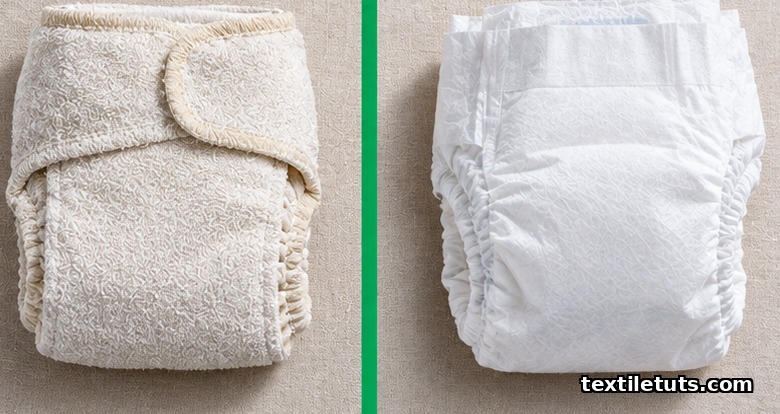
Modern pocket-style cloth diapers combine a polyester microfiber or bamboo inner with a PUL (polyurethane laminate) outer, with the same fluid-blocking requirements as a disposable back sheet. They do not contain SAP.
Disposables outperform cloth on rewet and total capacity per gram; cloth wins on reuse, waste volume per change, and breathability for some babies. Both product types must clear the same skin-safety framework where they carry a medical-device registration.
Frequently Asked Questions
How much fluid can a diaper actually hold?
A size-4 disposable diaper typically holds 250 to 400 mL of saline before reaching free-swelling saturation, equivalent to about three to five typical infant urinations. The superabsorbent polymer alone is rated at 15 to 30 g of saline per gram of dry mass, and the fluff pulp contributes roughly 8 to 12 g/g by capillary action.
Why does the top sheet feel dry even when the diaper is wet?
The top sheet is a hydrophobic polypropylene nonwoven that lets fluid pass through once and does not hold it. The acquisition layer pulls fluid sideways into the core, so the top sheet only sees a brief liquid film that is wicked away within 1 to 3 seconds of the insult, leaving a dry skin-facing surface.
Is superabsorbent polymer safe against a baby’s skin?
Sodium polyacrylate is the same chemistry used in soil conditioners and food-contact packaging, and finished diapers must pass ISO 10993 cytotoxicity and irritation tests, the same biocompatibility framework used for medical devices in contact with skin.
If a diaper is so absorbent, what actually causes diaper rash?
Rash is mainly driven by prolonged moisture and friction, not absorbency itself. A wet diaper left too long raises skin surface pH and weakens the stratum corneum, which allows fecal enzymes to irritate the skin. Frequent changes and a breathable back sheet reduce this. SAP reduces rash when paired with timely changes; it does not cause it.
Are biodegradable diapers actually compostable?
Most biodegradable diapers replace the plastic back sheet with a PLA or starch-blend film and the SAP with a starch-grafted superabsorbent. The cellulose pulp and topsheet can compost, but the SAP, elastics, and adhesives generally do not break down in a backyard pile and need industrial composting conditions to degrade within a few months.
References
- International Organization for Standardization. ISO 17190-5:2001, Urine absorbing aids, Polyacrylate superabsorbent powders, Test methods. Defines free swell capacity for diaper-grade SAP.
- American Association of Textile Chemists and Colorists. AATCC Test Method 79-2018, Absorbency of Textiles. Water drop disappearance method applied to diaper top sheets.
- EDANA. WSP 0.1 and WSP 70.7, Rewet and Acquisition Time for Absorbent Hygiene Products. Worldwide Strategic Partners test methods published by the European Disposables and Nonwovens Association.
- International Organization for Standardization. ISO 10993-5:2009 and ISO 10993-10:2010, Biological evaluation of medical devices. Cytotoxicity and skin irritation testing applied to skin-contact materials.
- Buchholz, F.L., and Graham, A.T. (eds.). Modern Superabsorbent Polymer Technology. Wiley-VCH. Reference text on sodium polyacrylate chemistry and swelling mechanics.
- Sapna, R., et al. (2020). Superabsorbent polymers in hygiene applications. Springer Nature. Peer-reviewed review of SAP performance in diapers and sanitary products.
This article is the working reference for diaper construction and absorbency. Editorial by Md. Asad Ullah (Meem), TextileTuts. Sources: ISO 17190-5, AATCC TM 79, EDANA WSP 0.1 and 70.7, ISO 10993-5 and 10993-10, ASTM F1671, Wiley-VCH SAP textbook, and Springer SAP review as cited.


