
Poplin, Twill, Denim: Weave Structure Comparison

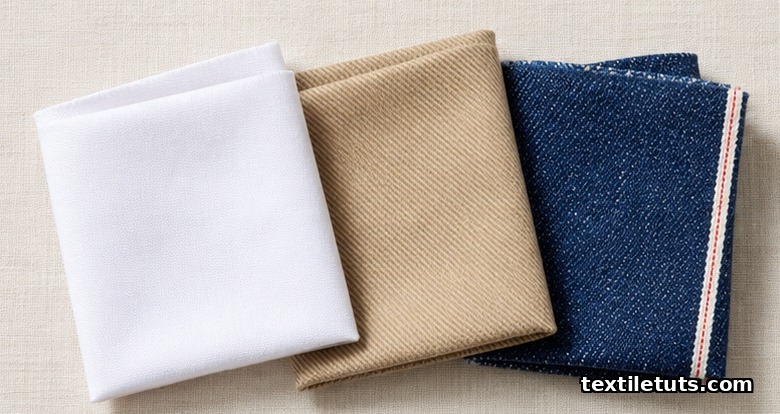
Poplin is a 1/1 plain weave that pairs a fine cotton warp (typically Ne 60 to 80) with a coarser weft (Ne 16 to 30) at thread counts of 30 to 60 ends per cm by 20 to 30 picks per cm, while twill uses an offset 2/1 or 3/1 construction that floats yarns over two or more orthogonal picks to produce a 45 to 63 degree diagonal wale, and denim is a warp-faced 3/1 twill that packs indigo-dyed Ne 6 to 12 warp yarns at 28 to 36 ends per cm against an undyed weft to deliver the fabric’s signature blue face and white back at 380 to 510 g/m squared.
These three constructions account for the majority of commercial cotton and cotton-blend wovens, and the differences in yarn count, float length, and thread density directly control drape, tear strength, abrasion resistance, and breathability at every weight class.
This article breaks down each weave structure, shows how float length and density change fabric behavior, and gives a specification-level comparison you can apply when sourcing shirtings, chinos, or denim for production or personal use.
Poplin: The Balanced 1/1 Plain Weave
Poplin uses the simplest possible weave: one warp over one weft, repeated across the fabric. The defining feature of poplin is the use of a fine warp and a heavier weft, with the warp typically two to four times finer than the weft in cotton count terms, which produces fine horizontal cords across the fabric face. Thread density is usually 30 to 60 ends per cm in the warp and 20 to 30 picks per cm in the weft for shirting weights of 90 to 130 g/m squared.
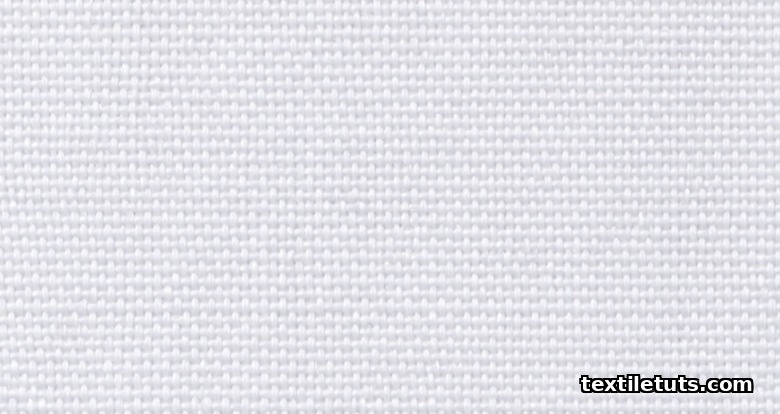
Because no yarn floats over more than one orthogonal yarn, poplin has a tight, balanced structure with low yarn mobility. This produces excellent dimensional stability and a smooth, slightly lustrous surface when mercerized. Mercerization with sodium hydroxide at 20 to 25 percent on weight of fabric swells cotton fibers, increases luster, and improves dye uptake, a process standardized under AATCC TM 89 and described in detail within the ISO 7211-1 methods for woven fabric construction analysis.
The plain weave structure also distributes stress evenly across warp and weft, which is why poplin is among the most abrasion-resistant simple weaves relative to its weight. Cotton poplin shirting at 110 to 130 g/m squared is the standard for dress shirts because it takes a crisp press, resists pilling, and holds fine yarn-dyed stripes and checks without distortion. The tradeoff is that the short float length also means lower drape and lower tear strength compared with twill at the same yarn count.
Twill: The Diagonal Float Structure
Twill weaves are defined by a step pattern in which a yarn floats over two or more orthogonal yarns before going under one, creating a diagonal wale on the fabric face. The three most common types are 2/1 twill, where the warp floats over 2 picks and under 1; 3/1 twill, where the warp floats over 3 picks and under 1; and 2/2 twill, a balanced construction used in worsted suitings where warp and weft floats are equal.
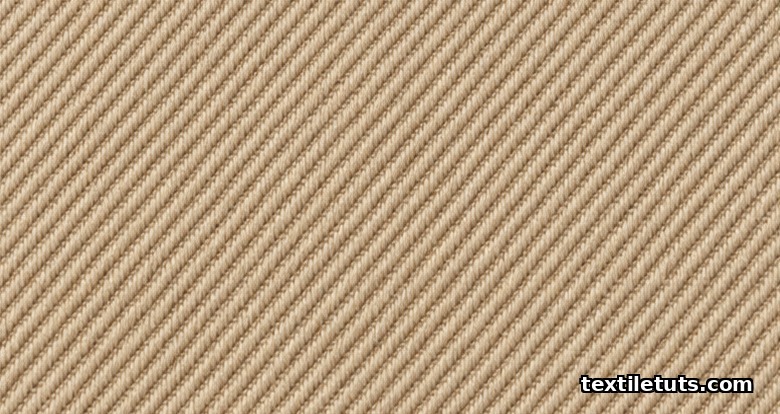
The diagonal line angle is a direct function of the float ratio and yarn count differential. A 2/1 cotton twill at 35 ends per cm warp and 22 picks per cm weft typically shows a 45 degree wale; increasing the warp density to 45 ends per cm, or moving to a 3/1 construction, shifts the angle toward 63 degrees and produces what the trade calls a steep twill. Steep twills have higher tear strength in the warp direction because more warp yarns cluster on the face and resist propagation at the tear tip.
Yarn floats longer than one pick give twill its superior drape and recovery. A 3/1 twill at 240 to 280 g/m squared is the standard construction for cotton chinos and work trousers, while a 2/1 twill at 180 to 220 g/m squared dominates flannel shirts and pocket linings. The longer float also reduces the number of yarn interlacings per unit area, lowering bending stiffness and producing a softer hand than poplin of equivalent weight.
Denim: Warp-Faced 3/1 Twill with Indigo Dye
Denim is a specific application of 3/1 twill in which the warp yarns are dyed with indigo, a vat dye applied in the reduced leuco form and re-oxidized on the fiber, while the weft is left undyed. The warp covers the fabric face completely, so the surface shows the indigo-dyed yarns while the back shows the creamy white cotton weft. This warp-faced structure is what distinguishes denim from balanced twills like chino, even though both use the same 3/1 weave repeat.
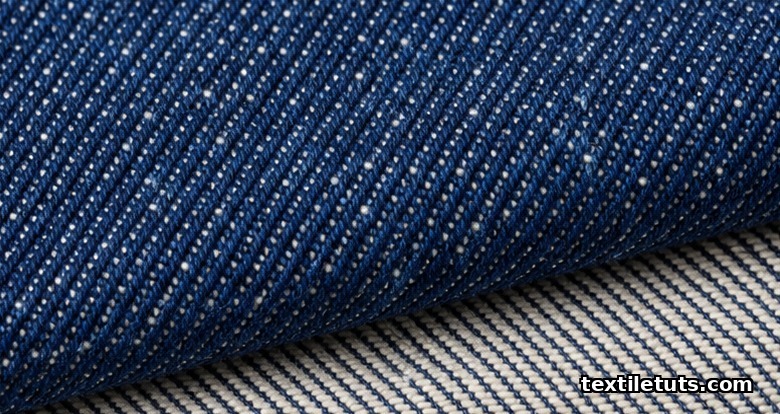
Traditional denim uses coarse, ring-spun cotton yarns: Ne 6 to 12 for the warp and Ne 8 to 14 for the weft. Thread counts run 28 to 36 ends per cm warp and 18 to 24 picks per cm weft, producing weights of 380 to 510 g/m squared, which is 11 to 15 oz/yd squared, for classic five-pocket jeans. Ring-spun yarns have variable diameter along their length, which is why denim fades with wear: the indigo coating wears off the raised fibers first, leaving characteristic whiskers at the hip, honeycombs behind the knee, and stacked wash marks at the hem.
The 3/1 warp-faced structure concentrates stress on the warp yarns, giving denim exceptional warp-direction tensile strength (typically 80 to 120 daN per 5 cm strip at 14 oz) and high abrasion resistance. The trade-off is lower warp-direction tear strength once the fabric is cut, which is why selvedge denim woven on shuttle looms is prized: the self-finished edge prevents fray, and the lower tension during weaving produces a denser, more compact fabric with smaller float irregularities.
Construction Specifications at a Glance
| Parameter | Poplin | Twill (2/1 or 3/1) | Denim (3/1 warp-faced) |
|---|---|---|---|
| Weave repeat | 1/1 plain | 2/1 or 3/1 diagonal | 3/1 warp-faced |
| Warp yarn count (cotton) | Ne 60 to 80 | Ne 30 to 50 | Ne 6 to 12 |
| Weft yarn count (cotton) | Ne 16 to 30 | Ne 24 to 40 | Ne 8 to 14 |
| Thread density (ends x picks / cm) | 30 to 60 x 20 to 30 | 35 to 45 x 20 to 25 | 28 to 36 x 18 to 24 |
| Weight (g/m squared) | 90 to 130 | 180 to 280 | 380 to 510 |
| Typical wale angle | None | 45 to 63 degrees | 63 degrees (steep) |
| Tensile strength (warp, daN/5 cm) | 40 to 60 | 55 to 80 | 80 to 120 |
| Drape coefficient (higher = stiffer) | High | Medium | Low to medium |
Data compiled from ISO 7211-1 weave analysis, ASTM D3775 thread-count methods, and manufacturer technical sheets for cotton shirting, chino, and 14 oz denim references.
How Float Length Drives Fabric Behavior
Float length, meaning the number of orthogonal yarns a single warp or weft passes over, is the single most predictive specification for woven fabric behavior. A 1/1 poplin has the shortest possible float of 1, which means every yarn is locked at every pick; this produces dimensional stability but limits drape. A 3/1 twill denim has a float of 3 on the warp, allowing warp yarns to move under stress and absorb energy before breaking.
Three practical consequences follow from this single specification.
First, abrasion resistance. Each yarn crossover is a potential abrasion point. Poplin has more crossovers per cm squared than twill of the same density, so poplin actually shows surface abrasion faster despite its tighter construction. Denim’s longer floats allow surface fibers to wear off gradually rather than fracturing at the crossover, which is what produces fades rather than holes during normal use.
Second, drape and hand. Longer floats mean fewer interlacings, lower bending modulus, and softer hand. A 3/1 twill at 240 g/m squared drapes noticeably better than a 1/1 poplin at the same weight. This is why casual trousers are almost universally twill, while crisp dress shirts are poplin.
Third, tear strength. Tear strength depends on yarn mobility: how many yarns can bunch together at the tear tip to resist propagation. Twill and denim allow more yarn bunching than poplin, which is why Elmendorf tear strength in the warp direction rises from roughly 1,500 to 2,500 cN for poplin shirting to 4,000 to 8,000 cN for 14 oz denim when measured per ASTM D1424.
Identifying the Three Weaves Visually
Look at the face of the fabric under a loupe or against a strong backlight.
- Poplin: The clearest, most uniform grid pattern. Fine horizontal cords are visible from the weft side because the weft yarn is heavier than the warp. No diagonal pattern.
- Twill: A continuous diagonal wale runs from lower left to upper right in a Z twill, or lower right to upper left in an S twill. The wale is visible on the face and can be felt with a fingernail running perpendicular to it.
- Denim: Diagonal wale visible on the back (white weft face) and a solid blue face where the indigo warp covers the weft completely. The wale is typically steeper than chino twill because the 3/1 construction shifts the angle toward 63 degrees.
The direction of the diagonal (S versus Z) does not change performance but does affect how seams lay when cutting patterns. Most commercial denim is Z twill, with a right-handed diagonal that matches standard jeans pocket orientation and lets the twill line run parallel to the inseam.
Frequently Asked Questions
Is denim a twill weave?
Yes. Denim is a 3/1 warp-faced twill in which the warp yarns float over three weft yarns and under one, creating a diagonal wale. The twill structure gives denim its strength and surface mobility; the indigo warp dye and white weft give it the blue/white contrast that distinguishes it from solid-color chino twill.
What is the difference between poplin and twill shirts?
Poplin shirts use a 1/1 plain weave with a fine warp and slightly heavier weft, producing a smooth, crisp surface at 90 to 130 g/m squared. Twill shirts use a 2/1 weave with a visible diagonal wale, producing a softer hand, better drape, and more wrinkle recovery at 110 to 150 g/m squared. Poplin reads as dressier; twill reads as more casual and is easier to iron after washing.
Why is denim so much heavier than poplin?
Denim uses coarse ring-spun yarns (Ne 6 to 12) packed at 28 to 36 ends per cm to reach 380 to 510 g/m squared, while poplin uses fine yarns (Ne 60 to 80 warp, Ne 16 to 30 weft) at lower total density to stay near 100 g/m squared. The denim specification is driven by the need for abrasion resistance during hard wear; poplin’s specification is driven by the need for a smooth, breathable shirting hand.
Can you tell poplin and twill apart by touch?
Yes. Run a fingernail across the fabric face. Poplin feels uniform and smooth, with very fine horizontal ribs from the heavier weft. Twill shows directional softness: smooth when the nail follows the diagonal wale, slightly rough when running perpendicular to it. The twill also drapes more softly when held by a corner.
Which weave is strongest?
By tensile strength per unit weight, 3/1 twill denim is the strongest of the three because the long warp floats distribute load across multiple yarns. By abrasion cycles to failure, denim also leads because the long floats wear gradually rather than failing at crossover points. Poplin leads on dimensional stability and seam slippage resistance, which is why it remains the choice for fitted dress shirts.
References
- International Organization for Standardization. ISO 7211-1:1984 — Textiles — Woven fabrics — Construction — Methods of analysis — Part 1: Methods for the presentation of a weave diagram and for the measurement of the basic construction parameters. iso.org — defines warp count, weft count, and weave repeat notation.
- ASTM International. ASTM D3775 — Standard Test Method for End (Warp) and Pick (Filling) Density of Woven Fabric. astm.org — thread-count measurement method applicable to plain, twill, and denim constructions.
- ASTM International. ASTM D1424 — Standard Test Method for Tearing Strength of Fabrics by Falling-Pendulum (Elmendorf-Type) Apparatus. astm.org — pendulum tear method cited for the tear strength ranges above.
- AATCC. AATCC Test Method 89 — Mercerization of Cotton. aatcc.org — sodium hydroxide concentration and treatment conditions for mercerized cotton poplin.
- Kumar, P. and Chatterjee, A. Effect of weave structure on fabric properties — a review. ResearchGate — peer-reviewed chapter covering poplin, twill, and denim mechanical behavior.
- Yang, Y. and Sun, D. Indigo Dyeing and Weave Structure in Denim Fabrics. MDPI Textiles — peer-reviewed analysis of 3/1 twill denim and warp dye uptake.
- The Textile Institute. Handbook of Technical Textiles. textileinstitute.org — yarn count, thread density, and weave repeat standards for cotton wovens.
Editorial by Mohammad Yousuf (Anik), TextileTuts. Sources: ISO 7211-1, ASTM D3775, ASTM D1424, AATCC TM 89, and the cited peer-reviewed chapters.


