
Plain Weave vs Twill vs Satin: Structural Differences

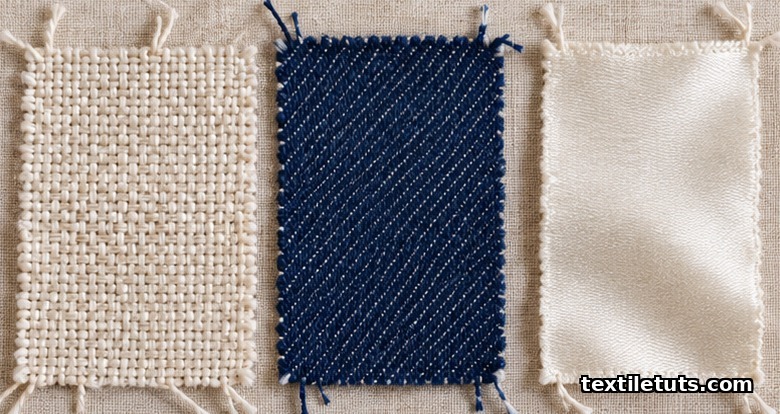
Plain weave, twill, and satin are the three fundamental weave structures classified under ISO 9354:2023, distinguished by float lengths of 1, 2 to 3, and 4 or more yarns respectively, with binding-point density and step number that together determine cover factor, drape, mechanical strength, and surface luster. The number of yarns a single yarn crosses over before going under defines each structure: plain weave interlocks on every yarn (notation 1/1), twill steps the binding point over 2 or 3 yarns in a regular diagonal sequence (commonly 2/1, 3/1, 2/2, or 3/2), and satin scatters binding points across 4 to 8 yarns using defined skip numbers, producing long surface floats that reflect light as a near-mirror finish. This article breaks down how each weave is built on the loom, how the construction drives measurable physical properties, and where each weave is the right choice for a given end-use.
How the Three Weaves Are Built
Woven fabric forms on a loom by interlacing two perpendicular yarn sets: warp (lengthwise, held under tension) and weft (crosswise, inserted by shuttle, projectile, rapier, air-jet, or water-jet). Every crossing where a warp yarn passes over a weft yarn is called an interlacing or binding point; every yarn segment that floats across the surface without interlacing is a float.
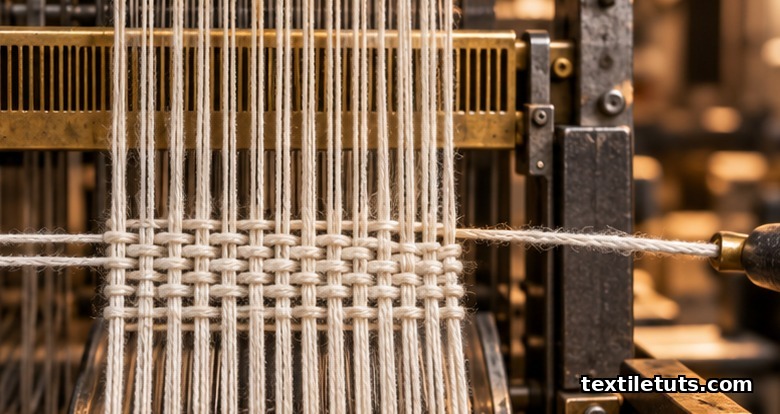
Plain weave uses the simplest interlacing possible. Each warp yarn passes over one weft yarn, then under the next, alternating across the full fabric width. The neighboring warp yarn runs the opposite sequence, which produces a checkerboard of binding points where every warp is held by every weft. Float length is always 1, and the structure is balanced on both faces unless a sized or calendared finish shifts the surface.
Twill advances the binding point by one yarn on each successive pick or end. This offset produces a diagonal line, called a wale, that runs across the fabric face. The wale angle depends on the ratio of warp density to weft density: a balanced 2/2 twill shows roughly a 45-degree wale, while a warp-faced 3/1 twill (used in most denim) shows a steeper, more vertical wale because the warp dominates the face.
Satin (and its weft-face counterpart, sateen) uses long floats of 4 to 8 yarns, with binding points scattered so that no two sit adjacent either along the same row or the same column. ISO 9354:2023 defines the construction by harness count and step number: a 5-harness satin uses a step of 2 or 3, an 8-harness satin uses a step of 3 or 5, and so on. The wide scatter is what gives the surface its smooth, low-scatter specular reflection.
Structural Metrics You Can Measure
The simplest way to compare weaves is on three quantifiable axes drawn from ISO 7211 and ASTM D4850:
- Float length, the number of yarns one yarn crosses before interlacing. Plain weave = 1, twill = 2 to 3, satin = 4 to 8.
- Interlacing frequency, binding points per unit area. A plain weave at 20 ends/cm and 20 picks/cm carries 400 binding points per cm². A 5-harness satin at the same density carries only about 80.
- Cover factor, the fraction of fabric area physically covered by yarn. Long-float weaves reach a higher cover factor at a lower yarn count, because the long floats overlap the perpendicular yarn more completely.
These three numbers govern nearly every downstream property. Tear strength, abrasion resistance, drape, air permeability, and optical reflectance all trace back to float geometry and yarn density.
Mechanical and Surface Performance
Float structure changes how a fabric absorbs load and how it looks.
Tensile and tear strength. In plain weave every yarn is crimped at every crossing, so warp and weft carry applied load almost equally. Twill, with fewer binding points, has lower crimp and higher yarn straightness, which generally improves tensile efficiency. Satin, with the fewest binding points, has the straightest yarns and the highest tensile efficiency per yarn, but its long floats snag and abrade easily.
Abrasion resistance. Plain weave is the most snag- and pill-resistant because broken yarn ends are trapped by the dense binding-point pattern. Twill sits in the middle; the diagonal structure redistributes surface wear along the wale. Satin is the most vulnerable because each float is a single point of failure.
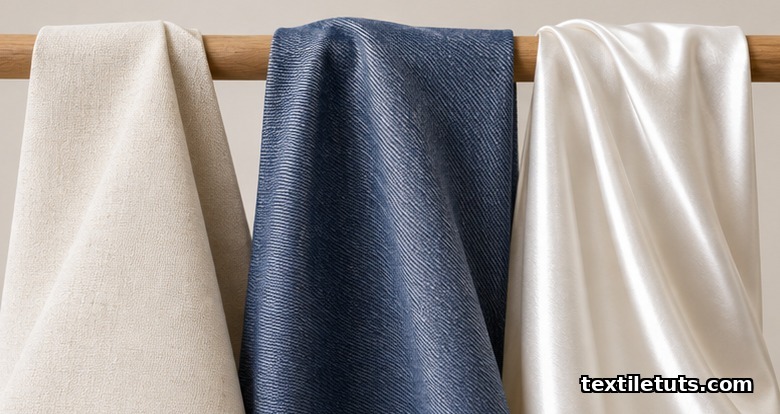
Drape. Long floats and low binding-point density allow yarns to slide past one another more freely, producing softer drape. Satin drapes more fluidly than twill, which drapes more fluidly than a plain weave of equivalent yarn count and density.
Luster. Surface luster is a function of how parallel and unbroken the surface yarns are. Satin’s 4- to 8-yarn floats create long, uninterrupted specular reflectors. Twill’s stepped pattern produces a visible diagonal sheen. Plain weave’s alternating pattern scatters light in every direction and reads as matte.
Comparison Table: Plain Weave vs Twill vs Satin
| Property | Plain Weave | Twill | Satin |
|---|---|---|---|
| Float length (yarns) | 1 | 2 to 3 | 4 to 8 |
| Common notation | 1/1 | 2/1, 3/1, 2/2, 3/2 | 4-, 5-, or 8-harness satin |
| Step number (ISO 9354) | 1 | 1 (offset every pick) | 2, 3, or 5 |
| Surface appearance | Matte, balanced | Diagonal wale | Smooth, lustrous |
| Drape | Crisp | Moderate | Fluid |
| Abrasion resistance | High | Moderate | Low |
| Typical yarn count range (Ne) | 30s to 80s | 20s to 60s | 40s to 120s |
| Common end-uses | Muslin, poplin, canvas, shirting | Denim, chinos, gabardine, tweed | Satin bedding, bridal, lining, sleepwear |
Choosing the Right Weave for an Application
The weave you specify is rarely a free choice. It is constrained by the yarn count available, the loom setup, and what the fabric must do in use.
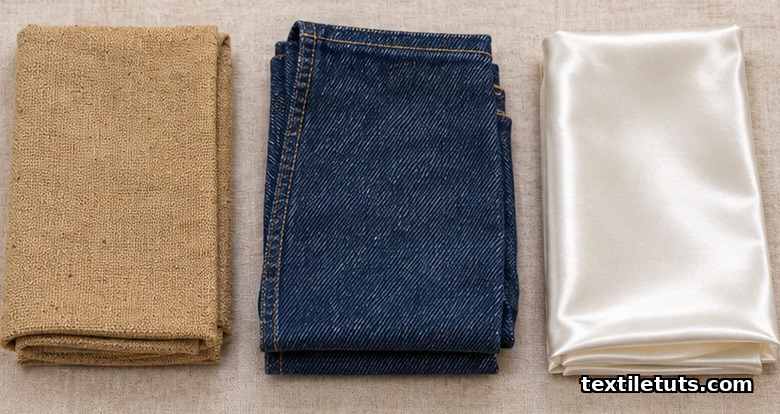
For workwear, uniform, and heavy-duty applications, plain weave in heavy yarn counts (10s to 20s Ne) gives the highest snag and tear resistance per gram of fabric. Canvas, duck cloth, and ballistic fabrics are all plain weaves for this reason.
For denim, chinos, and tailored garments, 3/1 warp-faced twill is the standard. The long warp floats hold the indigo dye on the surface while the white weft stays underneath, which is what creates the fade pattern unique to denim as the surface warp slowly abrades through wear and washing.
For lingerie, linings, bridal, and decorative satin, 5-harness or 8-harness satin is the right choice. Long floats give the fluid drape and high luster these end-uses require, and the fabric is typically deployed in low-abrasion applications where the snag risk is acceptable.
For balanced shirting and bedding, plain weave and 2/2 twill both perform well. The deciding factor is usually hand-feel and yarn count rather than structural performance.
How Float Length Affects Cover Factor and Air Permeability
Cover factor (K) is calculated as the fraction of fabric area covered by yarn projection. For a square plain weave, K = (d_p + d_t) − (d_p × d_t), where d_p and d_t are warp and weft diameter fractions. Long-float weaves (twill, satin) reach a higher K at a lower yarn density, which is why a satin sheet can feel dense and warm even at a relatively low GSM. The same property, however, reduces air permeability. ISO 9237 measurements show that for identical yarn count, an 8-harness satin typically delivers 30 to 50 percent lower air permeability than a plain weave of equal density, because the long floats block more of the inter-yarn pore space.
Frequently Asked Questions
What is the main structural difference between plain weave, twill, and satin?
The structural difference is float length. Plain weave interlocks every yarn with its neighbor (float length 1), twill steps the binding point by one yarn on each successive end or pick (float length 2 to 3), and satin scatters binding points across 4 to 8 yarns (float length 4 to 8) to create long, smooth surface floats.
Which weave is the strongest?
Plain weave has the highest snag and tear resistance per unit weight because every yarn is bound at every crossing. For pure tensile strength per yarn, however, satin and twill perform better because their yarns are straighter and carry less crimp. The strongest weave depends on which failure mode matters for the application.
Why does satin look shiny and plain weave look matte?
Luster depends on how parallel and uninterrupted the surface yarns are. Satin’s 4- to 8-yarn floats act as long, flat specular reflectors that bounce light back in a narrow cone. Plain weave’s alternating over-and-under pattern scatters reflected light in every direction, producing a matte appearance. Twill sits between, with a visible diagonal sheen along the wale.
Can you tell the weave of a fabric by touching it alone?
You can make a strong guess but not a definitive identification. Satin feels smooth and fluid with a cool surface temperature. Twill often shows a discernible diagonal ridge when you run a fingernail across it. Plain weave feels crisp and balanced with no directional grain. Definitive identification requires a pick glass or low-power microscope to count binding points per repeat unit.
Does a higher float always mean a weaker fabric?
Higher float lowers snag and abrasion resistance because each surface yarn has fewer binding points to anchor it. It does not, however, lower tensile strength, since long floats are straighter under load. The right weave depends on which failure mode dominates the end-use.
References
- International Organization for Standardization. ISO 9354:2023 Textiles — Weaves — Coding system and examples. iso.org — defines float length, step number, harness count, and notation for woven structures.
- ASTM International. ASTM D4850 Standard Terminology Relating to Fabrics. astm.org — fabric terminology including weave structure, float, and interlacing definitions.
- International Organization for Standardization. ISO 7211-5:2020 Textiles — Methods for analysis of woven fabrics — Part 5: Determination of linear density of yarn removed from fabric. iso.org — yarn-removal procedure used to measure yarn count in finished woven fabrics.
- International Organization for Standardization. ISO 9237:1995 Textiles — Determination of the permeability of fabrics to air. iso.org — air-permeability test method relevant to long-float cover factor.
- American Association of Textile Chemists and Colorists. AATCC TM8 Colorfastness to Crocking. aatcc.org — crocking test method, applied widely to surface-dyed long-float weaves.
- Peirce, F. T. (1937). The geometry of cloth structure. Journal of the Textile Institute, 28, T45–T96. — foundational peer-reviewed paper on woven-fabric geometry, float length, and cover factor.
- Kadolph, S. J. (2010). Textiles (11th ed.). Pearson. — standard textile-science textbook covering weave geometry, mechanical properties, and structural analysis of woven fabrics.
This article is the working reference for plain weave, twill, and satin structure. Editorial by Mohammad Yousuf (Anik), TextileTuts. Sources: ISO 9354:2023, ASTM D4850, ISO 7211-5:2020, ISO 9237:1995, AATCC TM8, Peirce (1937), and Kadolph (2010) as cited.


