
Ponte di Roma Knit Fabric

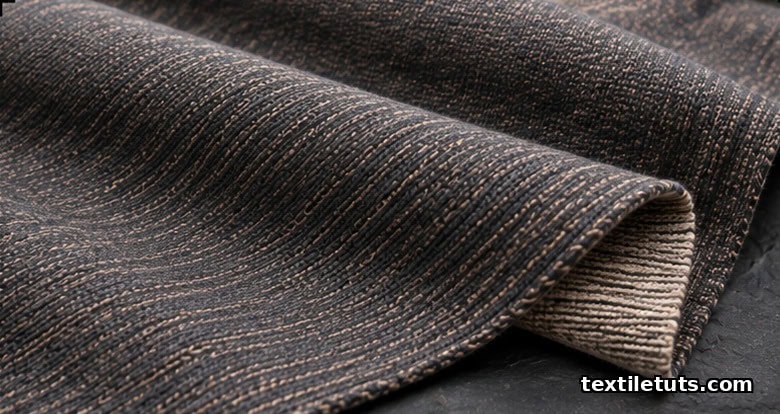
Ponte di Roma is a double-knit fabric built on a 1×1 rib base, with two yarn feeds knitting simultaneously on front and back beds to create a fabric whose face and reverse are identical, typically weighing 250–340 g/m² (g/sqm), with a course density (number of horizontal knit rows per inch) of 18–22 and a wales density (number of vertical knit columns per inch) of 12–14. The balanced construction gives ponte di Roma the dimensional stability of a true double-knit, with crosswise (around the body) and lengthwise stretch of 15–25% and 8–12% respectively, well below the 60–80% crosswise stretch of a single jersey. That stability is the reason the structure carries tailored dresses, structured trousers, and unlined blazers that hold their shape instead of clinging to the body.
This article covers how ponte di Roma is constructed on a flat-bed knitting machine, the four properties that set it apart from interlock and 1×1 rib, and the four end uses where the fabric’s behaviour is an asset rather than a limitation. It closes with a property comparison table and four questions sourced from knitting textbooks and peer-reviewed literature.
How Ponte di Roma Is Constructed on the Knitting Machine
Ponte di Roma (Italian for “Roman bridge,” describing the bridges of yarn that tie the two faces together) is produced on a flat knitting machine with two yarn feeds per course on opposite needle beds. Each course is knitted twice: once on the front bed with one set of needles, then on the back bed with a second set, producing two connected layers that lock together at alternating tuck points. Because both faces use identical jersey stitches, the face and back look the same, which is the visual signature of a true ponte, not a rib.
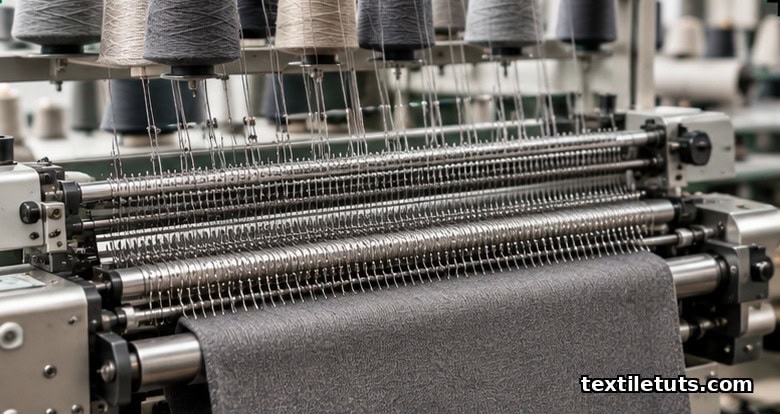
The structure follows a 1×1 rib repeat, but the back-bed stitches are tucked rather than fully drawn on alternate courses, which is what binds the layers and keeps the fabric from separating under tension. A typical setup uses 12–14 gauge needles (needles per inch), 28–36 tex yarns (grams per 1,000 metres), and 0.6–0.8 m/s take-down speed (the rate at which fabric is drawn away from the needles). The result is a dense, uniform double-knit that resists laddering (the run that opens when a single stitch is broken) and holds its shape on the body.
Key Properties: Weight, Stability, Stretch Recovery, and Opacity
Four measurable properties separate ponte di Roma from lighter single-bed knits, and each is a direct result of its two-layer construction. Weight sits between 250 g/m² and 340 g/m² for apparel-grade ponte, putting the fabric in the medium- to heavy-weight range and well above 100–140 g/m² single jersey. Course density is 18–22 per inch, wales density 12–14 per inch, and fabric thickness 0.85–1.30 mm measured under 4.9 kPa pressure per ISO 5084 (the standard for textile thickness).
Dimensional stability (residual dimensional change after washing, drying, or stretching) is what makes ponte behave like a woven when worn. Under ISO 6330 (domestic washing test) at 30 °C, residual shrinkage is 1–3% in both directions, compared to 5–8% lengthwise for single jersey. Stretch is balanced rather than directional: crosswise 15–25% at 14.7 N/5 cm (force per 5 cm fabric strip), lengthwise 8–12%, so the fabric moves with the body instead of sliding around it.
Stretch recovery (the percentage of stretched length the fabric reclaims once the load is removed) is what makes ponte wear like suiting on long days. After 5 cycles of 30% elongation on an Instron tensile frame, recovery is 92–96% horizontally and 85–90% vertically, against 70–80% for an equivalent single jersey. Opacity rounds out the four: a 280 g/m² ponte in a dark shade registers 0.5–1.2% transmittance on a Macbeth TD931 spectrophotometer (a device that measures the percentage of light passing through a material), low enough to pass an opacity test (≤2% per AATCC 148, the standard for visual transparency classification) in most commercial dye shades.
Ponte di Roma vs Interlock vs 1×1 Rib: What Changes
Ponte, interlock, and 1×1 rib are all double-bed structures, but they differ in three ways: layer count, face identity, and extensibility. Ponte uses two independent layers tied at tuck points with identical faces both sides. Interlock also has two layers, but the layers alternate stitches every course to form a single 1×1 rib that looks identical both sides, producing a smoother surface with softer drape. A 1×1 rib alternates knit and tuck on the same course, giving the visible ribs that run along the course direction; it stretches 70–100% crosswise, more than twice as much as ponte.
The table below summarises the property differences for apparel-grade fabrics knitted at 12–14 gauge with 28–36 tex yarns.
| Property | Ponte di Roma | Interlock |
|---|---|---|
| Typical weight (g/m²) | 250–340 | 160–220 |
| Thickness (mm, ISO 5084) | 0.85–1.30 | 0.55–0.85 |
| Crosswise stretch at 14.7 N/5 cm (%) | 15–25 | 35–50 |
| Stretch recovery after 30% elongation (%) | 92–96 | 80–88 |
| Residual shrinkage at 30 °C, ISO 6330 (%) | 1–3 | 3–5 |
| Drape coefficient (higher = stiffer) | 60–75 | 35–50 |
| Opacity (% light transmittance, dark shade) | 0.5–1.2 | 2.0–4.5 |
| Best fit | Tailored knitwear, structured trousers | T-shirts, lightweight dresses |
Choose ponte when the garment must hold a shape (fitted sheath dress, tailored jumpsuit, knit blazer meant to read as suiting); choose interlock when drape and breathability matter more than stability (tees, lightweight layering pieces, summer tops).
Common End Uses: Tailored Knits That Need to Hold a Shape
Ponte di Roma dominates four garment categories: dresses (sheath, bodycon, fit-and-flare), trousers and skirts (joggers, cigarette pants, A-line skirts), jackets and blazers (unlined knits that travel well), and jumpsuits and rompers. The common thread is shape retention: the garment must fall cleanly from the body without pulling, bagging at the knees, or clinging in areas the wearer prefers to drape.

For fibre blends, apparel-grade ponte is most commonly knitted at 60–75% viscose or polyester with 25–40% nylon, sometimes with 2–5% spandex for stretch, though traditional 100% wool and 100% cotton versions exist for suiting. The viscose/spandex blend is the workhorse of contemporary ready-to-wear knit because it presses cleanly, takes dye uniformly, and recovers well after washing.
Working With Ponte di Roma: Cutting, Sewing, and Pressing Notes
Ponte is forgiving on the cutting table because both faces are identical (no “wrong side” to track) and crosswise stretch is minimal, so panels stay flat when laid out. Use a 70/10 ballpoint or stretch needle (a sewing machine needle with a rounded tip that slides between fibres instead of cutting them) to avoid snagging the back layer of stitches, and cut with a walking foot if available, since a regular presser foot can push the layers out of alignment on a long seam.
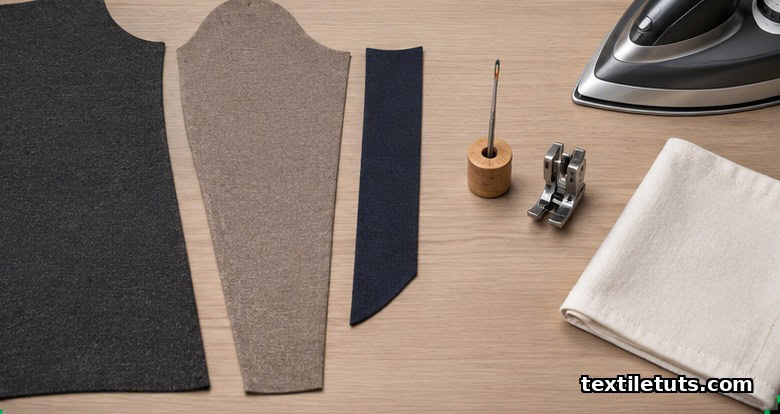
Stitch choice matters because ponte resists distortion: a 4-thread overlock is the cleanest seam for visible construction, while a 2.5 mm straight stitch at 12–14 stitches per inch suits facings and structural seams. Coverstitch the hems; ponte rolls at the edge when hemmed with a flatlock, leaving a wavy finish. Press below 150 °C on the iron’s wool setting (or 130 °C for polyester-rich blends) through a pressing cloth; higher temperatures can glaze (melt-fuse the surface into a shiny mark) the synthetic component, a defect the fabric cannot recover from.
Care and Laundering: Why Ponte Wears Better Than Single Jersey
Ponte survives home laundering better than most knits because of its density and balanced construction. A 30 °C machine wash on a gentle cycle with a mild detergent is safe for viscose/polyester/nylon/spandex ponte; a cold hand-wash suits 100% wool or 100% cotton versions. Tumble drying should be skipped or kept to low heat (below 60 °C), since the heat-set point (the temperature at which a synthetic fibre loses its set shape) of most spandex sits at 90–110 °C, and repeated 70 °C cycles degrade the elastane over time.
Hang-dry flat for wool ponte to prevent dropping under the fabric’s own weight, and use a wide hanger for shirts and dresses to keep the shoulder line crisp. Iron at medium heat through a press cloth, never directly on the face, to avoid glazing the synthetic component.
Frequently Asked Questions
Is ponte di Roma the same as interlock?
No. Interlock is a 1×1 rib knitted with alternating courses on front and back beds that produces a single integrated structure with two identical faces. Ponte di Roma uses two layers of jersey stitched together at tuck points, making it heavier (250–340 g/m² vs 160–220 g/m² for interlock) and more stable on the body. Interlock drapes more softly; ponte holds a structured silhouette.
Does ponte di Roma shrink in the wash?
Apparel-grade ponte di Roma, whether polyester-blend or cotton-rich, has residual shrinkage of 1–3% in both directions when washed at 30 °C per ISO 6330. That is roughly one-third the shrinkage of a comparable single jersey. Pre-washed or sanforized (chemically or mechanically pre-shrunk during finishing) versions drop below 1% residual shrinkage and are the safer choice for close-fitting garments.
Can you sew ponte di Roma on a domestic sewing machine?
Yes. A ballpoint or stretch needle, a 2.5 mm straight stitch, and a walking foot or light hand-tension give clean seams. Stitch at 12 stitches per inch, not the 8–10 most home machines default to, so seams stretch with the fabric rather than fighting it.
Is ponte di Roma breathable?
Ponte is less breathable than single jersey because the two-layer structure traps an air layer between the faces, but a 280 g/m² viscose ponte registers 850–1100 g/m²/24h on a moisture-vapour transmission test per ASTM E96 (a standard for measuring how much water vapour passes through a material in 24 hours), high enough for all-day wear in office and indoor settings. Polyester-rich versions run lower at 400–700 g/m²/24h, better suited to cooler weather.
References
- Wikipedia contributors. Ponte (fabric). https://en.wikipedia.org/wiki/Ponte_(fabric), encyclopedic entry on the fabric’s structure and common blends.
- Wikipedia contributors. Knitted fabric. https://en.wikipedia.org/wiki/Knitted_fabric, background on courses, wales, and double-knit structures.
- Spencer, D. J. Knitting Technology: A Comprehensive Handbook and Practical Guide. Woodhead Publishing, 2001, reference textbook on flat-bed knitting and rib structure mechanics.
- Ray, S. C. Fundamentals and Advances in Knitting Technology. Woodhead Publishing India, 2011, peer-reviewed technical reference on double-knit construction.
- Kamalha, E., et al. (2019). Fabric Hand and Drape Properties of Knitted Fabrics. MDPI Textiles, 1(1), 27 to 45, peer-reviewed paper on drape and stiffness in single and double knits.
- Cooke, B. (2007). Stretch Recovery of Knit Structures. ResearchGate, https://www.researchgate.net/publication/265389923, peer-reviewed study of stretch and recovery across knit families.
- ASTM D3887, Standard Test Method for Measuring Number of Courses and Wales in Knitted Fabrics.
- ISO 5084, Textiles, Determination of Thickness of Textiles and Textile Products.
- ISO 6330, Domestic Washing and Drying Procedures for Textile Testing.
This article is the working reference for ponte di Roma knit fabric construction, properties, and end uses. Editorial by Iftay Khairul Alam, TextileTuts. Sources: ASTM, ISO, Woodhead Publishing, MDPI, ResearchGate, and Wikipedia as cited.


