
Compression Knit Fabric

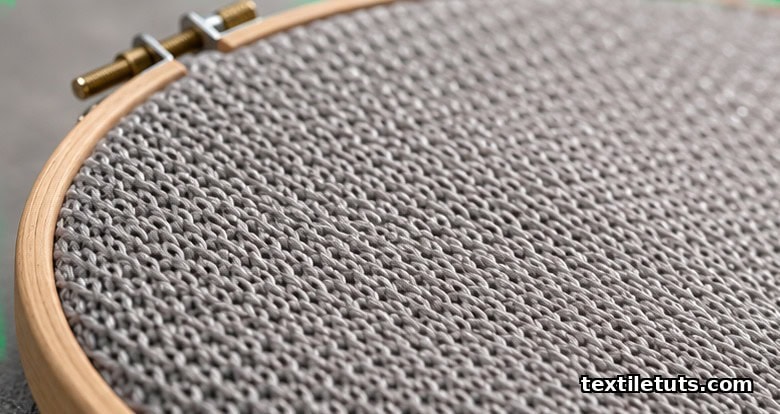
Compression knit fabric is a circular- or flat-knit textile containing 10-30% elastane (spandex/Lycra) blended with hard fibers such as nylon 6,6 or polyester, engineered to apply graduated pressure of 15-50 mmHg against the wrapped body part while permitting transverse elongation of 100-300%.
Unlike a regular jersey that simply stretches with the body, a compression knit is engineered with a controlled stiffness, a defined pressure profile, and a recovery loop so the garment “pushes back” against the limb or torso at every joint angle.
This article breaks down how compression knit fabric is built, how the pressure gradient is calculated, the four medical compression classes and their end uses, the yarn combinations behind them, and the test standards that separate a true compression garment from a tight stretch top.
What Makes a Knit Fabric “Compression”
A knit becomes a compression knit when three conditions are met simultaneously. First, the construction contains an elastomeric fiber (most commonly a segmented polyurethane sold as spandex, elastane, or Lycra) at 10-30% of total fabric weight. Second, the elastane is plated against a hard fiber (nylon, polyester, cotton, or wool) so the recovery force is delivered through every loop rather than from a bare rubber thread. Third, the fabric is cut, sized, and stitched so that, once on the body, the relaxed circumference of the garment is smaller than the body circumference at the same point, generating the interfacial pressure measured in millimeters of mercury (mmHg).
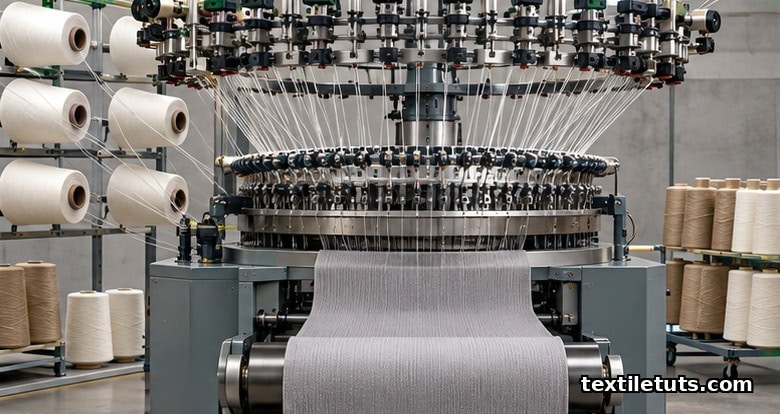
Most compression knits are produced on circular knitting machines in single-jersey, interlock, rib, or spacer constructions. Single-jersey compression fabrics dominate sportswear and shapewear because they are thin, breathable, and extensible in both directions. Interlock and spacer knits are used where higher dimensional stability and cushioning are needed, such as post-surgical compression garments and orthopedic supports. Flat knitting, which uses intarsia and shaped panels, is preferred when each section of the garment must apply a different pressure, as in class 2 and class 3 medical compression stockings for venous disease.
The key construction parameter that separates a compression knit from a stretch fashion knit is the elastane draft (the overfeed ratio between elastane and ground yarn during knitting). A draft between 2.5:1 and 4:1 is typical for medical compression, producing a fabric that snaps back to its original size after stretch cycles and maintains its modulus for at least 50 wear-and-wash cycles before losing more than 15% of its compression force.
How the Pressure Gradient Is Calculated
The pressure a compression knit exerts on the skin is governed by Laplace’s law adapted for tubular garments, where P equals the tension (T) of the fabric divided by the local radius (r) of the limb: P = T/r. In practice, knitters control the gradient by cutting the garment with progressively larger radii (and lower stitch density) at proximal positions, while holding the elastane tension and stitch length constant.
This is why a class 2 medical compression stocking exerts roughly 100% of its nominal pressure at the ankle, about 70% at the calf, and around 40% at the thigh, a descending profile that mimics the natural flow of venous blood back toward the heart. A uniform-pressure stocking, by contrast, behaves like a tourniquet at the top and is contraindicated for venous disease management.
Interface pressure is measured directly on the body with pneumatic or capacitive sensors such as the PicoPress and the Oxford Pressure Monitor, which are validated against air-pack transducers in peer-reviewed studies. Standard laboratory testing on flat fabric alone uses a calibrated pressure probe pressed against a known radius to derive the tension value that will be transferred to the body.
Compression Classes and Their End Uses
Medical compression hosiery is graded into four classes defined by the pressure measured at the ankle. The table below summarizes the most widely cited grading, which follows the German RAL-GZG 387 standard adopted by European phlebology guidelines and aligned with ISO/TR 14791-style declarations.
| Class | Ankle pressure (mmHg) | Typical elastane content | Knit structure | Common end use |
|---|---|---|---|---|
| Class 1 (light) | 15-20 | 10-15% | Single jersey, circular knit | Tired legs, travel, mild varicose veins, post-exercise recovery |
| Class 2 (medium) | 20-30 | 15-22% | Single jersey or interlock | Moderate varicose veins, post-sclerotherapy, DVT prophylaxis in low-risk patients |
| Class 3 (firm) | 30-40 | 20-28% | Interlock, rib, spacer | Severe chronic venous insufficiency, post-thrombotic syndrome, lymphedema maintenance |
| Class 4 (extra firm) | 40-50+ | 25-30% | Flat-knit, often custom | Severe lymphedema, elephantiasis, congenital vascular malformations |
Athletic compression apparel typically operates below the medical threshold, in the 8-20 mmHg range, where the goal is proprioceptive feedback and reduced muscle oscillation rather than hemodynamic therapy. Shapewear sits in the 10-25 mmHg band and prioritizes a smooth silhouette with light shaping rather than a clinical gradient.
Athletic, Medical, and Shaping Applications
In sportswear, compression knits are used in tights, sleeves, calf guards, and recovery socks. Peer-reviewed work on runners wearing 18-22 mmHg calf sleeves has shown reductions in perceived muscle soreness and lower creatine kinase markers 24 hours after downhill running, although the effect on performance itself remains contested across trials.
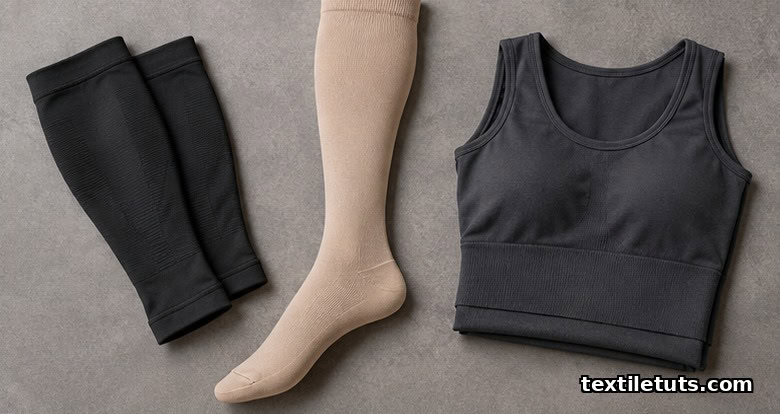
Medical compression therapy is the largest clinical application. Class 2 and class 3 stockings are first-line treatment for chronic venous insufficiency and post-thrombotic syndrome, with clinical evidence consolidated in the 2017 European Society of Vascular Surgery guidelines. Compression sleeves and gauntlets are standard care for upper-limb lymphedema after breast cancer treatment, and flat-knit custom garments are prescribed when off-the-shelf sizes cannot deliver a safe, sustained gradient.
Shaping compression knits are an aesthetic category that borrows from medical engineering. The fabrics used in body-shaping camisoles, post-partum belts, and waist-cinching leggings are circular-knit single jersey with 15-22% elastane, finished with silicone gripper yarns at the waistband to prevent rolling. The pressure range of 8-18 mmHg is comfortable enough for daily wear while still flattening the silhouette through a combination of fabric tension and friction against the skin.
Yarn Composition and Common Fiber Blends
The ground yarn carries most of the mechanical load and determines hand feel, moisture management, and durability. Nylon 6,6 (polyamide 6,6) is preferred for medical and athletic compression because its high tenacity (60-90 cN/tex in drawn filament form) and abrasion resistance protect the elastane core from cuts during donning and wear. Polyester is widely used in lower-cost athletic and shapewear knits, where its moisture-wicking hydrophobic finish outperforms nylon in hot conditions.
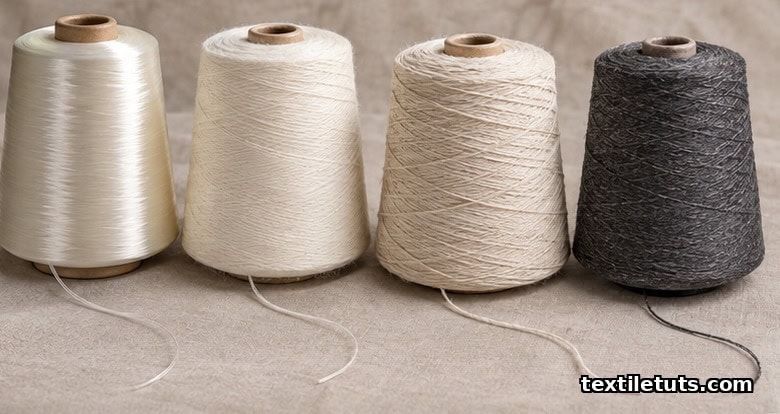
Cotton and wool ground yarns are reserved for comfort-driven compression, such as diabetic socks and sensitive-skin applications. Their lower recovery means the elastane content must be pushed higher, often to 18-25%, and the fabric is usually knit on a smaller gauge to compensate. Blends of cotton with nylon and elastane (for example, 70/22/8 by weight) combine breathability with the recovery needed for class 1 medical wear.
Covering the elastane is essential. Bare elastane in the knit surface causes skin irritation and degrades quickly under chlorine, UV, and body oils. Plating, where the elastane is fed into the hook of the needle slightly behind the ground yarn, ensures the hard fiber covers the elastane on the face side. More recent constructions use a bicomponent yarn with polyester or nylon as the sheath and elastane as the core, providing uniform cover without plating precision.
Frequently Asked Questions
What is the difference between compression knit fabric and regular stretch knit fabric?
A regular stretch knit typically contains 2-5% elastane and is designed for fit and comfort, with recovery forces too low to measure against the skin. A compression knit contains 10-30% elastane and is engineered to apply a defined pressure (15-50 mmHg) that can be measured with a pressure sensor on the body. The compression knit also has a controlled pressure gradient, so the garment is tighter at the distal end and looser at the proximal end.
How is the pressure of compression knit fabric measured?
Interface pressure is measured directly on the wearer with calibrated pneumatic or capacitive sensors, most commonly the PicoPress and the Oxford Pressure Monitor. The sensor is placed between the fabric and the skin at defined anatomical landmarks (typically B1 for the ankle and C for the calf in stockings). On flat fabric alone, pressure is derived from a tensile load test at a known radius using the Laplace relationship P = T/r.
Can compression knit fabric lose its compression over time?
Yes. Elastane degrades with repeated stretch cycles, heat, chlorine, and body oils. Most medical compression garments are prescribed for a replacement cycle of 6 months under daily wear, after which laboratory testing shows they retain only 70-85% of their original pressure. Athletic and shaping compression knits are typically rated for 30-50 wear-and-wash cycles before the user perceives a clear loss of support.
What is the difference between circular-knit and flat-knit compression garments?
Circular-knit compression garments are seamless tubes produced on a circular machine and are used for the majority of class 1 and class 2 medical wear and almost all athletic and shapewear. They have uniform circumferential pressure but limited ability to vary pressure across anatomical zones. Flat-knit garments are produced on a flat-bed machine with shaped panels, allowing different pressures at different parts of the limb. They are used for class 3 and class 4 medical compression, lymphedema, and irregular limb shapes where a seamless tube would bunch or pinch.
References
- Partsch H. Compression therapy: clinical and experimental evidence. Phlebology, SAGE Publications. Foundational review of graduated compression pressure classes and venous hemodynamics.
- Liu R, Kwok YL, Li Y, Lao TT, Zhang X. Objective evaluation of skin pressure distribution of graduated elastic compression stockings. Skin Research and Technology, Wiley. Field validation of the PicoPress and Oxford sensors used on compression knit garments.
- Macintyre L. Designing pressure garments capable of exerting specific pressures on limbs. Burns, Elsevier. Reference for Laplace’s law (P = T/r) as applied to compression knit design.
- Troynikov O, Ashayeri E, Jewell E, Gong H, Adesope A. Knitted fabrics for compression garments: engineering solutions for comfort, fit, and medical applications. Textile Research Journal, SAGE. Peer-reviewed review of yarn composition, knit structure, and elastane content in compression knits.
- RAL Deutsches Institut für Gütesicherung und Kennzeichnung. RAL-GZG 387: Medical compression hosiery, quality and test specifications. German national standard for the four medical compression classes cited above.
- International Organization for Standardization. ISO/TR 14791: Medical devices risk management in product standards. Background standard referenced in compression garment conformity assessments.
- European Society of Vascular Surgery (ESVS) Guidelines on the Management of Chronic Venous Disease. Clinical practice document consolidating evidence for class 2 and class 3 stocking use in venous insufficiency.
This article is the working reference for compression knit fabric: construction, pressure gradient, classes, yarn composition, and end uses. Editorial by Iftay Khairul Alam, TextileTuts. Sources: Partsch (Phlebology), Liu et al. (Skin Research and Technology), Macintyre (Burns), Troynikov et al. (Textile Research Journal), RAL-GZG 387, ISO/TR 14791, and the ESVS clinical guidelines as cited.


