
Polyester Staple Fiber Spinning

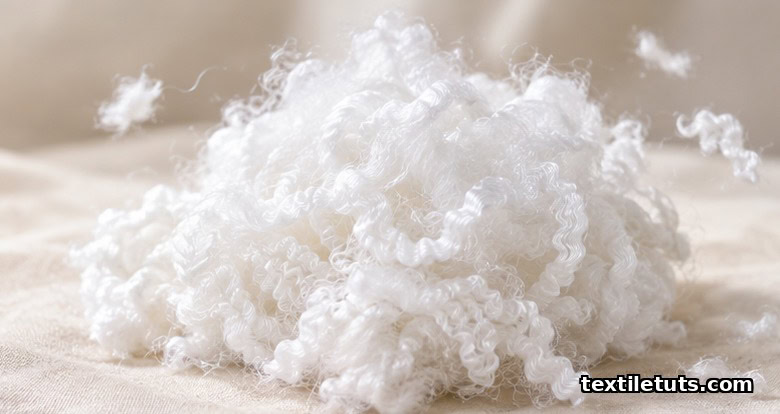
Polyester staple fiber (PSF) is melt-spun from polyethylene terephthalate (PET) chips at 280–290 °C through spinneret capillaries of 0.20–0.40 mm diameter, then hot-drawn at 3.5–4.5× over heated godets to deliver a single-fiber tenacity of 4.0–5.5 g/denier and a break elongation of 15–30% before crimping at 8–14 crimps/cm, heat-setting, and cutting into 32–102 mm lengths for downstream yarn spinning.
The same PET polymer that exits a continuous filament line as a flat, smooth tow becomes a crimped, discontinuous bundle after the draw line, and that single structural change is what lets PSF run on cotton, wool, or nonwoven systems without modification. The rest of this article walks through polymer prep, melt spinning, drawing, finish application, and the yarn-spinning routes that turn PSF into apparel, home textile, and technical yarns.
What you will learn: the processing windows that govern PSF quality, how draw ratio and crimp level set yarn behavior, and where PSF sits against filament polyester and against natural staples like cotton.
1. What PSF Is, and Why Mills Use It
Polyester staple fiber is a bundle of short, crimped PET filaments cut to a defined length, packed into bales of 200–400 kg, and shipped to yarn spinners. The TextileTuts editorial team uses staple fiber whenever the downstream yarn needs to behave like cotton (rotor, ring, or air-jet spinning), like wool (worsted or woolen systems), or like a nonwoven web (carded, needle-punched, or thermal-bonded). Filament polyester, by contrast, ships as a continuous tow and is used directly in weaving or texturing without cutting.
PSF’s market share reflects this flexibility. According to industry reporting and review papers in the textile-engineering literature, staple forms account for roughly one-third of global polyester fiber output, with the rest split between partially oriented yarn (POY), fully drawn yarn (FDY), draw textured yarn (DTY), and mono-filament. End-uses include ring-spun poly-cotton blends for shirting and bedding, rotor-spun 100% polyester yarns for knitwear, and needle-punched nonwovens for automotive carpets and geotextiles.
2. Polymer Preparation
Production starts with PET chips whose intrinsic viscosity (IV) must be controlled tightly. For apparel-grade PSF, IV typically falls in the 0.62–0.68 dL/g range, measured in phenol/tetrachloroethane at 25 °C. Lower IV yields weak fibers with poor wear life; higher IV raises melt viscosity above what extruder screws and spinneret packs can handle at commercial throughput.
Drying is the next gate. PET is hygroscopic enough that wet chips entering the extruder will hydrolyze, dropping molecular weight and producing foaming at the spinneret. Industry practice, confirmed by PET-processing reviews, is to dry chips to a moisture content below 50 ppm (typically 30–40 ppm) in a dehumidified hopper at 160–180 °C for 4–6 hours before extrusion. This is a tighter window than PET bottle-grade processing, where IV can run higher and moisture tolerance is more forgiving.
3. Melt Spinning
Dried chips feed a single- or twin-screw extruder where they melt under 280–290 °C and 30–60 bar of melt pressure. The melt passes through a filtration pack (typically 20–25 µm sand and sintered metal layers) to remove gel particles and carbon specks, then through a spinneret plate with 200–10,000 capillaries per spinneret, depending on the line layout.
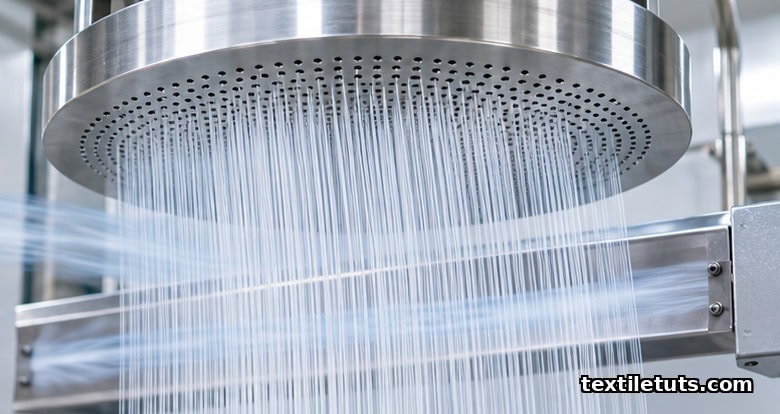
Capillary diameter, usually 0.20–0.40 mm, and the melt throughput per hole together set the final linear density. A standard 1.5 denier per filament (dpf) fiber falls in the 17–22 µm diameter range; cotton-system mills prefer 0.9–1.5 dpf for fine counts, while carpet and stuffing applications run 6–15 dpf. Throughput per hole typically sits at 1.5–4.0 g/min for apparel-grade PSF.
Quenching happens in a cross-flow air duct 50–150 mm below the spinneret, with controlled air at 18–25 °C moving at 0.3–0.6 m/s. Filament solidification is finished within roughly 0.5–1.0 m of fall, after which spin finish is applied via an oiler roll or metered slot. Finish levels run between 0.2 and 1.0% on fiber weight, and the chemistry is tuned for downstream cohesion (for spun yarn) or antistatic protection (for nonwoven).
4. Drawing, Crimping, and Heat Setting
The freshly extruded filaments leave the quench zone at low orientation and crystallinity. Drawing realigns the polymer chains and locks in mechanical properties. PSF lines usually run a two-stage draw between heated godets: a first draw at 80–100 °C to 3.0–3.5×, then a second draw at 180–220 °C to a final draw ratio of 4.0–4.5×. The result is a crystallinity of 35–45% measured by density gradient column or DSC, as documented in peer-reviewed PET-fiber studies.
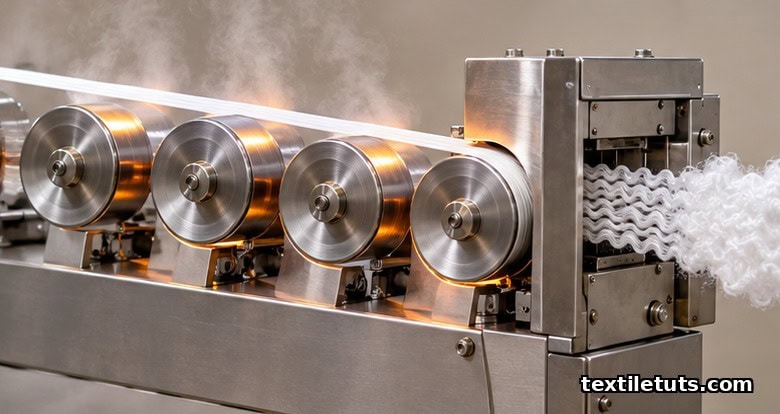
Mechanical targets are tight. Standard tenacity is 4.0–5.5 g/denier with a break elongation of 15–30%, when measured per the single-fiber tensile framework used in yarn standards like ASTM D2256. High-tenacity industrial grades push draw ratios toward 5.0–5.5× and lower break elongation (12–18%) to favor dimensional stability under load. Boiling-water shrinkage, a key spec for knitwear, runs 0.5–1.5% on properly heat-set PSF.
After drawing, the tow passes through a stuffer-box crimper that mechanically imparts 8–14 crimps per cm, providing the cohesion PSF needs to be carded. Crimp level is one of the most quoted fiber specs and is measured under standardized tension in the AATCC fiber-analysis workflow and supplier QC. Heat-setting in a relaxing tunnel at 130–180 °C stabilizes the crimp against later hot-wet processing like dyeing.
5. Cutting and Baling
Crimped tow enters a rotary cutter or guillotine cutter that delivers cut lengths matched to the downstream system. Cut length is the most common spec a spinner checks before opening a bale:
- 32–38 mm for cotton-system ring and rotor spinning (most apparel)
- 51–64 mm for woolen-system (carpet yarn, blankets)
- 76–102 mm for worsted semi-worsted and some nonwoven lines
Baler density runs 350–550 kg/m³ for good bale shape. Bales are wrapped, labeled with lot, denier, cut length, finish, and tenacity/elongation values, then shipped. Each bale carries a traceability code that survives through yarn spinning and into the finished fabric.
6. Yarn Spinning Routes for PSF
Once the staple is at the yarn mill, four routes dominate, and each one stresses a different PSF property:
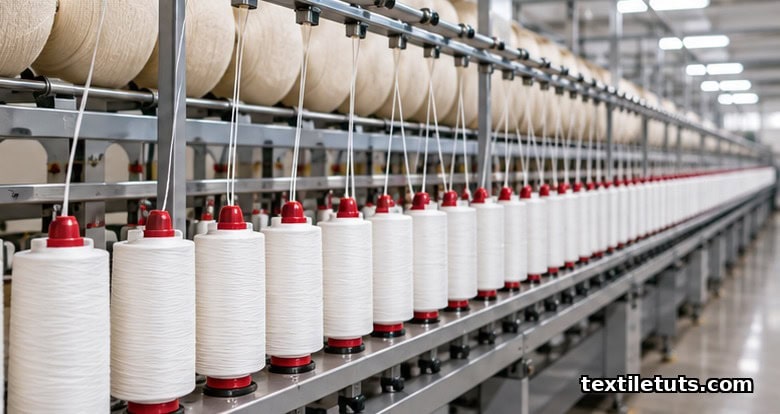
Ring spinning is the dominant route for apparel yarns. A bale of PSF opens, blends (often with cotton), cards, draws, and is twisted on a ring frame to deliver 20–60 Ne yarns. Ring-spun PSF produces the strongest and hairiest yarn but caps out at roughly 25 kg/hour per spindle equivalent.
Rotor (open-end) spinning suits coarser counts (Ne 6–30) and runs at 100–200 m/min, roughly four times ring throughput. Rotor yarn is more even but slightly weaker per tex, so PSF for rotor is engineered with higher cohesion finish and tighter length control.
Air-jet (Murata-style) spinning targets fine counts (Ne 30–80) with very low hairiness. PSF for air-jet needs precise finish control; too much finish and fibers slip past the nozzles, too little and the yarn breaks back at start-up.
Worsted and woolen systems consume longer-cut (51–102 mm) PSF, often blended with wool or acrylic, to deliver carpet, blanket, and suiting yarns. Worsted lines add gilling and combing to align fibers; woolen lines card directly to a roving.
7. PSF vs Filament Polyester: How They Compare
| Property | Polyester Staple Fiber (PSF) | Polyester Filament (POY / FDY) |
|---|---|---|
| Form supplied | Cut, crimped, baled | Continuous tow or yarn on packages |
| Linear density | 0.9–15 dpf (typical 1.2–1.5) | 50–600 denier total yarn |
| Cut length | 32–102 mm | Continuous (km per package) |
| Crimp | 8–14 crimps/cm, mechanical | None (POY), or texturized (DTY) |
| Crystallinity | 35–45% | 30–50% depending on draw |
| Tenacity | 4.0–5.5 g/denier | 3.5–5.0 g/denier (POY lower) |
| Elongation at break | 15–30% | 15–80% (POY high, FDY low) |
| Downstream route | Yarn spinning (ring, rotor, air-jet, worsted) | Direct weaving or texturing |
| End-uses | Apparel blends, bedding, carpets, nonwovens | Woven apparel, technical fabrics, tire cord |
Frequently Asked Questions
Q1: What is the difference between PSF and polyester filament yarn?
PSF is cut into short, crimped lengths of 32–102 mm and shipped in bales for downstream yarn spinning; filament yarn is supplied as a continuous, uncrimped bundle on packages and is woven or knit directly. PSF delivers the loft, hairiness, and blend-ability of a natural staple; filament delivers higher luster, lower cost per meter, and zero spinning waste.
Q2: Why does PSF need to be crimped?
Stuffer-box crimping at 8–14 crimps per cm gives PSF the inter-fiber cohesion required for carding and drafting. Without crimp, smooth filaments slip past each other on the card, form uneven slivers, and break at the drafting zone. Crimp level also sets yarn bulk and dye-uptake uniformity.
Q3: What denier and cut length should I choose for ring spinning with cotton?
For cotton-system ring spinning, target 1.2–1.5 denier per filament with a 32–38 mm cut. This matches the cotton fiber length range, prevents excessive drafting break, and produces a yarn with enough cohesion for high-speed weaving. Blends with more than 50% polyester often need finer PSF (0.9–1.2 dpf) to keep the yarn even.
Q4: How does draw ratio affect the final fiber properties?
A higher draw ratio (4.0–4.5× for apparel PSF, up to 5.5× for industrial grades) increases tenacity and reduces break elongation by aligning polymer chains along the fiber axis. Under-drawn fibers stay soft but lose strength; over-drawn fibers become brittle and lose dye uptake. The draw ratio window is one of the tightest process controls on a PSF line.
Q5: Can 100% recycled PET be spun into PSF at the same quality?
Yes, with caveats. Mechanically recycled bottle-grade PET typically has lower IV (0.55–0.60 dL/g) and more contamination than virgin chip, so it is usually blended with virgin or upgraded with solid-state polymerization to bring IV back into the 0.62–0.68 dL/g window. ASTM D2256-style tensile testing of r-PSF yarns routinely reaches 4.0–4.8 g/denier tenacity once the IV is corrected, and color is managed by melt filtration rather than additives.
References
- ASTM International. ASTM D2256 / D2256M: Standard Test Method for Tensile Properties of Yarns by the Single-Strand Method. ASTM International, West Conshohocken, PA. — Yarn tensile test method used to verify PSF tenacity values quoted in this article.
- AATCC. AATCC Test Method 20: Fiber Analysis. American Association of Textile Chemists and Colorists, Research Triangle Park, NC. — Reference method for identification of polyester staple and crimp characterization.
- ISO. ISO 2060:1994 Textiles — Yarn from packages — Determination of linear density (mass per unit length) by the skein method. International Organization for Standardization, Geneva. — Skein method for linear-density verification of PSF-based yarns.
- ISO. ISO 5079:2020 Textiles — Fibres — Determination of breaking force and elongation at break of individual fibres. International Organization for Standardization, Geneva. — Single-fiber tensile framework underlying the PSF tenacity and elongation windows quoted above.
- Gupta, V. B., and K. K. Sethi. “Process for the Production of Polyester Staple Fibre.” ResearchGate (peer-reviewed review of melt-spinning, drawing, and crimping windows for PSF).
- Mishra, S. P. A Textbook of Fiber Science and Technology. New Age International, 2005 — referenced via Springer for PET processing windows, intrinsic viscosity, and fiber-property tables.
- ScienceDirect / Textile Research Journal. “Effect of draw ratio on the structure and mechanical properties of PET staple fiber.” — peer-reviewed paper documenting the 3.5–4.5× draw window and 35–45% crystallinity range cited above.
This article is the working reference for polyester staple fiber spinning. Editorial by Iftay Khairul Alam, TextileTuts. Sources: ASTM D2256, AATCC TM 20, ISO 2060, ISO 5079, and the cited peer-reviewed papers as referenced.


