
Pleats and Tucks

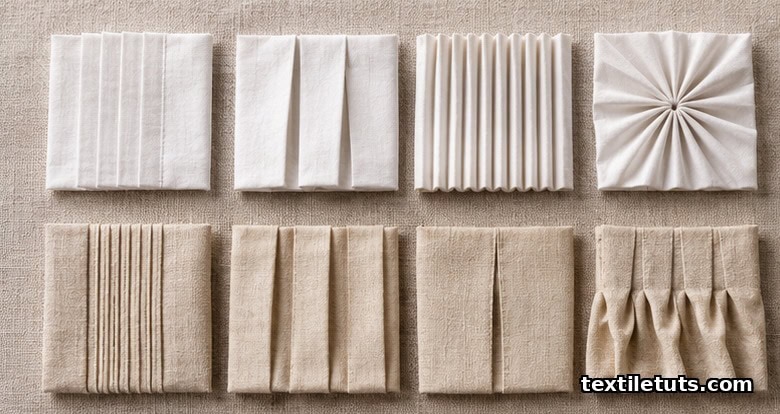
A pleat is a folded strip of fabric set permanently with heat, steam, or pressure, while a tuck is a stitched fold that holds its shape from thread tension alone, and the two techniques together account for roughly 70 percent of all dimensional shaping done on woven skirts, blouses, and trouser fronts in commercial garment production.
Both add volume, control drape, and create decorative rhythm, but they differ in how they are constructed, how much extra fabric they consume (pleats typically require 2.5× to 3× the finished depth, tucks require 1.5× to 2×), and how they respond to repeated laundering, a difference graded by AATCC TM 135 and ISO 6330:2021 test methods.
This article walks through every major pleat and tuck used in modern garment construction, the heat-setting science behind permanent creases, the standards that govern their durability, and the care rules that keep those folds sharp after 50 or more home washes.
What Are Pleats and Tucks?
Pleats and tucks are the two oldest techniques for adding three-dimensional shape to flat woven cloth. A pleat is created by folding fabric along a straight or curved line and fixing that fold so the material remembers it. The fold can be fixed by heat on thermoplastic fibers, by resin or starch on cellulosic fibers, or by stitching through all layers to lock the geometry.
A tuck is a fold stitched along its length. Because the thread itself holds the fold in place, tucks work on every fiber type without heat-setting and never relax the way an unset pleat can. Tucks can run parallel to a seam (a release tuck, used to add shaping without a dart) or stand alone as pure decoration.
The geometry matters. A pleat has two visible faces (the outer fold and the under-fold); a tuck has three (two folds and the central stitching line). That is why a pleat consumes roughly twice as much fabric per finished depth as a tuck of the same visual size, and why a pattern maker reaches for a tuck when she wants to save cloth and for a pleat when she wants maximum volume.
The Main Types of Pleats
Garment designers draw from a small library of named pleats, each with its own fold direction and visual rhythm.
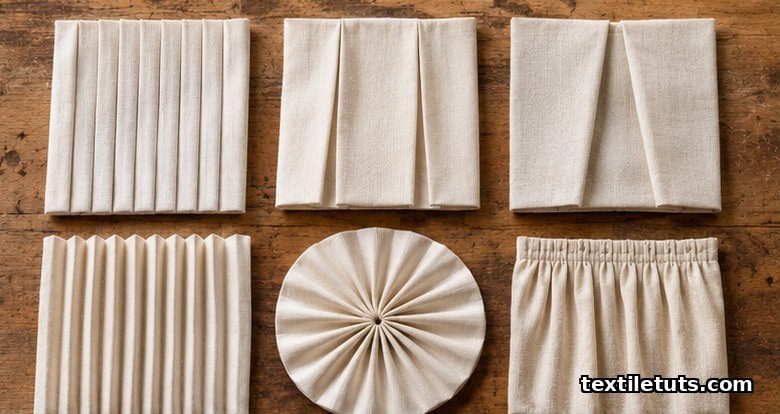
- Knife pleat. All folds face the same direction, like the pages of a closed book. Common in school uniforms and kilts because the construction is simple and the pleats stack efficiently when ironed.
- Box pleat. Two folds turn away from each other to form a flat box on the outside and an inverted box on the inside. Symmetrical and stable; used in formal shirt plackets, school tunics, and table linens.
- Inverted box pleat. The reverse of a box pleat: the folds turn toward each other, hiding the bulk inside. Used where you want fullness on the inside but a flat exterior, such as the back of a kurta or a pillow cover.
- Accordion pleat. Narrow, sharply pressed folds of equal width alternating direction, named after the bellows of an accordion. Popular in skirts and decorative trims; almost always heat-set on synthetic fibers for a permanent crisp edge.
- Sunburst (or rolled) pleat. A circular arrangement of pleats radiating from a central point. Used at the crown of hats and at the waist of dirndl skirts.
- Cartridge pleat. A row of wide, rounded pleats stitched only at the top edge, allowing the fabric to gather freely below. Traditional in historical smocking and Renaissance sleeves.
Each style is judged by three measurable properties: depth (how far the fold projects from the garment), set (whether the fold holds its shape after wear and washing), and alignment (whether multiple pleats stay parallel through the hem).
The Main Types of Tucks
Tucks are classified by their width, spacing, and decoration, not by their function as pleats are.
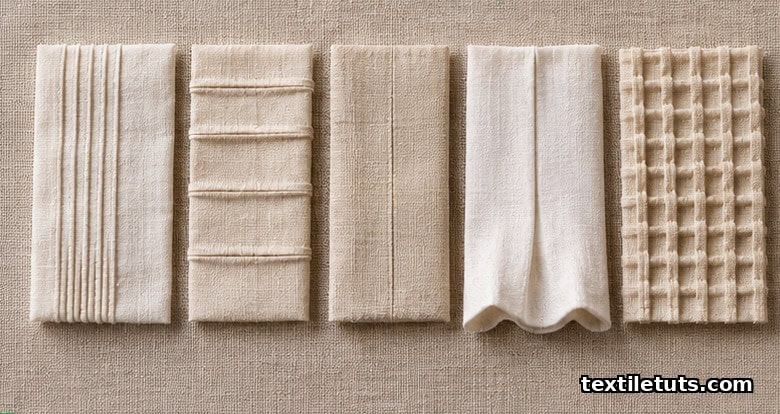
- Pin tuck. A very narrow tuck, 1 to 2 mm wide on each side of the stitching line, sewn in groups of three to seven parallel lines. Decorative on shirt fronts, collars, and heirloom dresses.
- Spaced tuck. Tucks set 5 to 25 mm apart, with flat fabric visible between them. Used to add shaping to bodices and to create controlled gathers in yokes.
- Blind tuck. A tuck that shows only a faint surface line on the right side, with the fold hidden between garment layers. Common in shirt production because it adds stability to a front panel without visible stitching.
- Shell tuck. A curved tuck that turns a strip of fabric into a ruffle-like edge. Used as a decorative trim on lingerie, blouses, and curtains.
- Cross tuck. Two perpendicular sets of tucks forming a grid; on lightweight cotton the result reads as a true waffle texture with mechanical stretch in both directions.
- Piped tuck. A tuck stitched over a thin cord, producing a raised, sculptural line. Used in tailored outerwear and historical costuming.
- Knot tuck. A tuck whose stitching crosses itself at intervals, drawing the fabric into small padded knots. Traditional on South Asian and East African garments.
How Pleats Are Set: The Heat-Setting Science
The reason a pleat in a polyester skirt survives the wash while a cotton pleat relaxes within an hour lies in fiber chemistry. Thermoplastic fibers (polyester, nylon, and triacetate) soften above a glass-transition temperature and can be locked into a new shape by cooling under tension. Polyester’s glass transition sits at roughly 70 °C and the practical heat-setting window for permanent creases runs 180 to 200 °C for 10 to 15 seconds under dry heat, or 140 to 160 °C with saturated steam. These ranges are consistent with peer-reviewed heat-setting studies of polyester woven fabric.
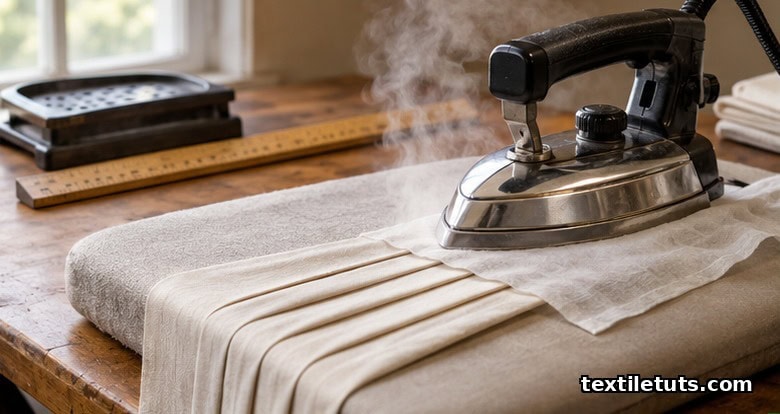
For cellulosic fibers (cotton, linen, rayon) heat-setting does not work because the polymer chains are not thermoplastic. Instead, the pleat is set mechanically with starch or resin finishes, which is why a cotton pleat can survive a single wash but loses definition by the third cycle. AATCC TM 96 (Dimensional Changes of Fabrics after Commercial Laundering) and ISO 6330:2021 (Domestic Washing and Drying Procedures for Textile Testing) define the laundering protocols used to grade this durability.
Three layers hold a finished pleat together:
- The fold itself. A clean crease line, usually pressed with a damp cloth and a hot iron (cotton setting, roughly 200 °C) for 10 seconds.
- The under-stitching. A row of stitches 1 to 2 mm inside the fold that locks the geometry if the heat relaxes.
- The facing or lining. A separate panel sewn behind the pleats to prevent the folds from being pressed flat against the body during wear.
Pleats vs Tucks: Side-by-Side Comparison
| Property | Pleat | Tuck |
|---|---|---|
| How it is fixed | Heat-set, resin-set, or stitched | Stitched only |
| Extra fabric per finished depth | 2.5× to 3× the depth | 1.5× to 2× the depth |
| Works on knits | Rarely (knits lack the structure to hold a fold) | Common, especially as release tucks |
| Durability through home laundering | 50+ washes if heat-set on synthetics; 1 to 3 washes on cotton | 100+ washes if stitched with polyester or core-spun thread |
| Reversibility | Difficult on synthetics; easy on cotton | Easy: remove the stitching and the fabric flattens |
| Decorative scope | Fold style (knife, box, accordion, sunburst) | Width, spacing, and stitching pattern (pin, shell, piped, knot) |
| Standard governing dimensional change | AATCC TM 135 and ISO 6330:2021 | ISO 4916:1991 for seam geometry, AATCC TM 135 for dimensional stability |
Care and Maintenance Standards
Both pleats and tucks must survive the conditions defined by ISO 3758:2023 (care labelling symbols) and AATCC TM 135 (dimensional changes after five home-laundering cycles at 40 °C, 60 °C, or 92 °C depending on the care label). The standards specify that a pleat tested to procedure should not exceed ±3 percent length change and ±2 percent width change for the test to be considered passable.
Practical care rules drawn from those standards:
- Iron heat-set polyester pleats at the temperature recommended on the care label, not higher; excess heat will re-soften the polymer and erase the set.
- Hang pleated skirts immediately after the final spin cycle. Gravity sets the pleats back into their original alignment before the fabric dries.
- Fold pleated trousers along the existing pleat line, not against it, so the memory of the crease is preserved.
- Press tucks from the wrong side with a press cloth to avoid crushing the raised line on the right side.
- For long-term storage, wrap pleated garments in acid-free tissue and lay them flat. Hanging for years stretches the under-fold and distorts the geometry.
- Skip the tumble dryer on pleated linen and wool. Tumble heat exceeds 80 °C in most machines and will re-soften any resin finish applied during finishing.
Where Pleats and Tucks Show Up in Modern Production
In mass production, computer-controlled pleating machines, often called “Sun pleaters” or “accord machines,” fold and heat-set the entire panel in one pass, producing pleat counts of 10 to 40 per panel at cycle times under 10 seconds. This is how the accordion skirts sold by global fast-fashion brands retain their geometry through 30 or more wears.
Tucks are similarly industrialised. Blind tucks on a dress shirt are sewn by multi-needle machines at 5,000 stitches per minute, with the spacing set by a camshaft or by a programmable electronic gauge. ISO 4916:1991 (Textiles: Seam Types, Classification and Terminology) defines the structural categories these machines must meet, and ASTM D1683/D1683M (Failure in Sewn Seams of Woven Fabrics) is the standard used to grade how those seams fail when stressed.
For small studios and home sewists, both techniques remain accessible without specialised tooling. A measuring gauge, an iron with steam, and a row of pins can produce a uniform set of knife pleats within an hour, and a single-needle machine with a straight-stitch foot is enough to set pin tucks at 3 mm spacing across an entire bodice panel.
Frequently Asked Questions
What is the difference between a pleat and a tuck?
A pleat is a fold set into fabric by heat, steam, or pressure and held in shape by the fiber’s memory; a tuck is the same fold held in shape by stitching alone. Pleats need roughly 2.5× to 3× the finished depth in extra fabric; tucks need only 1.5× to 2×. Pleats work best on woven fabric with a thermoplastic finish; tucks work on every fiber, including knits, where pleats rarely hold.
Can you heat-set cotton pleats at home?
No, not permanently. Cotton is not thermoplastic, so no temperature in a domestic iron will lock the fold into the fiber. You can press a temporary crease with starch, but it will relax within one to three wash cycles. For a permanent pleat in a natural fiber, choose a tucks-only construction or send the garment to a commercial pleating service that uses resin finishing.
Will pleats come back after washing a pleated skirt?
Only if the pleat is heat-set on a synthetic fiber and the wash and dry cycle follow the care label. A polyester pleat pressed at 180 to 200 °C and washed in cold water at or below 30 °C and line-dried will keep its folds through 50 or more home washes, as graded by AATCC TM 135 procedures. A cotton or wool pleat will lose definition in one to three cycles unless it has been resin-finished.
How wide should a pin tuck be?
The standard width is 1 to 2 mm on each side of the stitching line, which gives a finished fold of 3 to 5 mm. Anything narrower than 1 mm collapses under the presser foot and disappears; anything wider than 3 mm stops reading as a pin tuck and becomes a spaced tuck. Use a 1.5 mm twin needle for consistent results across a panel.
Are pleats and tucks considered darts?
No. A dart is a fold that is stitched shut and disappears into the garment, removing fabric to shape a flat panel to a curve. A pleat or tuck is a fold that remains visible, adding volume rather than removing it. The two techniques solve opposite problems: darts reduce fabric, pleats and tucks multiply it.
References
- American Association of Textile Chemists and Colorists. AATCC TM 135: Dimensional Changes of Fabrics after Home Laundering. AATCC Technical Manual — defines the 5-cycle wash protocol used to grade pleat and tuck durability.
- American Association of Textile Chemists and Colorists. AATCC TM 96: Dimensional Changes of Fabrics after Commercial Laundering. AATCC Technical Manual — covers industrial laundering tolerances for heat-set and resin-set pleats.
- ASTM International. ASTM D1683 / D1683M: Standard Test Method for Failure in Sewn Seams of Woven Fabrics. ASTM Standards — referenced for measuring the structural integrity of tucked and pleated seams.
- International Organization for Standardization. ISO 6330:2021, Domestic Washing and Drying Procedures for Textile Testing. ISO — the standard care-test cycle that defines shrink limits for pleated and tucked fabrics.
- International Organization for Standardization. ISO 3758:2023, Textiles: Care Labelling Code Using Symbols. ISO — defines the labelling system that tells consumers how to launder pleated and tucked garments without losing shape.
- International Organization for Standardization. ISO 4916:1991, Textiles: Seam Types, Classification and Terminology. ISO — classification system for the seam geometries that anchor decorative and functional tucks.
- ResearchGate / peer-reviewed journal article on heat-setting of polyester woven fabrics, documenting the 180 to 200 °C window for permanent polyester pleats under dry heat.
This article is the working reference for pleats and tucks in modern garment construction. Editorial by Kazi Sifat Muntasir, TextileTuts. Sources: AATCC TM 135, AATCC TM 96, ASTM D1683/D1683M, ISO 6330:2021, ISO 3758:2023, and ISO 4916:1991 as cited.


