
Dart Manipulation

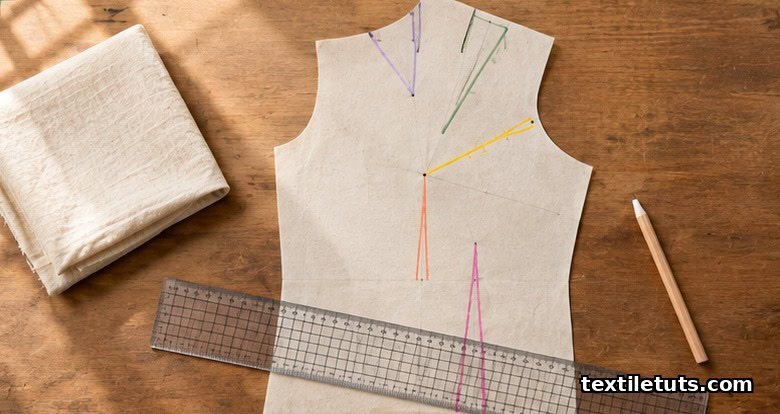
A standard women’s bodice dart removes between 2.5 cm and 3.8 cm (1.0 to 1.5 inches) of fabric excess at the waistline, with the dart point terminating 3.8 to 5.1 cm (1.5 to 2.0 inches) short of the bust apex so the fabric curves around the breast without producing a visible depression on the body surface.
For a fitted blouse drafted on a size 10 block using ASTM D5585-22 body dimensions, the total waist dart intake across two darts runs 5.1 to 7.6 cm (2.0 to 3.0 inches), with each dart leg 7.6 to 15.2 cm long depending on placement and bust circumference.
This article explains the engineering behind dart manipulation: what each standard dart does on a basic bodice, why a pattern maker moves a dart from one location to another, the two established techniques for relocating dart position, and the seam and grainline rules that keep the resulting garment flat and balanced.
What a Dart Does on a Flat Pattern
A dart is a folded, stitched wedge that converts a flat panel of fabric into a shape that matches a body curve. The fold reduces the panel’s outer edge length relative to its inner edge, so the cloth cups inward around the body volume below. On a basic bodice block, a waist dart typically removes 2.5 to 3.8 cm of waistline width per dart, measured at the seamline, while leaving the bust circumference unchanged.
ASTM D5219-21, the standard terminology relating to body dimensions for apparel sizing, defines the body landmarks a pattern maker uses to position darts, including the bust point, the natural waistline, the high hip, and the shoulder point. ISO 8559-1:2017 (Size designation of clothes, Part 1: Anthropometric definitions) sets the corresponding measurement protocols, so a “bust girth” or “waist girth” cited in a commercial size chart has a defined method behind the number. Without those reference landmarks, dart placement becomes guesswork.
The Five Standard Bodice Darts and Their Functions
On a conventional two-piece bodice block drafted from the ASTM D5585-22 women’s measurement tables, the waist shaping is distributed across up to five dart locations. Each dart solves a different fitting problem, and the pattern maker chooses among them based on the silhouette the design requires.
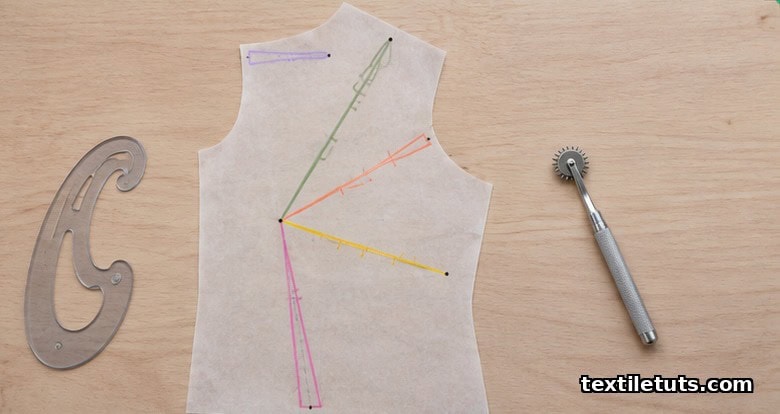
- Bust (vertical) dart. Runs from the side seam or shoulder seam downward to the bust point. Removes 2.5 to 3.8 cm at the waistline and adds 2.5 to 5.1 cm of shaping across the bust circumference.
- Waist dart. A vertical dart pointing toward the natural waist, used when no separate bust dart is required and the shaping reads as a soft vertical line.
- Shoulder dart. An angled dart starting at the shoulder seam, useful for tops with sleeves and visible necklines where a side dart would interrupt the design line.
- French dart. A diagonal dart originating from the side seam at the underarm and angling toward the bust point. Common in princess-line garments and in vintage-style fitted blouses.
- Neck dart. A short dart at the neckline, used for subtle shaping without a full bust dart. Often combined with shoulder pleats in blouses.
The sum of all dart intakes on a fitted bodice must equal the difference between the bust circumference and the waist circumference of the target body, divided by four (two darts on the front, two on the back). For a size 10 with a 91 cm bust and a 71 cm waist, the total dart intake across the four darts is roughly 20 cm, or about 5 cm per dart. That figure is set by the body measurements in ASTM D5585-22, not by the designer’s preference.
Why a Pattern Maker Manipulates Dart Position
Dart manipulation is the process of relocating the dart intake from one position on the pattern to another without changing the total volume of shaping. Designers do this for three reasons, and the choice between them drives most pattern revisions on a production line.
First, style. A shoulder dart creates a different silhouette than a side-bust dart, even when both remove the same amount of fabric. Moving the dart changes where the eye reads the garment’s shaping, and a single dart relocation can shift a design from “tailored” to “softly feminine” without changing the body fit.
Second, design line. A princess seam, a yoke, or an asymmetric panel often replaces a dart, but the shaping still has to go somewhere. The pattern maker imports the dart intake into the new seam by adding the original dart width to the corresponding edge of the new panel. If the princess seam is on grain and balanced at the side seam, the garment will fit the same as the original darted version.
Third, fabric economy and grain. A dart running perpendicular to the fabric’s warp can pull the cloth off grain, distorting print or plaid alignment. Moving the dart closer to parallel with the warp keeps the print or weave straight, which is why grainline-correct dart placement is a hard rule in industrial pattern making rather than a soft guideline.
The Two Established Manipulation Methods
Pattern makers relocate dart intake using one of two geometric methods, both of which preserve the original shaping while changing where the dart appears on the panel.
Slash-Spread Method
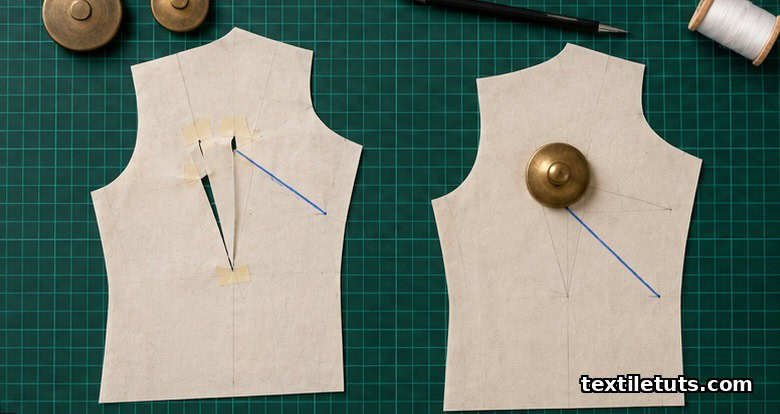
In the slash-spread method, the pattern maker draws the desired dart position on a copy of the original block, then cuts along the new dart’s center line from the dart point toward (but not through) the seam edge. The original dart is closed, which forces the cut to open, and the opening is filled with paper to form the new dart. Because the original dart is folded flat during this process, no fabric is added or removed; the shaping is transferred intact.
The slash-spread method is the standard technique taught in commercial pattern-making courses and is the method used in most published pattern-construction textbooks for blouse and bodice blocks. It is preferred when the new dart runs in a clearly different direction than the original and the pattern maker wants to verify that the new seamline still meets cleanly at the dart point.
Pivot Method
In the pivot method, the pattern maker keeps the original dart intact, marks the new dart position with a pin at the bust point, and rotates the original dart around that pivot until the dart leg aligns with the new dart position. The new dart legs are then drawn, and the original is erased. The pivot method is faster than slash-spread for simple relocations and is the standard for industrial sample rooms, where pattern revisions are made in minutes rather than hours.
For a relocation from a side-bust dart to a shoulder dart, the pivot method is straightforward. For a relocation that crosses the panel’s center line, such as moving a side dart to the opposite side, the pivot method can introduce seam-length errors that the pattern maker must reconcile with a separate slash-spread pass.
Dart Equivalents and Substitutions
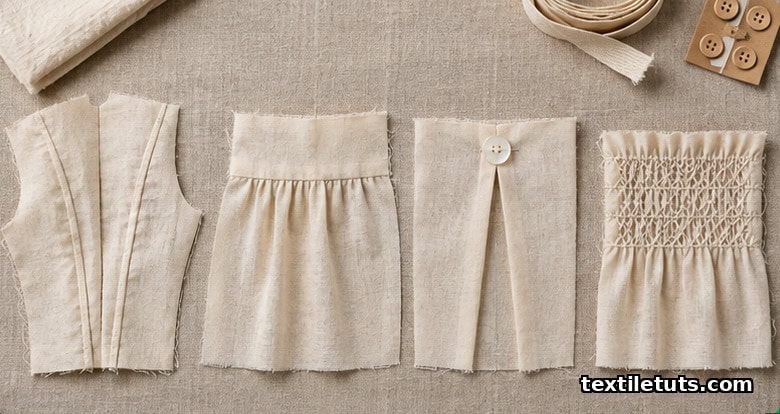
A dart can be replaced by a seam or a fabric manipulation that runs from one dart leg to the other. The most common substitutions, and what each does to the original intake, are listed below.
| Substitution | Where the Shaping Goes | Effect on the Garment |
|---|---|---|
| Princess seam | Divided into two panels, each carrying half the dart intake | Continuous vertical shaping, no visible dart |
| Yoke with gathered lower panel | Fullness taken up in gathers below the yoke | Decorative; introduces volume rather than removing it |
| Release pleat | Partial dart intake released as a pleat | Combines shaping with a design feature |
| Smocking or shirring | Dart distributed across multiple rows of elastic stitching | Stretch control plus shaping; common in knit bodices |
In each substitution, the total intake at the waistline must still match the body dimension difference established by the size standard. ISO 8559-1:2017 and ASTM D5585-22 both publish the waist girth values that drive this calculation, and a substitution that drops more than 0.5 cm of intake will read as poor fit on the wearer.
Stitching and Stability of the Finished Dart
A correctly drafted dart is finished with stitching that locks the dart fold at the dart point. ASTM D6193-23, the standard practice for stitches and seams, classifies the dart stitch as a superimposed seam, and lists lockstitch and chainstitch as the two stitch types most commonly specified for bodice and skirt darts in woven fabrics. The stitch length typically runs 2.0 to 2.5 mm (12 to 14 stitches per inch) along the dart leg, with a back-tack or tie-off at the dart point to prevent the stitch from migrating beyond the fold.
For woven fabrics, AATCC TM135-2018 (Dimensional Changes of Fabrics After Home Laundering) is the standard reference for predicting how the dart intake will behave after repeated wash cycles. A 100% cotton bodice can shrink 3% to 5% along the warp after five wash cycles at 40 °C, which reduces the effective dart intake and pulls the garment closer to the body. Pattern makers typically add 0.5 to 1.0 cm of ease allowance to the dart intake on pre-washed cotton to compensate.
For knit fabrics, dart manipulation is often unnecessary because the fabric’s stretch accommodates the waist-to-bust circumference difference without a stitched fold. When a dart is used on a knit, the dart intake is reduced by 30% to 50% relative to a woven block, and the dart point is extended 1.3 to 2.5 cm further from the apex to distribute the shaping over a longer line.
Grainline and Pattern Balance Checks
After dart manipulation, the pattern maker must verify two things: that the grainline on the new pattern still runs parallel to the fabric warp, and that the bodice front and back balance at the side seam.
If the new dart forces the grainline off the warp by more than 1.0 cm across the panel width, the fabric will pull and the print or plaid will misalign. The fix is to rotate the entire panel so the dart manipulation redistributes the grainline error, or to draft a new block rather than manipulate the old one.
Side-seam balance means the front and back panels meet at the side seam with matching lengths from the armhole to the waist, and from the waist to the hem. ASTM D5585-22 publishes the side-seam length values for each size, and a manipulated dart must not change those lengths by more than 0.3 cm. If it does, the pattern maker adjusts the side-seam dart intake until the balance is restored.
Frequently Asked Questions
How wide should a dart be at the waistline?
A standard waist dart on a women’s fitted bodice measures 2.5 to 3.8 cm (1.0 to 1.5 inches) wide at the seamline. Two darts together typically remove 5.1 to 7.6 cm of waist width for a size 10 garment drafted against ASTM D5585-22 measurements.
How long should a bust dart be?
A vertical bust dart leg runs between 7.6 cm and 15.2 cm (3.0 to 6.0 inches), depending on bodice length and dart style. The dart point should always fall 3.8 to 5.1 cm short of the bust apex to avoid a visible depression on the body surface.
Can a dart be moved without redrafting the whole pattern?
Yes. The slash-spread method and the pivot method both relocate dart intake on a copy of the existing block without changing the total volume of shaping. Both methods are standard in industrial sample rooms and produce identical garments when executed correctly.
What is the difference between a single-point dart and a double-point dart?
A single-point dart has one fold point and two legs, removing a triangular wedge of fabric. A double-point dart has two points and three legs, removing a diamond-shaped wedge and adding shaping in two directions. The double-point dart is commonly used at the waist on close-fitting dresses where the waist curve transitions to both bust and hip.
Do knit fabrics need darts?
Knits usually do not require darts because the fabric stretch accommodates the waist-to-bust circumference difference on its own. When a dart is used on a knit, the dart intake is reduced by 30% to 50% relative to a woven block, and the dart point is extended further from the apex to distribute the shaping over a longer line.
References
- ASTM D5219-21. Standard Terminology Relating to Body Dimensions for Apparel Sizing. ASTM International, West Conshohocken, PA. https://www.astm.org/d5219-21.html — defines body landmarks and anthropometric terms used in dart placement.
- ASTM D5585-22. Standard Tables of Body Measurements for Adult Female Misses Figure Type, Size Range 00 to 20. ASTM International, West Conshohocken, PA. https://www.astm.org/d5585-22.html — size chart that drives bust, waist, and hip dart intake calculations.
- ISO 8559-1:2017. Size designation of clothes, Part 1: Anthropometric definitions and measurement procedures. International Organization for Standardization, Geneva. https://www.iso.org/standard/63581.html — defines the measurement protocols behind any size label.
- ASTM D6193-23. Standard Practice for Stitches and Seams. ASTM International, West Conshohocken, PA. https://www.astm.org/d6193-23.html — classifies dart stitching and lists lockstitch and chainstitch options.
- AATCC TM135-2018. Dimensional Changes of Fabrics After Home Laundering. American Association of Textile Chemists and Colorists, Research Triangle Park, NC. https://www.aatcc.org/testing/test-methods/ — predicts how dart intake will behave after repeated wash cycles.
This article is the working reference for dart manipulation in woven and knit garments. Editorial by Kazi Sifat Muntasir, TextileTuts. Sources: ASTM D5219-21, ASTM D5585-22, ASTM D6193-23, ISO 8559-1:2017, AATCC TM135-2018, as cited.


