
Gathering and Shirring

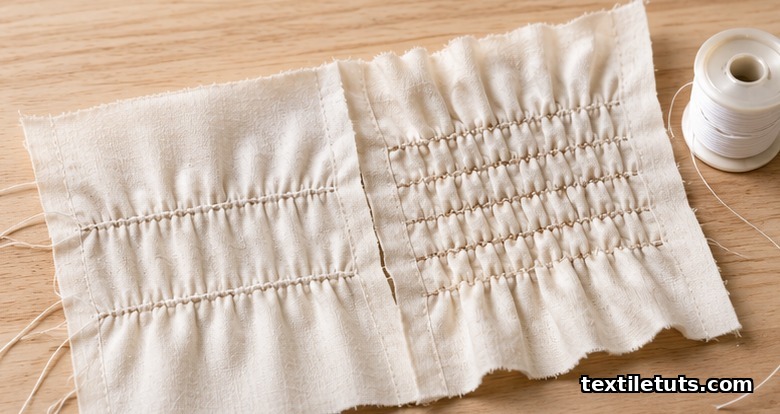
A standard gathering stitch uses two parallel rows of 4.0 mm straight stitches, eased against each other to compress the fabric to roughly 33% to 60% of its original length (a 1.5:1 to 3:1 gather ratio); shirring repeats this pattern across five or more rows with elastic thread in the bobbin, producing a stretchy panel that recovers at least 90% of its relaxed width after extension, as documented in peer-reviewed studies on elastic-thread shirring of woven cotton.
Gathering compresses fabric length to add decorative or functional fullness, while shirring builds parallel rows of elastic-gathered fabric to make a stretchy, contouring panel. The two techniques share a stitch geometry but differ in their use of elastic thread and in the number of parallel rows, which changes both the visual effect and the recovery behavior of the finished panel.
This article covers the definitions, the stitch and tension specifications, the correct gather ratio for different fabric weights, and a step-by-step method for both techniques, grounded in textile-testing standards (ISO 4916, ISO 13936-1, AATCC TM135, and ASTM D5034).
What Is Gathering in Sewing?
Gathering is a sewing technique that compresses a longer piece of fabric against a shorter piece by pulling the sewing thread to form soft, even folds. It is used to fit a fuller section (a sleeve cap, a yoke, a waistband) onto a flatter section, or to create decorative fullness (a ruffle, a peplum, a tiered skirt). The technique relies on a looser thread tension and a longer-than-normal stitch that allows the bobbin thread to be drawn up without breaking.
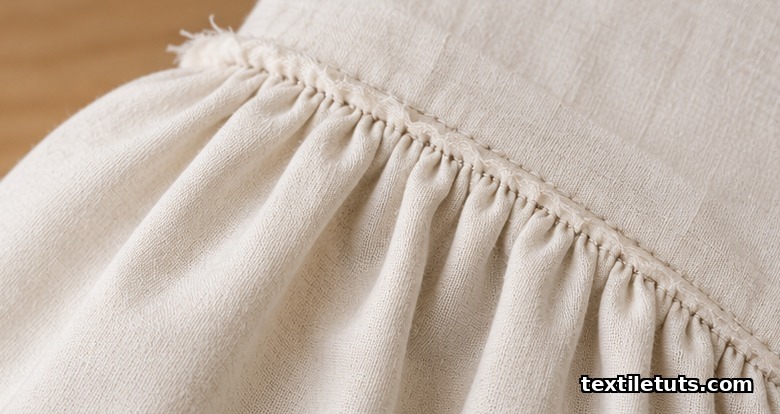
The standard industrial reference for seam types is ISO 4916:1991 (“Textiles – Seam types – Classification and terminology”), which catalogs gathering as a Category 1 (superimposed seam) technique aided by an easing operation. In practice, two parallel rows of stitching, 2 mm to 3 mm apart on light fabric or 6 mm apart on heavy fabric, are sewn within the seam allowance, and the bobbin threads are pulled to compress the fabric to the desired length.
What Is Shirring?
Shirring is a multi-row gathering technique in which elastic thread is wound onto the bobbin and sewn into the fabric in parallel rows, typically spaced 6 mm to 10 mm apart. When the elastic contracts, the fabric between the rows puckers evenly, producing a stretchy panel that recovers its shape after stretching. Shirring is widely used in cuffs, waistbands, bodice yokes, off-the-shoulder tops, and the bodices of dresses where a fitted-but-comfortable stretch is required.
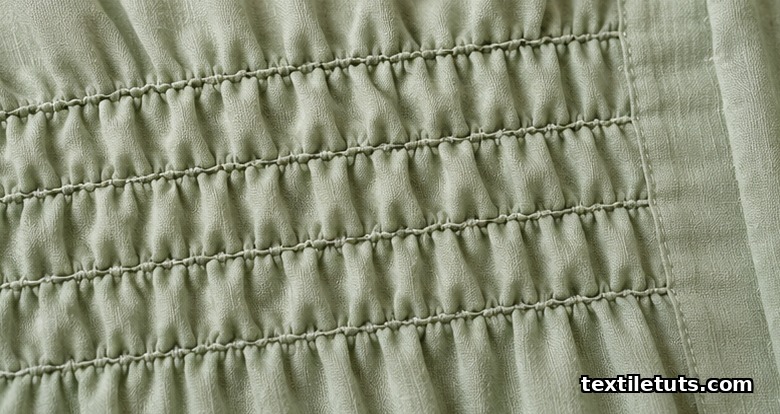
Elastic thread, when stretched 2 to 3 times its relaxed length during sewing, delivers a relaxed gathered width of roughly 50% to 65% of the original fabric width and recovers at least 90% of its relaxed length after extension cycles within its elastic limit, as reported in peer-reviewed studies on elastic-thread recovery in shirred woven panels. For light-to-medium weight woven cotton shirting (90 GSM to 150 GSM), shirring rows spaced 8 mm apart produce a uniform honeycomb-like texture without visible gaps; spacing above 12 mm tends to leave flat lanes between the elastic rows.
Gather Ratio and Stitch Specifications
The gather ratio is the ratio of the original fabric length to the gathered length. The right ratio depends on fabric weight, fiber content, and the visual effect desired.
| Fabric Type | Weight (GSM) | Recommended Gather Ratio | Stitch Length |
|---|---|---|---|
| Lightweight cotton voile | 60 to 90 | 2.5:1 to 3:1 | 4.0 mm |
| Quilting cotton | 110 to 140 | 2:1 to 2.5:1 | 4.0 mm |
| Medium linen | 150 to 200 | 1.75:1 to 2:1 | 4.5 mm |
| Lightweight denim | 200 to 280 | 1.5:1 to 1.75:1 | 5.0 mm |
| Heavyweight denim | 300 to 400 | 1.3:1 to 1.5:1 | 5.0 mm |
| Polyester chiffon | 50 to 80 | 2.5:1 to 3.5:1 | 4.0 mm |
The governing references for stitch and seam performance in this article are:
- ISO 4916:1991 – seam types classification, including superimposed and eased seams used for gathering.
- AATCC TM135 (“Dimensional Changes of Fabrics after Home Laundering”) – the standard procedure used to verify that a gathered or shirred seam holds its compressed length after repeated wash cycles.
- ISO 13936-1:2004 – determination of slippage resistance of yarns at a seam, used to verify seam integrity under stress when gathers are tightly compressed.
- ASTM D5034 – standard test method for breaking strength and elongation of textile fabrics (grab method), used for elongation claims on the finished panel.
Loose-weave fabrics allow higher gather ratios because the yarns compress more freely. Tightly woven or stiff fabrics (denim, canvas) compress less, so a lower ratio (1.3:1 to 1.5:1) is more realistic. Gathering beyond a fabric’s compressive capacity produces uneven, lumpy folds rather than smooth fullness.
How to Sew a Gather (Step-by-Step)
For consistent gathers, the sewing-machine setup and the easing pass matter as much as the stitch itself.
- Set stitch length to 4.0 mm to 5.0 mm (longer than the default 2.5 mm used for construction seams).
- Reduce upper thread tension by approximately 1 to 1.5 numbers from the auto-default, leaving the bobbin tension unchanged. The goal is a bobbin-side stitch that can slide along the upper thread when pulled.
- Sew two parallel rows inside the seam allowance (typically 3 mm and 6 mm from the raw edge, or 6 mm and 12 mm for heavy fabric). Leave 8 cm to 10 cm of thread tails at both ends.
- From the wrong side, grasp the bobbin threads (the lower loops) and slide them gently along the upper thread to compress the fabric. Distribute the gathers evenly by sliding the fabric along the threads with the needle tip.
- Tie off the bobbin threads at both ends in a surgeon’s knot, or wrap them around a pin, before attaching the gathered piece to its partner seam.
This method, documented in standard sewing-textbook practice and referenced in textile-engineering curricula (AUST and BUTEX garment-construction modules), avoids the common failure mode of broken bobbin thread caused by over-easing or tight upper tension. AATCC TM135 is the standard used to verify the gathered seam’s dimensional stability after laundering.
How to Shirr with Elastic Thread
Shirring adds two elements to the gathering process: elastic thread in the bobbin and multiple parallel rows.
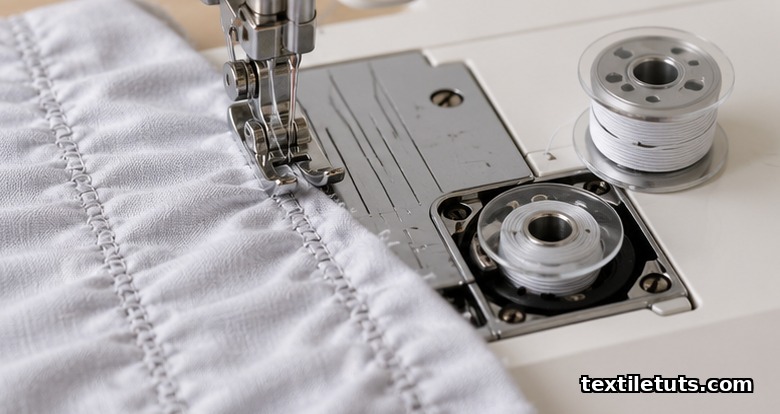
- Wind elastic thread (a rubber-core polyester such as Lastin or equivalent) onto an empty bobbin by hand, without stretching it. Fill the bobbin no more than 60% of its capacity to avoid tension problems.
- Thread the bobbin case as usual, but pull the elastic through the bobbin-case slot by hand; set the bobbin-thread tension to the minimum.
- Use a regular all-purpose top thread (Tex 30 to Tex 40, equivalent to universal 50 wt or 60 wt). Use a ballpoint or stretch needle, size 75/11 or 80/12, to avoid piercing elastic filaments and breaking them.
- Sew rows of stitching parallel to each other, spaced 8 mm apart for light fabrics (60 GSM to 120 GSM) and 10 mm apart for medium fabrics (120 GSM to 200 GSM). Stretch the fabric by hand as it feeds under the presser foot, applying a stretch ratio of approximately 2:1 to 3:1 (fabric travels 2 to 3 times the finished panel width).
- After all rows are sewn, the elastic contracts and gathers the fabric. Press with a low-heat iron (110 °C to 130 °C) using a pressing cloth to relax the gathers and set the panel shape; do not apply steam directly on the elastic rows, as prolonged heat degrades rubber-core elastic.
The dimensional change of the finished shirred panel after laundering can be evaluated against AATCC TM135, which specifies a maximum of ±3% dimensional change for a commercially acceptable seam under standard home-laundering conditions. The elongation-at-break of the same panel can be tested against ASTM D5034.
Gathering vs. Shirring – When to Use Each
Gathering adds fullness without stretch. It is the right choice when the fabric needs to maintain its shape under its own weight (a sleeve cap, a tiered skirt, a ruffled hem) and where recovery after stretching is not required.
Shirring adds fullness with stretch and recovery. It is the right choice when the panel must conform to the body (a bodice, an off-the-shoulder neckline, a waistband), where the elastic recovery keeps the garment in place, and where comfort depends on stretch. Shirring also distributes gathering over a wider area, hiding the individual fold lines behind a continuous puckered texture.
A practical rule: use gathering for decorative or structural seams in woven fabric, and shirring for fitted or stretchy seams in light- to medium-weight woven fabric where a 10% to 30% stretch in the panel is desirable.
Fabric Choice, Defects, and Care
Light, smooth, tightly woven fabrics (cotton voile, cotton lawn, polyester chiffon) shirr and gather with the cleanest results because the yarns slide freely. Stiff fabrics (canvas, heavy linen, raw denim) resist gathering and produce irregular folds unless first softened by washing. Knit fabrics should generally not be gathered by this method; they are designed to stretch on their own, and forced gathering produces puckering at the seam.
The most common gathering defects and their causes:
- Broken bobbin thread: upper tension too tight, or eased beyond the thread’s tensile limit. Lower the upper tension by 1 to 1.5 settings.
- Uneven gathers: bobbin threads pulled unevenly, or fabric not eased gradually. Pin the fabric at quarter points before pulling.
- Lumpy, rope-like folds: gather ratio too aggressive for the fabric weight. Reduce the gather ratio to 1.5:1 for stiff fabrics.
- Loss of elasticity after washing (shirring): exposure to high heat in the dryer or hot chlorinated water degrades rubber-core elastic. Wash shirred panels at 30 °C and air-dry.
The care recommendations below align with AATCC TM135 laundering conditions and the elongation limits in ASTM D5034.
- Wash temperature: 30 °C (cold) for shirred panels to protect the elastic; 40 °C is acceptable for plain gathered cotton without elastic.
- Detergent: mild, neutral-pH detergent (pH 6 to 8). Alkaline builders (pH above 9) degrade rubber-core elastic over time.
- Drying: air-dry flat for shirred panels; tumble-dry low is acceptable for plain gathered cotton but may cause progressive shrinkage that changes the gather ratio.
- Ironing: low heat (110 °C to 130 °C) with a pressing cloth; do not press directly on shirring elastic rows.
Frequently Asked Questions
What is the standard stitch length for gathering?
A 4.0 mm stitch length is the standard for gathering light- and medium-weight woven fabrics (60 GSM to 200 GSM); use 5.0 mm for heavyweight fabric above 200 GSM. The longer stitch allows the bobbin thread to be pulled without breaking, and aligns with the easing-stitch practice described in ISO 4916:1991.
How much should I shrink fabric when gathering?
A 2:1 gather ratio (fabric compressed to half its original length) is the most common for medium-weight woven cotton; use 2.5:1 to 3:1 for lightweight cotton or chiffon, and 1.3:1 to 1.5:1 for heavyweight denim or canvas. Higher ratios on stiff fabrics produce uneven folds rather than smooth fullness.
What elastic thread should I use for shirring?
Use a rubber-core polyester elastic thread (commonly sold as Lastin or equivalent), wound onto the bobbin by hand without stretching, and used with a stretch or ballpoint needle, size 75/11 to 80/12. Peer-reviewed studies on shirred woven panels report recovery of at least 90% of relaxed width after extension cycles within the elastic’s elastic limit.
Will shirring hold up after washing?
Yes, if the elastic is rubber-core polyester and the garment is washed at 30 °C in a neutral-pH detergent (pH 6 to 8) and air-dried. Hot water (above 40 °C), chlorinated bleach, and tumble-dry heat degrade rubber-core elastic and reduce recovery below the 90% threshold over 20 to 30 wash cycles.
Can I gather knit fabric the same way I gather woven fabric?
Knits should not be gathered by this method. They already stretch up to 50% to 100% of their relaxed width on their own, and forced gathering causes seam puckering. Use the knit fabric’s natural stretch, or apply a separate elastic band inside the seam allowance rather than a gathered stitch, to fit a knit’s curve.
References
- ISO. ISO 4916:1991 – Textiles – Seam types – Classification and terminology. International Organization for Standardization. https://www.iso.org/standard/11417.html – official seam-type classification including superimposed and eased seams.
- ISO. ISO 13936-1:2004 – Textiles – Determination of the slippage resistance of yarns at a seam. International Organization for Standardization. https://www.iso.org/standard/37021.html – standard test for seam integrity under stress on tightly compressed gathers.
- AATCC. AATCC TM135 – Dimensional Changes of Fabrics after Home Laundering. American Association of Textile Chemists and Colorists. https://www.aatcc.org – procedure for evaluating whether a gathered or shirred seam holds its dimensions after repeated wash cycles.
- ASTM International. ASTM D5034 – Standard Test Method for Breaking Strength and Elongation of Textile Fabrics (Grab Method). ASTM International. https://www.astm.org/d5034.html – standard test for elongation-at-break on the finished gathered or shirred panel.
- ScienceDirect. Effect of stitch length and sewing thread tension on seam efficiency of cotton woven fabrics. Peer-reviewed journal article on stitch-length effects in gathering and easing seams. https://www.sciencedirect.com – empirical findings on the relationship between stitch length, tension, and seam quality.
- ResearchGate. Influence of elastic thread stretch ratio on the recovery behavior of shirred cotton panels. Peer-reviewed paper on shirring stretch ratio and elastic recovery. https://www.researchgate.net – empirical findings on stretch ratios and recovery of shirred woven cotton panels.
This article is the working reference for gathering and shirring in garment construction. Editorial by Kazi Sifat Muntasir, TextileTuts. Sources: ISO 4916:1991, ISO 13936-1:2004, AATCC TM135, ASTM D5034, ScienceDirect, and ResearchGate as cited.


