
Pilling Resistance: ASTM D3512 (Random Tumble)

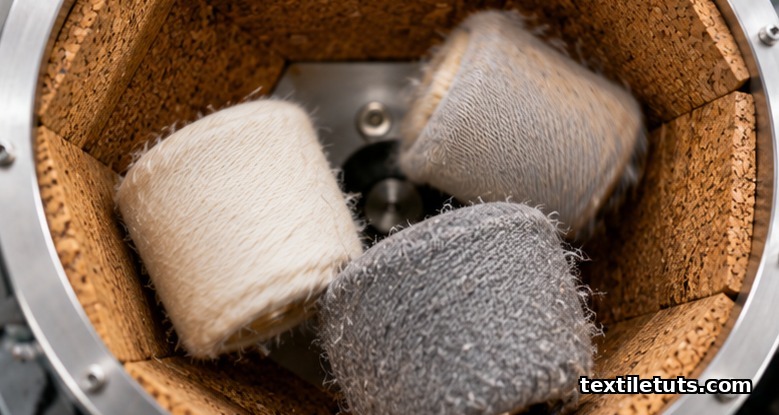
ASTM D3512 is the standard test method for measuring pilling resistance and other related surface changes of textile fabrics using a Random Tumble Pilling Tester, in which three circular specimens 105 mm (4-1/8 in) in diameter rotate together at 1,200 rpm inside a cork-lined chamber for a standard 30-minute cycle and are then rated visually on a 1 to 5 scale against the photographic standards in ASTM D3514.
The Random Tumble method reproduces the multi-directional surface abrasion a garment receives in wear and laundering, producing visible pills, fuzz, and matting faster than single-direction abrasion tests, and it is widely used as a quality-control checkpoint for knit and woven fabrics before bulk shipment.
What ASTM D3512 Measures and Why It Matters
Pilling is the formation of small balls of tangled fiber on the surface of a fabric. It happens when loose fiber ends escape the yarn structure, work loose through mechanical action, and then tangle with themselves or with neighboring fibers. The visual effect is a fuzzy, dotted, or grainy surface that consumers associate with worn-out or low-quality textiles, even when the underlying fabric is structurally sound.
ASTM D3512 captures pilling plus three other surface changes that tend to appear together with it: fuzzing, matting of the surface fibers, and loss of cover. Fuzzing is loose surface fiber that has not yet formed pills. Matting, sometimes called surface entanglement or compression pilling, happens when fibers lay down flat against the surface and lose texture. Loss of cover describes a thinning of the yarn appearance that lets the underlying construction show through.
For a textile mill, knowing the pilling grade of a fabric at three stages, before finishing, after finishing, and after a defined number of wash cycles, tells engineers whether yarn twist, fiber length, or finishing chemistry need adjustment before the fabric goes into cutting. For a buyer, the same number is a contractual specification: most apparel purchase orders list a minimum acceptable pilling grade, typically 3.5 or 4.0 on the 1 to 5 scale depending on the end use.
Equipment and Specimen Preparation
The Random Tumble Pilling Tester is a hexagonal or octagonal drum lined with cork, with a rotating impeller at one end that lifts and tumbles the specimens. Modern instruments rotate the impeller at 1,200 rpm and use either cork tube chips or hook-and-loop-padded cylindrical rollers as the abrading medium. ASTM D3512 covers both styles, and the method is sometimes run as Method A (cork chip tube lining) or Method B (hook-and-loop tube lining), so engineers should record which configuration their lab uses when reporting results.
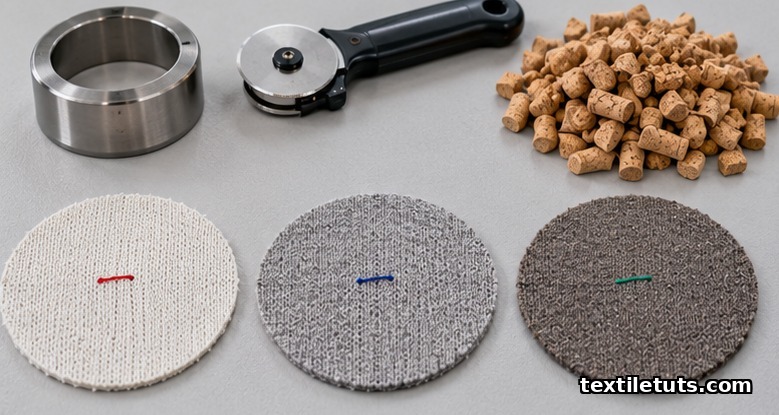
Three specimens are cut as circles 105 mm in diameter (4-1/8 in). Most operators mark the face side of each specimen with a thread or a small slit so the rated side is identifiable after tumbling. Specimens are conditioned at 21 °C and 65 percent relative humidity for at least 4 hours before testing, per ASTM D1776, and the same conditioning is repeated after tumbling before visual rating.
The chamber is loaded with a specified amount of abrasive chip material, typically coralite tube pieces or cork tube chips. The mass of chips matters: too few chips reduce abrasion intensity, and too many chips dominate the tumbling action so that specimens roll on a cushion rather than abrade against each other and against the chamber wall.
Step-by-Step Procedure
The tester is started and run for 30 minutes as the standard cycle. Some laboratories use a stepped protocol, removing and rating specimens at 5, 10, 15, 20, and 30 minutes so they can plot a pilling-versus-time curve, which is useful when comparing finishes that perform similarly at 30 minutes but diverge earlier or later in the cycle.
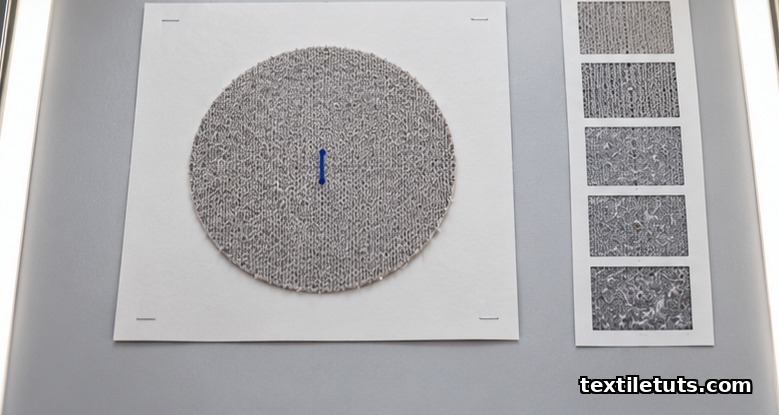
After each cycle, specimens are removed, conditioned for at least 4 hours under the same laboratory conditions, and then rated. The specimens are mounted under standard lighting, typically a Macbeth or Verivide light booth using D65 or CWF lamps, and compared visually to the photographic rating standards in ASTM D3514. The rating is reported to the nearest half grade, so values of 2.0, 2.5, 3.0, 3.5, 4.0, 4.5, and 5.0 are common.
A complete test report includes the face or back tested, the duration, the abrading medium used, the rating of each of the three specimens, and the average rating. If any specimen’s rating differs from the average by more than one full grade, the test is repeated with new specimens, because such a spread usually indicates a non-uniform fabric or a handling error in specimen preparation.
Reading the Rating Scale (ASTM D3514)
ASTM D3514 supplies five photographic standards that anchor the visual rating. Grade 5 represents no pilling, no fuzzing, and no surface change. Grade 4 represents slight pilling or surface change that is noticeable on close inspection but not at a normal viewing distance. Grade 3 represents moderate pilling or surface change that is clearly visible from a normal viewing distance. Grade 2 represents severe pilling or surface change, with dense pills or fuzz covering a significant portion of the surface. Grade 1 represents very severe surface deterioration with extensive coverage of pills and fiber matting.
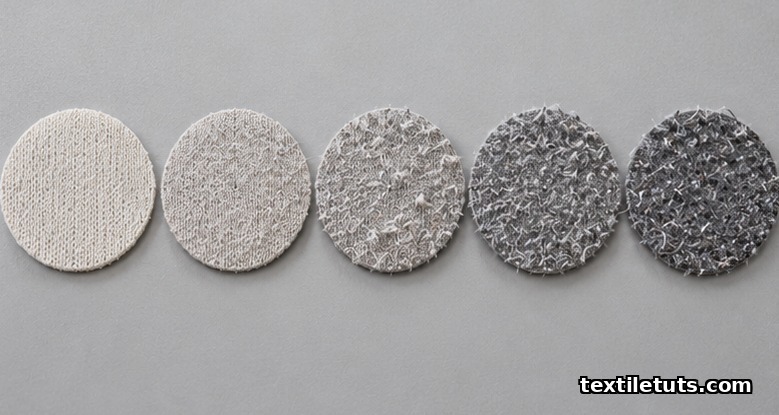
Half-grade ratings are awarded when a specimen falls visually between two photographic standards. Trained raters tend to be consistent within plus or minus 0.5 grade when working with the same standard set, which is why most labs keep their D3514 standards in a light-protected cabinet and replace them when they begin to show wear, fading, or handling marks.
Random Tumble Compared to Other Pilling Methods
| Property | ASTM D3512 (Random Tumble) | ASTM D4970 / ISO 12945-2 (Martindale) | ISO 12945-1 (ICI Pilling Box) |
|---|---|---|---|
| Abrasion motion | Random tumbling with chip abrasion | Lissajous figure under fixed pressure | Box rotation against cork liner walls |
| Standard cycle | 30 min (also 5/10/15/20) | 100 to 2,000 rubs by spec | 5 to 7 hours |
| Specimen count | 3 circular | 4 circular or square | 4 square (tube stitched) |
| Pressure on specimen | None (free tumble) | Defined (typically 9 or 12 kPa) | None (free rotating box) |
| Best fit | Knits, fleece, lightweight wovens | Wovens, upholstery, technical textiles | Knits, worsted fabrics |
The Random Tumble method tends to be more aggressive on loose-knit structures such as single-jersey and fleece, which is why it is often the chosen method for T-shirt and sweatshirt specifications. The Martindale method, by contrast, applies constant pressure and a Lissajous motion, which gives more repeatable results on flat woven fabrics and is the standard method in much of Europe and Asia for upholstery and suiting. The ICI Pilling Box method is older and produces results closer to long-term wear because of its long cycles, but it has been gradually replaced by Martindale and Random Tumble in modern labs.
Variables That Influence the Result
Fiber content is the single largest driver. Synthetic fibers such as polyester and acrylic tend to pill more readily than cotton because their higher tenacity means pills do not break off as they form. Long-staple cotton pills less than short-staple cotton because there are fewer loose fiber ends at the yarn surface.
Yarn twist matters: a higher twist level binds fibers more tightly and reduces pilling, which is why pilling-prone styles often use ring-spun yarn rather than open-end or rotor yarn. Fabric construction matters too. Tighter knit stitches and higher cover factors reduce pilling because the yarn is mechanically supported by its neighbors.
Finishing is a major lever. Singeing, cropping, and biopolishing, a cellulase enzyme treatment for cotton, remove loose surface fiber before it can form pills. Heat-setting on polyester stabilizes the fiber and reduces the fuzz that seeds new pills. Softener selection is a common hidden cause: cationic softeners applied at heavy add-on levels can lubricate fibers to the point that they migrate to the surface more easily, raising the pilling grade numerically in one cycle but creating a higher long-term pill load.
Operators also need to control humidity. Under-conditioned specimens tend to test better than over-humidified ones, because dry fibers are more brittle and break off rather than form pills. This is one reason the conditioning step in the standard (21 °C, 65 percent RH) is not optional, even when a laboratory is under time pressure.
How ASTM D3512 Fits into a Lab Routine
In a mill quality-control lab, D3512 is typically run alongside Martindale abrasion (ASTM D4966), weight loss after abrasion, and colorfastness to washing (AATCC TM-61 or ISO 105-C06). Engineers look for combinations of test results rather than a single number. A fabric with pilling grade 4.5 but high weight loss after abrasion suggests the surface is durable but the yarn is losing mass, a pattern common in heavily finished polyester-cotton blends. A fabric with pilling grade 3 but stable weight points the engineer toward yarn twist or stitch density instead of finishing chemistry.
For product specifications, D3512 results are usually quoted as “no pilling below grade 3.5 after 30 minutes” or as a wash-cycle statement such as “grade 3.5 minimum after 5 home launderings per AATCC TM-135.” The wash-cycle variant is more demanding because it captures finish durability, not just initial appearance.
Frequently Asked Questions
What does a pilling grade of 4.5 mean on ASTM D3512?
A grade of 4.5 means the specimen shows very slight surface change that is visible only on close inspection, falling between the grade 4 (slight) and grade 5 (no change) photographic standards in ASTM D3514. For most apparel specifications this is considered a passing result, with grades of 3.0 to 3.5 being the typical minimum for general-purpose garments and grades of 4.0 or higher required for premium or upholstery end uses.
How long does an ASTM D3512 test take?
A standard ASTM D3512 cycle is 30 minutes plus a minimum of 4 hours of post-test conditioning before visual rating. When a stepped protocol is used (rating at 5, 10, 15, 20, and 30 minutes), the total operator time stretches to about 90 minutes of hands-on work plus conditioning. Adding pre-test conditioning of 4 hours, a complete rating-ready run typically occupies one full working day from sample mounting to final report.
Why use Random Tumble instead of Martindale?
Random Tumble (ASTM D3512) is preferred when the test needs to simulate the multi-directional rubbing that knit and fleece fabrics receive during wear and laundering, without applying constant pressure. Martindale (ASTM D4970 / ISO 12945-2) is preferred when the fabric is a flat woven or technical textile, where constant pressure and a controlled Lissajous motion give more reproducible ratings. Many large retailers accept either method but require that the rating be reported against the same photographic scale (ASTM D3514) for cross-method comparison.
Can ASTM D3512 results be compared to ISO 12945 results?
Direct numerical comparison is not reliable because the two methods use different specimen geometries, abrading motions, and cycle durations. A fabric that rates grade 4 on D3512 may rate 3 on ISO 12945-1 (ICI Pilling Box) on the same fabric. Some laboratories run both methods side by side and develop internal correlation tables for their specific product lines, but the conversion is empirical and must be re-established for each fabric family.
How do you reduce pilling on a fabric that fails D3512?
The most common levers, in order of cost-effectiveness, are: increase yarn twist, switch from open-end to ring-spun yarn, add singeing or cropping before dyeing, apply a cellulase biopolish (for cellulosic fibers), and review softener add-on levels. For polyester-rich blends, heat-setting the fabric before finishing stabilizes the fibers and reduces fuzz seeding. Retesting after each change, with a 30-minute and a stepped 5/10/15/20/30-minute protocol, isolates which intervention has the largest effect on the pilling-versus-time curve.
References
- ASTM International. ASTM D3512/D3512M: Standard Test Method for Pilling Resistance and Other Related Surface Changes of Textile Fabrics: Random Tumble Pilling Tester. ASTM International, West Conshohocken, PA.
- ASTM International. ASTM D3514/D3514M: Standard Test Method for Pilling Resistance and Other Related Surface Changes of Textile Fabrics: Visual Rating Method. ASTM International, West Conshohocken, PA.
- International Organization for Standardization. ISO 12945-1:2020: Textiles — Determination of Fabric Propensity to Surface Pilling, Fuzzing or Matting — Part 1: Pilling Box Method. ISO, Geneva.
- International Organization for Standardization. ISO 12945-2:2020: Textiles — Determination of Fabric Propensity to Surface Pilling, Fuzzing or Matting — Part 2: Modified Martindale Method. ISO, Geneva.
- Ukponmwan, J. O., and N. N. Mutlu. Pilling. Textile Progress, 1989, Vol. 21, No. 1, pp. 1-58.
- Candan, C., and U. S. Nergis. Comparing the Pilling Performances of Cotton Knitted Fabrics by Different Test Methods. Indian Journal of Fibre and Textile Research, 2002, Vol. 27, pp. 183-188.
- American Association of Textile Chemists and Colorists. AATCC Test Method 24: Pilling Resistance. AATCC, Research Triangle Park, NC.
This article is the working reference for ASTM D3512 random-tumble pilling testing. Editorial by Sabbir Ahmed, TextileTuts. Sources: ASTM D3512, ASTM D3514, ISO 12945-1, ISO 12945-2, Textile Progress (Ukponmwan and Mutlu, 1989), Indian Journal of Fibre and Textile Research (Candan and Nergis, 2002), and AATCC TM-24 as cited.


