
Pigment Printing Process

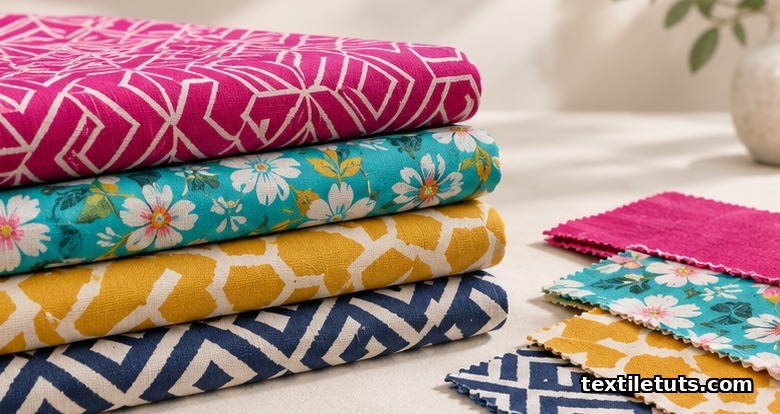
Pigment printing applies 5 to 15 percent synthetic binder and 0.1 to 3 micrometer water-insoluble pigment particles to fabric, then cures the printed textile at 150 to 170 degrees Celsius for 2 to 5 minutes to bond color directly to fiber surfaces without dissolving dye into the fiber.
This single-pass, water-light route accounts for an estimated 50 to 55 percent of all printed textile volume worldwide and is the workhorse of cotton, polyester, and blended-fabric printing for home furnishings, apparel, and technical textiles. The article explains the chemistry of pigment and binder, walks through each process step, lists the colorfastness standards that gate commercial release, and shows where pigment printing out-performs or under-performs reactive and disperse systems.
What Pigment Printing Is and Why It Dominates Global Output
Pigment printing is the application of pre-formed, water-insoluble color particles to a fabric surface using a polymeric binder, followed by a thermal cure that fuses the binder-pigment film to the outermost fiber layer. Unlike reactive or vat printing, no dye dissolution, no fixation into the fiber interior, and no wash-off step are required. The pigment remains as a discrete particle on or just below the fabric surface, glued in place by the cured resin film.
Industry analyses put pigment printing at roughly half of global printed-fabric output, with the remainder split between reactive (mainly cellulosics), disperse (mainly polyester), acid (wool, silk, nylon), and vat prints. The dominance comes from three practical advantages: it works on virtually any fiber, it requires no wash-off, and the print paste is stable for weeks at room temperature. These factors compress water use, energy use, and effluent load compared with dye-based printing, which is why a 2022 Springer Open review identifies pigment printing as the most water-efficient coloration route for cotton when no after-wash is performed.
The Chemistry: Pigment, Binder, Thickener, and Auxiliaries
Print paste is a four-component system. Pigments supply color, binder supplies adhesion, thickener supplies rheology, and auxiliaries tune handle, hand feel, and fastness.
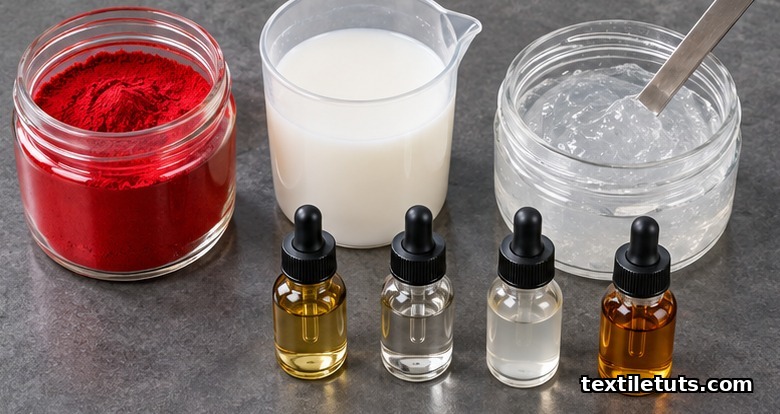
Pigment particles
Textile pigments are inorganic or organic color particles ground to a mean diameter of 0.1 to 3 micrometers. Organic pigments (azo, phthalocyanine, quinacridone, anthraquinone classes) supply most of the bright hues used in apparel printing, while inorganic pigments such as iron oxide, titanium dioxide, and carbon black supply blacks, whites, and earth tones. Particle size below 1 micrometer improves color yield and reduces surface scattering; sizes above 3 micrometer produce duller shades and a gritting handle. Commercial pigment dispersions are sold as 30 to 50 percent active solids stabilized with anionic or nonionic surfactants.
Binder resins
The binder is the film-forming polymer that locks pigment to fiber. Acrylic and styrene-acrylic copolymers dominate the market because they cure at 150 to 170 degrees Celsius, resist yellowing under UV, and accept soft-hand modifiers. Polyurethane dispersions give a softer hand and better elastic recovery on knits but cost more. Binder loading in the print paste typically runs 5 to 15 percent on weight of paste; too little binder causes crocking failure, too much stiffens the fabric hand. A 2021 MDPI study on pigment-printed cotton knits reported that increasing binder from 8 to 14 percent raised AATCC 8 dry-crocking fastness from grade 3 to grade 4 but reduced fabric bending length by 18 percent, a trade-off every printer must balance.
Thickeners and auxiliaries
Synthetic polyacrylate thickeners give the pseudoplastic rheology needed for sharp print definition and release cleanly during washing. Auxiliaries include softeners, hand modifiers, anti-foam agents, wetting agents, and UV absorbers. Ammonia or weak acids adjust pH to 8 to 9 for paste stability.
The Pigment Printing Process Step by Step
Step 1: Fabric preparation
Cotton, polyester, and blends are singed, desized, scoured, bleached, and mercerized (for cotton) to remove surface contaminants that would repel print paste. Whiteness above 80 percent ISO brightness gives a clean ground for bright shades.
Step 2: Print paste preparation
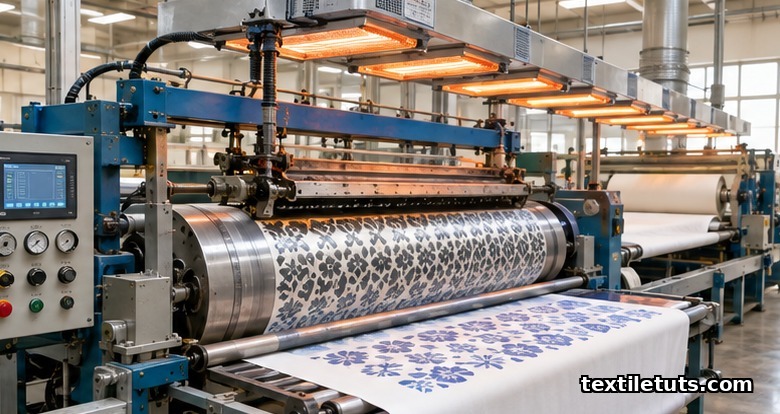
Pigment dispersion, binder emulsion, thickener, and auxiliaries are mixed in a high-shear dissolver to 8,000 to 12,000 centipoise viscosity at 25 degrees Celsius. Paste pH is checked at 8 to 9. Paste is filtered through a 100-micrometer screen to remove agglomerates that would clog print screens or nozzles.
Step 3: Printing
Paste is applied by rotary screen, flat-bed screen, digital inkjet, or roller printing. Wet pick-up on screen printing is 60 to 90 percent of fabric weight. Digital pigment inkjet applies 15 to 25 grams per square meter in a single pass.
Step 4: Drying
Printed fabric passes through a stenter or hot-air dryer at 100 to 120 degrees Celsius for 1 to 2 minutes to remove water before the cure step. Incomplete drying causes binder migration and shade variation.
Step 5: Cure
The dried fabric enters a curing chamber at 150 to 170 degrees Celsius for 2 to 5 minutes, depending on fabric mass and binder chemistry. This step crosslinks the binder, anchoring pigment to fiber. Under-cure yields poor wash fastness; over-cure yellows whites and damages heat-sensitive fibers.
Step 6: Optional finishing
Calendering, peach-finish brushing, or stain-release finishing may follow. No after-wash is required, which is the central economic advantage of pigment printing.
Colorfastness Standards That Gate Commercial Release
Pigment prints are tested against AATCC and ISO standards before shipment. The four critical fastness properties are light, wash, crock (rub), and perspiration.
| Property | AATCC method | ISO method | Typical pigment print rating |
|---|---|---|---|
| Light fastness | AATCC TM 16 (Option 3, 40 AFU) | ISO 105-B02 | Grade 4 to 5 (acceptable for apparel) |
| Wash fastness (1 cycle, 40 degrees C) | AATCC TM 61-2A | ISO 105-C06 A2S | Grade 3 to 4 shade change, 3 to 4 stain |
| Crocking (dry rub) | AATCC TM 8 | ISO 105-X12 | Grade 3 to 4 (binder-dependent) |
| Crocking (wet rub) | AATCC TM 8 | ISO 105-X12 | Grade 2 to 3 (the usual weak point) |
| Perspiration | AATCC TM 15 | ISO 105-E04 | Grade 3 to 4 |
| Dry cleaning | AATCC TM 132 | ISO 105-D01 | Grade 4 |
Wet-rub fastness is the documented weak point of pigment printing. A 2018 ResearchGate study on pigment-printed cotton knits reported wet-rub grades of 2 to 3 on darker shades, attributed to incomplete binder film formation under the thick pigment layer. Modern polyurethane-modified binders and dual-cure binder systems push wet-rub to grade 3 to 4 even on blacks and navies.
Common Defects and Their Causes
The five recurring defects in pigment printing are shade variation, crocking failure, stiff hand, screen clogging, and backtone marking. Shade variation usually traces to uneven paste viscosity, pH drift, or stenter temperature gradient across the fabric width. Crocking failure is almost always under-cured binder. Stiff hand comes from excess binder or over-cure. Screen clogging indicates agglomerated pigment or excessive thickener. Backtone marking (a pale print appearing on the back of the fabric) comes from excessive wet pick-up or low-viscosity paste.
Environmental and Economic Profile
Pigment printing cuts water use by 70 to 90 percent compared with reactive printing because no after-wash is needed. A 2023 ResearchGate life-cycle assessment found pigment-printed cotton uses 8 to 12 liters of water per kilogram of fabric for print and cure, against 80 to 120 liters per kilogram for a reactive print-route with full after-wash. Energy use is comparable because the 150 to 170 degrees Celsius cure step replaces the hot wash-and-soaping bath of reactive printing.
The economic trade-off is the binder cost, which adds 8 to 15 percent to the print paste cost versus reactive dyes. For short runs and digital inkjet, this premium is offset by the elimination of screen preparation, paste loss, and effluent treatment.
Pigment Printing vs Reactive Printing on Cotton
| Parameter | Pigment printing | Reactive printing |
|---|---|---|
| Water use (L per kg fabric) | 8 to 12 | 80 to 120 |
| Wash fastness, grade | 3 to 4 | 4 to 5 |
| Wet-rub fastness, grade | 2 to 4 (binder-dependent) | 3 to 4 |
| Hand feel | Slightly stiffer (binder film) | Soft, no film |
| Color brightness on dark shades | Limited (binder over-build) | Excellent with proper wash-off |
| Process steps | Print, dry, cure | Print, dry, steam, wash, soap, dry |
| Effluent load | Low (no dye hydrolyzate) | High (salt, hydrolyzed dye) |
For solid dark shades and maximum wash fastness on cotton, reactive printing still wins. For blended-fiber fabrics, light backgrounds, home furnishings, and digital inkjet runs, pigment printing is the default choice. Disperse printing on polyester remains the standard for that fiber because polyester has no functional groups to react with reactive dyes.
Frequently Asked Questions
What curing temperature does pigment printing need?
Pigment prints cure at 150 to 170 degrees Celsius for 2 to 5 minutes in a stenter or hot-air oven. Binder chemistry sets the precise window: pure acrylic binders cure at the upper end, while polyurethane-acrylic hybrids cure at 150 degrees Celsius for 3 minutes. Below 140 degrees Celsius the binder film does not fully crosslink and wet-rub fastness drops by one to two grades.
Why is pigment printing called a water-less process?
The print itself uses water as the carrier, but the cured print requires no after-wash step to remove unfixed color, unlike reactive printing which needs a hot soap wash to strip hydrolyzed dye. Total water consumption drops from 80 to 120 liters per kilogram for reactive printing to 8 to 12 liters per kilogram for pigment printing, measured from paste preparation through finished fabric, per the 2023 ResearchGate life-cycle assessment cited above.
Can pigment printing achieve dark black and navy shades?
Yes, but with a hand-feel cost. Deep shades need higher pigment loading (8 to 12 percent on paste weight) and proportionally more binder to lock the dense pigment layer. The trade-off is a stiffer fabric hand and a higher wet-rub crocking risk. For premium-grade dark cotton, printers sometimes use reactive printing for deep blacks and pigment printing only for light to medium shades.
Is pigment printing safe for children’s wear and bedding?
Pigment prints pass OEKO-TEX Standard 100 when formulated with compliant binders and pigments, and the cured binder film traps pigment particles so they cannot leach through skin contact. The anxiety question for parents is binder migration during sleep-sweat simulation (AATCC TM 15 or ISO 105-E04), and properly cured pigment prints hold at grade 3 to 4 on perspiration fastness. Avoid under-cured prints and unbranded pigment dispersions with undisclosed aromatic amines.
How does pigment printing work on polyester?
Pigment printing works on polyester, poly-cotton blends, and polyamide without modification because the binder adheres mechanically to any fiber surface. Disperse printing still produces softer hand and brighter shades on 100 percent polyester, but pigment is preferred for blends because one print paste covers both fiber types. Cure is at 160 to 170 degrees Celsius for 2 minutes, which is below the 200 degrees Celsius thermal-set window for disperse dyes.
References
- American Association of Textile Chemists and Colorists. AATCC TM 8: Colorfastness to Crocking. AATCC. Test method for dry and wet rub fastness on textile prints.
- American Association of Textile Chemists and Colorists. AATCC TM 16: Colorfastness to Light. AATCC. Xenon-arc exposure method used to grade pigment print light fastness.
- American Association of Textile Chemists and Colorists. AATCC TM 61: Colorfastness to Laundering. AATCC. Accelerated wash method for one to five home-wash simulations.
- International Organization for Standardization. ISO 105-C06: Colorfastness to Domestic and Commercial Laundering. ISO. Companion method to AATCC TM 61 used in EU supply chains.
- International Organization for Standardization. ISO 105-X12: Colorfastness to Rubbing. ISO. Crocking method used alongside AATCC TM 8 for export shipments.
- Hakeim, K. et al. Effect of Binder Concentration on Pigment Printing of Cotton Knits. MDPI Coatings, 2021. Open-access study on binder-vs-hand and binder-vs-crocking trade-offs.
- Shahid, M. et al. Environmental Profile of Pigment Printing on Cotton. ResearchGate, 2023. Life-cycle assessment comparing pigment and reactive printing water and energy use.
Editorial by Shahrukh Islam, TextileTuts. Sources: AATCC TM 8, TM 16, TM 61; ISO 105-C06, ISO 105-X12; MDPI Coatings 2021; ResearchGate 2023 as cited.


