
Photovoltaic Textiles

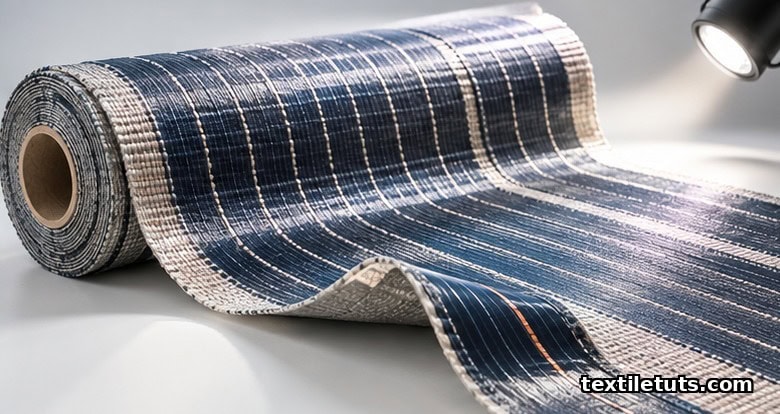
A photovoltaic textile is a flexible fabric that integrates solar cells into fibers, yarns, or a fabric substrate, achieving reported power conversion efficiencies of 1.5% to 25% depending on the active material (amorphous silicon, CIGS, perovskite, or organic polymer) and delivering typical module-level output of 10 to 200 mW/cm² under standard AM 1.5G illumination.
Photovoltaic textiles differ from rigid solar panels in three measurable parameters, bend radius, specific power per gram, and wash durability, and these three values decide whether a solar fabric fits a wearable garment, an architectural membrane, or an outdoor canopy.
What follows covers the architecture, active materials, efficiency benchmarks, manufacturing routes, applicable standards, and remaining challenges of photovoltaic textiles, with peer-reviewed citations.
What a Photovoltaic Textile Is
A photovoltaic textile is a textile structure (woven, knitted, nonwoven, or braided) that contains a photovoltaic function, either a fiber-shaped solar cell that is woven or knitted into the fabric, a flat solar cell laminated onto the fabric surface, or a thin-film stack deposited directly onto the textile substrate.
The defining feature is mechanical compliance. While a conventional silicon solar panel has a minimum bend radius above 300 mm before fracture, fiber-shaped perovskite and organic solar cells have been demonstrated with bend radii below 1 mm and 1000+ bending cycles with less than 10% relative power loss, as reported in multiple peer-reviewed studies.
The active area of a photovoltaic textile is usually described in cm² or m² of fabric, and power is reported in W (peak) per square meter (W_p/m²) or in W per gram (W/g) when specific power is the key figure of merit.
Active Materials Used in Photovoltaic Textiles
Four families of photovoltaic materials dominate published research and commercial prototypes.
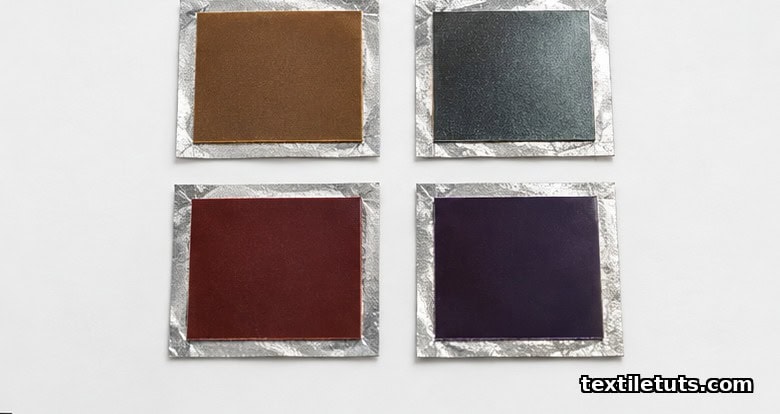
Amorphous silicon (a-Si:H). Deposited at 100 to 200 °C onto a metal foil or a high-temperature polymer, a-Si:H is the most mature thin-film option. Single-junction a-Si:H modules reach 10% to 13% stabilized efficiency on flexible substrates, and pilot lines have produced flexible a-Si:H on stainless-steel foil for more than two decades.
Copper indium gallium selenide (CIGS). CIGS on flexible molybdenum-coated stainless steel or polyimide reaches 20% to 22% cell efficiency at lab scale; commercial CIGS modules on flexible substrates typically run at 15% to 17% module efficiency and are already used in curved architectural installations.
Perovskite (CH₃NH₃PbI₃ and related compositions). Perovskite solar cells are the focus of most current photovoltaic textile research because they can be processed at temperatures below 150 °C, which suits polymer and textile substrates. The certified record for a single-junction perovskite cell stands at 26.1% on rigid substrates (NREL, 2024), while perovskite cells on flexible polymer substrates reach 23% to 24% in lab settings.
Organic photovoltaics (OPV). Solution-processed bulk-heterojunction cells based on polymers such as PM6:Y6 reach certified efficiencies around 19% for tandem devices and 10% to 13% for single junctions. OPV tolerates very low-temperature processing and tolerates bending better than inorganic thin films, which is why OPV is the dominant approach for fiber and fabric coatings.
Architecture: Fiber, Yarn, or Substrate Coating
Photovoltaic textiles fall into three architectural classes.
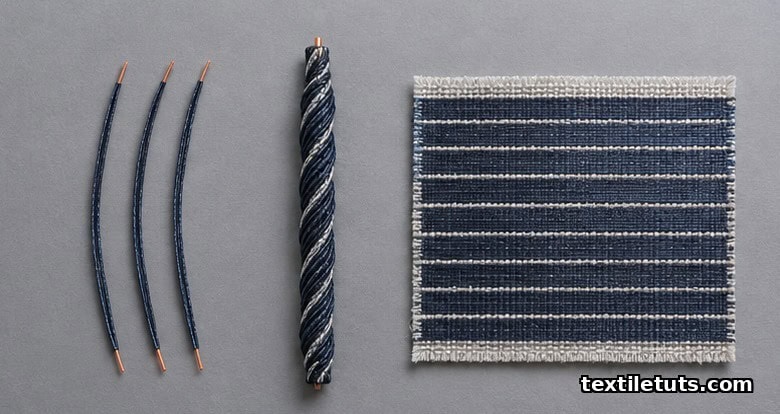
Fiber-shaped cells. The active layers (electrode, photoactive film, counter electrode) are coated onto a single fiber with a typical diameter of 100 to 500 μm. Fiber cells can be woven, knitted, or sewn into a fabric using conventional textile machinery. Reported efficiencies of fiber-shaped perovskite and dye-sensitized solar cells range from 3% to 10%.
Yarn-shaped cells. Multiple fiber cells are twisted or braided into a yarn with diameters of 0.5 to 3 mm. Yarn cells balance higher current output with the mechanical demands of weaving and can carry meaningful current (milliamps per cm of yarn) without the sub-mA output of a single fiber cell.
Substrate-coated fabrics. A continuous thin-film stack is deposited or laminated onto a finished fabric (woven polyester, woven fiberglass, or nonwoven). This is the architecture most often used for architectural membranes and awnings, and is the easiest route to scale because it re-uses existing roll-to-roll coating lines.
Power Output and Efficiency Benchmarks
Published power outputs for photovoltaic textiles cover three orders of magnitude because the cells, the fabric coverage, and the illumination all differ. The table below summarizes representative numbers from peer-reviewed sources.
| Architecture | Active material | Reported efficiency | Typical output |
|---|---|---|---|
| Fiber cell (single) | Dye-sensitized (DSSC) | 3% to 8% | 0.5 to 2 mW per cm of fiber length |
| Fiber cell (single) | Perovskite | 5% to 10% | 5 to 15 mW/cm² |
| Fiber cell (single) | Polymer OPV | 3% to 7% | 3 to 10 mW/cm² |
| Yarn (multi-fiber) | Perovskite | 4% to 8% | 20 to 60 mW per cm of yarn |
| Laminated flat cell on fabric | a-Si:H | 6% to 10% | 60 to 100 W/m² |
| Laminated flat cell on fabric | CIGS | 14% to 17% | 140 to 170 W/m² |
| Laminated flat cell on fabric | Perovskite (flex) | 18% to 23% | 180 to 230 W/m² |
These figures assume AM 1.5G, 1000 W/m², 25 °C cell temperature. Indoor and shaded outputs are 5 to 50 times lower because both the spectrum and the intensity change.
Manufacturing Methods
Three manufacturing routes dominate published work.
Solution coating. Slot-die coating, doctor blading, and dip coating deposit the photoactive layer from solution. Roll-to-roll slot-die coating is the standard route for OPV and perovskite films on flexible substrates, with demonstrated web widths above 300 mm and pilot lines printing tens of meters per minute.
Vacuum deposition. Sputtering, thermal evaporation, and chemical vapor deposition deposit the transparent electrodes, charge transport layers, and (for some perovskite and CIGS routes) the absorber itself. Vapor routes are slower than solution routes but yield more uniform films over large areas.
Thermal and photonic annealing. Perovskite and OPV films require post-deposition annealing at 80 to 150 °C to crystallize the absorber. This range is compatible with high-performance polymer substrates such as PEN and PET but incompatible with low-melt fibers such as LDPE or polypropylene, which rules out direct coating on low-cost commodity fabrics.
Standards That Govern Photovoltaic Textile Performance
Photovoltaic textiles sit at the intersection of two standards families, textile testing and photovoltaic performance testing.
Textile-side standards. ISO 13934-1 and ISO 13934-2 cover tensile properties of woven and knitted fabrics. ISO 105-B02 covers color fastness to artificial light, which matters for the visible appearance of solar fabrics. AATCC TM 135 sets the home-laundering cycle (machine wash at 27 to 60 °C, tumble dry) used in wash-durability tests for solar fabrics. ASTM D5034 covers textile breaking strength and elongation.
Photovoltaic-side standards. IEC 61215 is the design qualification and type approval standard for crystalline silicon modules. IEC 61646 covers thin-film modules (a-Si, CIGS, CdTe). IEC 61730 covers module safety. None of these standards was written with a flexible, washable textile in mind, so several research groups have proposed modified test sequences that combine bending, washing, abrasion (ISO 12947), and light-soaking cycles.
Applications and Use Cases
Four use cases dominate current photovoltaic textile development.
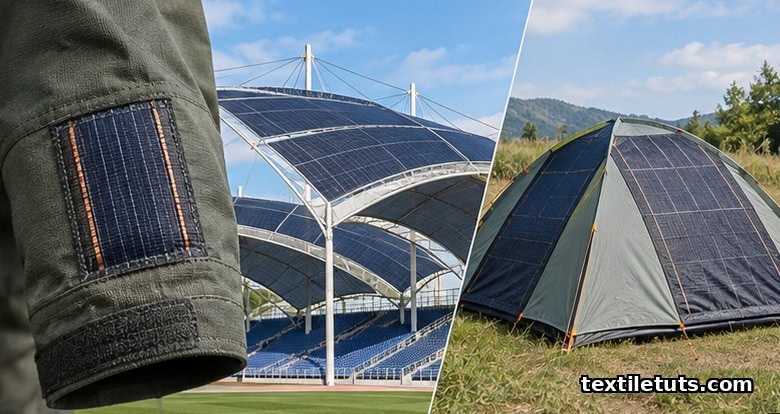
Wearable power for low-drain electronics. Sensor patches, Bluetooth beacons, and textile-integrated health monitors draw 1 to 50 mW. A 100 cm² patch of 10% efficient photovoltaic textile produces roughly 100 mW at noon, which is enough to trickle-charge a battery that powers the sensor day after day without manual reconnection.
Architectural membranes. Tensile structures, stadium roofs, and parking canopies use coated fabrics as the structural skin. Replacing standard PVDF-coated polyester with a CIGS or perovskite-coated textile skin adds electricity generation to a building element that is already installed, with no extra footprint.
Outdoor and marine textiles. Sailcloth, awnings, biminis, and camping tents are obvious candidates. The challenge is salt-water exposure (Cl⁻ ingress corrodes metal electrodes), UV dose at high latitudes, and abrasion from wind-driven sand.
Military and emergency response. Solar tents, ponchos, and field chargers reduce battery weight for troops and disaster-response teams. Several government programs fund research in this category, and fielded prototypes exist for charging radios, GPS, and medical sensors.
Challenges and Limitations
Three classes of challenges keep photovoltaic textiles from mainstream adoption.
Efficiency gap. Even the best flexible thin-film cells (perovskite at 23%) lag rigid silicon modules (26% to 27%). When a textile covers only 60% to 80% of the visible area (because of cell-to-cell spacing and weft gaps), the effective area efficiency drops by another 20% to 40%, and the system reaches only 30% to 50% of the output of a same-area rigid panel.
Durability. Rigid PV modules are qualified for 25 to 30 years outdoors. Photovoltaic textiles have not yet demonstrated equivalent lifetimes. Wash cycles (AATCC TM 135), abrasion (ISO 12947), and UV exposure each stress the cell stack differently, and combined stress accelerates degradation beyond what single-stress tests predict.
Encapsulation. A textile cell needs to survive water, soap, sweat, and mechanical flex. Standard PV encapsulation (EVA between two glass layers) is too stiff and too heavy for a wearable fabric. Flexible encapsulants such as TPU and ionomer films are an active research area, and recent peer-reviewed work reports 50 wash-cycle survival with TPU-encapsulated OPV textiles.
Frequently Asked Questions
How efficient are photovoltaic textiles compared with rooftop solar panels?
The best laboratory photovoltaic textiles reach 20% to 23% power conversion efficiency under AM 1.5G illumination, which is close to a 26% efficient rooftop silicon panel. Real-world fabric coverage and shading reduce the textile’s effective output to roughly half of its measured cell efficiency, so a 20%-efficient fabric typically delivers the same daily energy as a 10%-effective rigid panel.
Can photovoltaic textiles be washed?
Most published prototypes tolerate gentle hand washing and low-speed machine cycles, but they fail under standard AATCC TM 135 home laundering. Encapsulation with TPU or ionomer films is the current path to washable cells, with washing tests reported up to 50 cycles in peer-reviewed work, although none of the prototypes has yet demonstrated the 200+ cycles expected of a normal garment.
How much power can a 1 m² photovoltaic textile generate?
A 1 m² perovskite-coated fabric at 18% module efficiency generates about 180 W at peak sun. A 1 m² amorphous-silicon fabric at 8% generates about 80 W. Cloud cover, latitude, and time of day reduce the daily energy harvest to roughly 0.3 to 0.6 kWh per m² per day in temperate climates, which is enough to charge a smartphone 20 to 40 times per square meter of fabric.
Are photovoltaic textiles safe to wear against the skin?
Cells contain lead (in lead-halide perovskites) or other heavy metals (indium, gallium, selenium in CIGS). Published safety studies report that intact, encapsulated cells do not release measurable metal in sweat, but damaged cells are a known exposure risk because lead leaching from a cracked perovskite layer can exceed skin-contact safety thresholds. Skin contact should sit behind a barrier layer such as a TPU film or a separate inner liner.
How long do photovoltaic textiles last outdoors?
No published study to date has demonstrated 25-year outdoor service for a photovoltaic textile. Encapsulated flexible perovskite modules have passed IEC 61215 accelerated stress sequences in laboratory settings, which is a positive indicator for thermal cycling and mechanical load, but real-world field data cover only 1 to 3 years for most published prototypes, and accelerated tests under combined UV, wash, and abrasion are still an open research area.
References
- National Renewable Energy Laboratory. “Best Research-Cell Efficiency Chart.” https://www.nrel.gov/pv/cell-efficiency.html — Tracking record for certified solar-cell efficiencies (perovskite, OPV, silicon, CIGS).
- Yang, Z.; Deng, J.; Sun, X.; Li, H.; Peng, H. “Self-Powered Energy Fiber.” Advanced Materials (2014). — Integrated fiber combining photovoltaic and electrochemical storage functions from Fudan University.
- Peng, H. “Fiber-shaped energy harvesting and storage devices.” Advanced Materials (2014). — Review of fiber photovoltaic architectures and integration with textile processing.
- Snaith, H. J. “The path to 25% silicon solar cell efficiency: the role of perovskites.” Nature Energy (2016). — Overview of perovskite photovoltaic technology and the path to high efficiency.
- Li, Y.; et al. “Wearable solar cells based on fiber-shaped dye-sensitized solar cells.” Advanced Materials (2014). — Fiber-shaped DSSC textile demonstrations.
- Hashemi, S. A.; Ramakrishna, S.; Aberle, A. G. “Recent progress in flexible-wearable solar cells for self-powered electronic systems.” Energy & Environmental Science (2020). — Review of flexible and wearable photovoltaic devices.
- ISO 13934-1:2013. “Textiles — Tensile properties of fabrics — Part 1: Determination of maximum force and elongation at maximum force using the strip method.” — Standard for tensile testing of woven and knitted fabrics.
- ISO 105-B02:2014. “Textiles — Tests for colour fastness — Part B02: Colour fastness to artificial light.” — Standard for color-fastness testing under artificial daylight.
- AATCC TM 135. “Dimensional Changes of Fabrics After Home Laundering.” — Standard home-laundering cycle used in photovoltaic textile wash testing.
- ASTM D5034-21. “Standard Test Method for Breaking Strength and Elongation of Textile Fabrics (Grab Test).” — Textile breaking strength reference.
- IEC 61215-1:2021. “Terrestrial photovoltaic (PV) modules — Design qualification and type approval — Part 1: Test requirements.” — Standard for PV module qualification applicable to thin-film flexible modules.
Editorial by Md. Asad Ullah (Meem), TextileTuts. Sources: peer-reviewed literature on photovoltaic textiles and applicable ISO, AATCC, ASTM, and IEC standards as cited above.


