
Phosphorescent Printing

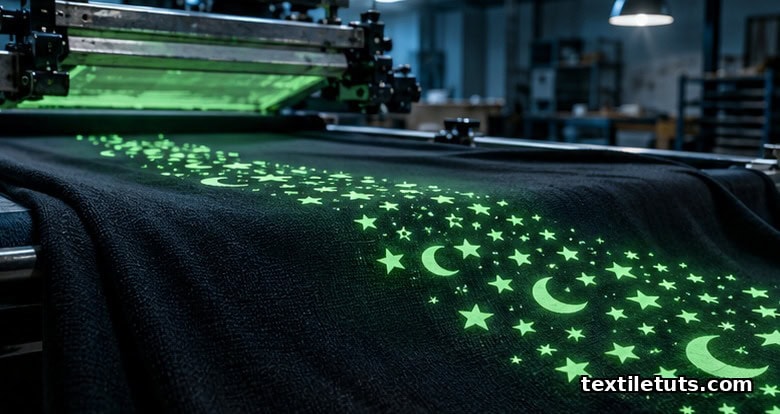
Phosphorescent printing on textiles uses rare-earth-doped strontium aluminate (SrAl₂O₄:Eu²⁺,Dy³⁺) pigments, which absorb ambient light at wavelengths of 200–450 nm and emit a visible afterglow for 8–12 hours at peak luminance above 0.32 mcd/m², the DIN 67510-1 minimum for safety-grade markings.
This is significantly brighter and longer-lasting than the older zinc sulfide (ZnS:Cu) pigments, which typically fade below the DIN threshold within 30–60 minutes of light removal.
This article covers the pigment chemistry behind the afterglow, how the printing paste is formulated, durability under repeated washing, the international standards that govern any “glow time” claim, and the practical applications where a phosphorescent print earns its 3–8× price premium over standard pigment printing.
What Phosphorescent Printing Actually Is
Phosphorescent printing is a textile coloration technique that deposits a layer of long-afterglow photoluminescent pigment onto the fabric surface, typically via screen printing with a pigment-binder paste. The pigments store energy from ambient or UV light and re-emit it as a visible glow for hours after the light source is removed.
The term is sometimes confused with fluorescent printing, but the two describe different physical phenomena and produce visibly different end products. Fluorescent pigments emit only while a UV or short-wavelength source is active, often within 10⁻⁹ to 10⁻⁶ seconds of excitation. Phosphorescent pigments keep glowing because the absorbed energy is trapped in metastable energy states inside the crystal lattice and is released slowly through thermally activated electron transitions.
For textiles, two pigment families dominate the market. The older zinc sulfide system (ZnS doped with copper, often co-doped with cobalt or manganese) produces a green to blue-green afterglow that typically drops below 0.3 mcd/m² within an hour. The newer strontium aluminate system (SrAl₂O₄ doped with europium and dysprosium) produces a green afterglow at roughly 520 nm that holds measurable luminance for 8–12 hours after a single 5-minute light exposure.
The Chemistry of the Afterglow
Strontium aluminate owes its performance to a two-step energy mechanism first commercialized in the mid-1990s. Europium (Eu²⁺) ions substitute into the SrAl₂O₄ lattice and serve as the luminescent centers. When UV or short-wavelength visible light hits the crystal, Eu²⁺ absorbs a photon, promoting an electron from the 4f⁷ ground state to the 4f⁶5d¹ excited state.
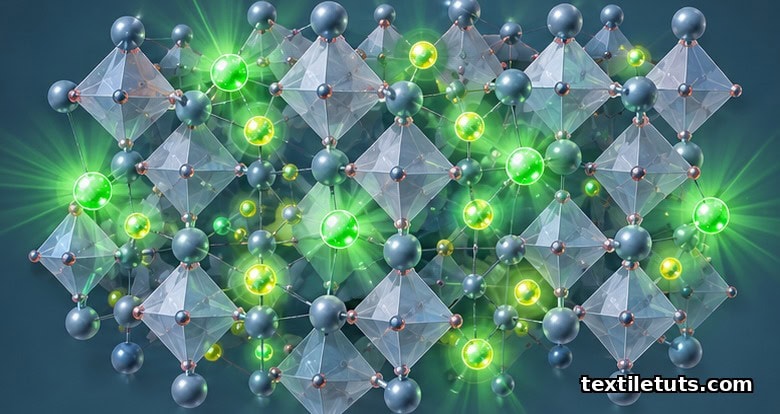
The dysprosium (Dy³⁺) ions act as electron traps. Excited electrons from Eu²⁺ migrate to Dy³⁺ sites, where they sit in metastable states just below the conduction band. Thermal energy at room temperature is enough to release these electrons gradually, and they fall back through Eu²⁺, emitting photons at about 520 nm (green) in the process. The release rate is what gives the afterglow its hours-long decay profile.
Particle size matters for textile printing. Most commercial SrAl₂O₄:Eu,Dy pigments are milled to a D50 of 15–45 µm so they pass through standard screen mesh counts of 60–120 without clogging, while still providing enough crystal volume per pigment particle to store a meaningful charge.
How the Printing Paste Is Built
Phosphorescent textile inks are pigment pastes, not dye solutions, so the recipe has three working components: pigment, binder, and rheology modifier.
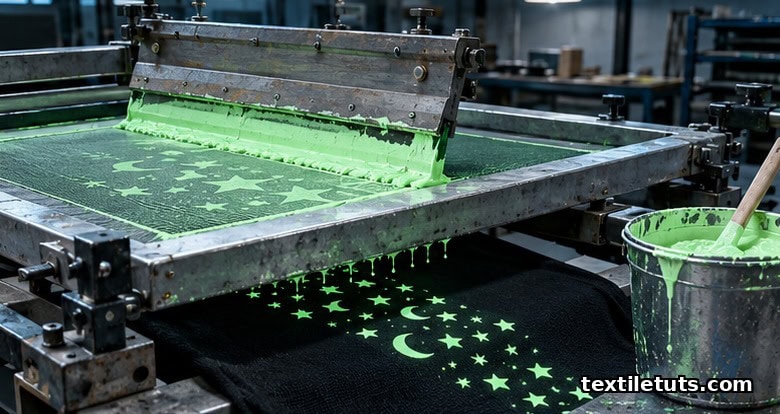
The pigment loading is typically 25–45% by weight of the paste, with higher loadings giving brighter afterglow but stiffer hand feel. For apparel, printers usually stay at 25–35% to keep the fabric flexible. For safety signage or trim where hand feel is irrelevant, loadings can climb to 50%.
The binder is usually an acrylic emulsion or a polyurethane (PU) dispersion, applied at 20–35% of the paste weight. Acrylics are cheaper but tend to yellow under heavy pigment loading. PU binders give better flexibility and washing durability but cost 2–4× more per kilo. A thickener (typically a polyacrylate or modified cellulose at 1–3%) brings the viscosity to the 8,000–15,000 mPa·s range that screen printing needs.
Curing is critical. The print must reach 140–160 °C for 3–5 minutes to fully crosslink the binder, encapsulate the pigment particles, and lock the print against washing. Under-cured prints lose 40–60% of their afterglow in the first wash cycle because unbound pigment particles wash off the surface.
Standards That Govern the Afterglow Claim
Three standards govern how phosphorescent performance is measured and classified, and they are why a “8-hour glow” label on a printed textile carries an enforceable claim rather than marketing copy.
DIN 67510-1:2009 defines afterglow time as the time the material remains above 0.32 mcd/m² after the excitation source is removed. Safety-grade phosphorescent markings must meet a minimum of 8 hours above this threshold under standard D65 excitation. High-performance SrAl₂O₄:Eu,Dy systems typically meet the 10-hour class.
ASTM E2072-14 specifies the photoluminescent requirements for safety markings in buildings and on equipment, including a charging time of 5 minutes under a 21.6 lux xenon arc lamp and a 90-minute minimum afterglow above 0.017 mcd/m² for exit-path markings.
ISO 17398:2004 classifies safety signs by afterglow performance into classes A through F, with class C requiring 40 minutes above 7 mcd/m² and 200 minutes above 0.3 mcd/m². ISO 7010 specifies the safety sign pictograms that may use these photoluminescent bases.
Wash Durability and Real-World Performance
The wash durability of a phosphorescent print depends primarily on binder choice and curing, not on the pigment itself. SrAl₂O₄:Eu,Dy pigment particles are chemically inert and do not degrade in detergent at normal wash pH (5.5–8.5) or in the presence of optical brighteners.
What degrades is the pigment-binder interface. A well-cured print on polyester-cotton blend at 40% pigment loading typically retains 70–80% of initial afterglow luminance after 30 ISO 6330 wash cycles at 40 °C. After 50 cycles, that drops to 50–60%. By 100 cycles, most standard acrylic-bound prints are operating at 20–30% of the initial brightness, which still passes DIN 67510 visibility thresholds for indoor safety wear but starts to fall short for emergency signage applications.
PU-bound prints roughly double this durability. Industrial wash tests at 60 °C with perchloroethylene dry cleaning (ISO 3175) show PU-bound SrAl₂O₄ prints retaining 75–85% of afterglow after 50 cycles, which is why PU is the binder of choice for workwear and rental-textile applications.
UV exposure is a different story. Direct sunlight (peak irradiance around 1,000 W/m²) accelerates the degradation of the dysprosium trap states, and a print left on a sunlit window can lose 30% of afterglow capacity after 200 hours of UV-A exposure. For outdoor applications, UV absorbers in the print paste are non-negotiable.
Where Phosphorescent Printing Earns Its Place
The premium over standard pigment printing (roughly 3–8× cost per square meter) means phosphorescent prints only make sense where the afterglow adds a real function or a clear aesthetic payoff.
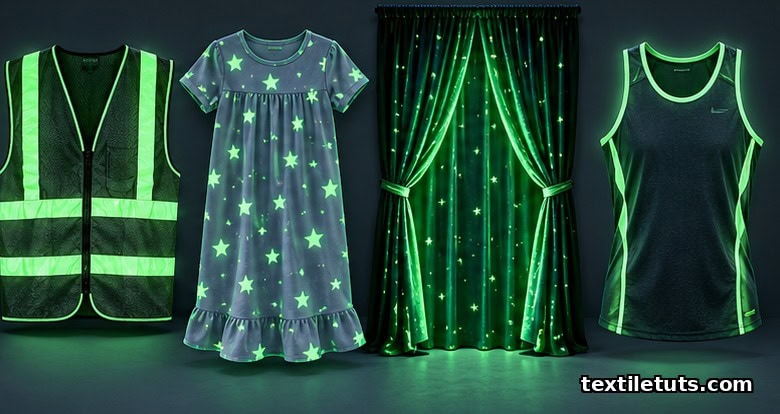
Safety wear and emergency egress gear is the largest volume application. Low-location lighting systems on commercial aircraft, ship deck markers, evacuation route markings in hotels and tunnels, and high-visibility trim on firefighting gear all depend on photoluminescent textiles that meet ISO 17398 or IMO Resolution A.752(18) standards.
Children’s wear and party textiles are a growing retail segment. Nightwear, costume fabric, and festival apparel use SrAl₂O₄:Eu,Dy prints because the afterglow survives repeated home laundering and is bright enough to be a feature rather than a footnote.
Stage and event textiles, including dance costumes, props, and theatrical backdrops, use phosphorescent printing where UV-charging stage lights double as the excitation source. The afterglow creates a visible trail effect during blackouts.
Performance and outdoor apparel is a smaller but high-margin segment. Running and cycling garments with phosphorescent trim print on top of a base retroreflective layer, and the combined print gives both daylight visibility (from retroreflection) and residual visibility in low light (from phosphorescence) for 30–60 minutes after sunset.
Phosphorescent vs Fluorescent: The Frequent Mix-Up
The terms “phosphorescent” and “fluorescent” are used interchangeably in casual textile marketing, but they describe different physical phenomena and produce visibly different end products.
Fluorescent pigments (such as the optical brighteners used in paper or the rhodamine-based dyes used in high-vis safety vests) absorb high-energy photons and re-emit lower-energy photons almost instantly, typically within 10⁻⁹ to 10⁻⁶ seconds. The moment the excitation source is removed, the emission stops.
Phosphorescent pigments, by the standard IUPAC definition, persist in emission for longer than 10⁻⁸ seconds after excitation, and modern SrAl₂O₄:Eu,Dy systems persist for hours. The “glow-in-the-dark” effect that consumers expect a phosphorescent textile to deliver is strictly a phosphorescence phenomenon.
In practical textile terms, a fluorescent high-vis vest disappears the moment a car’s headlights pass, while a phosphorescent trim keeps glowing for hours afterward. Both have their place, and they are often combined on the same garment to give layered visibility through the dusk-to-night transition.
Frequently Asked Questions
How long does a phosphorescent print actually glow?
A DIN 67510-class SrAl₂O₄:Eu,Dy print on cotton-polyester holds measurable luminance above 0.32 mcd/m² for 8–12 hours after a 5-minute charge under D65 light. The first 30 minutes are when the glow is most visible to the dark-adapted eye; after 4–6 hours the luminance has typically dropped to 1–5% of peak but is still detectable.
Is phosphorescent printing safe for skin-contact garments?
Yes, when the print is fully cured and the pigment particles are encapsulated in the binder. SrAl₂O₄:Eu,Dy pigment is non-toxic and non-radioactive, unlike the older radium-based luminous paints used in mid-20th-century watch dials. OEKO-TEX Standard 100 certified phosphorescent inks are available from several European manufacturers for children’s wear and sleepwear applications.
Does phosphorescent printing work on dark fabrics?
Yes, and it actually performs better on dark ground than on white, because the dark background absorbs any scattered ambient light and lets the afterglow read more cleanly. Most safety-grade phosphorescent textiles are made on black or navy polyester-cotton for exactly this reason. The trade-off is that the daylight appearance of the print is masked by the dark ground, which is acceptable for safety trim but not for decorative uses where the printed area needs to be visible by day.
Can you phosphorescent print at home with a hobby heat press?
Partially. Pre-made phosphorescent heat-transfer vinyl (HTV) sheets are widely available and cuttable on hobby vinyl cutters, then applied at 160 °C for 15 seconds. The afterglow performance of these consumer films is roughly half of what a properly cured screen-printed paste achieves, and durability drops to 10–20 wash cycles before significant fading, but for a costume or a child’s nightlight shirt they work well.
What is the biggest mistake when printing phosphorescent textiles?
Under-curing. Phosphorescent pigments absorb heat during curing, and a print that does not reach at least 140 °C for a full 3 minutes will have pigment particles sitting loosely on the fabric surface rather than locked into a binder film. The first wash cycle removes 40–60% of the unbonded pigment, and the afterglow looks like it has failed even though the pigment itself is fine. Always verify cure temperature with a contact thermometer on the actual substrate, not just the oven thermostat.
References
- Matsuzawa, T., Aoki, Y., Takeuchi, N., & Murayama, Y. (1996). A new long phosphorescent phosphor with high brightness, SrAl₂O₄:Eu²⁺,Dy³⁺. Journal of the Electrochemical Society, 143(8), 2670–2673. ResearchGate / IOP Science publication record.
- DIN 67510-1:2009. Photoluminescent pigments and products — Part 1: Measurement and marking of the afterglow behaviour. Beuth Verlag.
- ASTM E2072-14. Standard Specification for Photoluminescent (Phosphorescent) Safety Markings. ASTM International.
- ISO 17398:2004. Safety colours and safety signs — Classification, performance and durability of safety signs. International Organization for Standardization.
- ISO 6330:2021. Domestic washing and drying procedures for textile testing. International Organization for Standardization.
- IMO Resolution A.752(18) (1993). Guidelines for the approval of low-location lighting (LLL) systems on passenger ships. International Maritime Organization.
Editorial by Shahrukh Islam, TextileTuts. Sources: Matsuzawa et al. 1996 (Journal of the Electrochemical Society); DIN 67510-1:2009; ASTM E2072-14; ISO 17398:2004; ISO 6330:2021; IMO Resolution A.752(18) as cited.


