
Glitter Printing

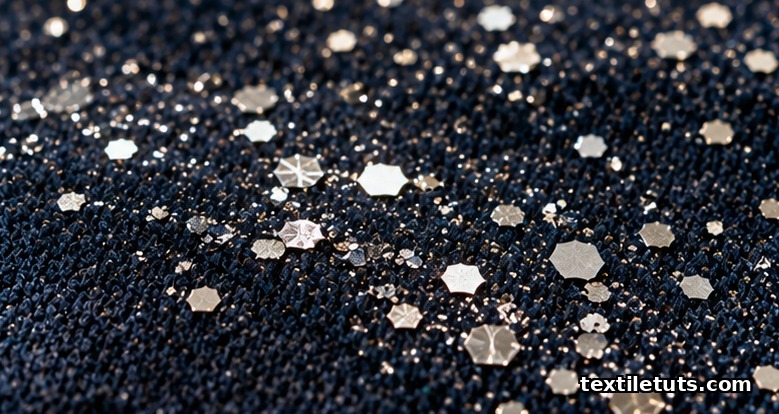
Glitter printing is a textile decorating process that bonds 0.1–0.4 mm precision-cut flakes of vacuum-metallized PET (polyethylene terephthalate) film to fabric using a cured textile adhesive, applied at 150–170 °C for 15–30 s and evaluated against AATCC TM61, ISO 105-C06, and ISO 6330 wash protocols. The visual effect depends on flake size, hex-cut geometry, and metal-layer thickness; the durability depends on adhesive chemistry, cure temperature, and post-cure pressure.
Glitter printing sits between decorative foil printing and pigment printing, and it behaves mechanically like a bonded particulate coating rather than a continuous film. This article walks through the materials, the application routes, the durability numbers reported in industry testing, and the questions textile engineers ask before specifying a glitter finish for production.
What Glitter Actually Is
Textile-grade glitter is not craft glitter. It is precision-cut flakes of biaxially oriented polyethylene terephthalate (BoPET) film, vacuum-metallized on one face with a thin aluminum layer (typically 30–80 nm) and often top-coated with a clear epoxy or acrylic lacquer to slow oxidation of the metal. The film is slit into hexagonal, square, or rectangular shapes; hexagonal cuts dominate because the six-sided geometry packs with fewer overlap zones and produces a more uniform sparkle field.
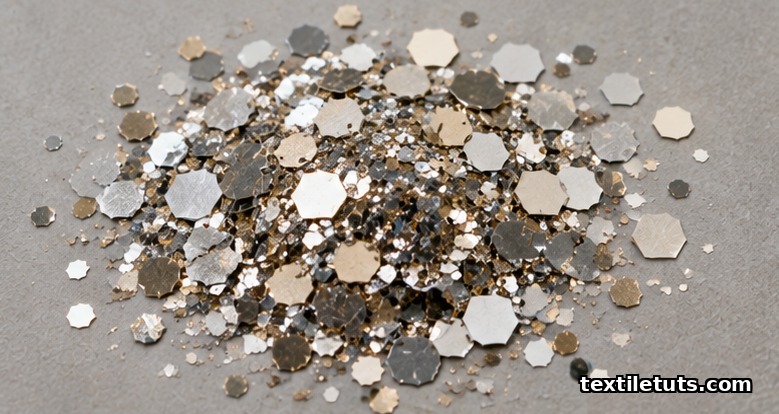
Standard flake grades used in textile printing cluster in three size bands:
- 0.004 inch (≈0.10 mm) — fine “shimmer” cuts for screen printing through 60–80 mesh
- 0.008 inch (≈0.20 mm) — mid-cut glitter for 40–60 mesh screens and heat-transfer films
- 0.015 inch (≈0.38 mm) — chunky glitter for hand-applied effects, limited machine-wash durability
Particle shape, cut tolerance, and metal-layer uniformity are the three variables that separate industrial glitter from craft glitter. The metal-layer thickness in particular drives both reflectivity and the tendency of the flake to bend or “pill” during wear.
Application Methods
Three production routes dominate commercial glitter printing on apparel and accessories.
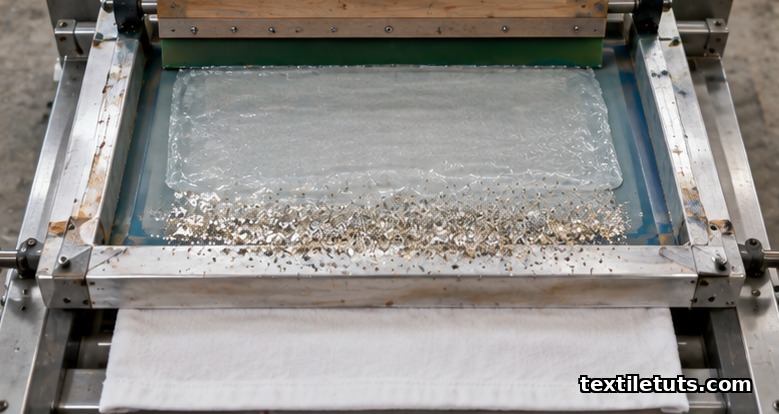
1. Wet adhesive screen printing. A textile-grade plastisol or water-based polyurethane adhesive is printed through a 25–40 mesh screen, the glitter is sprinkled or “dusted” across the wet adhesive, excess is vacuum-recovered, and the fabric is cured at 150–170 °C for 15–30 s. This is the dominant method for cotton-rich knit fabrics used in dancewear and children’s apparel because plastisol chemistry tolerates high cure temperatures without yellowing.
2. Heat-transfer glitter film. Glitter is pre-bonded to a carrier film with a thermoplastic hot-melt adhesive (typically a copolyester or TPU). The composite is cut, weeded, and pressed onto the garment at 150–160 °C for 10–15 s under 3–5 bar pressure. Heat-transfer glitter is the dominant route for small-batch customization and for graphics that require sharp edges, such as team logos and monograms.
3. Electrostatic deposition. Used in specialty mills, charged glitter flakes are sprayed through an electrostatic field onto a tacky adhesive printed on the substrate. This produces denser coverage with less adhesive mass but requires humidity-controlled production halls.
All three routes depend on a fully cured adhesive film. Under-cured adhesive is the single most common cause of glitter loss in the first wash cycle.
Fabric Suitability
Glitter printing behaves differently across fiber types. Woven cotton and cotton-polyester blends accept plastisol adhesive most readily because the flat, dimensionally stable weave surface allows consistent adhesive film thickness. Knit fabrics, especially single-jersey cotton and cotton-Lycra blends, require lower cure temperatures (≤160 °C) to prevent shrinkage that disrupts the glitter-adhesive bond.
Polyester substrates present a different challenge. The cure window of the adhesive overlaps with the heat-setting window of the fiber (around 160–180 °C for most PET woven fabrics), so the adhesive must be formulated for low-cure activation. Heat-transfer glitter films generally outperform wet adhesive on 100% polyester because the transfer adhesive cures at a lower temperature than the polyester heat-set point.
Elastane-containing fabrics (above 5% spandex) impose an additional constraint. Any glitter finish must stretch with the fabric. Rigid glitter-adhesive composites crack and shed particles at elongations above 30%. For activewear, TPU-based heat-transfer films rated for 50–80% elongation are the typical specification.
Wash Fastness and Abrasion Numbers
Two standardized test families predict how a glitter print will survive domestic laundering and wear:
- AATCC TM61 (colorfastness to laundering) — accelerated home-laundry simulation at 40 °C.
- ISO 105-C06 (colour fastness to domestic and commercial laundering) — single-cycle reference.
- ISO 6330 — domestic washing and drying procedures for textile testing.
- ASTM D4966 (Martindale abrasion) — rub resistance of the bonded glitter surface.
- AATCC TM8 (colorfastness to crocking) — dry and wet rub transfer.
Industry test data on metallized-particle prints report that a properly cured plastisol glitter print typically retains 85–95% of its original particle count after 10 wash cycles per ISO 6330 procedure 4N (40 °C, normal agitation, flat dry). The same prints drop to 60–75% retention after 30 cycles. Heat-transfer glitter films usually lose 15–25% of particles in the first five cycles because the edge seal of the transfer adhesive fails at fold points before the bulk adhesive loses adhesion.
Abrasion data are reported in cycles to first visible particle loss on a Martindale apparatus (ASTM D4966, 9 kPa load, worst-case surface). Plastisol-bound glitter on woven cotton averages 5,000–8,000 cycles; heat-transfer glitter on polyester averages 2,500–4,500 cycles; electrostatic-deposit glitter on polyurethane-coated substrates averages 8,000–12,000 cycles.
Comfort, Safety, and Environmental Notes
Glitter particles are a comfort constraint because each flake adds local stiffness to the fabric. On a single-jersey knit, a 30–40% area coverage of 0.20 mm glitter raises the bending stiffness of the print zone roughly 3–5× over the unprinted substrate. This is why most production prints localize glitter to graphics rather than using it as an all-over finish. For skin-contact garments, the printed surface is usually backed with a soft-feel laminate or printed on the reverse side of the fabric.
Safety testing focuses on two failure modes: particle release during wear (small flakes can detach and become eye-irritation hazards, particularly in children’s wear) and edge sharpness of poorly cut flakes. OEKO-TEX Standard 100 class II testing, used for skin-contact textiles, requires that loose glitter particles not exceed 1 mg/kg of fabric mass after a tumble test. Most plastisol-bonded prints meet this figure when the adhesive film is fully cured.
End-of-life is the open question. PET glitter does not readily dissolve in standard textile-recycling processes, and metallized PET cannot be mechanically recycled into new fiber without delaminating the aluminum layer. Glitter-decorated fabrics are typically downcycled into non-woven substrates or shoddy, not re-spun into new apparel yarn.
Glitter Printing vs Foil Printing vs Metallic Pigment
| Property | Glitter print | Foil print | Metallic pigment print |
|---|---|---|---|
| Reflective element | Cut PET flake + Al layer | Continuous Al/PET foil | Flake pigment in binder |
| Particle size | 0.1–0.4 mm flakes | Continuous film | 10–100 µm pigment |
| Typical coverage | 30–60% area | 5–25% area (logos) | 100% area possible |
| Hand (feel) | Stiff, sandy | Smooth, plastic | Smooth, soft |
| Wash cycles to 80% retention | 10–20 (ISO 6330) | 5–15 | 30–50 |
| Cost per m² (production) | Medium–high | High (foil carrier waste) | Low–medium |
| Recyclability of print | Poor | Poor | Moderate |
The choice is essentially a trade-off between sparkle intensity and process economics. Glitter gives the most visible particle sparkle but adds the most stiffness and the most recycling friction. Metallic pigment prints give the least sparkle but behave like a standard pigment print during wear and aftercare.
Frequently Asked Questions
Does glitter printing come off in the wash?
Some glitter loss in the first 3–5 wash cycles is normal because edge particles of the print sit at the perimeter of the cured adhesive and are mechanically lifted by agitation. Properly cured plastisol-bonded glitter typically retains 85–95% of particles after 10 cycles per ISO 6330 4N. Wash inside-out at 30 °C, avoid tumble drying on high heat, and skip fabric softener, since softeners can swell the adhesive and accelerate edge lift.
Is glitter printing safe for children’s clothing?
Glitter-bonded prints that meet OEKO-TEX Standard 100 class II limits on extractable heavy metals and pass the loose-particle tumble test are considered acceptable for skin-contact garments including children’s wear. The remaining risk is mechanical: detached glitter particles can irritate eyes, so avoid glitter on infant sleepwear and on garments for children under three years.
Can you glitter print polyester or stretch fabric?
Yes, but specify heat-transfer glitter films with TPU adhesive rated for at least 50% elongation rather than plastisol wet adhesive. Plastisol cure temperatures overlap with polyester heat-set windows (160–180 °C) and can shrink or distort the substrate. For elastane blends above 5%, request a stretch-test report from the printer showing particle retention after 5,000 stretch cycles.
What mesh count should I use for screen-printing glitter?
Match mesh count to glitter flake size. 0.10 mm flakes print cleanly through 60–80 mesh; 0.20 mm flakes need 40–60 mesh; 0.38 mm flakes are too large for rotary screen printing and are typically applied by hand or via a dedicated shaker. Under-meshing causes screen blockage and uneven adhesive film. Over-meshing drops adhesive mass and reduces bond strength.
How is glitter fabric tested for durability?
The standard battery is AATCC TM61 (or ISO 105-C06) for wash fastness, AATCC TM8 for crocking, and ASTM D4966 for Martindale abrasion. Reports should quote the number of cycles to first visible particle loss, the wash-cycle rating (for example “10 cycles at 4N”), and a before-and-after image at standardized lighting. A print that loses more than 20% of particles in the first five wash cycles is generally rejected by major apparel brands.
References
- ASTM International. ASTM D4966 — Standard Test Method for Abrasion Resistance of Textile Fabrics (Martindale Abrasion Tester Method). https://www.astm.org/d4966 — abrasion testing of bonded particle surfaces on textiles.
- AATCC. Test Method 61 — Colorfastness to Laundering: Accelerated. https://www.aatcc.org — five-cycle accelerated laundering protocol for print durability.
- ISO. ISO 105-C06:2010 — Textiles — Tests for colour fastness — Part C06: Colour fastness to domestic and commercial laundering. https://www.iso.org — single-cycle reference for colorfastness.
- ISO. ISO 6330:2021 — Domestic washing and drying procedures for textile testing. https://www.iso.org — procedure 4N (40 °C, normal agitation) is the standard reference for home-laundry simulation.
- AATCC. Test Method 8 — Colorfastness to Crocking: AATCC Crockmeter Method. https://www.aatcc.org — dry and wet rub transfer of bonded decorative particles.
- ISO. ISO 105-X12:2016 — Textiles — Tests for colour fastness — Part X12: Colour fastness to rubbing. https://www.iso.org — European equivalent of the AATCC crocking test.
- OEKO-TEX Association. Standard 100 by OEKO-TEX — Annex 4, Class II Limits. https://www.oeko-tex.com — extractable-substance limits for skin-contact textiles including bonded decorative prints.
Editorial by Shahrukh Islam, TextileTuts. Sources: ASTM D4966, AATCC TM61, ISO 105-C06, ISO 6330, AATCC TM8, ISO 105-X12, OEKO-TEX Standard 100 as cited.


