
Phase-Change Materials (PCM) in Textiles

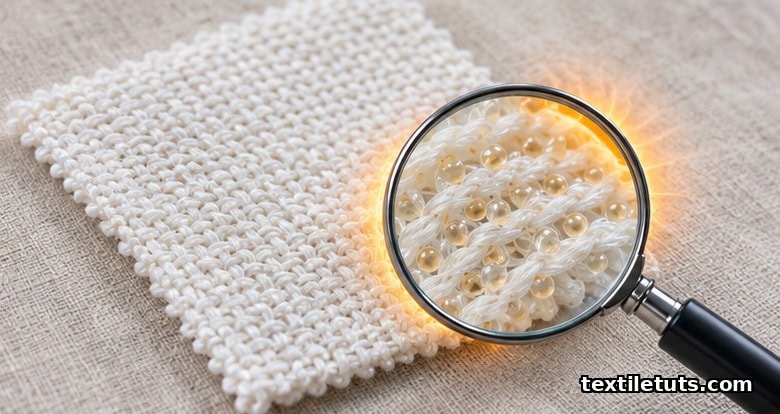
Phase-change materials (PCMs) absorb 150–250 kJ/kg of latent heat during a solid–liquid transition near skin temperature (typically 28–32 °C), which is why PCM-microcapsule-treated fabrics can buffer a wearer’s microclimate against temperature swings of 2–4 °C for 20–50 laundry cycles.
This buffering works because the encapsulated paraffin inside each 1–10 µm microcapsule melts when the body heats up and re-solidifies when it cools, acting as a thermal capacitor woven directly into the fabric.
Below, we explain what PCMs are, how they get into textile fibers, the test methods that measure their performance, the real durability limits, and where the technology is heading.
What Phase-Change Materials Are and Why Textiles Use Them
Phase-change materials are substances that store and release large amounts of thermal energy during a phase transition, most commonly solid to liquid and back, at a narrow, controllable temperature range. The latent heat of fusion absorbed or released at that transition is what makes them useful for thermal management. Paraffin-based n-alkanes such as n-eicosane (C20), n-heneicosane (C21), and n-docosane (C22) are the workhorses of textile-grade PCMs because their melting points (36–44 °C for the C20–C22 range) sit close to human skin temperature, and their latent heat values (around 160–250 kJ/kg) are among the highest of any organic PCM.
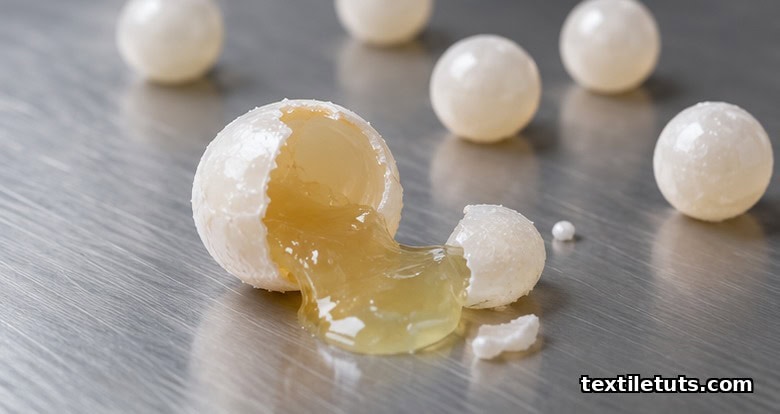
Salt hydrates (such as Glauber’s salt, Na₂SO₄·10H₂O, with a melting point near 32 °C and latent heat of about 254 kJ/kg) are a second family, though they are more commonly used in construction panels than apparel because of supercooling and phase-segregation issues. For clothing, the textile industry has standardized on microencapsulated paraffin PCMs, where the paraffin core is sealed inside a polymer shell (typically melamine formaldehyde or acrylic) that protects the wax from mechanical damage and from leaching during washing.
The concept originated in NASA’s space program in the 1980s, where microencapsulated PCMs were developed to protect astronauts from extreme temperature swings. The technology was commercialized for clothing by Outlast Technologies in the 1990s and has since spread across athletic, workwear, bedding, and medical-textile applications.
How PCMs Are Applied to Textiles
There are three main routes for incorporating PCM microcapsules into a textile:
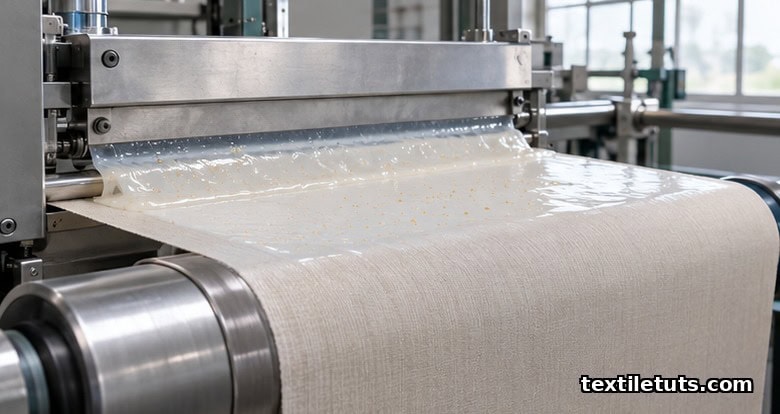
1. Coating or padding. PCM microcapsules are dispersed in an aqueous binder (acrylic, polyurethane, or silicone-based) and applied to fabric by knife coating, foam coating, or pad-dry-cure. Add-on levels are typically 15–30% by fabric weight. This is the most common method for woven and knitted outerwear and for bedding.
2. Melt extrusion into synthetic fibers. PCM microcapsules are compounded into the polymer melt before fiber spinning, so the capsules are embedded inside the fiber itself rather than sitting on the surface. Polyester and polypropylene staple fibers containing 5–20% PCM microcapsules by weight have been commercialized for thermal underwear and socks.
3. Foam or laminate incorporation. For some nonwoven and shoe-lining applications, PCM microcapsules are mixed into polyurethane foam or bonded into multi-layer laminates where the PCM layer is sandwiched between two fabric faces.
The first two routes dominate because they survive laundering better than surface coatings, with PCM add-on in acrylic-coated fabrics typically losing 30–40% of its thermal-storage capacity after 20 wash cycles at 40 °C, while fiber-incorporated PCM can retain 70–80% of capacity over the same number of cycles.
How PCM-Textile Performance Is Measured
Three test methods matter most:
- ISO 11092 (or its ASTM equivalent ASTM F1868, Part C) measures thermal resistance and water-vapor resistance of a fabric using a sweating guarded-hot-plate. It quantifies how much heat passes through a fabric under fixed environmental conditions. PCM fabrics typically show 10–30% higher thermal-resistance values than untreated controls when measured through a dynamic temperature cycle that crosses the PCM transition point.
- AATCC TM135 evaluates dimensional change after home laundering, and is used here as a proxy for PCM durability: the test specifies washing temperatures of (27 ± 3) °C, (41 ± 3) °C, or (60 ± 3) °C, with tumble-dry cycles. PCM-treated fabrics are normally characterized after 5, 10, 20, and 50 cycles to track latent-heat loss by differential scanning calorimetry (DSC).
- DSC (ISO 11357-1) is the direct thermal method: a small fabric sample is heated and cooled at a controlled rate (typically 5–10 °C/min) while heat flow is recorded, giving the melting point, crystallization point, and enthalpy (latent heat) in J/g of fabric. A 200 g/m² cotton fabric with 25% PCM add-on typically registers 20–40 J/g of fabric enthalpy, which corresponds to roughly 8–16 g of paraffin per square meter.
For protective apparel, ASTM F2731 and ASTM F2732 add cold-protective and heat-protective rating tests that simulate a sudden thermal exposure, and ASTM D7024 covers the thermal-protective performance of fabrics for clothing against short-duration flame exposure.
PCM Properties: Paraffin vs Salt Hydrate vs Bio-Based
| Property | n-Alkane paraffin (C18–C22) | Salt hydrate (e.g. Na₂SO₄·10H₂O) | Bio-based (fatty acid / ester blend) |
|---|---|---|---|
| Typical melting range for textiles | 28–44 °C | 25–32 °C | 20–35 °C |
| Latent heat (kJ/kg) | 160–250 | 200–260 | 150–210 |
| Microcapsule shell compatibility | Excellent (industry standard) | Poor (corrosion, supercooling) | Good (research stage) |
| Wash durability at 40 °C, 20 cycles | 60–80% retention | n/a (rarely used in apparel) | 55–75% retention |
| Cost relative to paraffin | 1.0× (baseline) | 0.5–0.8× | 1.5–2.5× |
| Main limitation | Flammable, derived from petroleum | Phase segregation, supercooling | Limited supply, batch variability |
For most apparel and bedding, paraffin PCMs remain the practical choice. Salt hydrates are favored in building materials (gypsum board, concrete) where their higher enthalpy and lower cost outweigh the encapsulation issues. Bio-based fatty-acid and fatty-ester PCMs are an active research area, with melting points tunable through chain length, and offer a renewable feedstock for sustainability-focused brands.
Real Durability Limits and Honest Trade-Offs
PCM-treated fabrics are not magical, and three honest constraints matter:
Limited cycle life. A standard acrylic-coated PCM textile loses roughly 30–40% of its enthalpy after 20 wash cycles and 50–60% after 50 cycles. Fiber-incorporated PCMs last longer (10–25% loss at 20 cycles) but cost more. End-of-life is usually defined as the point where the fabric’s measured enthalpy falls below about 50% of its initial value.
One-shot per temperature swing. PCM microcapsules store latent heat at a single transition temperature, so a fabric tuned to melt at 28 °C helps a wearer crossing 28 °C from cool to warm but does nothing above that. Once the PCM has fully melted, additional heat is no longer buffered until the wearer cools back down and the PCM re-solidifies. For high-exertion activities or prolonged heat exposure, the effect saturates.
Add-on weight and hand. A 20% add-on by weight noticeably stiffens the fabric and can reduce water-vapor permeability, partially offsetting the comfort benefit. Coating-grade PCM fabrics are typically heavier (250–350 g/m²) and stiffer than the equivalent untreated version. Modern melt-spun PCM fibers mitigate this but are still limited to synthetic substrates.
Where PCM Textiles Are Used Today
PCM-treated textiles have moved well beyond spacesuits and now appear in:
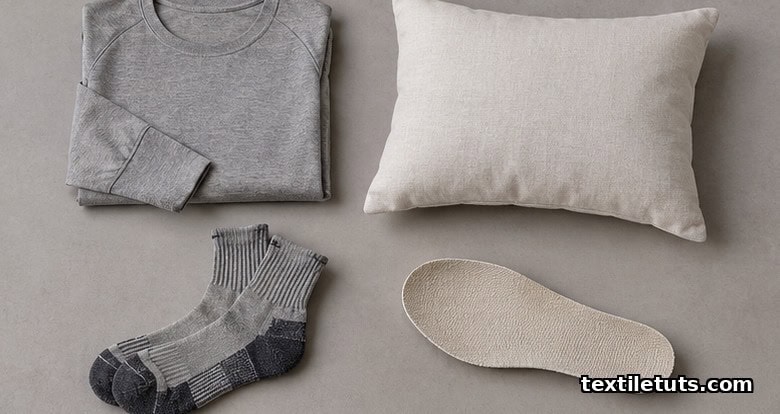
- Athletic and outdoor apparel: running shirts, cycling jerseys, ski underwear, and hiking socks from brands using Outlast or proprietary PCM systems.
- Bedding: mattress toppers, pillows, and duvet covers where the PCM absorbs body heat during sleep onset and re-radiates it as the sleeper cools.
- Workwear: fire-service base layers and cold-storage uniforms rated under EN 342 or NFPA 1971 for thermal insulation, where PCM supplements conventional insulation.
- Medical textiles: burn-care garments, fever-management wraps, and operating-room gowns where microclimate control matters for patient comfort or thermoregulation.
- Footwear: shoe linings and insoles, where the small surface area amplifies the buffering effect during a single temperature swing.
Frequently Asked Questions
Q1: Do phase-change materials actually keep you cooler, or is it marketing?
PCM textiles buffer short temperature swings rather than cooling you below ambient temperature. In controlled wear trials, PCM-treated garments typically reduce skin-temperature peaks by 1–3 °C during a 20–30 minute exercise-and-rest cycle compared with untreated controls of the same construction. They do not replace evaporative cooling or insulation; they delay and smooth the temperature response.
Q2: How long do PCM-treated fabrics last in normal use?
For acrylic-coated PCM fabrics, expect 60–70% of original thermal-storage capacity after 10 wash cycles and 40–50% after 20 cycles when laundered at 30–40 °C with mild detergent and no bleach. Fiber-incorporated PCM typically retains 75–85% at 20 cycles. Hot washing (≥60 °C), tumble-drying on high heat, and chlorine bleach accelerate capsule damage.
Q3: Are PCM textiles safe to wear on sensitive skin?
Commercially available PCM textiles use microencapsulated paraffin inside a polymer shell (typically melamine formaldehyde or polyacrylate), and reputable manufacturers certify the capsules as non-toxic and non-sensitizing under OEKO-TEX Standard 100 Class I (for baby articles) or Class II. For broken skin or burn garments, only medical-grade PCM textiles with documented biocompatibility should be used.
Q4: Can PCMs be added to natural fibers like cotton or wool?
Yes, by coating or padding. Cotton and wool fabrics accept PCM coatings well because their hydroxyl-group-rich surfaces bond readily with acrylic binders. The resulting hand is stiffer than untreated cotton, and durability tracks the binder durability rather than the fiber itself. For wool, melt-extrusion is not an option, so coating is the standard route.
Q5: What is the difference between microencapsulated PCM and “phase-change” finishes that some brands advertise without microcapsules?
True PCM performance requires a substance with a measurable solid–liquid phase transition and an enthalpy above about 100 kJ/kg. Some brands advertise “phase-change” or “thermal-regulation” finishes that are simply moisture-management or hygroscopic finishes with no latent-heat component. Ask the manufacturer for a DSC curve showing a melting peak in the 25–35 °C range with enthalpy in J/g; if they cannot produce one, it is not a real PCM.
References
- ISO 11092:2014. Textiles — Physiological effects — Measurement of thermal and water-vapour resistance under steady-state conditions (sweating guarded-hot-plate test). International Organization for Standardization. Test method used to quantify PCM-fabric thermal resistance.
- AATCC TM135-2018. Dimensional Changes of Fabrics after Home Laundering. American Association of Textile Chemists and Colorists. Wash-cycle protocol for PCM-durability studies.
- ASTM F2731-18. Standard Test Method for Measuring the Transmitted and Stored Energy of Firefighter Protective Clothing Systems. ASTM International. Cold- and heat-protective rating method used in PCM workwear evaluation.
- ASTM D7024-20. Standard Test Method for Steady State and Dynamic Thermal Performance of Textile Materials. ASTM International. Thermal-protective performance test relevant to PCM-treated fabrics.
- Mondal, S. (2008). Phase Change Materials for Smart Textiles — An Overview. Applied Thermal Engineering, 28(11–12), 1536–1550. Peer-reviewed review of PCM-fiber systems, methods, and applications.
- Sharma, A., Tyagi, V. V., Chen, C. R., & Buddhi, D. (2009). Review on Thermal Energy Storage with Phase Change Materials and Applications. Renewable and Sustainable Energy Reviews, 13(2), 318–345. Comprehensive review including salt-hydrate and paraffin PCMs.
- Zhang, X. X., Wang, X. C., Tao, X. M., & Yick, K. L. (2005). Energy Storage Polymer/MicroPCMs Blended Chips and MicroPCMs/Polyurethane Composite Sheets and Their Applications in Textile. Journal of Applied Polymer Science, 97(1), 121–126. Experimental study of PCM-coated fabric durability over multiple wash cycles.
This article is the working reference for phase-change materials in textiles. Editorial by Md. Asad Ullah (Meem), TextileTuts. Sources: ISO 11092, AATCC TM135, ASTM F2731, ASTM D7024, and peer-reviewed reviews in Applied Thermal Engineering, Renewable and Sustainable Energy Reviews, and Journal of Applied Polymer Science as cited.


