
Copper Wire Integration

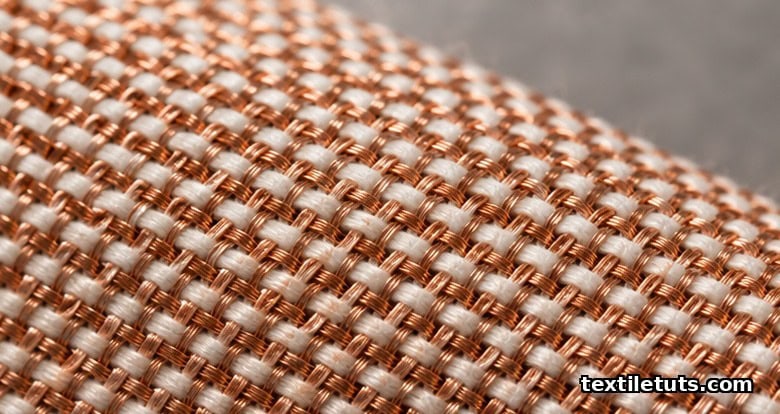
Copper wire integrated into textile substrates delivers an electrical conductivity up to 5.96×10^7 S/m at 20°C, equal to 100% IACS (International Annealed Copper Standard), which places it ahead of aluminum (3.5×10^7 S/m) and iron (1.0×10^7 S/m) and just behind silver (6.30×10^7 S/m) on the conductivity ranking that governs wearable heating, electromagnetic shielding, and signal-carrying e-textile applications.
This single conductivity value, paired with copper’s ductility (it draws down to diameters below 0.04 mm without breaking), is why textile engineers select copper for knitted heating meshes, embroidered antennas, and braided EMI shields over costlier alternatives.
This article walks through the metallurgy that governs textile-grade copper, the four main integration methods (weaving, knitting, embroidery, and adhesive lamination), the ASTM and ISO test methods used to grade performance, the application areas where copper wire textiles are deployed today, and how copper compares with silver-coated and stainless-steel alternatives.
What Copper Wire Integration Means in Technical Textiles
Copper wire integration is the deliberate placement of copper conductors inside a textile construction so the fabric retains its flexibility while gaining electrical function. The goal is not bulk conductivity but distributed function: a heating grid that warms a jacket, a braided mesh that attenuates electromagnetic radiation by 60 dB to 90 dB, or a stitched antenna pattern that communicates at 2.4 GHz. ASTM F3050 frames e-textiles as textile-based systems that sense, react, or transmit a signal in response to a physical stimulus, and copper wire is the most common backbone material that fits that definition.
Textile-grade copper differs from the magnet wire used in motors and transformers. Conductor diameters typically range from 0.04 mm (40 µm) for embroidery threads to 0.30 mm for heating-element spirals, with most commercial weavable wire landing between 0.06 mm and 0.10 mm. Above 0.10 mm, the wire behaves more like a structural element and breaks down the drape of the host fabric; below 0.05 mm, the wire fatigues rapidly under repeated flex and loses conductivity after fewer than 1,000 bending cycles.
Why Copper: Properties That Matter in a Textile
Copper wins in textiles for five reasons that show up in every engineering spec sheet:
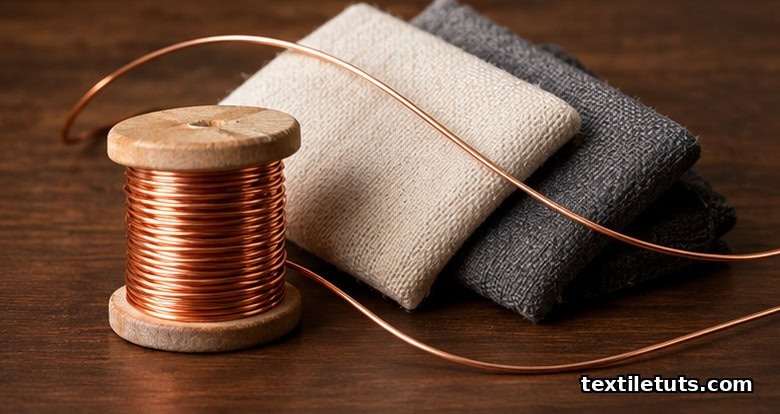
- Electrical conductivity: 5.96×10^7 S/m at 20°C (100% IACS), the reference against which all other conductor materials are graded per ASTM B193.
- Density: 8.96 g/cm³, light enough to integrate without weighing the fabric down.
- Ductility: cold-drawable to diameters below 0.04 mm while retaining more than 95% of original conductivity after annealing.
- Thermal conductivity: 401 W/(m·K), so copper wires spread heat evenly across a heating element and prevent hot spots.
- Recyclability: copper can be recovered at end-of-life without complex chemical separation, unlike silver-coated polymer yarns.
The trade-off is corrosion. Bare copper oxidizes in humid environments, raising surface resistance by a factor of 5 to 20 within weeks unless it is plated (typically with tin, nickel, or silver) or encapsulated in a polymer sheath. ASTM B193 measurements are conducted on cleaned samples, so any real-world textile reading will include oxide losses unless a protective coating is specified.
Four Integration Methods Used in Production
The four methods below account for the majority of copper wire textiles in commercial use today. Each method changes the mechanical and electrical profile of the resulting fabric.
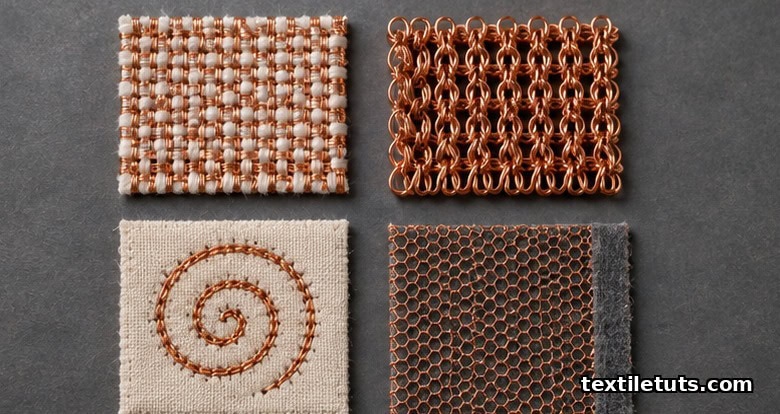
1. Weaving
Copper wire is fed as a warp or weft on a conventional loom alongside cotton, polyester, or aramid yarns. Plain weave is the most common construction because it sandwiches the wire and protects it from abrasion. Weaving produces the most stable electrical path: resistance drift after 10,000 flex cycles is typically under 5%. The cost is fabric handle, since wires above 0.10 mm start to feel like a screen rather than a cloth.
2. Knitting
Knitted copper textiles, particularly warp-knitted on a raschel machine, exploit loop geometry to keep the wire under tension and accommodate stretching. This is the preferred route for heating garments, since a 10% to 20% stretch range lets the wire expand with body movement without cracking. Loop density typically runs 4 to 8 courses per centimeter when 0.08 mm wire is used.
3. Embroidery
Computerized embroidery places copper thread (often a 7-strand twisted bundle, each strand around 0.05 mm) along any 2D pattern. This is the method of choice for RFID antennas and NFC tags, where the copper trace replaces a printed circuit. Stitch density of 3 to 5 stitches per millimeter balances conductivity against perforation of the substrate.
4. Adhesive Lamination
In lamination, a pre-formed copper grid (often a knit, braid, or etched mesh) is bonded to a fabric carrier with a thermoplastic adhesive or a reactive hot-melt film. Lamination is the only method that allows the wire grid to be a continuous sheet, useful for wide-area EMI shielding and large-area heating panels.
How Engineers Measure Performance: Standards and Test Methods
Three standards govern how copper wire textiles are graded. Without these test methods, performance claims are not comparable across suppliers.
- ASTM B193-20, Standard Test Method for Resistivity of Electrical Conductor Materials: the foundational test for bulk copper wire. A sample at 20°C is measured with a four-point probe, and resistivity is reported in ohm-circular-mil per foot or ohm-millimeters squared per meter.
- AATCC TM76, Electrical Surface Resistivity of Fabrics: adapts the bulk test to a textile surface. Results are reported in ohms per square, and a value below 10^3 Ω/sq indicates conductive-grade fabric, while a value above 10^12 Ω/sq indicates an insulator.
- ISO 31650:2023, Textiles – Determination of electrical resistance of conductive fabrics: the ISO counterpart to AATCC TM76, aligned within ±5%, which matters when a single fabric is sold into both US and EU markets.
For wearable heating, additional testing applies: IEC 60335-1 covers safety of household heating appliances and is referenced by most textile heating garment standards. For EMI shielding, ASTM D4935 measures shielding effectiveness in decibels over a 30 MHz to 1.5 GHz range, and well-designed copper textiles typically score 60 dB to 90 dB.
Where Copper Wire Textiles Are Deployed Today
Three application areas drive most of the commercial demand for copper wire textiles:
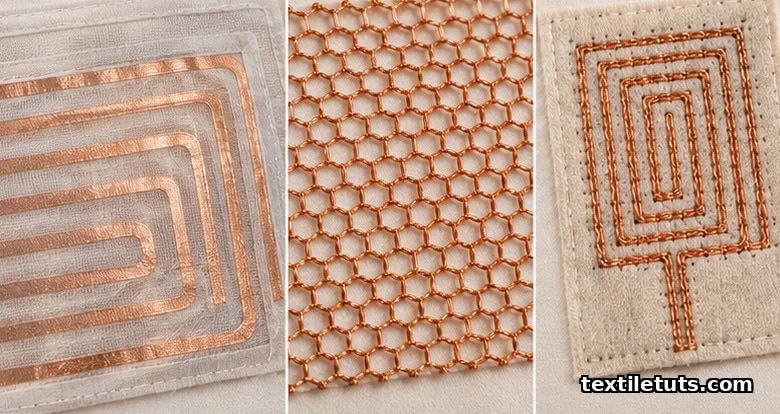
Wearable Heating
Copper heating textiles operate by Joule heating, where electrical current passes through the wire and converts to heat via I²R losses. Typical heating elements use 0.08 mm to 0.10 mm tin-plated copper wire in a serpentine pattern, delivering 30 W/m² to 80 W/m² at 12 V or 5 V (USB-powered). Applications include motorcycle jacket liners, electric blankets, hospital warming blankets, and outdoor workwear for cold-storage facilities.
Electromagnetic Interference Shielding
Copper wire textiles block electromagnetic radiation through reflection (the dominant mechanism at low frequencies) and absorption (dominant above 1 GHz). A copper mesh with 60% open area typically delivers 60 dB to 80 dB of shielding effectiveness from 100 MHz to 1 GHz, sufficient for hospital MRI rooms, military field tents, and electronics manufacturing cleanrooms.
Wearable Antennas and RFID
Embroidery-based copper antennas are the standard route for textile RFID tags and Bluetooth or Wi-Fi antennas in smart garments. A 2.4 GHz patch antenna embroidered with 0.10 mm copper wire typically achieves a gain of 2 dBi to 5 dBi and a return loss below -10 dB at the operating frequency, which matches the performance of a printed copper antenna on FR4 substrate.
Copper vs. Other Conductive Yarns
The table below compares the four most common conductive yarn families used in smart textiles. Conductivity is normalized to copper’s IACS rating.
| Property | Bare Copper Wire | Silver-Coated Polymer | Stainless Steel Filament | Carbon-Coated Polyester |
|---|---|---|---|---|
| Conductivity (% IACS) | 100% | 15% to 30% | 2% to 4% | 0.1% to 0.5% |
| Density (g/cm³) | 8.96 | 0.9 to 1.4 | 7.9 to 8.0 | 1.3 to 1.4 |
| Typical diameter (mm) | 0.05 to 0.30 | 0.10 to 0.50 | 0.02 to 0.08 | 0.10 to 0.50 |
| Wash cycles to 20% resistance gain | 30 to 80 (uncoated), 200+ (plated) | 50 to 150 | 300+ | 200+ |
| Relative cost (per meter) | 1× | 8× to 15× | 3× to 6× | 2× to 4× |
The takeaway is that copper dominates cost per unit of conductivity, while stainless steel and carbon-coated yarns dominate durability under repeated washing. Silver-coated polymer sits between, used when both flexibility and corrosion resistance matter most.
Durability and Wash Stability
Durability is where copper wire textiles most often fail in real-world use. ASTM B193 measurements on a clean wire sample will drop to as little as 50% of original conductivity after 30 standard home wash cycles unless the wire is plated or insulated. The three controllable failure modes are:
- Surface oxidation: copper oxide (Cu₂O / CuO) raises contact resistance. Tin plating at 1 µm to 3 µm thickness extends wash resistance past 100 cycles.
- Fatigue fracture: copper work-hardens at bending strains above 5%. Annealed copper (O temper per ASTM B49) survives more cycles than hard-drawn wire.
- Galvanic corrosion: contact with stainless steel or carbon fibers in the presence of sweat (chloride ions) accelerates pitting. Isolating the copper with a polymer overcoat prevents this.
For medical and workwear applications that demand wash survival above 100 cycles, the standard solution is a concentric polymer sheath (typically PET or PVC) that adds 0.01 mm to 0.02 mm to the wire diameter but lifts wash tolerance past 200 cycles.
Frequently Asked Questions
Is copper wire in textiles safe for direct skin contact?
Yes, when properly plated or insulated. Bare copper can cause mild green discoloration of skin from surface oxidation, and a small percentage of wearers react to copper ions released through sweat (copper is among the more reactive skin sensitizers in dermatology literature). Plated copper (tin or silver) and polymer-encapsulated copper avoid both issues.
How many wash cycles can copper wire textiles withstand?
Unplated copper wire textiles typically survive 30 to 80 home wash cycles before resistance rises by 20%. Tin- or silver-plated versions survive 100 to 200 cycles, and polymer-encapsulated wire exceeds 200 cycles. ISO 31650 is the standard test method for tracking resistance gain per cycle.
What gauge of copper wire is used in textile heating elements?
Most heating garments use copper wire in the 0.08 mm to 0.10 mm diameter range, which corresponds to AWG 32 to AWG 30. This is the sweet spot where resistance per meter is high enough to deliver heat (typically 2 Ω/m to 10 Ω/m) without needing excessive current draw from a portable battery.
Does copper wire in textiles affect drape and hand feel?
Yes, particularly above 0.10 mm diameter. Below 0.05 mm, the wire is barely detectable by hand. Most commercial smart textiles sit between 0.06 mm and 0.10 mm and accept a hand-feel tradeoff; the wire is normally placed on the back of a lining fabric to keep it away from the wearer’s skin.
How does copper compare to silver-coated yarns for e-textiles?
Copper delivers about 5 to 7 times higher conductivity per dollar, while silver-coated yarns win on flexibility and corrosion resistance. For applications where the wire is rarely washed or where the design tolerates plating, copper is the more cost-effective choice. Silver-coated yarn is preferred for skin-contact wearables that require many wash cycles.
References
- ASTM B193-20, Standard Test Method for Resistivity of Electrical Conductor Materials. ASTM International, West Conshohocken, PA. — Bulk resistivity test method for copper and other metallic conductors; reference for the 100% IACS rating.
- AATCC Test Method 76-2018, Electrical Surface Resistivity of Fabrics. American Association of Textile Chemists and Colorists. — Surface resistivity test for conductive textiles; defines the Ω/sq scale used to grade fabric conductivity.
- Copper Development Association Inc. (CDA), Material Properties of Pure Copper. copper.org — Reference source for the 5.96×10^7 S/m conductivity and the IACS standard rating.
- ISO 31650:2023, Textiles – Determination of electrical resistance of conductive fabrics. International Organization for Standardization. — ISO counterpart to AATCC TM76, aligned within ±5%.
- ASTM D4935-18, Standard Test Method for Measuring the Electromagnetic Shielding Effectiveness of Planar Materials. ASTM International. — Test method for EMI shielding textiles across the 30 MHz to 1.5 GHz range.
- Stoppa, M.; Chiolerio, A. (2014), Wearable Electronics and Smart Textiles: A Critical Review. Sensors, MDPI. — Peer-reviewed review of conductive textile materials and integration methods, including copper wire.
- ResearchGate (2019), Conductive Yarns and Threads for Smart Textile Applications. researchgate.net — Peer-reviewed review article covering weaving, knitting, and embroidery integration of metallic wires in fabrics.
This article is the working reference for copper wire integration in technical textiles. Editorial by Md. Asad Ullah (Meem), TextileTuts. Sources: ASTM B193, AATCC TM76, ISO 31650, ASTM D4935, Copper Development Association, MDPI Sensors, and ResearchGate as cited.


