
Microencapsulation for PCM

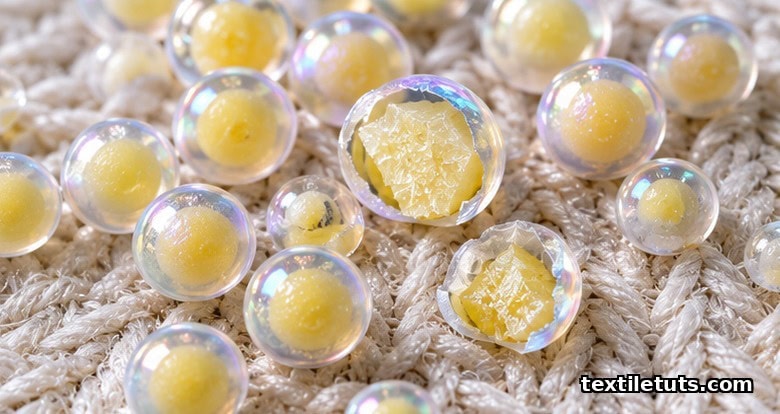
Microencapsulation confines 1–10 µm droplets of phase change material (PCM) inside a polymer shell, allowing textiles to absorb, store, and release 150–250 kJ/kg of latent heat at transition temperatures tuned between 18 °C and 35 °C. The result is a fabric that actively buffers the wearer’s microclimate against sudden temperature swings, a property used today in sportswear, firefighter turnout gear, bedding, and medical compresses. This article explains the chemistry, the capsule architecture, the methods used to bind capsules to fibers, the standards that govern their performance, and the practical limits a textile engineer has to design around.
What Is Microencapsulation for PCM in Textiles?
Phase change materials are substances that absorb large amounts of heat when they melt and release that same heat when they solidify, without an appreciable rise in temperature. Paraffin waxes such as n-octadecane (melting point ≈ 28 °C) and n-eicosane (melting point ≈ 36 °C) are the workhorses of textile PCMs because their transition temperatures sit inside the human comfort window. In bulk form a paraffin melt would simply run off the fabric, so it has to be compartmentalized into micron-scale capsules before it can be applied to a textile. Microencapsulation is the process of wrapping each PCM droplet in a tough polymer shell, producing a free-flowing powder that can be pad-coated, printed, or extruded into fibers.
The first commercial mPCM fabric appeared in the late 1990s, marketed under the Outlast brand and built on NASA-funded research into temperature-stabilizing suits for spacewalks. Today microencapsulated PCMs are used wherever a textile has to manage heat rather than just insulate, and the global market for these smart textiles is forecast to grow at a compound annual rate above 10% through 2030.
How Microencapsulated Phase Change Materials Work
Each microcapsule behaves like a tiny rechargeable thermal battery. When the skin or ambient temperature rises above the PCM’s melting point, the paraffin core absorbs heat as it transitions from solid to liquid, holding the local temperature at the transition value while the change of state completes. Once the environment cools below the transition point, the paraffin resolidifies and dumps that stored heat back into the surroundings. A standard n-octadecane capsule with a 5 µm diameter stores roughly 200 kJ/kg of latent heat, enough to offset several minutes of metabolic heat production during light exercise.
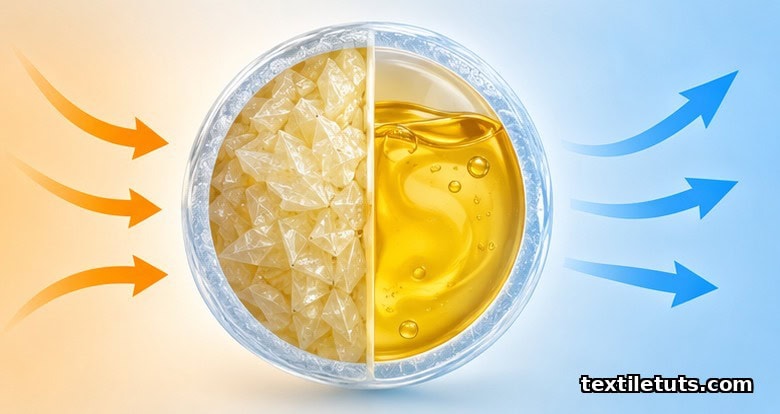
The trick for textile applications is matching the transition temperature to the use case. Capsules loaded with n-heptadecane (≈ 21 °C) cool athletes in mild weather, while n-eicosane (≈ 36 °C) suits firefighters whose external heat flux can exceed 1 kW/m². Because the latent heat is concentrated in a narrow temperature band, even a thin coating of mPCMs produces a measurable cooling or warming effect for a finite window, after which the capsules have to discharge before they can manage another thermal cycle.
Shell Materials, Core Materials, and Particle Size
The capsule shell has to survive melt-shear in spinning, multiple laundry cycles, and mechanical abrasion, while staying thin enough to allow rapid heat transfer. Shell-to-core ratios typically run 15:85 to 30:70 by mass, and the most common shell chemistries are melamine-formaldehyde (high durability but formaldehyde concerns), gelatin-gum arabic complex coacervates (food-grade but water-sensitive), polyurethane (flexible, soft hand), and polyacrylate or polystyrene (cheap, printable). Melamine-formaldehyde still dominates outdoor and military applications because of its abrasion resistance, while polyurethane shells are preferred for next-to-skin wear.
Core selection is governed by the desired transition temperature and the latent heat requirement. Among the linear n-alkanes, transition temperatures climb in roughly 2 °C steps from n-decane (≈ −30 °C) through n-triacontane (≈ 65 °C), so almost any comfort range can be hit by blending two adjacent chain lengths. Salt hydrates such as Glauber’s salt (Na₂SO₄·10H₂O) deliver higher volumetric storage but corrode textile equipment, which limits them to specialized cooling pads. Particle size is set by the application route: 1–3 µm capsules are needed for fiber extrusion because anything larger weakens the filament, while 5–20 µm capsules are used in coating and printing where higher payload per particle matters more than filament integrity.
Methods of Incorporating mPCMs into Textiles
Four industrial routes dominate. Fiber extrusion, the highest-performance route, mixes mPCM powder into the polymer melt before spinning, locking the capsules inside every filament. This produces fabrics that survive more than 50 domestic wash cycles and tolerate industrial dyeing, but it requires capital-intensive melt-spinning lines and caps the mPCM loading at roughly 10–15% by mass before the filament loses tensile strength.
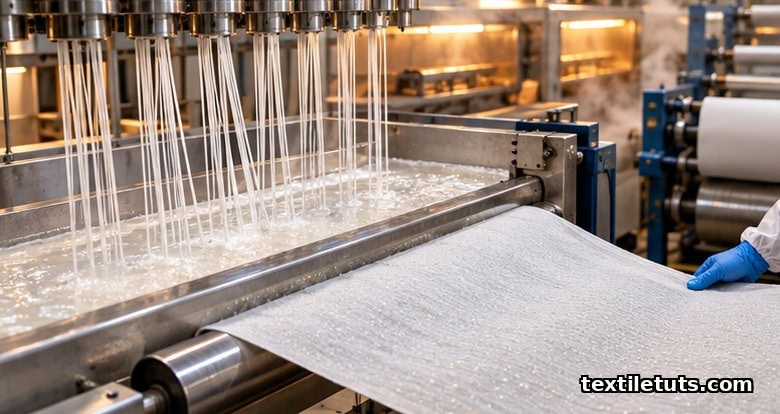
Coating and padding are the workhorses for cotton and cotton-blend fabrics. A slurry of mPCMs in an acrylic or polyurethane binder is applied to the fabric through a pad mangle, then cured at 120–160 °C. Coating adds 50–150 g/m² of mass and delivers the highest latent-heat storage per unit area, but the capsules sit on the fiber surface and wear off within 20–40 wash cycles. Foam finishing, where mPCMs are embedded in a thin polymeric foam laminated to the back of a fabric, is common in bedding because it preserves the face fabric’s hand. Microcapsule printing is the newest route, depositing mPCMs only where thermal buffering is needed (collar, spine, kidney area) and saving cost on high-visibility zones.
Thermal Performance and Durability Testing
Two metrics define a textile-grade mPCM: latent heat storage (J/g) measured by differential scanning calorimetry and the number of thermal cycles the capsule survives. A high-quality capsule retains more than 90% of its initial latent heat after 1,000 melt-solidify cycles in a DSC pan. In a finished garment, durability is usually tracked with hot-wash testing, since laundry agitation, detergent alkalinity, and tumble-dry heat are the dominant failure modes.
Standard methods now exist for almost every claim a manufacturer makes. ISO 22644 specifies how to characterize the thermal regulating properties of mPCM textiles using a sweating guarded hot plate. ASTM D7024 measures the thermal protective performance (TPP) of fabrics exposed to a 2 cal/cm²·s radiant flux, the test used to rate firefighter turnout gear. ISO 6330 and AATCC 135 codify domestic washing procedures, while AATCC TM158 sets the criterion for color change after repeated PC sweat exposure, a relevant test because mPCM-coated fabrics often trap perspiration against the skin. Together these standards let a buyer compare one mPCM fabric against another on the same axis.
Applications in Apparel, Bedding, and Technical Textiles
In apparel, mPCM coatings are most common in running shirts, cycling jerseys, and motorcycle linings, where the goal is to delay the onset of sweat and the discomfort that follows. Outlast, Coolcore, and 37.5 Technologies all market phase-change fabrics targeting this 10–20 minute microclimate buffer. Bedding is the largest volume category: mattress toppers, pillow covers, and duvet linings use mPCM coatings or foams to keep the sleeper’s skin temperature inside the 31–33 °C window associated with sleep onset, which is why several clinical studies report measurable improvements in sleep efficiency on mPCM-equipped bedding.
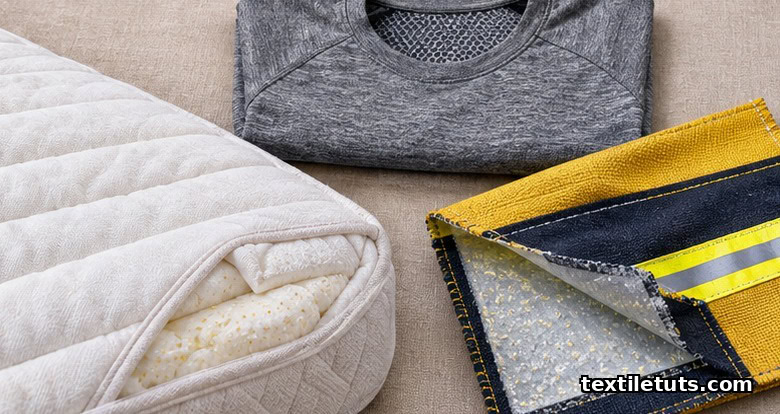
In technical textiles, mPCMs protect against thermal spikes. Firefighter turnout gear layers mPCM coatings under a moisture barrier to absorb the radiant heat that would otherwise burn the wearer, and NASA-style phase-change suits use panels of microencapsulated paraffin to buffer astronauts against the extreme thermal swings of an extravehicular activity. Medical compresses for hot/cold therapy are a smaller but growing use case, where mPCM microcapsules replace gel packs and keep their setpoint temperature for 20–40 minutes per application.
Standards, Safety, and Sustainability Considerations
Regulatory and sustainability questions now sit alongside thermal performance. Melamine-formaldehyde shell polymers have been progressively replaced by low-formaldehyde or formaldehyde-free systems to comply with OEKO-TEX Standard 100 and REACH restrictions on free formaldehyde (< 16 ppm in baby textiles, < 75 ppm in adult skin-contact textiles). Manufacturers also screen cores for substances of very high concern, because n-alkanes themselves are benign but paraffin feedstocks can contain polycyclic aromatic hydrocarbon (PAH) impurities above EU limits. End-of-life recycling is harder: most mPCM fabrics today end up in mixed-fiber waste streams that the current textile-to-textile recycling infrastructure cannot separate, a known limitation the industry is trying to solve through binder chemistry and shell design.
Frequently Asked Questions
How long do microencapsulated PCMs last in garments?
A capsule’s thermal life is set by how often the paraffin core cycles and how much shell survives abrasion. In laboratory melt-solidify testing, quality capsules retain more than 90% of their initial latent heat after 1,000 cycles, but in a real garment, mechanical wear and detergent exposure cut effective service life to 30–50 wash cycles for surface-coated fabrics and more than 100 cycles for melt-spun fibers. After that the fabric still insulates normally but no longer buffers temperature.
Are microencapsulated PCMs safe for skin contact?
Yes, provided the shell chemistry is OEKO-TEX Standard 100 compliant. Modern polyurethane and polyacrylate shells used in next-to-skin apparel release no measurable free formaldehyde and have passed skin-sensitization testing under ISO 10993-10. Melamine-formaldehyde shells are restricted to outerwear and protective equipment unless they pass the OEKO-TEX formaldehyde limits for their product class.
Can mPCM garments be machine washed?
Most can, on a gentle cycle in cool water (≤ 30 °C) with mild detergent, but tumble drying at high heat shortens capsule life because the shell softens above 80 °C. Always follow the garment label, and expect surface-coated fabrics to lose their thermal-buffering effect faster than melt-spun ones because the capsules sit on the outside of the fiber rather than inside it.
Do mPCM textiles really keep you cooler or warmer?
They buffer, which is different from air-conditioning. In a 25 °C room a 28 °C-transition fabric will feel neutral until you start sweating, at which point it absorbs heat for 10–20 minutes and delays the discomfort. Once the capsules are fully melted the fabric behaves like any other textile until the temperature drops and the capsules resolidify. Independent tests under ISO 22644 typically show 1–3 °C reductions in skin-facing fabric temperature during the active buffering window.
What is the difference between PCM and mPCM in textiles?
PCM is the bulk phase change material itself, usually a paraffin wax or a salt hydrate. mPCM, or microencapsulated PCM, is the PCM packaged inside a 1–10 µm polymer shell so it can be handled as a powder and locked into a textile without leaking. Almost every textile application today uses mPCM rather than bulk PCM because the microcapsule is the unit that survives spinning, coating, and washing.
References
- ASTM International. ASTM D7024 – Standard Test Method for Steady-State and Dynamic Thermal Performance of Textile Materials. https://www.astm.org/d7024 – Test method for thermal protective performance (TPP) used to rate fabrics under radiant heat exposure.
- International Organization for Standardization. ISO 22644:2006 – Textiles – Determination of the thermal regulating properties of textiles using a sweating guarded hot plate. https://www.iso.org/standard/36465.html – Method for measuring the latent-heat buffering of mPCM fabrics under simulated skin conditions.
- International Organization for Standardization. ISO 6330:2021 – Domestic washing and drying procedures for textile testing. https://www.iso.org/standard/76635.html – Standard laundry protocols used to score mPCM capsule durability.
- Salaün, F., Devaux, E., Bourbigot, S., Rumeau, P. (2010). Thermally buffering properties of phase change material–containing textiles. ScienceDirect / Thermochimica Acta. https://www.sciencedirect.com/science/article/abs/pii/S0040603110000747 – Peer-reviewed study showing 1–3 °C reductions in skin-facing fabric temperature using melamine-formaldehyde encapsulated n-alkanes.
- Mondal, S. (2008). Phase change materials for smart textiles – an overview. Springer / Applied Thermal Engineering. https://link.springer.com/article/10.1007/s11814-008-0077-0 – Open-access review of capsule chemistries, core alkanes, and integration routes used in commercial phase-change fabrics.
- OEKO-TEX Association. OEKO-TEX Standard 100 – Limit Values for Formaldehyde. https://www.oeko-tex.com/en/our-standards/oeko-tex-standard-100 – Restricted substance list referenced by textile manufacturers for mPCM shell compliance.
Editorial by Md. Asad Ullah (Meem), TextileTuts. Sources: ASTM D7024, ISO 22644, ISO 6330, Salaün et al. (Thermochimica Acta, 2010), Mondal (Applied Thermal Engineering, 2008), and OEKO-TEX Standard 100 as cited.


