
Peroxide Bleaching: Stabilizers and Activators

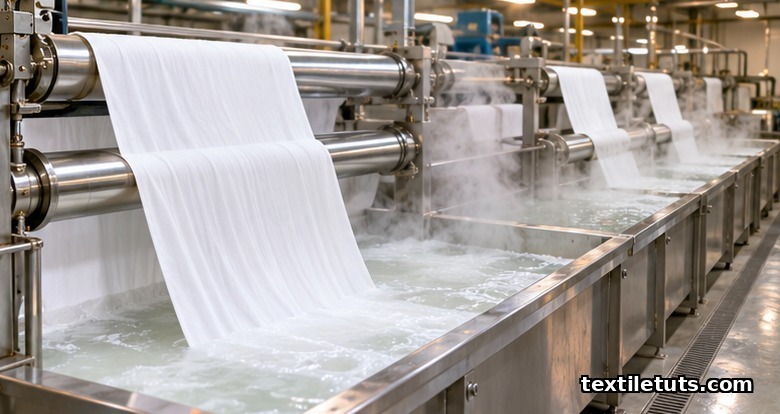
Hydrogen peroxide bleaching removes 70–85% of cotton’s natural color bodies within 60 minutes at 80–95°C when stabilizers cap peroxide decomposition below 10% of the applied dose (typically 2–5 g/L H₂O₂ at pH 10.5–11.5).
Without stabilizers, premature peroxide decomposition can reach 30–50% in the first 20 minutes, cutting fiber tensile strength by 20–40% and producing the yellowing and pinholing that mill managers classify as seconds.
This article covers the chemistry of stabilizers (silicates, EDTA, DTPA, polyacrylates, magnesium salts) and activators (TAED, NOBS, sodium perborate) used in industrial cotton bleaching, and how each shifts the bleach bath’s kinetics, working temperature, and fiber safety margin.
Why peroxide bleaching needs stabilizers
Hydrogen peroxide is a metastable oxidizing agent. In alkaline conditions the perhydroxyl anion (HOO⁻) is the active bleaching species that reacts with the conjugated flavone and flavonoid pigments carried over from cotton flowers into the seed-coat fibers. The same alkaline conditions, however, also enable a parallel decomposition pathway driven by transition metal contamination.
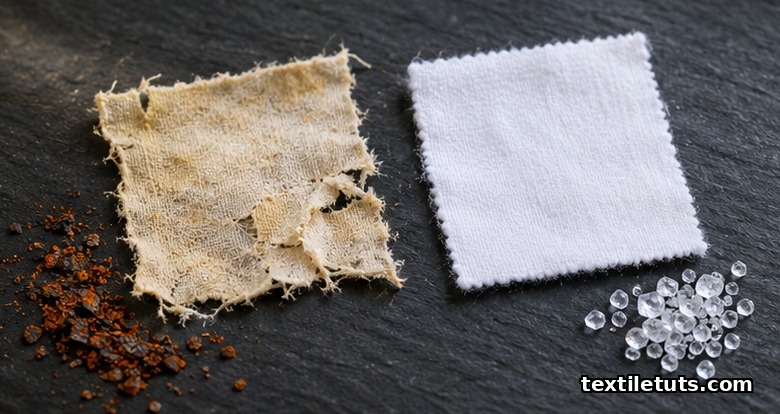
Trace iron (Fe³⁺/Fe²⁺), copper (Cu²⁺), and manganese (Mn²⁺) ions, typically present at 5–50 mg/kg in raw cotton and added further by metal pipes, fittings, and the steel parts of processing machinery, catalyze peroxide breakdown through Fenton-type reactions. The reaction chain produces hydroxyl radicals (•OH) and superoxide (•O₂⁻) that preferentially attack the cellulose backbone instead of the pigment. Each radical that escapes a cellulose chain cleaves a β-1,4-glycosidic bond and shortens the degree of polymerization.
A controlled bleach bath loses around 5–10% of its applied peroxide to this radical pathway over a 60-minute cycle at 90°C. An unprotected bath, especially one run in a metal-rich environment with high alkalinity and temperature, can lose 30–60% of its peroxide to decomposition within the first 20 minutes. The fiber pays the price: tensile strength drops of 20–40%, copper number increases that signal new reducing groups, and visible pinholing on lightweight fabrics. Stabilizers exist to redirect this side reaction so the peroxide does the work it was bought for.
Common peroxide stabilizers
Stabilizers work through four overlapping mechanisms: metal sequestration, buffering, radical scavenging, and surface adsorption. Industrial bleach baths typically blend two or three stabilizers so that no single additive must carry the full load.
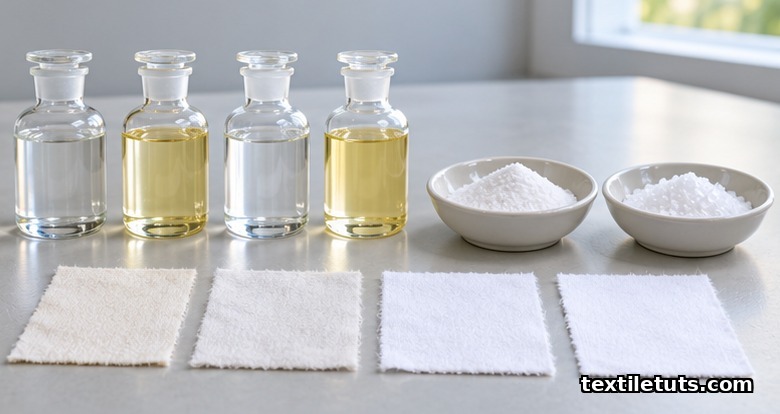
Sodium silicate (water glass, Na₂SiO₃) is the classical stabilizer and remains widely used in continuous and exhaust bleaching of cotton. It buffers the bath in the pH 10.5–11.5 window, sequesters iron by adsorption onto colloidal silica, and forms a protective silicate layer on metal equipment. Typical dosage is 1–3 g/L. The main drawback is silica deposits (white scale) on rollers, heating elements, and fabric, which require periodic acid descaling.
EDTA (ethylenediaminetetraacetic acid) and DTPA (diethylenetriaminepentaacetic acid) are strong chelators that bind Fe³⁺, Cu²⁺, and Mn²⁺ as stable, water-soluble complexes. DTPA binds iron more tightly than EDTA at pH 11, which is why DTPA-based stabilizers dominate high-speed peroxide applications where trace metal control is critical. Typical dosage is 0.2–0.5 g/L. The trade-off is poorer biodegradability compared with polyacrylate alternatives.
Polyacrylates (sodium salts of polyacrylic acid, 1,000–50,000 g/mol molecular weight) are organic sequestrants and dispersants that chelate calcium and magnesium hardness ions without forming insoluble scales. They are increasingly preferred where mills need to avoid silicate deposits or face effluent restrictions on silica discharge.
Magnesium salts (MgSO₄ or MgCl₂, 0.1–0.5 g/L) work by forming colloidal magnesium hydroxide on the fiber surface, which acts as a radical sink. Magnesium salts are usually combined with silicate or EDTA rather than used alone.
Organic phosphonates (HEDP, ATMP, DTPMP) provide strong chelation combined with lower effluent load than EDTA. Citric acid and gluconic acid function as mild, readily biodegradable chelators in low-temperature or short-cycle processes.
Activators for low-temperature bleaching
Activators are a different class of chemical. They do not slow decomposition. They react with hydrogen peroxide to generate a more aggressive peroxy species, typically a peroxyacid, that can bleach effectively at 40–70°C rather than the 80–95°C required by peroxide alone.
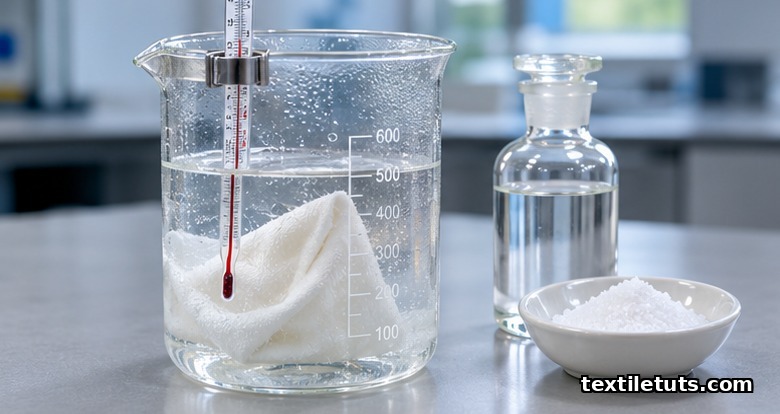
TAED (tetraacetylethylenediamine) is the most common peroxide activator in industrial laundry and textile pretreatment. TAED reacts with perhydroxyl anion to form peracetic acid plus diacetylethylenediamine. The peracetic acid is a stronger electrophilic oxidant than HOO⁻ and reaches comparable whiteness at 60–70°C in 20–40 minutes. Typical dosage is 2–4 g/L paired with 3–5 g/L H₂O₂.
NOBS (sodium nonanoyloxybenzenesulfonate) is the activator of choice in many U.S. detergent formulations because it remains stable in alkaline slurry and releases pernonanoic acid when the powder dissolves. In textile bleaching, it behaves like TAED with a slightly higher activation energy, so it is most useful at 60–80°C.
Sodium perborate (NaBO₃·4H₂O) and sodium percarbonate (2Na₂CO₃·3H₂O₂) are solid peroxide donors used in powder bleach formulations. They dissolve to release H₂O₂ plus either boric acid or sodium carbonate, so they couple the function of peroxide source with built-in alkalinity.
Activators and stabilizers are complementary. An activated bleach bath still needs a stabilizer: the peracid formed by TAED is itself prone to radical decomposition in the presence of transition metals. The practical recipe is 2–5 g/L H₂O₂, 0.2–0.5 g/L DTPA or polyacrylate, 2–4 g/L TAED, and 2–4 g/L NaOH at 60–70°C for 30 minutes, which delivers whiteness comparable to a 90°C peroxide-only bleach while saving roughly 25–35% of steam energy.
Process parameters and their interactions
The four controllable variables in peroxide bleaching are alkalinity, temperature, time, and peroxide concentration. They trade off against each other in ways that the right stabilizer or activator can shift.
pH controls the fraction of peroxide present as the active perhydroxyl anion. The peroxide pKa is around 11.6, so at pH 10.5 only about 7% of peroxide is in the active HOO⁻ form. At pH 11, the fraction rises to about 20%, and at pH 11.5 to about 44%. Above pH 11.5, peroxide decomposition accelerates faster than bleaching improves, which is why the practical window for cotton bleaching is 10.5–11.5 with a stabilizer to control the radical side reaction.
Temperature increases reaction rate. The apparent activation energy for peroxide bleaching of cotton is around 70–90 kJ/mol, which means each 10°C rise roughly doubles the bleaching rate between 60°C and 95°C. That sensitivity is why a stabilizer’s performance at 95°C must be tested at 95°C, not at 70°C.
Time at temperature follows first-order kinetics with respect to peroxide. A 60-minute cycle removes 70–85% of the chromophore load. Extending to 90 minutes adds another 5–10% whiteness at the cost of fiber damage, so most mills cap bleach cycles at 60–90 minutes.
H₂O₂ concentration is set by the target whiteness and the contamination level. A standard bleach of greige cotton uses 2–3 g/L H₂O₂ (35% w/w) for knit fabrics and 3–5 g/L for heavy woven goods. Higher doses do not proportionally increase whiteness once the bath passes the 5 g/L mark because the limiting factor shifts to chromophore accessibility.
Stabilizer vs activator: how to choose
| Property | Stabilizer | Activator |
|---|---|---|
| Primary function | Lowers peroxide decomposition rate | Generates stronger peroxy species |
| Mechanism | Metal chelation, buffering, radical scavenging | Forms peracetic, pernonanoic, or percarbonic acids |
| Effect on bleach rate | Indirect: maintains available peroxide | Direct: increases bleaching rate per °C |
| Effect on bleach temperature | No change | Lowers effective temperature by 20–30°C |
| Typical dosage | 0.2–3 g/L (silicate up to 3; DTPA 0.2–0.5) | 2–5 g/L paired with 3–5 g/L H₂O₂ |
| Effect on effluent | Silicate adds silica load; DTPA is poorly biodegradable | TAED biodegrades to CO₂, water, and ethylenediamine |
| Risk if overdosed | Whiteness reduction (over-stabilization) | Fiber damage and yellowing (over-activation) |
Frequently Asked Questions
What is the optimal pH for peroxide bleaching of cotton?
The optimal pH for peroxide bleaching of cotton is 10.5–11.5, set with sodium hydroxide or a combination of sodium hydroxide and sodium carbonate. Within this window, the fraction of peroxide in the active perhydroxyl anion (HOO⁻) form rises from roughly 7% at pH 10.5 to 44% at pH 11.5, while peroxide decomposition remains controllable with a stabilizer. Above pH 11.5, the radical decomposition pathway accelerates faster than bleaching improves.
Why do stabilizers matter in peroxide bleaching?
Stabilizers matter because transition metal ions (Fe, Cu, Mn) at concentrations as low as 5–10 mg/L catalyze peroxide decomposition into hydroxyl radicals that preferentially cleave cellulose chains. Without a stabilizer, an unprotected bleach bath can lose 30–60% of its peroxide to decomposition within the first 20 minutes and damage the fabric’s tensile strength by 20–40%.
What is TAED and how does it work as an activator?
TAED (tetraacetylethylenediamine) is a peroxide activator that reacts with the perhydroxyl anion to form peracetic acid plus diacetylethylenediamine. Peracetic acid is a stronger electrophilic oxidant than HOO⁻, so a bleach bath with 2–4 g/L TAED plus 3–5 g/L H₂O₂ reaches the same whiteness at 60–70°C that an unactivated bath reaches at 90°C, with a 25–35% reduction in steam energy.
Can peroxide bleaching damage cotton fibers?
Yes, if peroxide is allowed to decompose through the radical pathway rather than the controlled perhydroxyl pathway. Visible damage starts at tensile strength losses above 10–15% and shows up as pinholing on lightweight knits, weak seams, and high copper number readings. A correctly stabilized bleach bath keeps tensile loss below 5% while removing 70–85% of color bodies.
Is low-temperature peroxide bleaching effective?
Low-temperature peroxide bleaching at 50–70°C is effective when an activator such as TAED or NOBS is added at 2–5 g/L together with a DTPA or polyacrylate stabilizer. Industrial trials report 70–80% color removal in 30–45 minutes at 60°C with TAED, compared to 70–85% in 60 minutes at 90°C with peroxide alone. The trade-off is higher chemical cost for the activator, which is partly offset by reduced steam consumption.
References
- American Association of Textile Chemists and Colorists. AATCC Technical Manual, Test Method 101: Colorfastness to Bleaching with Hydrogen Peroxide. Research Triangle Park, NC: AATCC. Standard test method for color fastness of textile fibers under oxidative bleaching conditions.
- International Organization for Standardization. ISO 105-C09:2010 — Textiles — Tests for colour fastness — Part C09: Colour fastness to oxidative bleaching (potassium permanganate and hydrogen peroxide). Geneva: ISO. Standard color fastness test for oxidative bleach.
- International Organization for Standardization. ISO 105-J01:1997 — Textiles — Tests for colour fastness — Part J01: General principles for measurement of surface colour. Geneva: ISO. Reference for color measurement in bleach evaluation.
- Rouette, H. K. Encyclopedia of Textile Finishing. Berlin: Springer, 2002. Comprehensive reference on textile finishing chemistry including peroxide bleaching of cellulosics.
- American Association of Textile Chemists and Colorists. AATCC Review. Research Triangle Park, NC: AATCC. Peer-reviewed trade journal covering textile chemistry including bleaching auxiliaries and process chemistry.
- Textile Research Journal. Sage Publications. Peer-reviewed journal publishing original research on textile chemistry including peroxide bleaching kinetics and stabilizers.
- Cellulose. Springer. Peer-reviewed journal covering cellulose chemistry, oxidation, and bleaching reactions.
This article is the working reference for peroxide bleaching of cellulosic textiles with stabilizers and activators. Editorial by Shahrukh Islam, TextileTuts. Sources: AATCC TM 101, ISO 105-C09:2010, Rouette (Springer, 2002), AATCC Review, Textile Research Journal, Cellulose as cited.


