
Bleaching: Sodium Hypochlorite

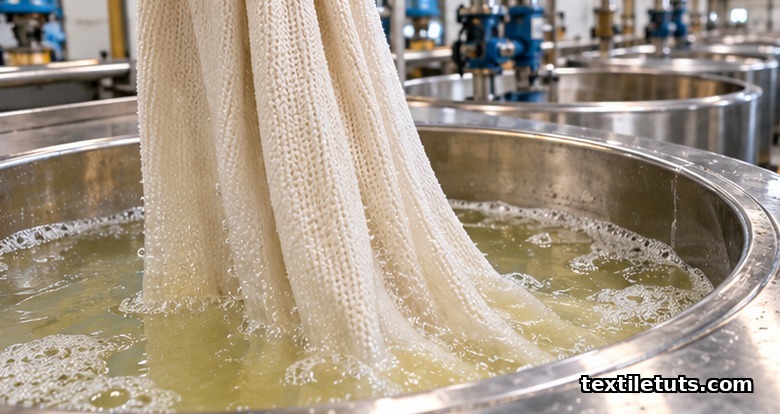
Sodium hypochlorite (NaOCl) at 2 to 5 g/L available chlorine bleaches cotton at pH 10.0 to 11.5 and 70 to 90 degrees C for 30 to 60 minutes, raising the CIE Whiteness Index by 30 to 65 points while limiting tensile-strength loss to under 15% when sodium silicate and an alkaline buffer are used to suppress oxycellulose formation.
This combination of concentration, pH, temperature, and time is the reference recipe against which hydrogen peroxide and sodium chlorite routes are benchmarked in industrial pretreatment ranges, and it is the recipe most textile-engineering textbooks (Trotman, 1984; Karmakar, 1999) reproduce for continuous and batch bleaching of cotton knit and woven fabric.
The rest of this article walks through the chemistry, the process variables, the equipment choices, the quality-control tests, the comparison with hydrogen peroxide, and the safety and effluent handling that a textile mill must keep in view when it selects a sodium-hypochlorite bleach line.
What Sodium Hypochlorite Bleaching Is and Why Mills Use It
Sodium hypochlorite is the sodium salt of hypochlorous acid, supplied to textile mills as a pale-yellow aqueous solution carrying 5 to 15% available chlorine by weight (typical commercial grade, 12.5 to 14% w/v). In water it dissociates into the hypochlorite ion (OCl-), which is the active bleaching species above pH 9. Below pH 7 the dominant species is HOCl (hypochlorous acid) and below pH 3 it is dissolved Cl2 (chlorine gas). All three oxidize coloured chromophores in cotton, but the OCl- form is preferred because it bleaches without liberating chlorine gas and without acid-hydrolyzing the cellulose chain.
For cellulosic substrates, sodium hypochlorite is the cheapest mass-bleaching agent on a per-kilogram-of-fabric basis and it is effective at relatively low temperatures (60 to 90 degrees C). For these reasons it remains the default bleach for grey-state cotton knit and for the desize-scour-bleach sequence on woven fabric where the mill already runs caustic treatment upstream.
How Sodium Hypochlorite Bleaches Cellulosic Fibers
The bleaching action of OCl- on the natural pigments in cotton (mainly flavonoid and tannin residues left over from the seed coat) is an oxidation of conjugated double bonds in the chromophores, which breaks the visible-light absorption and converts the colour to a colourless or pale-yellow product. The reaction is non-specific, so the same oxidant also attacks the cellulose chain itself, generating oxycellulose and shortening the degree of polymerization (DP).
The DP drop is the principal cost of the process. A control recipe is built around three countermeasures: holding the bath alkaline (pH 10.0 to 11.5) so that OCl- dominates over HOCl, capping the temperature (70 to 90 degrees C, never above the boil), and capping the contact time (30 to 60 minutes for most greige cotton). AATCC TM 110 and ISO 11475 are the standard methods for tracking the whitening that the bath produces; the same recipes typically deliver a Berger Whiteness of 55 to 75 on cotton knit after bleaching.
On protein fibers (wool, silk) sodium hypochlorite reacts with the amide bond to form chloramines, which yellow the fiber and damage the scale structure. For this reason NaOCl is never used on wool or silk, and is used on polyamide only under tightly controlled, near-neutral pH with a sequestering agent.
Process Parameters: Concentration, pH, Temperature, and Time
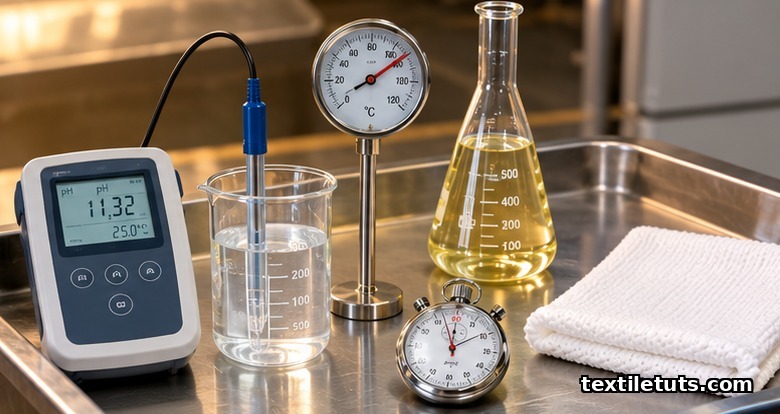
The recipe window for sodium-hypochlorite bleaching of cotton is narrow because all four main variables push in the same direction: more chlorine, higher temperature, lower pH, and longer time all produce more whitening, but also more strength loss. A typical mill recipe is summarized below.
| Parameter | Typical range for cotton | Effect of increase |
|---|---|---|
| Available chlorine | 2 to 5 g/L (continuous pad-steam) or 0.5 to 1.5% on weight of fabric (exhaust) | Higher whiteness, higher strength loss |
| pH | 10.0 to 11.5 (held with NaOH or Na2CO3) | Higher pH = slower bleach but lower fiber damage |
| Temperature | 70 to 90 degrees C (exhaust); 95 to 100 degrees C (continuous J-box) | Higher = faster bleach, faster degradation |
| Time | 20 to 45 min (exhaust); 5 to 15 min (continuous pad-steam) | Longer = more whitening, more strength loss |
| Stabilizer | 0.5 to 2 g/L sodium silicate (water-glass) or Na5P3O10 | Buffers pH and sequesters catalytic metal ions |
| Wetting agent | 1 to 3 g/L non-ionic surfactant | Faster wetting, more uniform bleach |
The pH window is non-negotiable. If pH drifts below 9, the equilibrium shifts toward HOCl and the bath starts to release Cl2 gas (workplace exposure hazard). If pH drifts above 12, the bath becomes so stable that bleaching slows to a crawl. Sodium silicate is the workhorse stabilizer because it buffers in the 10 to 11 region and precipitates iron and copper, which otherwise catalyze oxycellulose formation through Fenton-like side reactions.
Industrial Equipment and Process Routes
Three process routes dominate cotton-bleaching lines that use sodium hypochlorite.
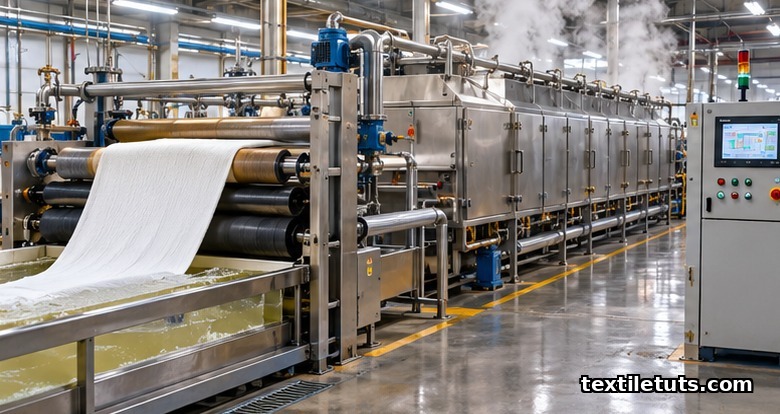
1. Exhaust (winch, jet, or soft-flow machine). Fabric is loaded into the machine, the bath is filled at 70 to 85 degrees C, NaOCl and NaOH are dosed, and the fabric circulates for 30 to 60 minutes. Used for knit fabric and for small lots. Liquor ratio 1:8 to 1:12.
2. Continuous pad-steam (J-box or roller steamer). Fabric is padded through the bleach liquor (2 to 5 g/L available Cl, pH 10.5 to 11.5) at 90 to 100% pick-up, then steamed in a J-box for 5 to 15 minutes at 95 to 100 degrees C. Used for woven fabric in production-scale ranges. Throughputs of 80 to 120 m/min are typical.
3. Pad-batch (cold). Fabric is padded with the bleach liquor at room temperature and stored in a rolling batch for 4 to 12 hours. Used where steam economy matters. Gives a softer hand and is gentler to the fiber.
After bleaching, the fabric passes through a hot rinse (80 to 90 degrees C), an antichlor step (1 to 3 g/L sodium thiosulphate Na2S2O3 or 1 to 2 mL/L hydrogen peroxide at pH 6 to 7) to neutralize residual chlorine, and a final cold rinse. The antichlor step prevents the fabric from yellowing in storage and protects reactive dyes applied downstream.
Quality Control: Measuring Whiteness and Strength Loss
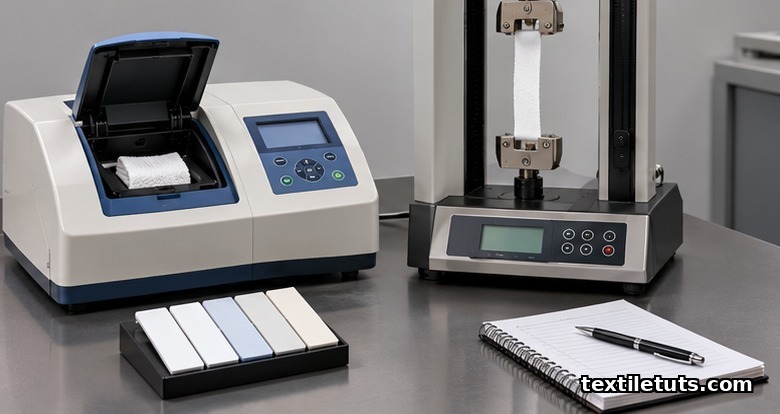
Whiteness on bleached cotton is measured by two standard test methods. AATCC TM 110 specifies the use of a spectrophotometer to compute the CIE Whiteness Index from the reflectance curve, with a 10 degree observer and D65 illuminant. ISO 11475 is the international equivalent. Typical targets after NaOCl bleaching of greige cotton are:
- CIE Whiteness Index: 55 to 75 (good commercial white)
- Berger Whiteness: 60 to 80
- Yellowness Index (ASTM E313): below 5 for a “white” grade
Strength loss is tracked with ASTM D5034 (grab test) or ASTM D5035 (strip test) on the bleached fabric compared with the greige reference. A well-controlled NaOCl recipe keeps tensile-strength loss below 15%; anything above 20% is flagged as over-bleached and the recipe is re-tuned (lower available chlorine, higher pH, shorter time, or move to peroxide).
Residual chlorine on the fabric is checked with potassium iodide-starch paper (qualitative) or by iodometric titration (quantitative). A pass criterion of less than 5 ppm extractable chlorine on the finished fabric is standard for downstream reactive dyeing.
Sodium Hypochlorite vs Hydrogen Peroxide: When to Use Which
Both reagents are oxidizing bleaches, but they sit at different points on the cost, handling, and quality trade-off. The table below summarizes the operating comparison for cotton.
| Property | Sodium hypochlorite | Hydrogen peroxide (35%) |
|---|---|---|
| Active species | OCl- (oxidizing chlorine) | HOO- (perhydroxyl anion) |
| Operating pH | 10.0 to 11.5 | 10.5 to 12.0 |
| Operating temperature | 70 to 90 degrees C (max 95) | 90 to 100 degrees C |
| Typical concentration | 2 to 5 g/L available Cl | 2 to 5 g/L H2O2 |
| CIE whiteness on cotton | 55 to 75 | 70 to 85 |
| Tensile-strength loss on cotton | Up to 15% at recipe | Under 8% at recipe |
| By-products | NaCl, chlorinated organics (AOX) | Water, oxygen |
| Effluent load (COD and salt) | High (AOX + salt) | Low |
| Per-kg cost (approx.) | Lower | 1.5 to 2.5x higher |
The practical decision rule: use sodium hypochlorite where cost dominates and the mill already has an AOX-removal effluent plant (chlorinated organics must be brought down before discharge); use hydrogen peroxide where brightness above 75 CIE is required (for example for optical-brightener substrate, or for white shirting) or where the effluent plant cannot handle chlorinated by-products.
Safety, Effluent, and Sustainability Notes
Sodium hypochlorite is a strong oxidizer and a corrosive alkali at the working pH. Storage tanks are typically HDPE or rubber-lined carbon steel at 10 to 25 degrees C, because NaOCl decomposes above 30 degrees C with the release of oxygen and chloride. Bleach ranges are exhausted and the working area is monitored for Cl2 below the ACGIH TLV of 0.5 ppm.
Effluent from NaOCl bleaching carries high salinity, residual chlorine, and absorbable organic halides (AOX). Modern mills route the bleach effluent through a dechlorination step (sodium thiosulphate or sodium sulphite) before biological treatment, and most jurisdictions cap AOX in discharged water between 0.5 and 5 mg/L depending on the receiving water body. The high salt load is the largest sustainability drawback of the NaOCl route and is the main reason mills are migrating to hydrogen peroxide for new lines.
Frequently Asked Questions
Does sodium hypochlorite bleach damage cotton fabric?
At the standard recipe of 2 to 5 g/L available chlorine, pH 10.0 to 11.5, 70 to 90 degrees C, and 30 to 60 minutes, tensile-strength loss is held below 15%. Damage climbs sharply if pH drops below 9, temperature exceeds 95 degrees C, or contact time is doubled without lowering the available-chlorine dose. ASTM D5034 grab-strength testing on the bleached fabric against the greige reference is the standard check.
What pH should I use for sodium hypochlorite bleaching?
Hold the bath between pH 10.0 and 11.5 with sodium hydroxide, sodium carbonate, or sodium silicate. Below pH 9 the equilibrium shifts to HOCl and Cl2, releasing chlorine gas and accelerating fiber damage. Above pH 12 the bleach becomes too stable and the whiteness gain slows to an uneconomical rate. Sodium silicate (water-glass, 0.5 to 2 g/L) is the most common stabilizer because it also buffers and sequesters iron and copper.
How does sodium hypochlorite compare with hydrogen peroxide on cotton whiteness?
On cotton knit, sodium hypochlorite typically achieves a CIE Whiteness Index of 55 to 75 (AATCC TM 110), while hydrogen peroxide at 2 to 5 g/L, pH 10.5 to 12, and 90 to 100 degrees C reaches 70 to 85. Peroxide is the preferred bleach when the substrate is destined for optical brighteners or for a brilliant-white shade. Sodium hypochlorite is preferred when cost dominates and the mill already has AOX effluent treatment.
Can sodium hypochlorite be used on wool or silk?
No. Sodium hypochlorite reacts with the amide bond of protein fibers to form chloramines, which yellow the fiber and strip the protective scale layer. Wool and silk are bleached with reducing agents (sodium hydrosulphite) or with hydrogen peroxide at near-neutral pH and low temperature (50 to 60 degrees C). ISO 11475 is the appropriate method for tracking whiteness on protein fibers.
How is residual chlorine removed after sodium hypochlorite bleaching?
An antichlor step is applied after the bleach bath. The two standard antichlors are 1 to 3 g/L sodium thiosulphate (Na2S2O3) at pH 6 to 7 for 10 to 15 minutes, or 1 to 2 mL/L hydrogen peroxide at pH 6 to 7. Residual chlorine on the finished fabric should be under 5 ppm by iodometric titration. Without the antichlor, the fabric yellows in storage and reactive dyes applied downstream are at risk of shade drift.
References
- AATCC. Test Method 110: Whiteness of Textiles. American Association of Textile Chemists and Colorists, Research Triangle Park, NC. Spectrophotometric method for CIE Whiteness Index on textiles.
- AATCC. Test Method 17: Colorfastness to Bleaching with Sodium Hypochlorite. American Association of Textile Chemists and Colorists. Chlorine-bleach colorfastness protocol.
- ASTM International. ASTM D5034: Standard Test Method for Breaking Strength and Elongation of Textile Fabrics (Grab Test). ASTM International, West Conshohocken, PA.
- ASTM International. ASTM E313: Standard Practice for Calculating Yellowness and Whiteness Indices from Instrumentally Measured Color Coordinates. ASTM International.
- International Organization for Standardization. ISO 11475: Textiles – Determination of CIE Whiteness. ISO, Geneva.
- Trotman, E. R. Dyeing and Chemical Technology of Textile Fibres. 6th edition, Charles Griffin & Co., 1984. Reference text covering sodium-hypochlorite bleach recipes and antichlor chemistry on cotton.
Editorial by Shahrukh Islam, TextileTuts. Sources: AATCC TM 110, AATCC TM 17, ASTM D5034, ASTM E313, ISO 11475 as cited.


