
Bleaching: Sodium Chlorite

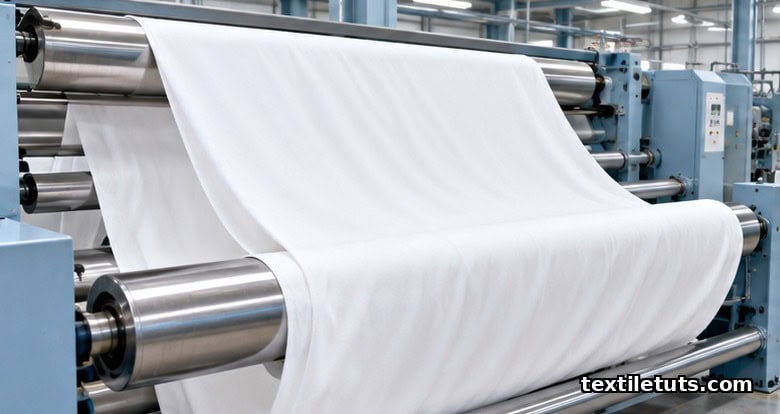
Sodium chlorite (NaClO2) activated to chlorine dioxide (ClO2) bleaches polyester, nylon, acrylic, aramid, and polyolefin fibers at 1 to 3 g/L NaClO2, pH 3.5 to 4.0, and 80 to 95 degrees C for 30 to 90 minutes, lifting the CIE Whiteness Index on synthetic substrates to 70 to 85 while holding tensile-strength loss on cellulose under 5%, because ClO2 oxidizes through a 5-electron transfer that attacks chromophores but leaves the polymer backbone intact.
That combination of low concentration, acidic pH, and selective chemistry is the reason sodium chlorite sits beside hydrogen peroxide as the second of the two industrial bleaches for synthetic and blended substrates, and the reason it is the preferred route when a mill needs a brilliant-white shade without the strength penalty that peroxide and hypochlorite carry on cotton.
The rest of this article walks through the chemistry of sodium chlorite activation, the process variables on cotton and on synthetic fibers, the equipment and safety controls for handling ClO2, the standard quality-control methods, the comparison with hydrogen peroxide and sodium hypochlorite, and the effluent handling a mill must keep in view when it selects a sodium-chlorite bleach line.
What Sodium Chlorite Bleaching Is and Why Mills Use It
Sodium chlorite (NaClO2) is supplied to textile mills as a white-to-pale-yellow powder or as a 25 to 31% w/w aqueous solution. On its own, in alkaline water, it is a slow and weak oxidant. The bleaching power arrives only after the chlorite ion is converted to chlorine dioxide (ClO2), and that conversion is what the mill controls through pH, temperature, and a small dose of an activator (an acid, a chlorine donor, or formaldehyde).
ClO2 is a radical species with a single unpaired electron, and it accepts five electrons in sequence as it is reduced. That five-electron transfer is what bleaches the chromophores in synthetic fibers without fragmenting the polymer chain: the chromophore loses its conjugated double bonds and stops absorbing visible light, while the polyester, nylon, or acrylic backbone is untouched. By contrast, hydrogen peroxide and sodium hypochlorite bleach by single-step oxidation that also breaks C-C and C-O bonds in the cellulose chain, generating oxycellulose and a measurable drop in degree of polymerization.
For this reason, sodium chlorite is the default bleach for polyester knit and woven fabric, for nylon and other polyamide substrates where chlorine damage is a concern, for acrylic and modacrylic fibers, for aramid and other high-performance fibers, and for polyolefin nonwoven where thermal-oxidative damage must be avoided. It is also used on cotton and cotton blends when the mill is willing to pay a higher chemical cost in exchange for a strength loss under 5% and a brilliant-white shade above CIE 75.
How Sodium Chlorite Activates and How the Activated Species Bleaches
The activation reaction is straightforward acid chemistry. In an acid bath, chlorite ion disproportionates into chlorine dioxide and chloride:
5 ClO2- + 4 H+ → 4 ClO2 + Cl- + 2 H2O
At pH 3.5 to 4.0, the dominant oxidant in solution is ClO2; below pH 2.5 the reaction becomes violent and releases free chlorine, and above pH 5 the chlorite ion does not disproportionate fast enough to drive a mill cycle. The activator therefore has two jobs: bring the bath to the right pH window, and hold it there against the alkaline reserve in the fiber and the buffer in the bath.
Standard activators are:
- Acetic acid (CH3COOH) at 0.5 to 2 g/L, the most common acid activator for batch exhaust bleaching.
- Hydrochloric acid (HCl) at 0.5 to 1 mL/L of 32% solution, used where a sharper pH drop is wanted.
- Sodium persulphate (Na2S2O8) at 0.5 to 1 g/L, an oxidant activator that liberates ClO2 without acid.
- Formaldehyde (HCHO) at 1 to 2 g/L, the classical activator used in the 1960s and still cited in older textile-engineering references (Trotman, 1984), now restricted in many jurisdictions for worker-exposure reasons.
On cotton, the active species is the same chlorine dioxide radical, but the bleaching reaction is gentler than on synthetics because cotton’s chromophores are easier to oxidize. On polyester, the chromophores are typically oligomeric dye-residues from the polymerization step, residual spin finishes, and surface oils; these are attacked by ClO2 and converted to pale-yellow products that are washed off in the subsequent rinse.
A point that textile-engineering students sometimes miss: sodium chlorite bleaches selectively because ClO2 is a one-electron radical, not a two-electron oxidant. Each ClO2 molecule accepts five electrons in five sequential steps, and the intermediate radicals (ClO, ClO2-) are themselves bleaching species. This is why the bath continues to bleach even after the initial pH peak is past.
Process Parameters: Concentration, pH, Temperature, and Time
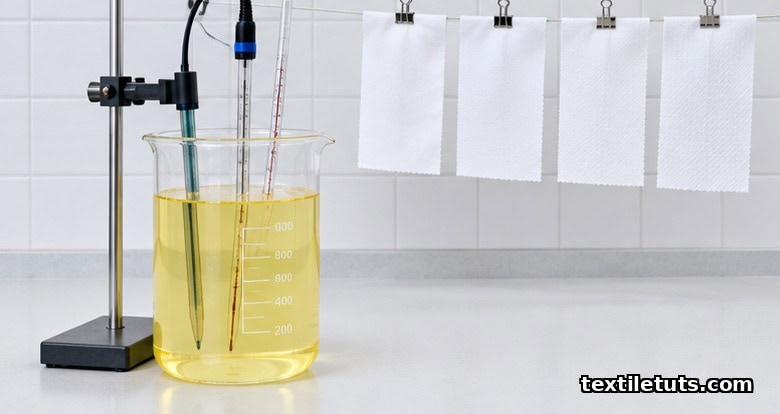
The recipe window for sodium chlorite bleaching is wider than for sodium hypochlorite because the strength-loss penalty is much smaller. The four main variables can be pushed in the direction of more whitening without the same cellulose damage. A typical mill recipe is summarized below.
| Parameter | Typical range (synthetic fibers) | Typical range (cotton) | Effect of increase |
|---|---|---|---|
| Sodium chlorite (NaClO2) | 1 to 3 g/L (exhaust); 5 to 20 g/L (pad-steam) | 0.5 to 2 g/L (exhaust) | Higher whiteness, higher ClO2 release |
| Activator (acetic acid) | 0.5 to 2 g/L | 0.5 to 1 g/L | Faster ClO2 generation, lower pH |
| pH | 3.5 to 4.0 | 3.5 to 4.5 | Lower pH = faster bleach, more ClO2 gas |
| Temperature | 80 to 95 degrees C | 70 to 90 degrees C | Higher = faster bleach, faster gas release |
| Time | 30 to 90 min (exhaust); 15 to 45 min (pad-steam) | 45 to 90 min (exhaust) | Longer = more whitening, more gas |
| Buffer | 1 to 3 g/L sodium acetate (CH3COONa) | 1 to 3 g/L sodium acetate | Holds pH window against drift |
| Wetting agent | 1 to 3 g/L non-ionic surfactant | 1 to 3 g/L non-ionic surfactant | Faster wetting, more uniform bleach |
The pH window is critical. Below pH 3 the bath generates ClO2 at a runaway rate and the working area can exceed the ClO2 workplace exposure limit. Above pH 5 the bleach slows to the point that the cycle becomes uneconomical. Sodium acetate (1 to 3 g/L) is the workhorse buffer because it sits in the right pKa region (4.76) and resists drift even when the fabric carries alkaline contamination from upstream desizing.
Industrial Equipment and Process Routes
Three process routes dominate sodium chlorite bleach lines.
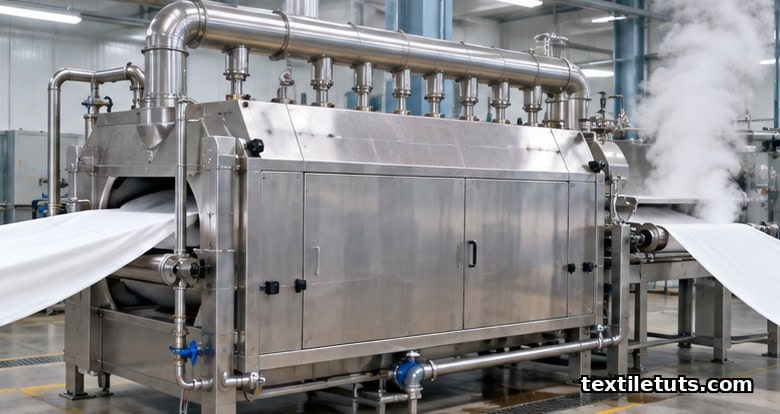
1. Exhaust (winch, jet, or soft-flow machine). Fabric is loaded into the machine, the bath is filled with sodium chlorite and buffer at 60 to 70 degrees C, and the activator is metered in over the first 10 to 15 minutes to bring pH to 3.5 to 4.0. The bath is then ramped to 80 to 95 degrees C and held for 30 to 90 minutes. Used for knit polyester, nylon taffeta, and small lots. Liquor ratio 1:8 to 1:12.
2. Continuous pad-steam. Fabric is padded through the bleach liquor (5 to 20 g/L NaClO2, activator at 2 to 5 g/L acetic acid) at 90 to 100% pick-up, then steamed in a J-box or roller steamer for 15 to 45 minutes at 95 to 100 degrees C. Used for woven polyester and polyester-cotton blends in production-scale ranges. Throughputs of 60 to 100 m/min are typical.
3. Pad-batch (cold). Fabric is padded with the bleach liquor at room temperature and stored in a covered batch for 4 to 12 hours. Used where steam economy matters and where the mill has the floor space to roll batches. The lower ClO2 release rate at ambient temperature gives a softer hand on knit fabric.
After bleaching, the fabric passes through a hot rinse (70 to 80 degrees C), a neutralization step (0.5 to 1 g/L sodium carbonate to bring pH to 6.5 to 7.5), and a final cold rinse. The neutralization step is essential because residual chlorite on the fabric will continue to liberate ClO2 in storage and will yellow the substrate.
Quality Control: Measuring Whiteness and Strength Loss
Whiteness on bleached synthetic fabric is measured by two standard test methods. AATCC TM 110 specifies the use of a spectrophotometer to compute the CIE Whiteness Index from the reflectance curve, with a 10 degree observer and D65 illuminant. ISO 11475 is the international equivalent. Typical targets after NaClO2 bleaching of polyester knit are:
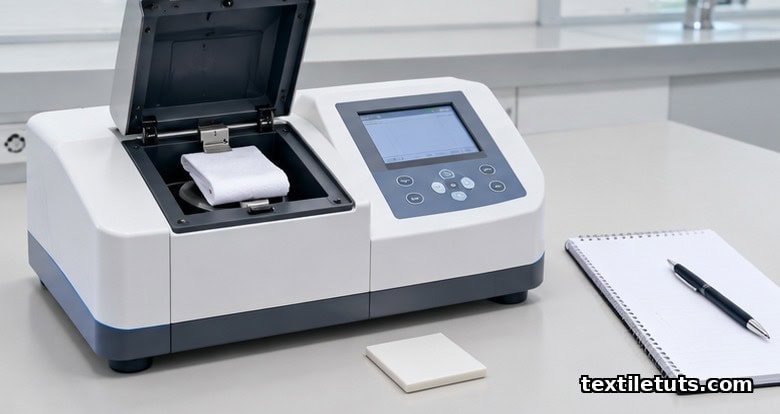
- CIE Whiteness Index: 70 to 85 (brilliant white)
- Berger Whiteness: 75 to 90
- Yellowness Index (ASTM E313): below 3 for a “white” grade
Strength loss is tracked with ASTM D5034 (grab test) or ASTM D5035 (strip test) on the bleached fabric compared with the greige reference. A well-controlled NaClO2 recipe on cotton keeps tensile-strength loss under 5%; on polyester, where the substrate is unaffected by the chemistry, strength loss is essentially zero and is not tracked.
Residual chlorite on the fabric is checked by iodometric titration after distillation. A pass criterion of less than 20 ppm extractable chlorite on the finished fabric is standard for downstream disperse-dye application. Higher residual chlorite is a flag that the neutralization step is under-dosed or that the rinse temperature is too low.
Sodium Chlorite vs Hydrogen Peroxide and Sodium Hypochlorite
The three industrial bleaches sit at different points on the substrate-suitability, strength-loss, and effluent trade-off. The table below summarizes the operating comparison for cotton and for polyester.
| Property | Sodium chlorite (NaClO2) | Hydrogen peroxide (35%) | Sodium hypochlorite (NaOCl) |
|---|---|---|---|
| Active species | ClO2 (chlorine dioxide radical) | HOO- (perhydroxyl anion) | OCl- (hypochlorite) |
| Operating pH | 3.5 to 4.0 | 10.5 to 12.0 | 10.0 to 11.5 |
| Operating temperature | 80 to 95 degrees C | 90 to 100 degrees C | 70 to 90 degrees C |
| Typical concentration | 1 to 3 g/L NaClO2 | 2 to 5 g/L H2O2 | 2 to 5 g/L available Cl |
| CIE whiteness on polyester | 70 to 85 | 55 to 70 | Not recommended (yellowing) |
| CIE whiteness on cotton | 70 to 80 | 70 to 85 | 55 to 75 |
| Tensile-strength loss on cotton | Under 5% | Under 8% | Up to 15% |
| By-products | Cl-, ClO2-, chlorinated organics (AOX) | Water, oxygen | NaCl, chlorinated organics (AOX) |
| Effluent load (COD and salt) | Moderate (AOX + salt) | Low | High (AOX + salt) |
| Per-kg cost (approx.) | 2.5 to 4x higher | 1.5 to 2.5x higher | Lower |
The practical decision rule: use sodium chlorite where the substrate is a synthetic fiber that peroxide and hypochlorite damage (polyester, nylon, aramid), where cotton strength loss must be held below 5%, or where a brilliant-white shade above CIE 75 is required and the mill already has AOX effluent treatment. Use hydrogen peroxide where cost dominates, where effluent is the binding constraint, and where the substrate is cotton, linen, or other cellulose. Use sodium hypochlorite only where the mill is equipped for full AOX removal and cost dominates.
Safety, Effluent, and Sustainability Notes
ClO2 is a toxic gas with a workplace exposure limit of 0.1 ppm (8-hour TWA, ACGIH) and a short-term exposure limit of 0.3 ppm. It is also a strong oxidizer that becomes explosive above 10% v/v in air. Sodium chlorite bleach ranges are therefore fully enclosed, fitted with ClO2 gas monitors, and exhausted through a sodium-hydroxide scrubber that converts the gas to sodium chlorate and sodium chloride.
Storage of sodium chlorite powder and solution is at 10 to 25 degrees C in HDPE or rubber-lined containers, because NaClO2 decomposes above 30 degrees C with release of oxygen and chlorate. Sodium chlorite is never stored near acids or reducing agents because accidental mixing can release ClO2 at explosive rates.
Effluent from NaClO2 bleaching carries residual chlorite, chloride, dissolved ClO2, and absorbable organic halides (AOX). Modern mills route the bleach effluent through a reduction step (sodium thiosulphate or sodium sulphite) before biological treatment, and most jurisdictions cap AOX in discharged water between 0.5 and 5 mg/L depending on the receiving water body. The salt load is lower than for hypochlorite bleaching but higher than for peroxide, and the AOX fraction is the main sustainability drawback of the NaClO2 route.
Frequently Asked Questions
Does sodium chlorite bleach damage polyester fabric?
No. Sodium chlorite activated to ClO2 is the standard bleach for polyester knit and woven fabric precisely because the chlorine dioxide radical attacks the chromophore (the colour-causing conjugated double bonds) without fragmenting the polymer backbone. Strength loss on polyester after a 1 to 3 g/L NaClO2 recipe at pH 3.5 to 4.0 and 80 to 95 degrees C is essentially zero. AATCC TM 110 is the standard method for tracking whiteness on polyester.
What pH should I use for sodium chlorite bleaching?
Hold the bath between pH 3.5 and 4.0 with acetic acid (0.5 to 2 g/L) and buffer the system with 1 to 3 g/L sodium acetate. Below pH 3 the bath generates ClO2 at a runaway rate and the working area can exceed the 0.1 ppm TWA. Above pH 5 the chlorite ion does not disproportionate to ClO2 fast enough and the cycle becomes uneconomical. Sodium acetate (pKa 4.76) is the workhorse buffer because it sits in the right pH region and resists drift against alkaline contamination from upstream desizing.
How does sodium chlorite compare with hydrogen peroxide on polyester?
On polyester knit, sodium chlorite at 1 to 3 g/L NaClO2, pH 3.5 to 4.0, and 80 to 95 degrees C achieves a CIE Whiteness Index of 70 to 85 (AATCC TM 110). Hydrogen peroxide at 2 to 5 g/L H2O2, pH 10.5 to 12, and 90 to 100 degrees C reaches only 55 to 70 on polyester because peroxide damages the polyester surface and yellows the fiber. Sodium chlorite is therefore the preferred bleach for polyester, while peroxide is preferred for cotton, linen, and other cellulose substrates.
Is sodium chlorite safe to use on wool or silk?
Sodium chlorite is safer on protein fibers than sodium hypochlorite because ClO2 does not form chloramines with the amide bond at the standard recipe. A controlled recipe of 1 to 2 g/L NaClO2 at pH 3.5 to 4.5 and 50 to 70 degrees C can be used on wool and silk, though most mills still prefer hydrogen peroxide at near-neutral pH for protein-fiber bleaching because the effluent is cleaner. ISO 105-C06 is the standard colorfastness method for tracking the effect of bleach on protein substrates.
How is residual chlorite removed after sodium chlorite bleaching?
A neutralization step is applied after the bleach bath: 0.5 to 1 g/L sodium carbonate (Na2CO3) for 10 to 15 minutes at 40 to 50 degrees C brings the fabric pH to 6.5 to 7.5 and converts residual chlorite to chlorate, which is then washed off in the subsequent rinse. Residual chlorite on the finished fabric should be under 20 ppm by iodometric titration. Without the neutralization step, residual chlorite will continue to liberate ClO2 in storage and will yellow the substrate, and disperse dyes applied downstream will be at risk of shade drift.
References
- AATCC. Test Method 110: Whiteness of Textiles. American Association of Textile Chemists and Colorists, Research Triangle Park, NC. Spectrophotometric method for CIE Whiteness Index on textiles.
- AATCC. Test Method 82: Fluidity of Dispersions of Cellulose from Bleached Cotton Cloth. American Association of Textile Chemists and Colorists. Degree-of-polymerization check on bleached cotton.
- ASTM International. ASTM D5034: Standard Test Method for Breaking Strength and Elongation of Textile Fabrics (Grab Test). ASTM International, West Conshohocken, PA.
- ASTM International. ASTM E313: Standard Practice for Calculating Yellowness and Whiteness Indices from Instrumentally Measured Color Coordinates. ASTM International.
- International Organization for Standardization. ISO 11475: Textiles – Determination of CIE Whiteness. ISO, Geneva.
- International Organization for Standardization. ISO 105-C06: Textiles – Tests for Colour Fastness – Part C06: Colour Fastness to Domestic and Commercial Laundering. ISO, Geneva. Colorfastness protocol applicable to bleached substrates.
- Trotman, E. R. Dyeing and Chemical Technology of Textile Fibres. 6th edition, Charles Griffin & Co., 1984. Reference text covering sodium-chlorite activation chemistry and bleach recipes on cotton and synthetics.
Editorial by Shahrukh Islam, TextileTuts. Sources: AATCC TM 110, AATCC TM 82, ASTM D5034, ASTM E313, ISO 11475, ISO 105-C06 as cited.


