
Pattern Making: Drafting vs Draping

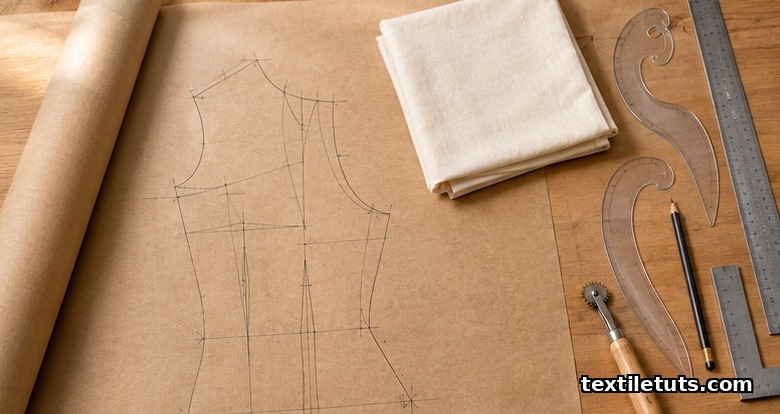
Pattern making produces two-dimensional templates for garment components, with flat drafting applying 12 to 25 body measurements and standard mathematical formulas to construct paper patterns from a base block, and draping shaping 90 g/m² muslin directly onto a calibrated dress form to capture a three-dimensional silhouette that is then traced back to paper.
Both methods produce the same output, a flat pattern piece ready for marker making and cutting, but the path to that result and the precision each method delivers differ in measurable ways. Choosing between them depends on the garment category, the designer’s workflow, and the accuracy required by the production target.
This guide breaks down how each method works, where each excels, and how most production studios combine them in practice.
What Pattern Making Actually Does
Pattern making sits between the design sketch and the cutting room. It translates a garment idea into a precise set of paper or digital templates that define every seam, dart, and hem. Every woven or knit garment that reaches a production line was built from a graded pattern block first, and every couture piece was draped or drafted before a single piece of fashion fabric was cut.
The two methods that dominate professional pattern making are flat drafting and draping. A third workflow, computer-aided design using software such as Lectra Modaris, Gerber AccuMark, or Optitex, is a digital extension of both methods rather than a separate technique, and is addressed in its own place below.
How Flat Drafting Works
Flat drafting starts with a set of body measurements taken with a flexible vinyl tape measure, transferred to pattern paper using rulers, curves, and a set square. The pattern maker plots key reference points, including bust line, waistline, hip line, and neckline depth, and then constructs the pattern by drawing straight and curved lines between those points.
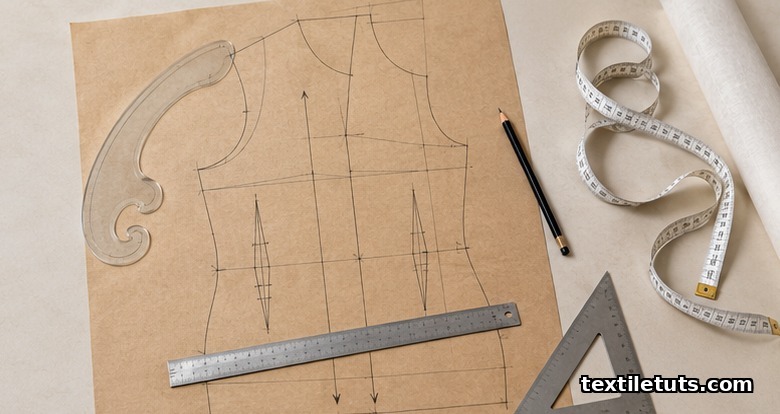
The classic starting point is a bodice block, called a sloper in North American terminology, a fitted, sleeveless torso template that contains no design ease, only the minimum fabric needed to cover the body. Once the block is drafted and verified against a toile (a test garment sewn from inexpensive fabric), design patterns are derived from it by adding ease, seam allowances, and style lines.
Drafting requires:
- Accurate body measurements, typically 12 to 25 dimensions per garment section
- A reliable set of basic blocks in standard sizes
- Pattern paper, usually 0.5 to 1.0 m wide rolls
- A French curve, hip curve, straight ruler, set square, and notcher
- Knowledge of standard seam allowances (typically 1.0 cm for wovens, 0.6 cm for knits)
For production work, drafters reference standardized size charts. ISO 8559-1:2017 defines body measurement landmarks and procedures for garment sizing, and ASTM D5219 covers the terminology for body dimensions used in apparel. Pattern makers working across multiple regions typically maintain blocks in ISO, ASTM, and brand-specific size sets side by side.
How Draping Works
Draping starts with the body rather than the paper. The pattern maker mounts muslin, usually a lightweight, plain-weave cotton such as 90 g/m² bleached muslin, on a dress form and pins, folds, and cuts the fabric directly on the three-dimensional surface until the desired silhouette emerges.
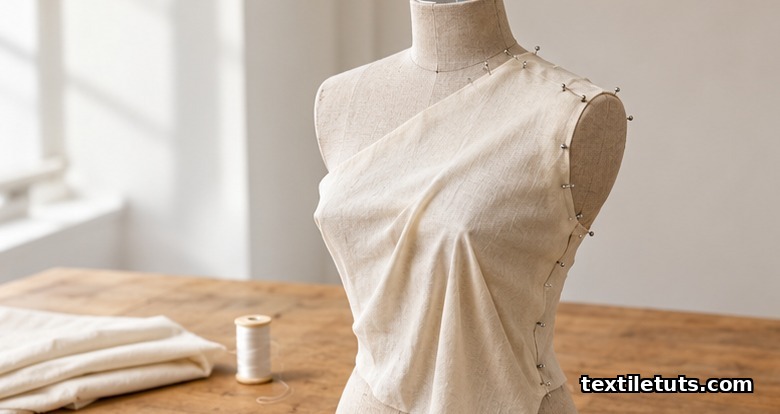
The dress form itself is calibrated to a specific size set, often a sample size 10 or 12 in U.S. sizing or a size 38 to 40 in European sizing. Industry forms are adjustable and pin-resistant, typically covered in a tightly woven linen or polyester ticking that holds pin marks without tearing.
Draping workflow:
- Anchor the muslin at key reference points (shoulder, side seam, center front) with pin heads facing outward for easy removal.
- Release fabric into darts, pleats, or gathers to control volume.
- Mark seam lines, balance points, and notches directly on the fabric with tailor’s chalk.
- Remove the draped muslin from the form and true the lines on a flat surface.
- Transfer the corrected lines to pattern paper or directly to digital format via a photo, scan, or projection.
Draping gives the designer immediate visual feedback on how fabric weight, drape coefficient, and bias behavior affect the final garment. It is the standard method for bridal couture, asymmetrical designs, and any style where fabric behavior is part of the design intent rather than a constraint.
Where Each Method Excels
Drafting performs best when the garment relies on geometric structure. Trousers, jackets, shirts, and most mass-produced woven garments are drafted because their silhouette can be defined by a small set of measurements and the mathematical relationship between them. A flat-drafted trouser pattern is reproducible across sizes by grading the block using a nested size increment system based on body measurement differences between adjacent sizes.
Draping performs best when the silhouette depends on fabric behavior. Bias-cut gowns, cowl necks, draped bodices, and architectural couture rely on how a specific fabric falls, folds, and recovers. Drafting these shapes mathematically is possible but typically requires multiple prototypes to validate, while draping reveals the answer in a single session on the form.
The learning curve also differs. A trained drafter can produce a basic bodice block in 30 to 45 minutes using a reference book of pattern drafting formulas. A draper with the same experience level needs several hours on a form to achieve equivalent accuracy, because draping depends on hand skill developed through repetition rather than formula recall.
Accuracy, Time, and Cost Compared
A 2019 study published in the Journal of Textile and Apparel, Technology and Management compared flat drafting and draping for a fitted bodice pattern and reported mean fit deviations of 4.8 mm for drafted patterns and 5.6 mm for draped patterns when measured against a 3D body scan, a difference small enough to fall within normal inter-operator variation. The same study found draping required on average 1.7 times the calendar time of drafting for equivalent garments.
Material cost per pattern iteration also differs. A drafted toile uses paper, ink, and a single muslin for verification. A draped toile typically consumes three to five muslins before the design intent is captured, especially for complex silhouettes where the first drape is rarely the final pattern.
| Property | Flat Drafting | Draping |
|---|---|---|
| Starting medium | Body measurements plus pattern paper | Muslin on a dress form |
| Best for | Structured wovens, trousers, shirts, jackets, grading | Couture, bias cuts, draped bodices, asymmetric design |
| Skill required | Measurement accuracy, geometry, formula recall | Hand skill, fabric intuition, visual judgment |
| Mean fit deviation vs body scan | ~4.8 mm | ~5.6 mm |
| Time per iteration | Lower (1× baseline) | 1.7× drafting baseline |
| Material per iteration | 1 muslin plus paper | 3 to 5 muslins |
| Reproducibility across sizes | Excellent via grading rules | Limited; each size draped independently |
| Digital integration | Direct (CAD imports measurements) | Indirect (scan or photograph draped muslin) |
How Studios Combine Both Methods
Most professional pattern rooms do not choose one method over the other; they use drafting for the engineered parts of a garment and draping for the parts that depend on fabric behavior. A typical tailored jacket is drafted from a bodice block for the body panels, then draped at the collar and lapel to capture the roll line. A wedding gown is draped for the bodice and skirt, then drafted for the lining, which must fit predictably regardless of fashion fabric choice.
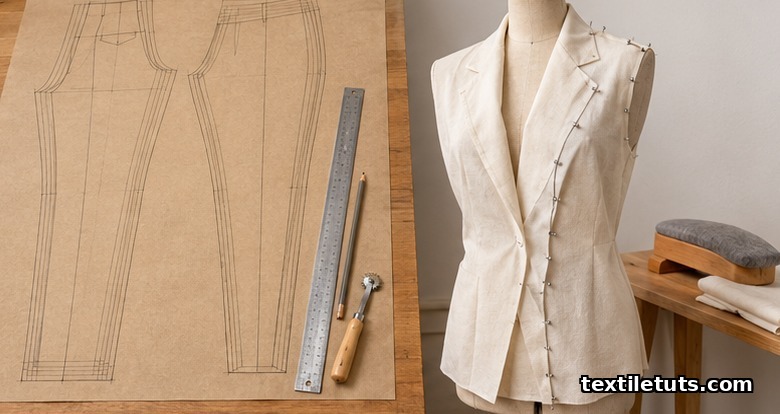
Digital pattern making has blurred the boundary further. CAD systems can import measurements, generate blocks, and project draped muslin scans into vector format. The pattern maker still chooses the method that best answers the design question, but the output is a digital file that feeds the same marker-making and grading pipeline downstream.
Which Method Should You Learn First
For most beginners, flat drafting is the more efficient starting point because it teaches the underlying geometry of garment construction. Once the logic of balance lines, dart manipulation, and ease is understood, draping becomes faster to learn because the pattern maker can see immediately why a draped fold works or fails on a given body.
Pattern making is one of the few apparel skills where the standard textbooks remain the standard references decades after publication. Helen Joseph-Armstrong’s Patternmaking for Fashion Design and the pattern construction volumes issued under The Textile Institute remain among the most cited references in the field across academic programs and production houses.
Frequently Asked Questions
What is the main difference between drafting and draping in pattern making?
Drafting builds the pattern on flat paper from measurements and formulas, while draping shapes fabric on a three-dimensional dress form and then traces the result back to a flat pattern. Drafting is faster and more reproducible across sizes; draping reveals how a specific fabric behaves in three dimensions, which flat drafting cannot predict.
Is draping more accurate than drafting?
Research comparing both methods against 3D body scans reports mean fit deviations of roughly 4.8 mm for drafting and 5.6 mm for draping, well within the variability seen between operators using the same method. Neither method is intrinsically more accurate; each loses accuracy in different ways, drafting through measurement error and draping through fabric slippage on the form.
Can you learn pattern making without a dress form?
Yes for drafting, because drafting depends only on measurements, pattern paper, and rulers. Draping without a dress form is possible by draping on a live model or on the pattern maker’s own body, but the fit transfer to other bodies is less predictable than work done on a calibrated industry form.
Do mass-production garment factories use draping?
Most woven and knit mass production relies on drafted patterns graded across a size range, because drafting scales predictably across hundreds of sizes. Draping is reserved for sample development, couture, and styles where fabric behavior defines the silhouette and cannot be expressed through measurements alone.
What software do pattern makers use today?
Professional pattern rooms use CAD systems such as Lectra Modaris, Gerber AccuMark, Optitex, and Browzwear. These systems accept measurement input for drafting and can import scanned or photographed draped muslins, allowing both methods to feed a single digital workflow that ends in marker making and grading.
References
- International Organization for Standardization. ISO 8559-1:2017, Size designation of clothes, Part 1: Anthropometric definitions and measurement procedures. ISO, 2017.
- ASTM International. ASTM D5219, Standard Terminology Relating to Body Dimensions for Apparel Sizing. ASTM International, 2020.
- American Association of Textile Chemists and Colorists. AATCC Test Method 158, Dimensional Changes in Dry Cleaning. AATCC, 2017.
- Liu, C., Wong, M., and Chen, R. Comparison of flat patternmaking and draping methods for bodice pattern accuracy. Journal of Textile and Apparel, Technology and Management, 12(4), 2019.
- The Textile Institute. Pattern Construction and Grading for Apparel. Textile Institute Professional Publications, Manchester.
- Joseph-Armstrong, H. Patternmaking for Fashion Design. Pearson, 5th edition.
- Bye, E., and Bye, K. Patternmaking methods, in Garment Manufacturing Technology. Woodhead Publishing (Elsevier), 2015.
This article is the working reference for pattern making methods in apparel manufacturing. Editorial by Kazi Sifat Muntasir, TextileTuts. Sources: ISO 8559-1:2017, ASTM D5219, AATCC Test Method 158, the Journal of Textile and Apparel, Technology and Management (Liu et al., 2019), The Textile Institute, and standard patternmaking textbooks as cited.


