
Laser Wash Denim

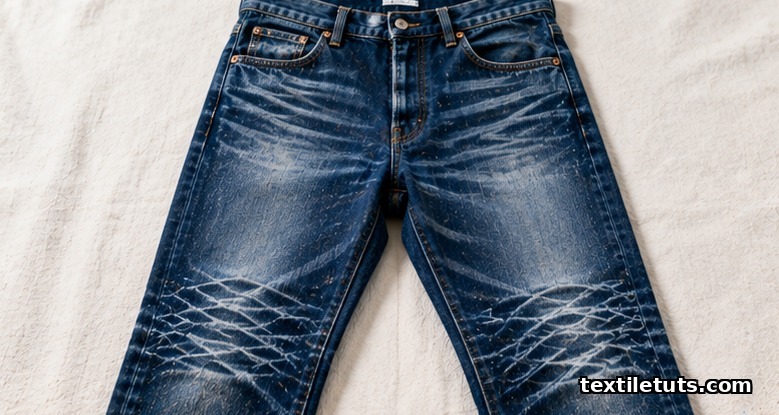
Laser wash denim uses a CO2 infrared laser (wavelength 10.6 µm, typical power 80 to 150 W) to ablate indigo dye from cotton denim fabric, replacing pumice stones and potassium permanganate sprays while cutting process water consumption by 50 to 90 percent per garment.
Because the laser removes dye by sublimating surface pigment rather than mechanically abrading yarn, the process produces no pumice sludge, eliminates manual sanding, and reproduces identical whisker and honeycomb patterns across production batches.
This guide explains how laser wash denim works, the process parameters that determine the final look, how it compares with traditional stone washing, and what durability and colorfastness testing says about the result.
What Is Laser Wash Denim?
Laser wash denim is a finishing technique in which a computer-controlled CO2 laser scans across indigo-dyed cotton twill, removing dye in precise patterns to create whiskers behind the knees, honeycombs behind the ankles, fades on the thighs, and distressed patches on the knees. The technique is dry, contact-free, and programmable.
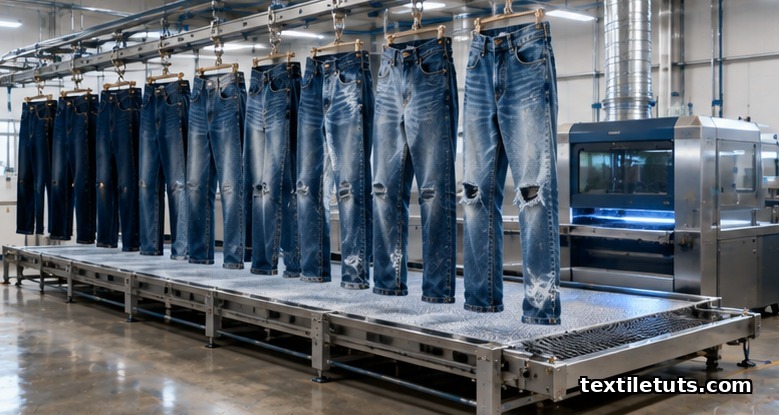
Industrially, the denim garment or flat fabric panel is placed on a working table with vacuum extraction; the laser head traces a vector or raster pattern designed in CAD software. Each pass removes a controlled depth of indigo dye from the fiber surface. Operators adjust the pattern file rather than resetting the machine, which is why a single jeans style can ship in dozens of fade variants without retooling.
The category falls under “dry processing” in denim finishing, alongside ozone fading and laser bleaching. Unlike pumice stone washing, which mechanically abrades cotton fibers along with the dye, laser treatment targets pigment primarily, though it does cause some incidental fiber damage at high energy densities.
How Laser Finishing Works on Denim
The CO2 laser emits a continuous-wave infrared beam at 10.6 µm, a wavelength strongly absorbed by the indigo chromophore and by cellulose fibers. When the beam strikes indigo-dyed cotton, two things happen in parallel:
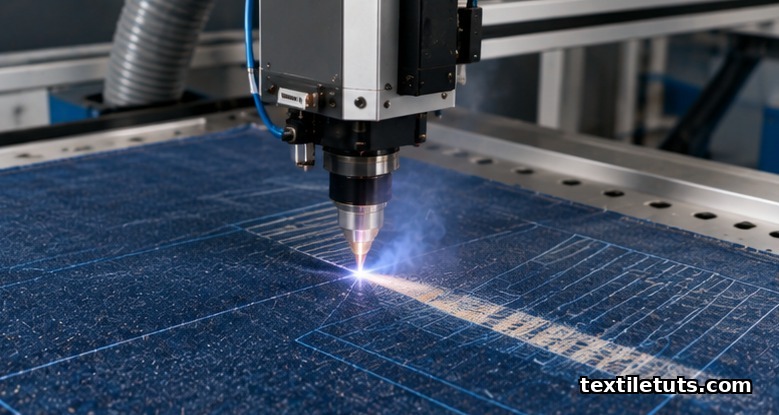
- The dye molecule absorbs the 10.6 µm radiation and sublimates (passes directly from solid to vapor), leaving the cotton fiber beneath it white or cream.
- A thin layer of the cotton surface itself can volatilize if the energy density is high enough, producing the characteristic “frosted” hand of a heavily laser-treated area.
The depth of dye removal scales with the energy delivered per unit area, which is the product of laser power (watts), pulse or scan duration at each spot (seconds), and the inverse of scan speed (millimeters per second). A typical industrial pass uses 100 W of power at a scan speed of 300 mm/s with a 0.3 mm beam spot, producing local fluences of 5 to 25 J/cm². Higher fluences remove more dye but also increase fiber damage.
Two beam-delivery modes are common:
- Vector mode: the laser traces thin lines for whiskers, seam impressions, and honeycomb creases.
- Raster mode: the laser fills a polygonal area for thigh fading, knee blowouts, and pocket-edge highlights.
The CAD pattern file (.plt, .ai, or .dxf) defines the geometry; resolution is measured in dots per inch (dpi), with 300 to 600 dpi typical for visible detail and 1,000 dpi or more for photographic gradients.
Laser Wash vs Stone Wash: A Side-by-Side Comparison
The trade-off between laser and traditional stone finishing is best summarized in a data table. Water and chemical values come from industrial mill studies comparing matched garment lots.
| Parameter | Traditional Stone Wash | Laser Wash |
|---|---|---|
| Water per garment | 50 to 100 L | 5 to 15 L (residual wash after laser) |
| Pumice stone consumption | 0.5 to 1.0 kg per garment | None |
| Potassium permanganate (PP) | Often used for local bleaching | Not required |
| Pumice sludge waste | High; requires landfill disposal | None |
| Energy per garment | 2.5 to 4.0 kWh (washing + drying) | 0.3 to 0.6 kWh (laser + short wash) |
| Cycle time | 60 to 120 min | 10 to 25 min |
| Pattern repeatability | Lot-to-lot variation typical | Identical batch to batch |
| Hand feel | Soft, full | Slightly drier, sometimes brushed afterward |
The single largest gain is the elimination of pumice sludge. A mid-sized denim mill processing 5,000 garments per day historically generated 2.5 to 5 tonnes of pumice waste per day; laser finishing removes this stream entirely.
Process Parameters That Decide the Final Look
Three controllable variables determine how a laser wash turns out on the finished jean.
Power density. Higher power removes dye faster but also chars cotton. Industrial jeans use 80 to 120 W for moderate whiskers and 150 to 200 W for distressed holes and aggressive fades. Above 200 W, fiber yellowing and tensile loss become noticeable.
Scan speed. Faster scan speeds reduce heat input per spot and produce softer fades; slower speeds concentrate energy and yield sharp contrast. A typical honeycomb pattern uses 200 to 400 mm/s; a soft thigh fade uses 600 to 1,000 mm/s.
Resolution and dot density. Raster patterns printed at 300 dpi produce slightly visible pixelation on close inspection; 600 dpi or higher looks photographic but takes two to three times longer to scan.
Beyond these, the indigo shade and yarn count of the base denim matter. Heavy 14 oz raw denim with a deep indigo rope-dyed warp responds to the laser with sharp contrast, because there is more pigment to remove; lighter 9 to 11 oz ring-dyed denim fades more evenly with less contrast because the dye ring is shallower.
Sustainability Impact and Lifecycle Numbers
Several peer-reviewed studies have quantified the environmental footprint of laser finishing. The headline numbers, expressed per standard 5-pocket jean (≈0.6 kg of fabric):
- Water savings of 50 to 90 percent compared to a conventional pumice wash sequence, because the wash cycle is reduced to a brief rinse.
- Energy reductions of 60 to 80 percent when the elimination of long wash and tumble-dry cycles is included.
- Chemical oxygen demand (COD) of the effluent drops by 40 to 70 percent because no permanganate enters the wastewater.
- Pumite sludge to landfill goes to zero.
These reductions are consistent with the LCA framework in ISO 14040, which prescribes the four stages of goal definition, inventory analysis, impact assessment, and interpretation. A well-run laser line scores better on every category except electricity-grid mix: if the mill draws from a coal-heavy grid, the energy advantage narrows.
Effects You Can Produce With Laser Wash
Almost every visual effect historically associated with denim aging can be replicated by laser, and several new ones are only possible with laser.
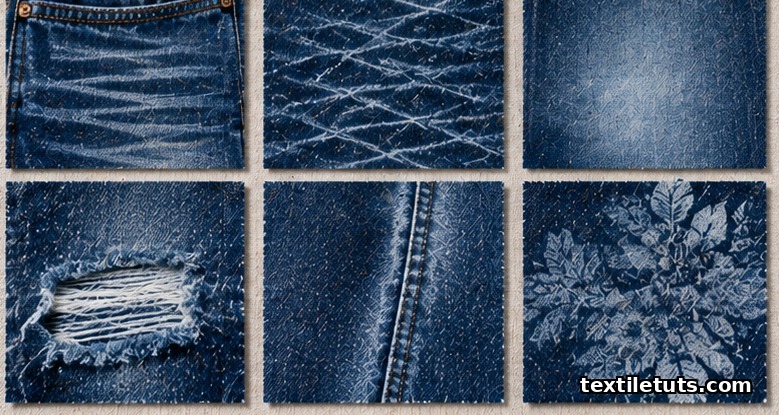
Whiskers. The creases radiating from the crotch in a worn jean, usually modeled in vector mode behind the front hip and pocket.
Honeycombs. The crisscross fade behind the knee and ankle. Vector lines following the natural crease geometry reproduce this convincingly.
Thigh fade. A large, soft gradient across the front thigh, done in raster mode at low power, often with a Gaussian density falloff.
Knee blowouts. Distressed patches exposing weft yarns. Lasers can fully remove warp dye in a defined shape without tearing the fabric; the hole is then optionally cut by hand or by a separate blade pass.
Side seam twist. A subtle vertical gradient where the warp yarns shift after washing. Laser finishing at the side seam can replicate this by selectively fading one yarn set.
Photographic prints. High-resolution raster images, including portraits and brand motifs, can be laser-printed onto denim without ink. This category is essentially unique to laser finishing and is the basis for many designer collaborations.
Does Laser Finishing Damage the Denim?
At commercial parameter sets, the tensile strength loss is small: typically 3 to 8 percent versus an unwashed control, according to published testing on 3/1 right-hand twill at 12 oz. Tear strength follows the same pattern, with losses concentrated in laser-treated zones rather than across the whole garment.
Colorfastness to laundering (tested per AATCC TM61, conditions similar to ISO 105-C06) shows that laser-treated zones may shed slightly more dye in the first few home washes because the residual surface pigment is loosely bound. After three to five home launderings, the dye release stabilizes and matches untreated indigo.
Lightfastness, tested per AATCC TM16.3 under xenon arc, is generally within one rating unit of untreated denim, so a laser-treated jean does not fade significantly faster under daylight than a traditionally washed one.
Frequently Asked Questions
Is laser wash denim safe to wear?
Yes. The laser treatment removes dye at the fiber surface and produces no chemical residue on the fabric. Finishing mills run a short rinse after laser treatment to clear any loose fiber fragments and lint, leaving a garment that is chemically and physically safe for skin contact.
Does laser finishing weaken the denim fibers?
It depends on the energy density. Standard industrial parameters reduce tensile strength by roughly 3 to 8 percent, which is comparable to the strength loss from a normal pre-wash. Aggressive distressing at high power can cut strength by 20 percent or more, but this is intentional and limited to localized patches like knee blowouts.
How long does a laser-faded pattern last through home washing?
The base pattern is permanent because the dye has been physically removed. Surface shade may shift slightly during the first three home launderings as loose pigment clears, but the contrast and geometry of the fade remain stable for the life of the garment under normal care (cold wash, line dry).
Can a laser wash pattern be copied exactly?
Yes, which is a defining benefit of laser finishing. Because the pattern is a digital file, the mill can produce 10 or 10,000 identical jeans from the same design. Stone washing, by contrast, is a stochastic process and varies from garment to garment by design.
Is laser wash denim more sustainable than stone wash denim?
On water, chemical oxygen demand, pumice waste, and process energy, laser finishing is significantly more sustainable than pumice stone washing, with peer-reviewed savings in the 50 to 90 percent range for water and 60 to 80 percent for energy. The advantage shrinks if the local electricity grid is coal-based and enlarges if the grid is renewable.
References
- Kan, C. W. (2014). Laser Surface Modification of Denim Jeans. ResearchGate. Research summary of CO2 laser parameters and colorfastness results on indigo denim.
- Onal, L., & Yildirim, M. (2012). Abrasion and colorfastness of laser treated denim fabrics. ScienceDirect (Wear). Tensile and color-change data for laser-treated cotton twill.
- ISO 105-C06:2010. Textiles — Tests for colour fastness — Part C06: Colour fastness to domestic and commercial laundering. International Organization for Standardization.
- AATCC TM16.3-2020. Colorfastness to Light: Xenon-Arc. American Association of Textile Chemists and Colorists.
- Hossain, M. D., et al. Sustainability assessment of laser finishing in denim manufacturing. MDPI Sustainability. Quantified water, energy, and COD savings versus pumice washing.
- ISO 14040:2006. Environmental management — Life cycle assessment — Principles and framework. International Organization for Standardization. The four-phase LCA methodology used for environmental claims.
- AATCC TM61-2013. Colorfastness to Laundering: Accelerated. American Association of Textile Chemists and Colorists. Standard test for wash-fast dye release on treated denim.
This article is the working reference for laser wash denim finishing. Editorial by Shahrukh Islam, TextileTuts. Sources: Kan (2014), Onal and Yildirim (2012), ISO 105-C06, AATCC TM16.3, MDPI Sustainability, ISO 14040, and AATCC TM61 as cited.


