
Oxford Cloth: Construction and Use

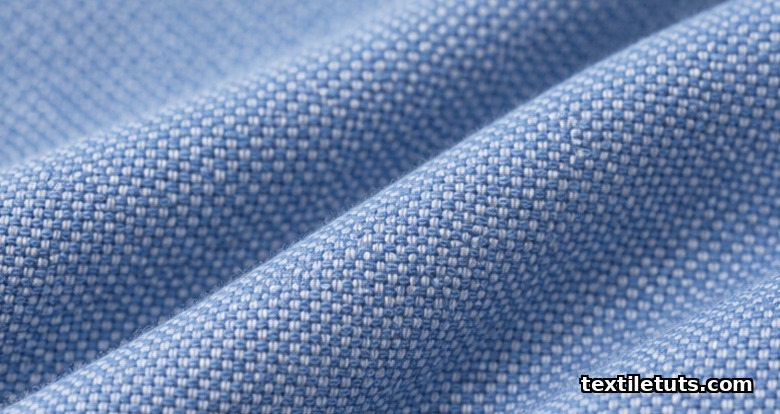
Oxford cloth is a basket-weave shirting fabric made by passing two or more warp yarns over a single weft yarn in a plain-weave derivation, producing a cotton cloth of 110 to 160 grams per square meter (GSM) with a soft, slightly textured surface and a visible paired-warp crosshatch.
The construction is most often expressed as a 2×1 or 2×2 basket weave, and the cloth is almost always yarn-dyed so one set of yarns reads as a contrasting color, which is what gives an “Oxford blue” or “Oxford white” shirt its subtle heathered appearance.
Below is how the cloth is built, how the common variants differ, and how those construction choices map to end-use performance in shirting and lightweight outerwear.
How Oxford Cloth Is Woven
Oxford is technically a derivative of the plain weave, not a separate weave family. In a plain weave, each warp yarn passes alternately over and under one weft yarn, which gives the densest, most balanced interlacing possible. In Oxford, two (occasionally three) warp ends are grouped and woven as a single unit over one weft pick, while the weft is woven singly under paired warps on the return pass. The resulting interlace is sometimes called a “basket weave” because the grouped warps look like the warp direction of a basket laid over the weft ribs.
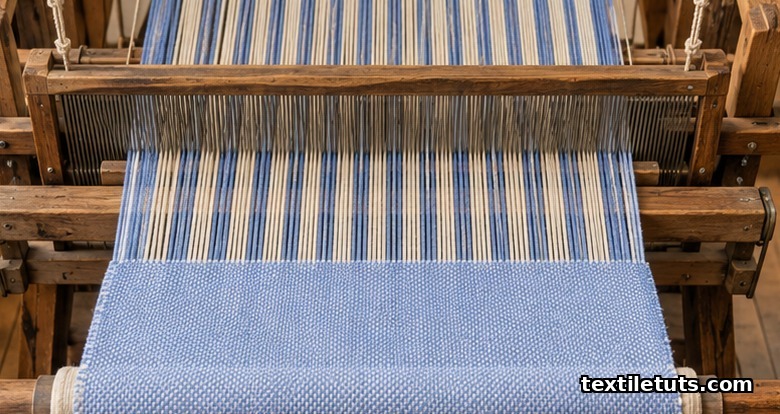
The warp yarn count for a standard shirting Oxford is typically Ne 40 to Ne 60 (40 to 60 hanks of 840 yards per pound), with Ne 50 the most common middle-of-the-range choice. The weft is often a coarser count to set up the surface texture, frequently Ne 16 to Ne 30. The contrast in yarn count, paired with the grouped-warp interlacing, is what produces the small, regular “granular” appearance on the face of the cloth.
Construction density for an Oxford shirting typically falls between 60 and 90 ends per inch (EPI) in the warp and 40 to 60 picks per inch (PPI) in the weft. Combined with a relaxed loom state, the cloth compresses during finishing to a finished EPI/PPI roughly 10 to 15 percent higher than the loom state. ISO 7211-2 describes the unit-length thread-count method used to confirm those figures, while ISO 7211-1 covers the weave-diagram presentation by which a laboratory analyst confirms that a cloth is a 2×1 basket derivative rather than a true plain weave; the visual difference between Oxford and a basic poplin is usually visible under 10x magnification and obvious to the touch on the finished cloth.
Yarn Composition, Twist, and Color
Oxford cloth is overwhelmingly woven from combed cotton. Combing removes short fibers and aligns the remaining long fibers, which gives the cloth its smooth hand despite the open interlacing. Open-end rotor-spun yarns are sometimes used in lower-cost versions, but ring-spun combed cotton is the standard for any Oxford intended for shirting, where pilling resistance and a clean surface matter.
Yarn twist is multi-ply for the warp in many Oxford cloths (two single yarns twisted together), which adds tensile strength and abrasion resistance for daily wear. Single-ply ring-spun warps are also acceptable but produce a softer, less durable cloth. Weft yarns are typically single-ply, with a moderately high twist multiplier (around 4.0 to 4.5 in the Tex system) to give the weft enough body to hold the basket structure open.
Almost every Oxford is yarn-dyed. The warp and weft are dyed separately before weaving, usually with fiber-reactive dyes that have a wash fastness rating of 4 or higher on the AATCC Gray Scale for color change (AATCC TM 8). The classic “Oxford blue” comes from a colored warp woven with a white weft, which mid-tone mixes at the cloth surface to a soft blue-gray. Reversing the color positions, or using two colors, produces the broader family of “university stripe” and “tattersall” Oxford cloths.
The Main Variants of Oxford Cloth
Five named variants dominate the market, and they differ in yarn count, weave grouping, and end use.
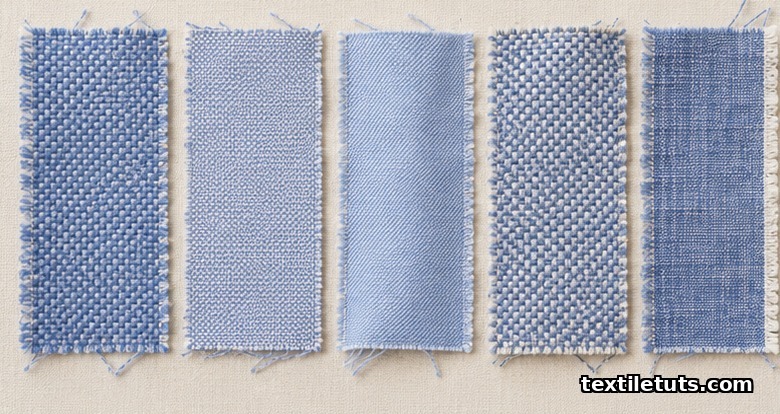
| Variant | Weave grouping | Typical warp / weft count | Typical GSM | End use |
|---|---|---|---|---|
| Standard Oxford | 2×1 basket | Warp Ne 40-50 / weft Ne 16-30 | 130-160 | Casual and business-casual button-down shirts |
| Pinpoint Oxford | 2×1 basket, finer yarns | Warp Ne 60-80 / weft Ne 30-40 | 110-140 | Dressier button-down shirts |
| Royal Oxford | 2×2 basket, finer yarns | Warp Ne 80-100 / weft Ne 40-50 | 120-150 | Premium dress shirts with a subtle sheen |
| Imperial Oxford | 2×2 basket, doubled warps | Warp Ne 80-100 (2-ply) / weft Ne 40-50 | 140-170 | Heavier formal shirts, sometimes lightweight jackets |
| Oxford chambray | 2×1 basket, indigo warp on white weft | Warp Ne 50-60 / weft Ne 20-30 | 120-150 | Casual shirting, denim substitute |
The defining variable across this table is the weave grouping (2×1 vs 2×2) and the warp yarn count. Pinpoint uses the same 2×1 grouping as a standard Oxford but with finer warps, which tightens the surface and reduces the basket texture. Royal Oxford and Imperial Oxford use a 2×2 grouping with even finer warps and produce a smoother, almost pinpoint-like surface with a faint luster from the doubled warp floats.
Mechanical Performance
Oxford cloth is stronger than a plain-weave poplin of the same yarn count because the grouped warp reduces the number of interlacing points per unit area, which in turn reduces the stress concentration at each crossover. Tensile strength for an Oxford warp strip typically falls between 800 and 1200 N (Newton) at a 5 cm strip width on an ASTM D5034 grab test, against 600 to 900 N for an equivalent poplin. Weft-direction strength is usually 40 to 60 percent of warp strength because the single weft is finer and the weft set is lower.
Tear strength is a different story. Because the interlacing is sparser, a tear can propagate more easily along the warp direction once it starts. ASTM D1424 (Elmendorf) values for Oxford typically range 20 to 40 N warp direction and 30 to 50 N weft direction, against 40 to 60 N and 50 to 70 N for a comparable plain-weave poplin. In practice this means Oxford resists puncture and abrasion slightly better than poplin but tears more easily once a tear starts. For shirt applications this trade-off is rarely noticed; it becomes relevant only when the cloth is used in lightweight outerwear.
Air permeability is higher than a comparable poplin because of the basket structure. ISO 9237 air-permeability values for a standard Oxford at a 100 Pa pressure drop typically run 200 to 400 L/m²/s, against 100 to 200 L/m²/s for a poplin of the same mass. Higher air permeability is why Oxford feels cooler against the skin and is preferred in warm-weather shirting despite a heavier fabric mass than some alternatives.
Dimensional Stability, Shrinkage, and Care
An untreated loom-state Oxford can shrink 8 to 12 percent in the warp direction and 4 to 8 percent in the weft direction on the first wash. Pre-shrunk (sanforized) or mercerized Oxfords are stabilized to 3 percent or less residual shrinkage in both directions, which is the threshold most shirt manufacturers require for retail sale. AATCC TM 135 is the standard test for measuring these residual shrinkage values across multiple home-laundering cycles.
Hot water washing (above 60 °C) and tumble drying on high heat will progressively relax any residual shrinkage and weaken the cotton fibers, leading to both dimensional change and surface pilling over time. The safest routine is a 30 to 40 °C machine wash with a mild detergent, line drying, and a warm iron (around 150 °C) while the cloth is still slightly damp. Drip-dry without spinning leaves the cloth relatively wrinkle-free because of the basket weave’s tendency to recover from creasing.
For stained Oxford shirts, oxidative bleach (sodium percarbonate) is acceptable on white Oxfords at 40 °C; chlorine bleach weakens cotton fibers and yellows the cloth over repeated use, and is not recommended. Colorfastness to laundering on a yarn-dyed Oxford typically scores 4 on the AATCC Gray Scale for color change after five home launderings under AATCC TM 135 conditions.
Common End Uses
The dominant end use is the button-down shirt, in all its variants. The basket structure gives the cloth enough body to hold a collar and cuff shape without the need for heavy interfacing, which is why Oxford has been the standard casual shirt fabric since the early twentieth century. The soft-collared, button-down Oxford shirt occupies a distinct middle ground between formal poplin dress shirts and casual knit polos (piqué knit is a different fabric entirely).
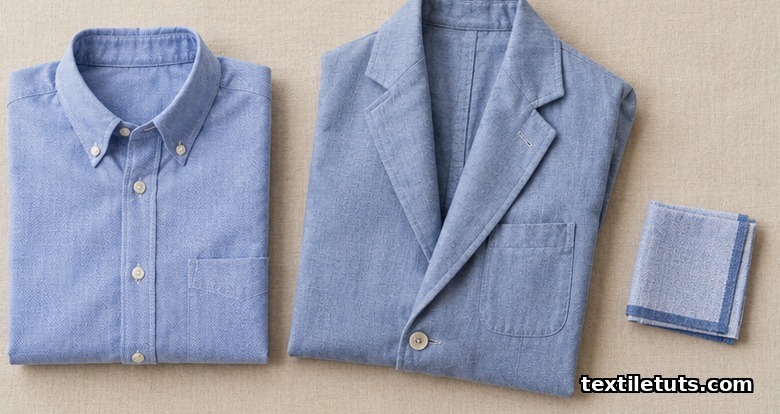
Beyond shirts, Oxford is also woven at heavier weights (180 to 220 GSM) for casual jackets, technical outerwear linings, and bag fabrics. The same construction at very high yarn counts (above Ne 100) is used in lightweight summer scarves and pocket squares. It is not used for trousers, suits, or formal tailored garments, where worsted wool or smoother plain-weave cottons dominate.
Blended Oxfords, typically 70 percent cotton and 30 percent polyester, are common in uniform workwear and hospitality shirts because the polyester adds abrasion resistance and reduces ironing time. Pure cotton remains preferred for dress shirts and any Oxford that will be printed or embroidered, because synthetic fibers resist dye uptake and reduce print clarity.
Sustainability and Sourcing Notes
Cotton Oxford’s main environmental costs come from cotton cultivation (water, pesticide, and land use) and from wet-processing in dyeing and finishing. Better Cotton Initiative (BCI) certified cotton and organic cotton (GOTS certified) are both available in Oxford constructions, and the performance is comparable to conventional cotton once woven and finished. Recycled cotton Oxfords exist but are limited in supply and are usually blended with virgin fiber for tensile strength.
Because Oxford is a yarn-dyed fabric, any color decisions lock in dye and water use at the yarn stage, not at the cloth stage. This is one reason solid-color Oxford shirts often cost less than patterned ones: solid colors can use package-dyed (cheaper) yarn, whereas heather, stripe, or tattersall effects require slasher or skein dyeing of the warp, which is more resource-intensive. Anyone specifying Oxford at scale should weigh the yarn-dyed aesthetic against the higher resource cost and consider whether the effect can be achieved with a finished-cloth print instead.
Frequently Asked Questions
What makes a fabric an Oxford cloth and not a poplin?
Oxford is a basket-weave derivative of the plain weave, with two or more warp yarns grouped over one weft. Poplin is a true plain weave with fine warps and coarser wefts. The basket grouping gives Oxford its surface texture and slightly higher air permeability, while poplin has a smoother, flatter surface. Under 10x magnification, Oxford shows paired warp floats and poplin does not.
Is Oxford cloth durable enough for daily wear shirts?
Yes. A standard 130 to 160 GSM combed cotton Oxford will hold up to daily machine washing and office wear for at least two to three years before visible pilling or collar fraying appears. Tensile strength is comparable to or higher than poplin of the same mass (ASTM D5034 grab tests of 800 to 1200 N in the warp), though tear strength is slightly lower because of the sparser interlacing.
Can Oxford cloth be ironed at high temperature?
Cotton Oxford tolerates iron temperatures up to about 200 °C (the cotton setting on most home irons). Above that, the cellulose fibers begin to yellow and weaken. Ironing while the cloth is still slightly damp, around 30 to 40 percent moisture content, gives the smoothest finish with the least heat exposure.
Does Oxford cloth shrink in the wash?
Untreated loom-state Oxford can shrink 8 to 12 percent on the first wash. Commercial shirting Oxfords are pre-shrunk (sanforized) to a residual shrinkage of 3 percent or less in both warp and weft directions, measured per AATCC TM 135. Home laundering at 30 to 40 °C and line drying will keep further shrinkage within that 3 percent envelope.
Is Oxford cloth breathable enough for hot weather?
Yes. Air permeability for a standard Oxford at a 100 Pa pressure drop is typically 200 to 400 L/m²/s, roughly twice that of an equivalent poplin (ISO 9237). The basket weave allows more air exchange through the cloth, which is why Oxford remains a preferred hot-weather shirting despite a higher fabric mass than some alternatives.
References
- International Organization for Standardization. ISO 7211-1:1984. Textiles — Woven fabrics — Construction — Methods of analysis: Part 1: Methods for the presentation of a weave diagram and for the determination of the type of weave. https://www.iso.org/standard/9313.html — Defines the weave-diagram method by which a 2×1 or 2×2 basket construction is confirmed.
- International Organization for Standardization. ISO 7211-2:1984. Textiles — Woven fabrics — Construction — Methods of analysis: Part 2: Determination of number of threads per unit length. https://www.iso.org/standard/9314.html — Method for the warp and weft density figures cited above.
- International Organization for Standardization. ISO 9237:1995. Textiles — Determination of the permeability of fabrics to air. https://www.iso.org/standard/13746.html — Reference method for the air-permeability values cited.
- ASTM International. ASTM D5034-21. Standard Test Method for Breaking Strength and Elongation of Textile Fabrics (Grab Test). https://www.astm.org/d5034-21.html — Tensile-strength method used for the warp and weft strength figures.
- ASTM International. ASTM D1424-21. Standard Test Method for Tearing Strength of Fabrics by Falling-Pendulum Type (Elmendorf) Apparatus. https://www.astm.org/d1424-21.html — Tearing-strength method.
- AATCC. AATCC TM 135-2018. Dimensional Changes of Fabrics after Home Laundering. https://www.aatcc.org — Standard wash-shrinkage test referenced for the residual shrinkage figures.
- American Association of Textile Chemists and Colorists. AATCC TM 8-2016. Colorfastness to Crocking: AATCC Crockmeter Method. https://www.aatcc.org — Colorfastness method cited for the yarn-dyed Oxford color-retention values.
This article is the working reference for Oxford cloth construction and end use. Editorial by Mohammad Yousuf (Anik), TextileTuts. Sources: ISO 7211-1, ISO 7211-2, ISO 9237, ASTM D5034, ASTM D1424, AATCC TM 135, AATCC TM 8 as cited.


