
Mechanical Textile Recycling

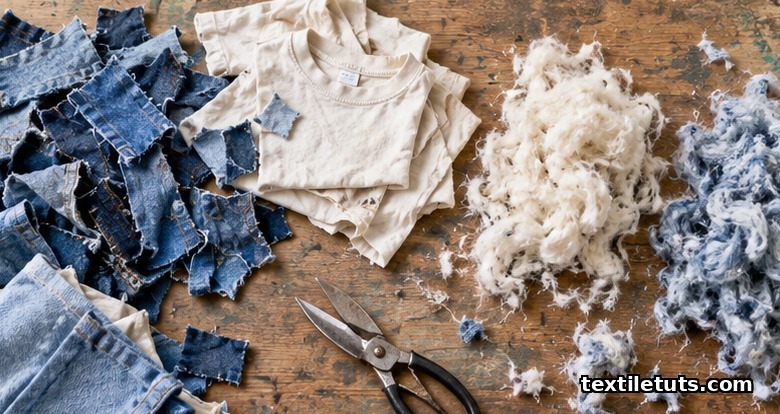
Mechanical textile recycling recovers between 30 and 70 percent of usable fiber mass by cutting post-consumer fabrics into 10 to 25 mm pieces, then tearing the pieces apart through carding and garnetting machines to separate individual fibers, which are respun into yarn or laid into nonwoven products.
It is the oldest and most widely deployed textile-to-textile recycling route, accounting for the bulk of clothing waste that does not go to landfill or incineration, and it underpins insulation, carpet backing, denim insulation, and the regenerated yarn used in many workwear and blanket products.
The rest of this article explains how the mechanical route actually works, where its limits are, and how it compares to chemical recycling.
What Is Mechanical Textile Recycling?
Mechanical textile recycling is a physical process that breaks waste fabric back down into fiber without dissolving or chemically altering the polymer. The fabrics are sorted by fiber type, cut into smaller pieces, and then pulled apart (a step called fiber opening or garnetting) until the original yarn structure is gone and only loose fibers remain. These fibers can be respun into new yarn, blended with virgin stock, or laid into nonwoven mats for insulation, automotive padding, and carpet underlay.
Unlike chemical recycling, which dissolves the polymer to rebuild it, mechanical recycling leaves the chemistry of the fiber unchanged. This is its main advantage: the process is simple, low-temperature, and works on most natural and many synthetic fibers. It is also its main limitation, because every cut shortens the fiber, and a fiber that has been cut, pulled, and re-cut several times eventually becomes too short to spin.
According to the European Commission’s 2022 EU Strategy for Sustainable and Circular Textiles, less than 1 percent of material used to produce clothing worldwide is recycled into new clothing, and the share that is recycled at all is dominated by mechanical rather than chemical processes.
The Mechanical Recycling Process, Step by Step
A typical mechanical line for cotton or wool garments runs through five stages.
1. Sorting and pre-conditioning. Garments are sorted by fiber composition (manual or NIR-assisted), color, and contamination level. Buttons, zippers, prints, and elastane are removed at this stage. A 2023 MDPI Textiles review reports that the presence of elastane above roughly 3 percent by mass is the single largest cause of yarn breakage in subsequent spinning of the reclaimed stock.
2. Cutting and shredding. Sorted fabric is fed into rotary cutters or guillotine blades that reduce it to 10 to 25 mm pieces. Smaller pieces open more easily in the next stage, but they also cut the fiber shorter, so most operators tune the cut length to the target end use.
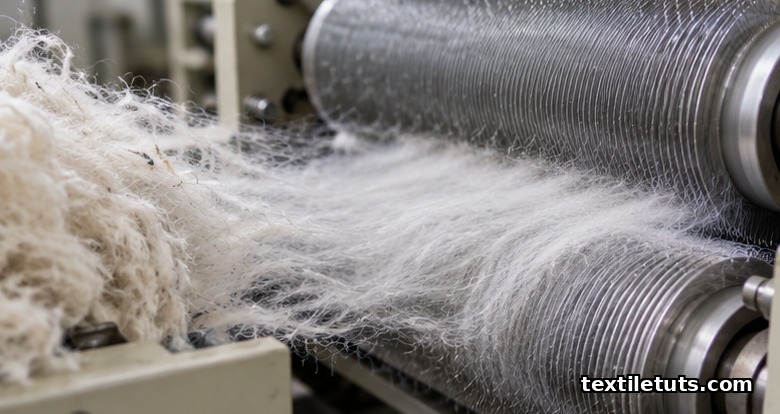
3. Fiber opening (garnetting). The cut pieces pass through a garnett machine, which is a series of rotating rollers covered in sharp wire teeth that tear the pieces apart into individual fibers. A modern line may use three to five garnetts in series, each progressively finer, with trash, dust, and short fly removed between stages.
4. Carding and cleaning. The opened fiber is carded to align the fibers into a web and to remove residual trash and neps. For high-grade output, the web is condensed into a sliver ready for spinning.
5. Spinning or nonwoven forming. The sliver is spun into yarn, typically blended with 30 to 70 percent virgin fiber to make up for the length loss, or it is laid into a web and bonded (thermally, mechanically, or chemically) into nonwoven fabric.
Fiber Length Loss and the Quality Ceiling
Every mechanical recycling cycle shortens the fiber. A virgin cotton fiber is typically 25 to 35 mm long; after one cycle of cutting and garnetting, the average length drops to roughly 12 to 18 mm, and the length distribution becomes much wider, with a long tail of very short fibers and nep fragments. A 2021 study published in Resources, Conservation and Recycling measured an average fiber length loss of 50 to 60 percent per cycle for cotton, with corresponding losses in tenacity of 25 to 40 percent.
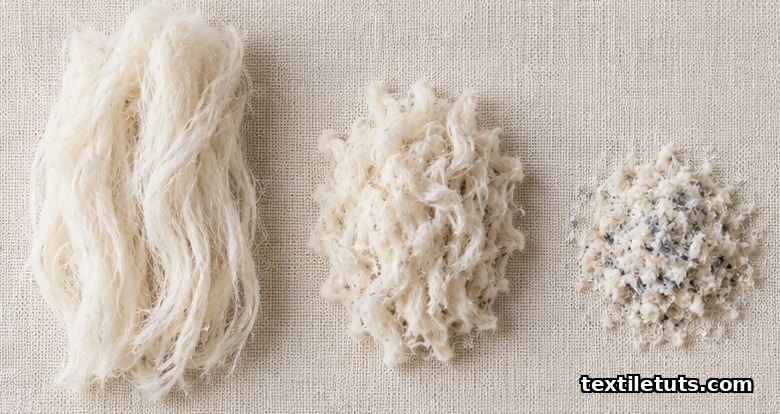
Once the average length falls below about 10 mm, the fiber can no longer be spun into a yarn strong enough for weaving or knitting. From that point on, the only economic use is in nonwoven products such as insulation, automotive acoustics, mattress filling, and carpet underlay.
This is why mechanical recycling is sometimes called a downcycling route: most output is destined for lower-grade applications, and only a small share, made from carefully selected post-industrial waste, can be re-spun for apparel.
Mechanical vs Chemical Recycling: A Side-by-Side Comparison
| Property | Mechanical | Chemical |
|---|---|---|
| Process type | Physical cutting and tearing | Polymer dissolution or depolymerization |
| Output quality | Shortened fibers, lower tenacity | Virgin-quality monomers or polymers |
| Typical fiber length after one cycle (cotton) | 12 to 18 mm | Restored to original |
| Blend handling | Requires pre-sorting by fiber | Some processes can separate blends |
| Energy intensity | Low to moderate | High, often with chemical inputs |
| Mature commercial capacity | High, established since the 19th century | Low, mostly pilot scale as of 2025 |
| Main end use | Insulation, nonwovens, workwear yarn | Virgin-quality apparel fiber |
Mechanical recycling is the only textile-to-textile route currently operating at scale. Chemical processes for polyester (depolymerization back to monomer) and cellulose (Lyocell-style solvent spinning from recycled pulp) are advancing rapidly but, as of 2024, remain a small fraction of total recycled fiber production by volume.
Where Mechanically Recycled Fibers End Up
The single largest outlet for mechanically recycled cotton is nonwoven insulation and padding. The second largest is yarn for denim, workwear, and blankets, where the recycled fiber is blended with virgin cotton or polyester to bring the yarn up to spinning strength.
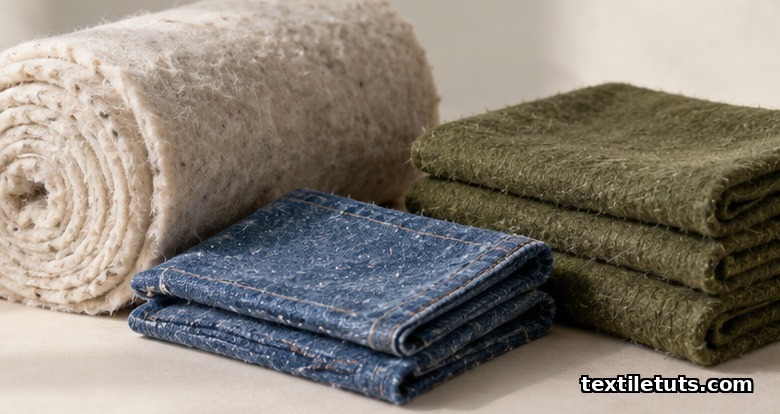
Wool follows a similar pattern: old wool garments are garnetted and respun into yarn for low-pilling knitwear, military blankets, and overcoats. The classic term for this product is shoddy, which originally meant fiber reclaimed from shredded woolen rags but now covers reclaimed fiber of any type. A closely related term, mungo, refers specifically to reclaimed fiber from felted or hard-twisted wool rags. Both terms date from the early 19th century in the woollen districts of West Yorkshire, where the practice first became industrial.
Other significant outlets include carpet backing, automotive interior padding, geotextile underlay, and stuffing for toys and furniture. According to ISO/TR 20118:2019, which sets the standard vocabulary for recycled textile fibers, all of these fall under the broad category of reclaimed fiber rather than recycled fiber, with the latter reserved for material that returns to a yarn or fabric of comparable quality.
Standards and Guidance for Recycled Textiles
Two international documents anchor the technical language of the field. ISO/TR 20118:2019 defines terms such as pre-consumer waste, post-consumer waste, reclaimed fiber, and recycled fiber, and sets out sampling and identification guidance for blends. ASTM D8103-17 covers the standard practice for determination of cotton fiber maturity by polarized light microscopy and is often cited in studies that compare virgin and recycled cotton length distributions.
The European Commission’s 2022 EU Strategy for Sustainable and Circular Textiles sets mandatory recycling targets for textile waste by 2025, including separate collection and sorting infrastructure, and is the policy lever that is currently pulling most of the new investment into both mechanical and chemical recycling lines in Europe.
Frequently Asked Questions
Is mechanical textile recycling really sustainable?
It is more sustainable than landfill or incineration, but it is not a closed loop. The fiber is shortened at every cycle, so even at 100 percent collection efficiency a cotton T-shirt cannot be mechanically recycled into another T-shirt more than two or three times before the fiber becomes too short to spin. The energy and water footprint per kilogram is, however, far lower than that of virgin cotton, and the process avoids the solvent recovery burden of chemical recycling.
Can blended fabrics be mechanically recycled?
Only with difficulty. A polyester-cotton blend cannot be separated by cutting and tearing, so the output is a mixed fiber that must be used in nonwoven applications or carded and spun as a blend yarn. A 2022 study in the journal Sustainability found that blend content above about 30 percent by mass reduces yarn strength to the point where it is uneconomic to spin for apparel.
How many times can cotton be mechanically recycled?
For apparel-grade yarn, one to two cycles in practice. After that, the fiber is short enough that it must be blended with virgin stock at 50 percent or more. After three to four cycles, the material is essentially nonwoven feedstock.
Does mechanical recycling damage the fiber?
Yes. The cutting blades and garnett wire teeth physically shorten the fiber and create surface damage that reduces tenacity. A 2021 study in Resources, Conservation and Recycling reported tenacity losses of 25 to 40 percent per cycle for mechanically recycled cotton, with the largest losses occurring in the first cut.
What is shoddy?
Shoddy is reclaimed fiber produced by shredding and garnetting wool or wool-blend rags. It is the oldest form of mechanical textile recycling, dating back to the early 19th century in the woollen districts of West Yorkshire, and it is still the dominant route by which old wool garments are turned into new yarn and insulation today.
References
- International Organization for Standardization. ISO/TR 20118:2019 Textiles — Guidelines for recycled fibres. iso.org — defines vocabulary, sampling, and identification guidance for recycled textile fiber.
- ASTM International. ASTM D8103-17 Standard Practice for Determination of Cotton Fiber Maturity by Polarized Light Microscopy. astm.org — reference method for cotton fiber length and maturity testing.
- European Commission. EU Strategy for Sustainable and Circular Textiles (COM/2022/141). europa.eu — 2022 policy framework setting mandatory textile collection and recycling targets across the EU.
- MDPI. Textiles (journal), 2023 review article on mechanical recycling of cotton-rich post-consumer textiles. mdpi.com — peer-reviewed review of pre-processing, cutting, and garnetting steps.
- Elsevier. Resources, Conservation and Recycling, 2021 study on fiber length and tenacity loss in mechanically recycled cotton. sciencedirect.com — quantitative data on fiber shortening and tenacity loss per cycle.
- MDPI. Sustainability (journal), 2022 study on yarn quality from mechanically recycled cotton-polyester blends. mdpi.com — peer-reviewed work on blend-content limits for spinning.
- The Woolmark Company. Wool and recycled fiber: industry technical reference. wool.com — historical and technical reference on shoddy, mungo, and wool reclamation.
Editorial by Shahrukh Islam, TextileTuts. Sources: ISO/TR 20118:2019, ASTM D8103-17, European Commission EU Strategy for Sustainable and Circular Textiles (2022), MDPI Textiles (2023), Resources, Conservation and Recycling (2021), MDPI Sustainability (2022), and The Woolmark Company as cited.


