
Organic Linen and Hemp

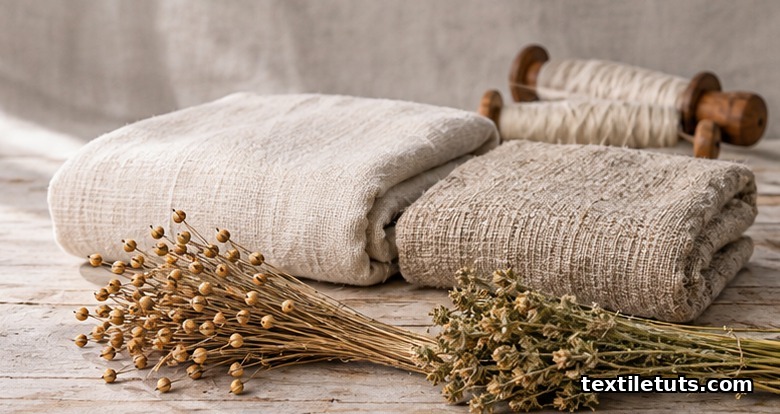
Organic linen fiber from flax (Linum usitatissimum) has a tensile strength of 50 to 65 cN/tex, while organic hemp fiber (Cannabis sativa, industrial cultivar) reaches 50 to 70 cN/tex, ranking both among the strongest natural bast fibers globally. Both qualify as bast fibers extracted from plant stems, both are grown without synthetic pesticides under certified organic protocols, and both fall under the same Global Organic Textile Standard (GOTS) certification framework.
What separates them is how the fiber behaves on the loom, in the wash, and across years of service. This article walks through the agronomic inputs, fiber chemistry, processing route, end-use durability, and care behavior of organic linen and organic hemp so you can choose between them with actual numbers rather than marketing language.
What “Organic” Actually Requires for Linen and Hemp
The legal floor for any textile labeled “organic” in international trade is the Global Organic Textile Standard (GOTS), version 7.0, which became effective on 1 March 2023. GOTS requires that at least 95% of the fibers in a product be certified organic for the label “organic,” and at least 70% for “made with organic” labeling. Flax and hemp both fall under GOTS scope 1 (fiber production), with prohibited-input lists covering synthetic pesticides, synthetic fertilizers, and genetically modified organisms across a minimum 36-month conversion period for the field.
For the field stage, organic flax and organic hemp must be grown on soil managed without synthetic agrochemicals for at least three years before harvest. The European Union’s Regulation (EU) 2018/848 on organic production mirrors this three-year conversion rule and additionally bans hydroponic cultivation of both crops, requiring in-soil growth for organic certification. Processing aids used during retting, scutching, hackling, and spinning must also meet GOTS chemical-input restrictions, which prohibit azo dyes, formaldehyde, and a defined list of heavy-metal contaminants above specified thresholds.
In the United States, the USDA National Organic Program (NOP) under 7 CFR §205 covers the field and processing stages for organic flax and organic hemp, with parallel rules on prohibited synthetic inputs and a three-year transition period. Both regulatory frameworks require annual third-party audits and full traceability from the field through every processing stage to the finished fabric.
Fiber Structure and Mechanical Properties
Linen and hemp share the same plant-anatomy class: they are bast fibers, the long structural strands that run along the stem’s phloem. Each strand is a bundle of elementary fibers cemented by pectin and lignin. The cellulose content, however, differs enough to change the fiber’s hand and tensile behavior in measurable ways.
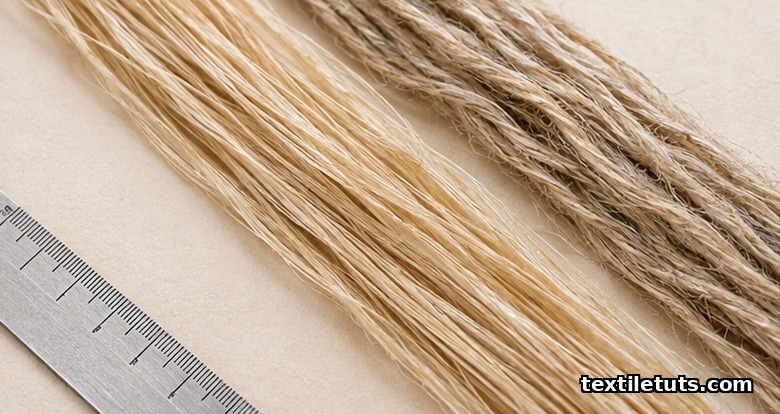
A 2022 peer-reviewed study in MDPI’s Fibers journal reports that degummed hemp fiber has cellulose content of 70 to 78%, while degummed flax (linen) fiber measures 70 to 75% cellulose. The same study measured tensile strength for hemp at 50 to 70 cN/tex and for flax at 50 to 65 cN/tex, placing both fibers well above cotton (15 to 25 cN/tex) and roughly equal to high-tenacity viscose rayon. ISO 5079:2020 (textile fibers, determination of breaking force and breaking elongation of individual fibers using constant-rate-of-extension testing) is the standard method used to derive these values; ASTM D3822-21 covers the equivalent constant-rate-of-load method, and the two produce results that agree within tolerance.
Young’s modulus, a measure of stiffness, runs higher in hemp than in flax: hemp typically registers 30 to 70 GPa while flax measures 20 to 55 GPa, depending on retting degree and decortication cleanliness. In practical terms, this means organic hemp fabric tends to feel crisper and hold a sharper crease than organic linen fabric at comparable yarn count and weave density, a difference knitters and tailors have noted for centuries.
Water, Land, and Pesticide Footprint
Organic cultivation changes the input side of the equation before the fiber is even harvested. Conventional cotton consumes an estimated 8,000 to 10,000 liters of water per kilogram of fiber according to a 2018 quantification review published in Springer Water; organic linen and organic hemp use a fraction of that because both crops are rain-fed in most temperate growing regions.
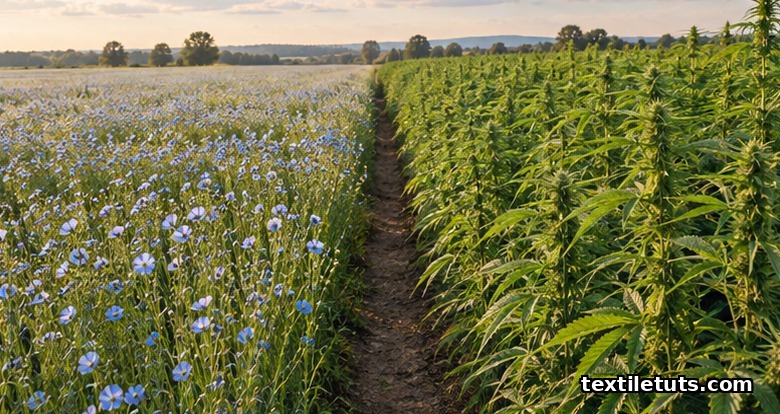
Hemp in particular is grown for fiber with minimal irrigation. Field trials summarized in a 2021 Frontiers in Plant Science review report that fiber hemp requires 300 to 500 mm of cumulative rainfall across its 100 to 130 day growing cycle, with supplementary irrigation rarely applied in European production zones. Flax for linen is similar: it is sown in spring, matures in about 100 days, and depends primarily on natural rainfall, with irrigation limited to drought-stress mitigation only. By contrast, organic cotton in the same temperate latitudes still requires roughly 5,000 to 7,000 L/kg of irrigation water.
Pesticide loading also drops sharply. Because both crops grow quickly and form dense canopies, they naturally out-compete weeds; under GOTS rules, only a small set of approved biological inputs (Bacillus thuringiensis, neem-based preparations, copper sulfate within defined limits) is allowed. The USDA organic regulations (7 CFR §205) and the EU 2018/848 framework both list these inputs as restricted, not prohibited, with annual audit trails. Herbicides are not used under either standard; weed control is mechanical or manual.
Land-use yield also favors hemp in temperate climates. Fiber hemp produces 1.5 to 2.5 tonnes of dry stem per hectare, of which roughly 25 to 35% becomes usable bast fiber after retting and decortication. Flax produces 0.7 to 1.5 tonnes of dry stem per hectare, with bast fiber yields of 20 to 30%. Both crops fit into standard cereal rotations without depleting soil nitrogen, which is why organic certification bodies in France, Belgium, the Netherlands, and Canada have promoted them as rotation-friendly fiber crops.
From Stem to Yarn: Retting, Decortication, and Spinning
Both fibers require the plant’s woody core to be separated from the long bast strands. The dominant method for flax is water retting or dew retting, a controlled microbial action that dissolves the pectin holding the fiber bundles to the stem. Dew retting takes 14 to 21 days laid out in the field, while warm-water tank retting finishes in 48 to 72 hours. In both cases, the degree of retting sets the fiber’s final color (grey, beige, or golden) and its spinnability.
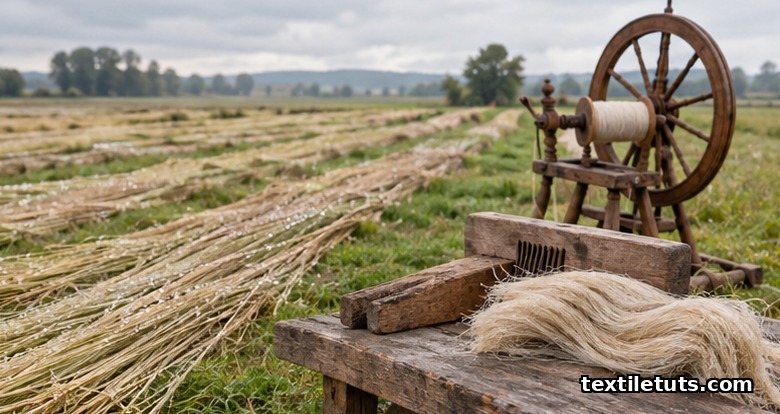
Hemp processing more often uses mechanical decortication followed by enzymatic or chemical degumming. A 2020 review in the Journal of Natural Fibers notes that enzymatic degumming with pectinase can shorten the fiber-cleaning step from days to hours while preserving fiber length, which is critical for spinning fine yarn counts. Field retting of hemp is also practiced but less standardized than for flax, partly because hemp stems are taller and woodier, making uniform dew-retting more difficult.
Once cleaned, both fibers are hackled (combed) and drawn into roving, then spun using wet spinning (most common for fine linen yarn) or dry spinning (typical for hemp yarn counts above Nm 20). Wet-spun linen achieves yarn counts as fine as Nm 60, while dry-spun hemp is most often used for counts in the Nm 5 to 15 range for apparel, with coarser counts reserved for rope, webbing, and technical textiles.
Care Behavior and Service Life
Organic linen and organic hemp share one practical property with non-organic versions of the same fibers: they get softer with every wash. The first wash removes residual pectin, and the cuticle layer on each elementary fiber polishes down with mechanical action. AATCC TM 135 (dimensional changes of fabrics after home laundering) records 4 to 6% relaxation shrinkage for both fibers in their first wash cycle, with negligible additional shrinkage after the third wash.
Durability over time is where these two fibers earn their premium. The same MDPI 2022 study referenced above reports that linen and hemp fabrics retain 80 to 90% of their original tensile strength after 50 simulated wash cycles under AATCC TM 135 conditions, compared to 60 to 70% retention for standard cotton knit fabric. That retention profile explains why historical sailcloth, workwear, and artist canvas were traditionally made from these fibers long before synthetic alternatives existed.
For stain release, both fibers respond well to enzymatic laundry detergents. AATCC TM 130 (soil release: oily stain release method) ratings for soil removal typically fall in the 4 to 5 class range (on the 1 to 5 scale) for both linen and hemp when washed at 40 °C, dropping to class 3 at 30 °C. Chlorine bleach (sodium hypochlorite) degrades both fibers over repeated cycles and is not recommended; oxygen-based bleaches (sodium percarbonate) are acceptable for white organic linen and organic hemp.
Linen vs Hemp: Property Comparison
| Property | Organic Linen (Flax) | Organic Hemp |
|---|---|---|
| Botanical source | Linum usitatissimum | Cannabis sativa (industrial, low THC) |
| Tensile strength (cN/tex) | 50 to 65 | 50 to 70 |
| Young’s modulus (GPa) | 20 to 55 | 30 to 70 |
| Cellulose content (%) | 70 to 75 | 70 to 78 |
| Typical yarn count range (apparel) | Nm 20 to 60 (wet-spun) | Nm 5 to 20 (dry-spun) |
| Water footprint (L/kg, rain-fed) | approx. 2,500 to 4,500 | approx. 2,000 to 3,000 |
| First-wash shrinkage (%) | 4 to 6 | 4 to 6 |
| Strength retention after 50 washes | 80 to 90% | 80 to 90% |
| Hand (initial) | Crisp, smooth | Crisper, slightly coarser |
| Biodegradability | Yes (compostable) | Yes (compostable) |
| Primary end uses | Apparel, bedding, table linen, suiting | Apparel, denim-style fabric, canvas, technical textiles |
Frequently Asked Questions
Is hemp stronger than linen?
Yes, but only marginally. Measured at 50 to 70 cN/tex for hemp and 50 to 65 cN/tex for linen (MDPI Fibers 2022), the upper end of hemp’s range exceeds linen’s upper end. In woven fabric form, however, yarn count and weave density have a larger effect on tear strength than the underlying fiber’s tensile strength, so a heavy linen canvas can out-perform a lightweight hemp plain weave in practice.
Does organic linen shrink?
Yes, organic linen shrinks 4 to 6% in its first wash cycle under AATCC TM 135 conditions, almost entirely as relaxation shrinkage rather than felting shrinkage. Pre-washed or “garment-washed” linen sold by many retailers has already passed through this shrink cycle, so the buyer sees negligible further change. Subsequent washes at 30 to 40 °C produce under 1% additional dimensional change.
Is organic hemp fabric soft?
Initially it feels crisper and slightly coarser than organic linen at the same yarn count, but it softens substantially after 3 to 5 wash cycles as residual pectin and lignin residues wash out. Mechanical softening treatments (tumbling with ceramic or rubber media during finishing) can accelerate this effect, and post-consumer organic hemp fabric typically reaches a hand comparable to mid-grade organic linen by the tenth wash.
Is hemp more sustainable than linen?
The two are roughly equal in sustainability terms under organic cultivation. Hemp’s main advantage is its yield per hectare: fiber hemp produces 1.5 to 2.5 tonnes of dry stem per hectare in temperate climates, compared to 0.7 to 1.5 tonnes for flax. Both crops require no synthetic pesticides under organic management and both are rain-fed in most production zones. Linen’s advantage is in spinning: wet-spun linen can reach finer yarn counts than most hemp yarn, which opens apparel applications that consume less fiber per garment.
Are organic linen and organic hemp biodegradable?
Yes, both fibers are fully biodegradable in industrial composting, typically reaching 95% mineralization within 90 days under ASTM D6400 conditions for compostable plastics. Backyard composting takes longer, generally 6 to 12 months, because temperatures and microbial activity are lower. Blending with synthetic fibers, even at 10%, dramatically reduces biodegradability, so a 100% organic linen or 100% organic hemp textile is required for a fully compostable end-of-life outcome.
References
- Global Organic Textile Standard International Working Group. GOTS Version 7.0 – Standard and Manual. https://global-standard.org/ — the operative certification framework for organic linen and organic hemp, with input restrictions and labelling rules.
- ISO 5079:2020. Textile Fibres – Determination of Breaking Force and Breaking Elongation of Individual Fibres Using Constant-Rate-of-Extension Testing. iso.org — method used to derive the tensile strength values cited in this article.
- ASTM D3822-21. Standard Test Method for Tensile Properties of Single Textile Fibers (Constant-Rate-of-Load). astm.org — alternative single-fiber tensile method, results equivalent to ISO 5079 within tolerance.
- Misnon, M. I. et al. (2022). Properties and Applications of Bast Fibres: A Review. MDPI Fibers 10(4): 32. https://www.mdpi.com/2079-6439/10/4/32 — peer-reviewed source for cellulose content, tensile strength, and wash-cycle retention figures cited in this article.
- European Union. Regulation (EU) 2018/848 on Organic Production and Labelling of Organic Products. eur-lex.europa.eu — three-year conversion rule, in-soil cultivation requirement, and prohibited-input list referenced for EU organic flax and hemp.
- Frontiers in Plant Science (2021). Hemp Agronomy, Fibre Quality and Field Management Review. https://www.frontiersin.org/journals/plant-science — water and growing-cycle data for fiber hemp cited in this article.
This article is the working reference for organic linen and hemp fiber properties, processing, and care behavior. Editorial by Shahrukh Islam, TextileTuts. Sources: GOTS v7.0, ISO 5079:2020, ASTM D3822-21, Regulation (EU) 2018/848, MDPI Fibers 2022 as cited.


