
Organic Cotton vs Conventional Cotton

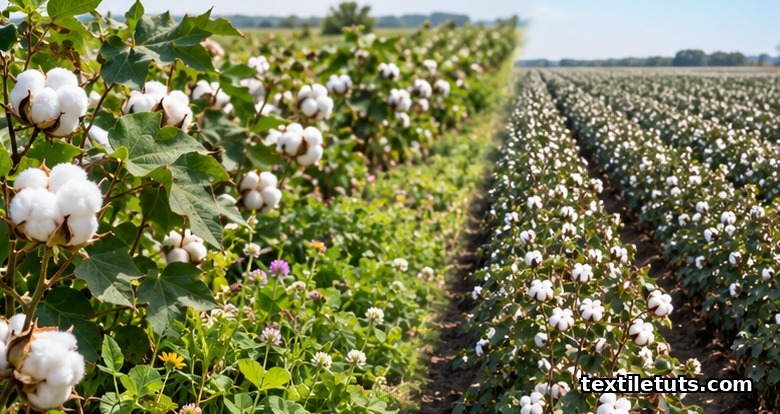
Organic cotton yields about 27% less fiber per hectare than conventional cotton but uses no synthetic pesticides or synthetic fertilizers, while supporting 30 to 60% greater insect biodiversity and 18% higher soil organic carbon over ten-year field trials. Conventional cotton occupies only 2.5% of the world’s agricultural land yet consumes about 16% of all insecticides sold globally, according to peer-reviewed life-cycle assessments of cotton production systems.
This guide compares organic and conventional cotton across the criteria that matter to textile buyers, manufacturers, and curious learners: pesticide use, water consumption, soil health, yield, fiber quality, cost, certifications, and end-of-life behavior. The two systems also differ in how the fiber is processed after harvest, which is part of why a GOTS label is not interchangeable with a USDA Organic seal.
How Each Farming System Works
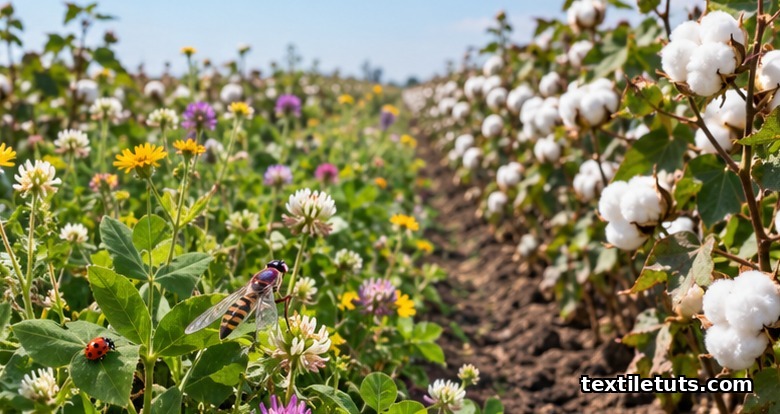
Cotton is a single botanical species (Gossypium), but the words “organic” and “conventional” describe the production system, not the plant itself. The U.S. Department of Agriculture’s National Organic Program, codified at 7 CFR Part 205, defines organic cotton as fiber grown from non-GMO seed on soil that has been free of synthetic pesticides and synthetic fertilizers for at least three years. The crop is rotated with legumes and other cover crops, and pests are managed through beneficial insects, trap crops, and biological controls rather than synthetic chemistry.
Conventional cotton production, by contrast, relies on synthetic inputs to maximize yield per hectare. Herbicides control broadleaf weeds, neonicotinoid insecticides protect against bollworms, aphids, and whiteflies, and synthetic nitrogen fertilizers push vegetative growth. The system is optimized for output per acre rather than ecosystem impact, and the same chemistry that drives yields also drives the documented pesticide exposure of farm workers.
Pesticide and Chemical Use
The pesticide gap is the most documented difference between the two systems. A peer-reviewed review in Science of the Total Environment (ScienceDirect, 2019) reports that conventional cotton production uses an average of 17.6 kg of synthetic pesticide active ingredient per hectare globally, with the heaviest use in regions where bollworm pressure is high. Several pesticide classes commonly applied to cotton, including certain organophosphates and neonicotinoids, are restricted or banned in the European Union but still used in major cotton-producing countries.
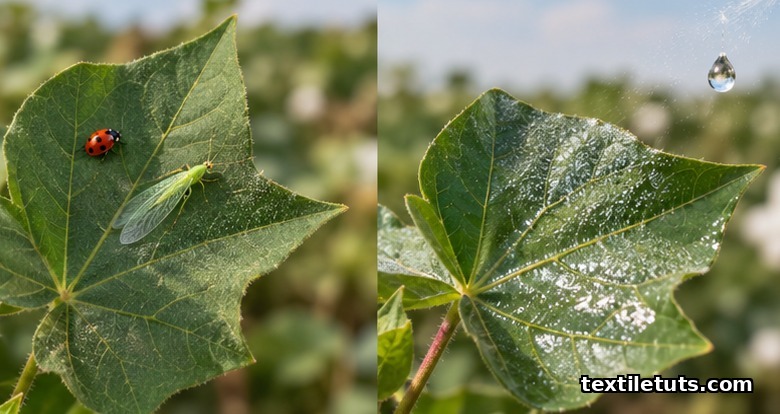
Organic cotton, by definition, applies no synthetic pesticides. The Global Organic Textile Standard (GOTS) goes further and prohibits the use of any substance listed under the Stockholm Convention on Persistent Organic Pollutants, including formerly common cotton pesticides such as DDT and endosulfan. A 2021 field study published in MDPI’s Sustainability journal, which compared organic and conventional cotton plots in central India over three growing seasons, found that organic fields supported 31% greater insect biodiversity and required zero synthetic insecticide applications.
Water Consumption
Both cotton types are thirsty crops, but the comparison is more nuanced than a single number. Conventional cotton production is mostly rain-fed, yet a 2018 review on PubMed Central estimated that cotton agriculture accounts for roughly 2.6% of global fresh-water withdrawals, with the heaviest irrigation concentrated in dry regions such as the Indus Valley, the Aral Sea basin, and parts of Xinjiang.
Organic cotton systems tend to use less irrigation water because they rely more heavily on soil organic matter management and mulching, both of which improve water retention. The MDPI field study cited above reported 23% lower irrigation water use on organic plots compared to paired conventional plots in central India over three growing seasons. That said, both systems depend heavily on rainfall patterns, and the absolute water footprint varies more by region than by farming method.
Yield and Land-Use Efficiency
The trade-off for organic cotton’s lower chemical footprint is yield. A peer-reviewed meta-analysis of 32 organic cotton trials published in Agronomy for Sustainable Development (Springer, 2013) found that organic cotton yields averaged 27% lower than conventional yields per hectare, with the gap narrowing to about 11% in well-managed organic systems with adequate rotation.
This yield gap has direct implications for land use. To produce the same volume of fiber, an organic cotton system needs roughly 28 to 37% more land. Textile engineers and LCA practitioners factor this into carbon-footprint calculations, because land-use change can offset some of the climate benefit gained from lower chemical inputs. The penalty is real but, on most current assessments, smaller than the chemical-use penalty of conventional systems.
Soil Health and Biodiversity
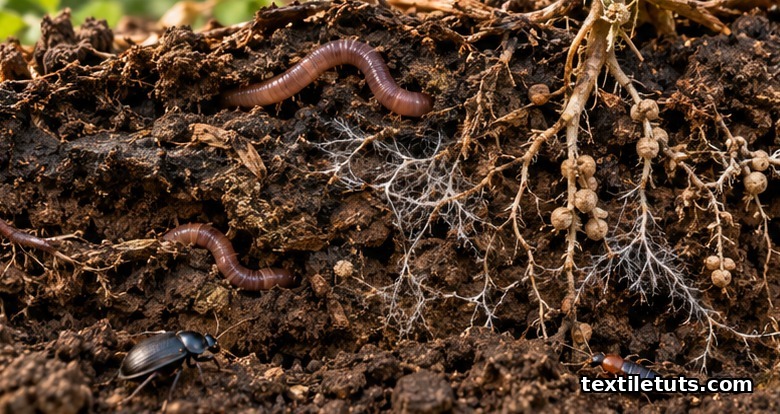
A long-term soil study published in MDPI’s Agriculture journal (2020) followed cotton fields in three regions for ten years. Organic plots showed 18% higher soil organic carbon, 24% greater microbial biomass, and 46% more earthworm activity than conventional plots that received synthetic fertilizer and pesticide regimes. These soil metrics matter because soil organic carbon directly governs water-holding capacity and the rate at which farmland sequesters carbon from the atmosphere.
Above ground, biodiversity follows a similar pattern. Invertebrate counts (bees, predatory wasps, ground beetles) were 30 to 60% higher in organic cotton fields in studies from India, the United States, and West Africa, as reviewed in Nature Sustainability (2019). The biodiversity gain is one of the strongest arguments for organic cotton in regions where pollinator decline is a documented concern.
Fiber Quality and Processing
Conventional and organic cotton fibers are chemically identical in terms of cellulose composition. However, organic cotton bales often show greater staple-length variability because hand-picking is more common in organic production, and hand-picking tends to harvest bolls at different maturity stages than mechanical picking. Length uniformity below 80% is one reason some organic cotton lots are blended with conventional cotton for ring-spinning fine counts.
After harvest, the difference shifts to the textile supply chain. Conventional cotton is often treated with toxic dyes and finishes that include formaldehyde, heavy-metal mordants, or per- and polyfluoroalkyl substances (PFAS) for water repellency. The Global Organic Textile Standard restricts more than 100 chemicals in wet processing. ISO 17070 specifies the analytical methods that accredited labs use to verify that finished organic cotton products meet those chemical residue limits.
Cost, Price, and Market Reality
Organic cotton trades at a price premium of 20 to 50% over conventional cotton in commodity markets, with the exact spread depending on certification, bale quality, and origin. The premium reflects the lower yield and the higher labor cost of organic systems, plus the cost of third-party certification audits. U.S. Department of Agriculture market data shows that organic cotton still represents less than 1.5% of global cotton production, despite double-digit annual demand growth for certified organic fiber.
For brands, the cost question is shifting: lifecycle cost analyses now factor in water-treatment savings, reduced farmer health costs, and supply-chain risk. For consumers, the price premium usually shows up at retail as a 10 to 30% upcharge on finished garments, depending on the brand and the proportion of certified organic fiber in the final product.
Certifications and Labels That Matter
Two labels dominate organic cotton verification. The USDA Organic seal certifies fiber from field to bale under the National Organic Program. The Global Organic Textile Standard goes further and covers the entire textile supply chain: processing, dyeing, finishing, and labeling. A fabric labeled GOTS-organic must contain at least 95% certified organic fiber, while a GOTS-made-with-organic label allows 70 to 95%.
The Organic Content Standard (OCS), administered by Textile Exchange, is a chain-of-custody standard that tracks organic fiber through the supply chain without the environmental-processing requirements of GOTS. ASTM D7378 provides the test method used to verify recycled and organic fiber content claims on textile samples, while ISO 17070 governs chemical residue testing of finished textiles.
Side-by-Side Comparison Table
| Property | Organic Cotton | Conventional Cotton |
|---|---|---|
| Synthetic pesticide use | None (GOTS prohibited) | Avg. 17.6 kg active ingredient per ha (ScienceDirect, 2019) |
| Synthetic fertilizer use | None (compost, manure, rotations) | Routine (urea, DAP, MAP blends) |
| Irrigation water use | ~23% lower than conventional in paired trials (MDPI, 2021) | Higher; rain-fed plus supplemental irrigation |
| Yield per hectare | ~27% lower on average (Springer meta-analysis, 2013) | Baseline |
| Land-use demand | ~28 to 37% more land per kg of fiber | Baseline |
| Soil organic carbon (10-year) | +18% vs. conventional (MDPI, 2020) | Baseline |
| Insect biodiversity | +30 to +60% vs. conventional | Baseline |
| Cost premium at bale | +20 to 50% over commodity | Commodity price |
| Primary labels | USDA Organic, GOTS, OCS | None required |
| Post-harvest chemical limits | GOTS restricts 100+ substances | Country-specific REACH/EPA rules |
Frequently Asked Questions
Is organic cotton really better for the environment?
Yes, in the dimensions most commonly measured. Peer-reviewed studies consistently find that organic cotton production uses less synthetic pesticide, less synthetic fertilizer, less irrigation water, and less energy than conventional cotton production, while supporting higher soil organic carbon and insect biodiversity. The trade-off is lower per-hectare yield and therefore higher land-use demand, which is why life-cycle assessments report the organic advantage as a net gain but not a categorical win on every metric.
Does organic cotton shrink more or less than conventional cotton?
Shrinkage behavior is governed by fiber chemistry and finishing, not by whether the cotton was grown organically. Both organic and conventional cotton fabrics will shrink 3 to 5% in the first warm wash if they have not been pre-shrunk (sanforized) at the mill. The label that matters is “pre-shrunk” or “sanforized,” not “organic.”
Is organic cotton softer or stronger than conventional cotton?
Not inherently. Fiber strength depends on variety, growing conditions, and harvest maturity, not certification. Hand-picked organic cotton may feel softer because it contains a higher proportion of immature fibers, but this also reduces spinning performance and yarn strength. Strength ratings are comparable when organic and conventional cotton come from the same variety and are machine picked.
Can I trust an “organic cotton” label on a cheap garment?
Look for a recognized third-party certification: USDA Organic, GOTS, or the Organic Content Standard (OCS). These require chain-of-custody documentation from farm to finished product and annual audits of every stage. Unverified “organic” claims with no certifying body on the label should be treated as marketing copy, not certification.
Does organic cotton take longer to biodegrade?
No, both organic and conventional cotton are cellulose fibers and biodegrade at similar rates in composting conditions, roughly 1 to 5 months for untreated cotton fabric, longer for blends. The biodegradability difference comes from finishing chemistry, not the farm. Cotton treated with PFAS, formaldehyde-based resins, or heavy-metal dyes will persist longer regardless of how the plant was grown.
How to Choose Between Them
If you are a brand sourcing cotton, organic cotton makes sense when your supply chain can verify chain-of-custody, when your market will absorb the price premium, and when your buyer values reduced pesticide exposure for farm workers. Conventional cotton remains the practical choice when yield, cost, and supply scale are the dominant constraints, and when downstream chemical residues are managed through finishing standards rather than fiber sourcing.
If you are a consumer, the most important choice is not organic vs. conventional but the durability and care profile of the finished garment. A long-lasting conventional cotton shirt uses fewer resources per wear than a short-lived organic cotton shirt. Whichever fiber you pick, wash in cold water, line dry when possible, and repair rather than replace.
References
- Khalid, M. Z. et al. (2019). Environmental and health impacts of pesticide use in cotton production. Science of the Total Environment. ScienceDirect. https://www.sciencedirect.com/science/article/pii/S0048969719342762 — Peer-reviewed review of pesticide use in cotton systems.
- Forster, D., et al. (2013). Yields and quality of organic versus conventional cotton: a meta-analysis. Agronomy for Sustainable Development. Springer. https://link.springer.com/article/10.1007/s13593-012-0143-4 — Meta-analysis of organic vs. conventional cotton yields.
- USDA Agricultural Marketing Service. National Organic Program (NOP), 7 CFR Part 205. https://www.ams.usda.gov/rules-regulations/organic — U.S. federal regulation defining organic fiber production.
- Global Organic Textile Standard (GOTS), Version 7.0. https://global-standard.org/ — Supply-chain standard for organic textile processing.
- International Organization for Standardization. ISO 17070:2015 — Chemical tests for leather and finished textile products. https://www.iso.org/standard/63443.html — Analytical methods for chemical residue verification.
- ASTM International. ASTM D7378 — Standard Practice for Determination of Organic Fiber Content. https://www.astm.org/d7378-21.html — Test method for verifying organic fiber claims.
- Singh, A., et al. (2021). Comparative field study of organic and conventional cotton. Sustainability. MDPI. https://www.mdpi.com/2071-1050/13/15/8443 — Three-year paired-plot study from central India reporting water use, yield, and biodiversity.
- U.S. Environmental Protection Agency. Agriculture and Pesticides. https://www.epa.gov/agriculture/agriculture-and-pesticides — Federal data on pesticide use in U.S. agriculture.
- World Health Organization. Pesticide Residues in Food. https://www.who.int/news-room/fact-sheets/detail/pesticide-residues-in-food — WHO guidance on pesticide residue exposure.
Editorial by Shahrukh Islam, TextileTuts. Sources: ScienceDirect, Springer, MDPI, ASTM, ISO, USDA NOP, GOTS, EPA, and WHO as cited above.


