
Common Knitting Defects and Solutions

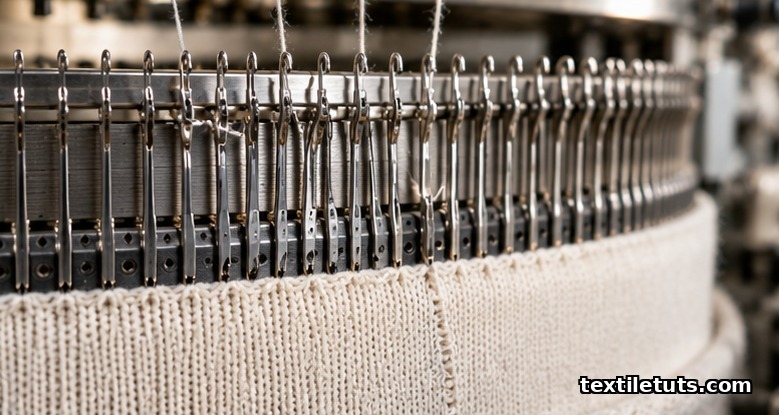
Knitting defects are classified under ISO 8388 and AATCC grading protocols into three families (structural faults, yarn faults, and surface faults), with spirality held below 5% rotation, pilling grade above 3, and bursting strength above 200 kPa on single-jersey apparel per ASTM D3786.
Most production stops on circular knitting machines trace back to one of seven recurring defect types, and the fixes for each one depend on whether the fault is mechanical, material-based, or process-based. This reference explains what each defect looks like, why it forms, how textile engineers grade it, and what corrective action brings the fabric back inside specification.
You will learn the ISO and ASTM test methods that define the limits, the inspection routine a knitting mill uses on every roll, and the prevention checklist that stops recurring defects before they reach the cutting table.
How Knitting Defects Are Classified
Knitting mills classify fabric faults along two axes: where they originate (machine, yarn, or finishing) and where they appear in the fabric (structure, surface, or dimension). The first axis tells you who is responsible for the fix. The second tells you how the defect will show up during garment inspection.
ISO 8388 defines the vocabulary for knitted fabric types and the basic terms used in defect logging. AATCC standards (TM135, TM150, and the visual grading series TM173) define the test conditions under which dimensional change, color, and surface appearance are rated. ASTM methods cover the mechanical performance side: D3786 for bursting strength, D3939 and D4846 for snagging, D4970 and D3886 for pilling resistance.
Defect rate is normally reported as faults per 100 linear meters on the inspection frame. A first-quality run typically lands between 8 and 15 faults per 100 m. Second quality allows 15 to 25. Anything above 25 usually triggers a mill-level review.
Structural Defects: Needle Lines, Press-Offs, and Holes
Structural defects are the most expensive faults because they cannot be repaired, only re-knitted. They originate inside the machine and propagate along the course or wale until the roll is cut.
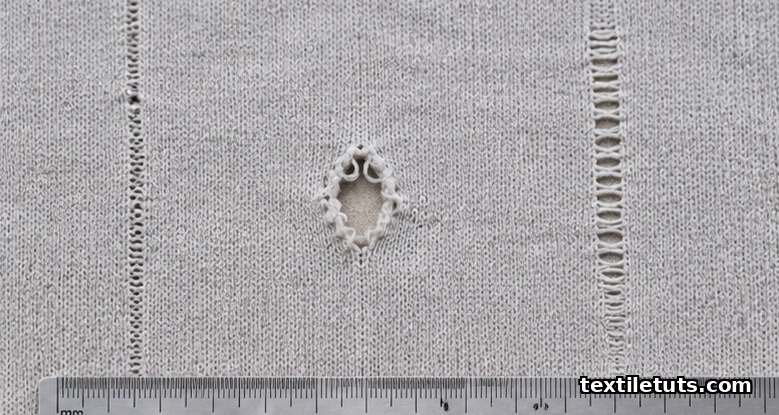
Needle line: A vertical stripe running the full length of a knit, aligned with a specific needle slot on the cylinder or dial. The cause is a bent, hooked, or improperly timed needle that loops at a different tension than its neighbors. Detection is by visual inspection against ASTM D5430, and confirmation is by unroving the wale under a loupe to compare loop size across needles.
Press-off: A press-off occurs when the yarn carrier misses one or more needles, the fabric separates from the needle bed, and a hole propagates down the roll. Modern circular machines detect this in under 1 second via yarn tension sensors and stop the cylinder, but on older frames a press-off can run several courses before the operator notices. Press-off rate is the leading KPI for needle bed health. Any rise above 0.1 presses per 1,000 needles per shift warrants a needle replacement pass.
Drop stitch / miss-knit: A single needle misses the yarn on one feed but recovers on the next, leaving a small vertical bar. This is the lightest structural fault and is usually marked down rather than cut out. Causes include yarn tension spikes, lint accumulation under the needle hook, and worn needle latches that fail to close fully.
Yarn-Related Defects: Barre, Slubs, and Fly Contamination
Yarn faults enter the fabric through the feeder and show up as horizontal stripes, isolated thick spots, or dark specks. The fix almost always sits upstream of the knitting machine, in the winding or spinning department.
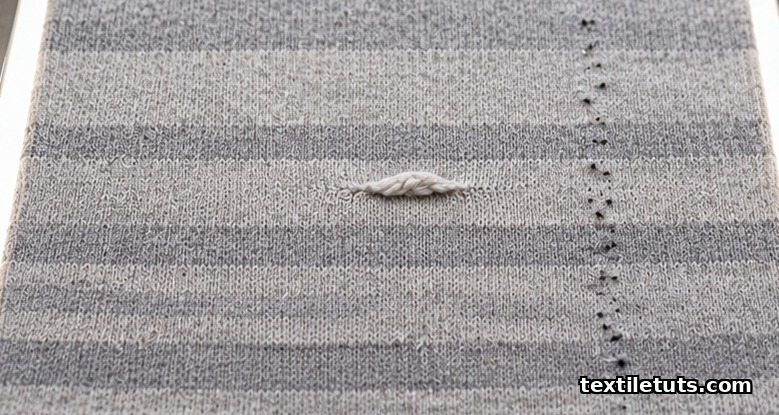
Barre: Horizontal bands of different appearance across the fabric, caused by variation in yarn count, yarn twist, or dye uptake between cones. Knit fabrics show barre far more visibly than woven fabrics because the loop structure amplifies small differences in yarn linear density (the CV% on the yarn count). A yarn with a CV above 4.0% will almost always produce visible barre on a 28-gauge single-jersey machine.
Slubs and thick places: Localized thickening of the yarn, typically 3 to 10 times the normal diameter, appearing as a small lump in the knit. Slubs are graded under Uster Statistics, with thick places above +50% of nominal count rejected for first-quality knit fabric. The cause is usually poor combing at the roving frame or improper drafting at the ring frame.
Fly and contamination: Airborne fiber fly from adjacent machines settles on the yarn or the needle bed and gets knit into the fabric as a dark or light speck. Fly contamination is graded under AATCC TM146, and a controlled environment with positive airflow away from the knitting zone reduces it dramatically.
Surface and Appearance Defects: Snagging and Pilling
Surface defects show up after the fabric leaves the knitting machine, in finishing, in storage, or during garment sewing. They are tested on the finished fabric because the finishing process changes surface behavior.
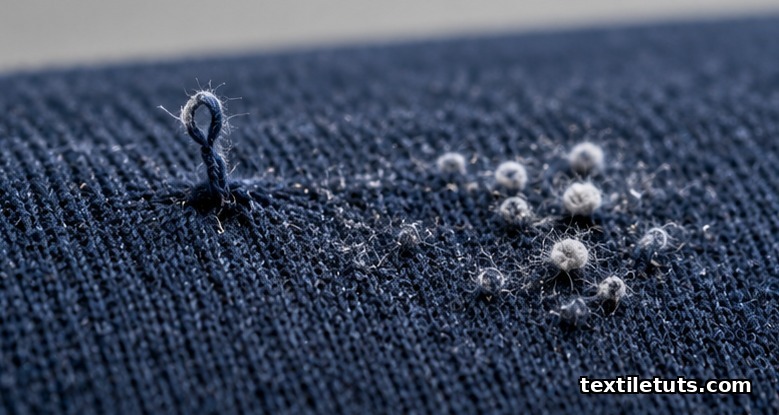
Snagging: A snag is a pulled loop on the fabric surface, caused by a sharp or rough object catching the yarn. Knit fabrics snag more easily than wovens because the yarn is free to move within the loop. Two standard methods exist: ASTM D3939 (Mace test) and ASTM D4846 (Bean bag snag test). Both rate the fabric on a 1 to 5 photographic scale, where 5 means no snagging. Most apparel end uses require a snag grade of 3.5 or higher. Below 3 the fabric is downgraded.
Pilling: Pills are small balls of fiber that form on the fabric surface when loose fibers migrate to the surface and tangle under abrasion. ISO 12945-2 (Martindale, 7,000 to 14,000 cycles) and ASTM D4970 (modified Martindale) rate pilling on the same 1 to 5 scale. A grade 3 after 7,000 cycles is the typical acceptance threshold for knit apparel. Grade 4 is required for premium shirting knit. Lower grade numbers mean heavier pilling.
Snagging and pilling are both amplified by loose yarn twist (TM values above 4.0 in singles yarn) and by insufficient yarn hairiness control at the roving frame.
Dimensional and Performance Defects: Spirality, Skew, Bursting, and Shrinkage
Dimensional defects affect how the fabric behaves when cut and sewn, and are usually caught at the relaxation and finishing stage rather than on the knitting frame.
Spirality: Weft knit fabrics tend to rotate diagonally when lifted off the machine, an effect called spirality. It is caused by asymmetric needle loop geometry and by the side-by-side stitch direction in plain single-jersey. Spirality is measured per AATCC TM179 and is reported as a percentage shift. Below 5% is acceptable for most apparel. Above 7% it causes severe garment twist at the side seam after washing. Calendering, heat-setting on a stenter, and resin finishing all reduce spirality. The cheapest fix is proper relaxation in steam before cutting.
Bowing and skew: Bowing is a curved course line in knit fabric and skew is a slanted course line. Both come from uneven take-up tension on the knitting machine or misalignment in the finishing stenter. Skew above 3% requires corrective re-tenter passage.
Bursting strength: Knits stretch in multiple directions, so they are tested for bursting rather than tensile strength. ASTM D3786 (diaphragm bursting) and ISO 13938-1 apply hydraulic pressure to a circular fabric sample until rupture. First-quality single-jersey for T-shirts typically bursts at 200 to 350 kPa. Double-knit and interlock reach 400 kPa or higher. Any roll below 200 kPa is rejected for body-wear end uses.
Dimensional change on washing: Knit fabrics relax on first wash, with cotton single-jersey typically shrinking 5 to 8% in length and 3 to 5% in width if not pre-shrunk. AATCC TM135 (1 home laundering cycle, tumble dry) and ISO 6330 set the test conditions. Pre-relaxation in steam or hot water before cutting reduces residual shrinkage to under 3% in both directions.
Prevention: The Mill-Level Checklist
Most recurring knitting defects have known mechanical or process causes, and a structured daily check eliminates roughly 80% of them. The standard mill routine covers:
- Needle bed inspection at the start of every shift, with bent, hooked, or worn needles replaced before the run starts.
- Yarn tension verification on every active feeder, set within ±5% of the recommended value for the yarn count.
- Positive air pressure in the knitting zone, with fly extraction pulling air away from the needle bed.
- Uster yarn evenness testing on every incoming lot, with thick places +50% count kept under 50 per 1,000 m.
- Press-off detection system test at the start of every shift, with the auto-stop circuit confirmed functional.
- Stenter alignment and overfeed calibration checked after every style change.
- Inspection frame review at 10% sampling on every roll, with defects logged by ISO 8388 vocabulary.
Defect Reference Table
| Defect | Cause | Acceptance Threshold | Primary Fix |
|---|---|---|---|
| Needle line | Bent or worn needle | None allowed (visual) | Replace needle, re-knit |
| Press-off | Yarn miss + propagation | ≤0.1 per 1,000 needles/shift | Repair sensor, re-knit |
| Barre | Yarn count or dye CV% | Yarn CV ≤ 4.0% | Replace lot, check feeder |
| Slub / thick place | Spinning drafting fault | Uster +50% count ≤ 50/km | Spinning-side correction |
| Spirality | Loop asymmetry + relaxation | ≤ 5% (AATCC TM179) | Steam relax, heat-set |
| Pilling | Fiber migration + abrasion | Grade ≥ 3 (ISO 12945-2) | Reduce yarn hairiness, finish |
| Snagging | Loose yarn caught | Grade ≥ 3.5 (ASTM D3939) | Tighter yarn twist, snag finish |
| Bursting strength | Yarn + loop geometry | ≥ 200 kPa (ASTM D3786) | Increase yarn count, tighter gauge |
| Shrinkage | Relaxation on wash | ≤ 5% (AATCC TM135) | Pre-relax, compactor pass |
Frequently Asked Questions
What causes needle lines in knitted fabric?
Needle lines are vertical stripes aligned with one wale and are caused by a bent, hooked, or improperly timed needle on the cylinder or dial. Loop size differs from neighboring needles, so the stripe runs the full length of the roll. Detection is by ASTM D5430 visual grading and confirmation by loop unroving under magnification. The fix is needle replacement followed by re-knitting the affected rolls, because no finishing process can remove the structural misalignment.
How do you reduce spirality in single-jersey fabric?
Spirality is reduced by relaxing the fabric in steam or hot water before cutting, then heat-setting it on a stenter with overfeed. The cheapest mechanical fix is proper relaxation on a steaming cylinder with 5 to 10% overfeed. Resin finishing provides a more permanent reduction. Per AATCC TM179, the acceptance threshold is 5% rotation or less for body-fit garments, and above 7% the side seams will twist noticeably after the first wash.
What is the acceptable pilling grade for knit apparel?
Most knit apparel end uses require a pilling grade of 3 or higher on the 1 to 5 ISO 12945-2 photographic scale, with 5 being no pilling. Premium shirting knit typically requires grade 4 after 7,000 Martindale cycles. Grade 3 corresponds to slight surface fuzzing with no formed pills, which is acceptable for casual wear. Anything grade 2 or below triggers a mill-level review of yarn hairiness and finishing chemistry.
Can press-off holes be repaired without re-knitting?
No. Press-off holes are structural faults that propagate along the course, and they cannot be repaired by mending because the loop geometry is destroyed. Modern circular knitting machines detect a press-off through yarn tension sensors and stop the cylinder in under 1 second. The affected roll is cut out and re-knitted from the last good course. The only prevention is a functional auto-stop circuit and clean needle bed condition.
How is bursting strength tested on knit fabric?
Bursting strength is measured per ASTM D3786, where a circular fabric sample is clamped and hydraulic pressure is applied through a rubber diaphragm until the fabric ruptures. The test records the pressure in kPa at rupture, with single-jersey T-shirt fabric typically bursting at 200 to 350 kPa and interlock reaching 400 kPa or higher. Knit is tested by bursting rather than tensile because knit stretches in multiple directions, and a single-axis tensile test would underestimate real-world stress on body-wear seams.
References
- ISO 8388:1998. Knitted fabrics, Types, Vocabulary. International Organization for Standardization. Vocabulary basis for classifying knit structures and defects.
- ASTM D3786/D3786M-13. Standard Test Method for Bursting Strength of Textile Fabrics (Diaphragm Bursting Strength Tester Method). ASTM International. Defines the hydraulic bursting test used for knit fabrics.
- ASTM D3939/D3939M-13. Standard Test Method for Snagging Resistance of Fabrics (Mace Test Method). ASTM International. 1 to 5 photographic snag grading for knit and woven apparel.
- ISO 12945-2:2020. Textiles, Determination of fabric propensity to surface pilling, fuzzing or matting, Part 2: Modified Martindale method. International Organization for Standardization. Pilling grade threshold used in knit apparel QC.
- AATCC TM179-2020. Test Method for Spirality after Laundering of Knitted Fabrics. American Association of Textile Chemists and Colorists. Spirality percentage reporting for weft knits.
- Uster Technologies. Uster Statistics 2018, Application Report for Yarn Evenness in Knitting. Uster. Provides the +50% thick place threshold per kilometer used to control barre and slubs.
- Anand, S. C. (2014). Knitting faults: causes and remedies. ResearchGate. Peer-reviewed summary of recurring circular knitting faults and their mill-level fixes.
- Ray, S. C. (2012). Fundamentals and advances in knitting technology. Woodhead Publishing (Elsevier). Industry reference for needle bed mechanics, spirality, and finishing interaction.
This article is the working reference for common knitting defects and their mill-level remedies. Editorial by Iftay Khairul Alam, TextileTuts. Sources: ISO 8388, ASTM D3786, ASTM D3939, ISO 12945-2, AATCC TM179, Uster Statistics, and the cited research papers as listed.


