
Online Textile Courses and Certifications (US Programs)


The Wilson College of Textiles at North Carolina State University, founded in 1899 as the first dedicated textile school in the United States, offers an online Master of Science in Textiles requiring 30 credit hours across four concentration tracks at graduate tuition of approximately $1,217 per credit hour for non-resident students in the 2025-2026 academic year.
The Fashion Institute of Technology (SUNY), founded in 1944, offers an online Master of Professional Studies in Technical Design (30 credits) and an online Advanced Certificate in Textile Design (15 credits), with graduate tuition of approximately $1,071 per credit hour for non-resident part-time students. Together, NC State and FIT represent the two largest dedicated textile-degree pathways available fully online in the United States, both holding regional accreditation recognized by the US Department of Education.
This article walks through the accredited online degree pathways, professional certifications, and modular short courses available to textile learners studying from outside a physical campus, with credit requirements, tuition ranges, and credential names verified against each program’s published catalog.
What Counts as an Online Textile Degree in the United States
An online textile degree in the US is a regionally accredited graduate program where 100% of the coursework is delivered asynchronously through a learning management system such as Canvas, Moodle, or Blackboard, with no required in-person residencies longer than three days. The Department of Education recognizes seven regional accrediting bodies, and textile programs at NC State (Southern Association of Colleges and Schools Commission on Colleges, or SACSCOC) and FIT (Middle States Commission on Higher Education, or MSCHE) carry the two most commonly held regional accreditations in this niche.
Programs labeled “online” sometimes include proctored exams at regional testing centers, such as Pearson VUE or Prometric, or a one-week intensive lab. NC State’s MS Textiles, for example, requires no campus visit for the lecture-track concentrations but offers optional on-site access to the Textile Protection and Comfort Center (T-PACC) for students who want hands-on fabric testing under ASTM and AATCC methods. The degree awarded is identical to the on-campus version, and the diploma and transcript do not distinguish the delivery mode.
Unlike a fully asynchronous continuing-education certificate (typically 4-8 hours of self-paced video), a graduate degree runs 18-24 months for full-time students and 30-36 months part-time, with tuition per credit hour ranging from approximately $436 (in-state graduate tuition at the University of Missouri-Columbia) to $1,224 (Thomas Jefferson University non-resident graduate tuition) for the 2025-2026 academic year.
Full Degree Programs: NC State, FIT, and Other US Universities
NC State’s Wilson College of Textiles is the only US institution offering an online Master of Science in Textiles with four named concentrations: Textile Chemistry, Textile Engineering, Textile Management, and Textile Marketing. The 30-credit curriculum includes a required statistics course, a textile-science core covering yarn formation, fabric construction, dyeing, and finishing, and a 6-credit thesis or non-thesis capstone. Applicants with a bachelor’s degree in any STEM field, business, or design are eligible, and the GRE is waived for the 2025-2026 application cycle.

Fashion Institute of Technology (FIT), a SUNY college of art and design founded in 1944, offers an online Master of Professional Studies (MPS) in Technical Design (30 credits) and an online Advanced Certificate in Textile Design (15 credits). FIT’s graduate tuition for the 2025-2026 academic year is approximately $5,545 per semester for New York State residents and $1,071 per credit for non-resident part-time students. Both programs accept students with a bachelor’s degree in any field, though FIT recommends prerequisites in design software such as Adobe Illustrator or Ned Graphics.
Thomas Jefferson University (which absorbed Philadelphia University in 2017) maintains an online Master of Science in Textile Design through the Kanbar College of Design, Engineering and Commerce, with tuition of approximately $1,224 per credit hour. The University of Missouri-Columbia offers an online Master of Arts in Textile and Apparel Management, requiring 36 credit hours at in-state graduate tuition of approximately $436 per credit for the 2025-2026 year, the lowest verified rate among regionally accredited graduate textile programs.
Liberty University, a nonprofit institution in Lynchburg, Virginia, offers a fully online Master of Arts in Design with a textiles-related concentration, requiring 30 credit hours at approximately $615 per credit hour, though this program is not accredited by SACSCOC, MSCHE, or HLC (Higher Learning Commission) for textile-specific outcomes and is therefore not widely accepted by US textile employers.
Professional Certifications: AATCC, the Textile Institute, and ISO-Aligned Labs
The American Association of Textile Chemists and Colorists (AATCC) administers the most widely held textile-testing certification in North America. The AATCC Textile Testing Certificate program requires completion of seven online modules covering colorfastness methods (such as TM 8-2016 for crocking and TM 15-2023 for perspiration), dimensional-change methods (TM 135-2018), and abrasion resistance (TM 8-2016), followed by a proctored exam administered at Pearson VUE centers. Tuition is approximately $650 for AATCC members and $850 for non-members, and successful candidates earn a digital badge recognized by member labs including SGS, Intertek, and Bureau Veritas.
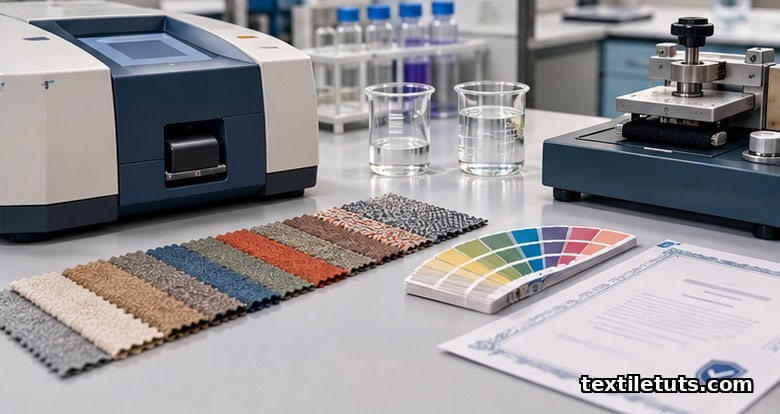
The Textile Institute, founded in 1910 in Manchester, UK, offers three credentials accepted globally: the Associateship of the Textile Institute (ATI), the Chartered Textile Technologist (CText), and the Chartered Colourist (CCol). Each requires a combination of academic qualifications, professional experience, and a written submission assessed by a panel of Fellows. CText and ATI are recognized by the European Union’s regulated-professions framework as evidence of competency in technical textiles, though neither is a state-mandated license in any US jurisdiction.
The International Organization for Standardization (ISO) does not issue individual certifications directly, but ISO 17025-accredited labs (those meeting ISO/IEC 17025:2017 for testing and calibration laboratories) such as SGS, Intertek, TÜV, and Bureau Veritas offer internal auditor and lab-manager certifications that cover textile testing under ISO 105 (colorfastness), ISO 139 (dimensional change), and ISO 5077 (wash-and-wear). These credentials require 40-80 contact hours of coursework and an on-site audit of the candidate’s own facility.
Industry Microcredentials and Short Courses
For learners seeking under-100-hour modular credentials, three categories dominate. First, OSHA 30-hour General Industry certificates (available online through OSHA-authorized providers at $89-$189) cover lockout/tagout, hazardous communication, and machine guarding as applied to textile cutting and sewing floors; these are required by many US garment manufacturers for supervisory staff under 29 CFR 1910. Second, NC State’s Textile Fundamentals online course (15 contact hours, $895 in 2025) covers fiber classification, yarn numbering systems, and weave identification at an introductory level, taught by Wilson College faculty but not for-credit toward a degree.

Third, FIT’s Continuing and Professional Education (CPE) division offers single-topic certificates in computer-aided textile design, including 36-hour programs in Ned Graphics Looms and 24-hour programs in Color Management. Tuition is $545-$1,295 per course depending on length, and credits do not transfer toward FIT’s graduate degrees. Coursera and edX also host textile-related microcredentials from university partners, including the University of Leeds’s “Sustainable Fashion” course (5 weeks, $49) and the Hong Kong Polytechnic University’s “Textile Fundamentals” course (6 weeks, $79), though these are global offerings rather than US-specific credentials.
Comparison of US Online Textile Programs
| Program | Credits / Hours | Tuition (US$, 2025-2026) | Accreditation | Format |
|---|---|---|---|---|
| NC State MS Textiles (online) | 30 credit hours | ~$1,217/credit (non-resident) | SACSCOC | Asynchronous + optional lab |
| FIT MPS Technical Design (online) | 30 credit hours | ~$1,071/credit (non-resident PT) | MSCHE | Asynchronous |
| FIT Advanced Certificate Textile Design (online) | 15 credit hours | ~$545/credit | MSCHE | Asynchronous |
| Thomas Jefferson MS Textile Design (online) | 30 credit hours | ~$1,224/credit | MSCHE | Asynchronous |
| U. Missouri MA Textile & Apparel Management (online) | 36 credit hours | ~$436/credit (in-state) | HLC | Asynchronous |
| AATCC Textile Testing Certificate | 7 modules (~40 hours) | $650-$850 total | AATCC (industry) | Self-paced + proctored exam |
| OSHA 30 General Industry | 30 contact hours | $89-$189 | OSHA (federal) | Online self-paced |
| NC State Textile Fundamentals | 15 contact hours | $895 | NCSU (university) | Asynchronous |
How to Choose an Online Textile Program
Selecting a credential depends on three factors: the credential’s acceptance in the industry you intend to enter, the time you can commit per week, and whether your employer reimburses tuition. AATCC certification is the most widely recognized single credential in US dyehouses and testing labs, while NC State’s MS Textiles is the strongest signal for technical-textile careers in research and development. For fashion-and-apparel merchandising, FIT’s MPS in Technical Design has broader employer recognition in the New York garment district than any non-NY-state degree.
Financial aid options include Federal Direct Loans for regionally accredited programs, employer tuition reimbursement (up to $5,250 tax-free per year under Section 127 of the Internal Revenue Code), and AATCC’s annual $1,000 student scholarship for members pursuing textile-testing coursework. International students on F-1 visas are eligible for NC State’s online MS Textiles because the program does not require campus attendance, but they remain ineligible for FIT’s online MPS, which requires one on-site weekend per semester for portfolio review.
Frequently Asked Questions
Are US online textile degrees recognized internationally?
Yes, provided the issuing institution holds regional accreditation recognized by the US Department of Education and listed in the Council for Higher Education Accreditation directory. NC State and FIT are recognized in the EU, Canada, India, and Bangladesh; AATCC certification is recognized across North America and in most Asian textile-testing labs through mutual recognition agreements with the Society of Dyers and Colourists (SDC) in the UK and the International Textile Manufacturers Federation.
Do these programs require a textile-engineering undergraduate degree for admission?
NC State’s MS Textiles recommends but does not require a STEM bachelor’s degree; the admissions committee considers applicants with backgrounds in chemistry, materials science, mechanical engineering, or business. FIT’s MPS in Technical Design accepts any bachelor’s degree plus a portfolio review, while the Advanced Certificate in Textile Design requires only an associate’s degree or equivalent professional experience (typically 3+ years in textile or apparel design).
What is the most affordable accredited US online textile program?
For students with in-state residency at a public university, the University of Missouri-Columbia MA in Textile and Apparel Management costs approximately $436 per credit, the lowest verified rate among regionally accredited graduate textile programs. Out-of-state learners should compare total program cost: a 30-credit NC State degree at $1,217 per credit totals approximately $36,510, while a 30-credit FIT MPS at $1,071 per credit totals approximately $32,130 before fees.
How long does an online MS Textiles take to complete?
Full-time enrollment at NC State is 9 credit hours per semester and completes the 30-credit degree in four semesters (about 18 months). Part-time enrollment at 6 credit hours per semester finishes in five semesters (about 30 months). The longest time allowed is six years from first enrollment, per the graduate school’s continuous-enrollment policy, though most students finish in 2-3 years.
Can a self-taught sewist earn a textile credential without prior college credit?
Yes. The AATCC Textile Testing Certificate, OSHA 30 General Industry, and NC State’s 15-hour Textile Fundamentals short course all accept students without a bachelor’s degree. These credentials do not transfer as college credit but are recognized as professional development by employers and can be listed on LinkedIn profiles to demonstrate competency to hiring managers.
References
- North Carolina State University Wilson College of Textiles. Online Master of Science in Textiles. https://textiles.ncsu.edu/academics/online-programs/ — admission requirements, tuition, and concentration tracks as published in the 2025-2026 catalog.
- Fashion Institute of Technology (SUNY). Master of Professional Studies in Technical Design (Online). https://www.fitnyc.edu/academics/graduate-studies/mps/ — credit hours, tuition, and admission criteria.
- American Association of Textile Chemists and Colorists. Textile Testing Certificate Program. https://www.aatcc.org/education/ — module list, exam proctoring, and fee schedule.
- ASTM International. ASTM D1776/D1776M-20 Standard Practice for Conditioning and Testing Textiles. https://www.astm.org/d1776_d1776m-20.html — the conditioning standard used by all US textile-testing certifications.
- International Organization for Standardization. ISO 105-B02:2014 Textiles — Tests for Colour Fastness — Part B02: Colour Fastness to Artificial Light. https://www.iso.org/standard/65220.html — referenced by AATCC and ASTM textile test methods.
- US Occupational Safety and Health Administration. 30-Hour General Industry Outreach Training Program. https://www.osha.gov/education/training-programs — federally authorized online safety certification for textile supervisors.
- Thomas Jefferson University Kanbar College. MS in Textile Design (Online). https://www.jefferson.edu/ — graduate program tuition and credit structure for 2025-2026.
- University of Missouri-Columbia. MA in Textile and Apparel Management (Online). https://cafnr.missouri.edu/ — graduate program tuition, credit hours, and admissions.
This article is the working reference for US online textile degrees, certifications, and short courses. Editorial by Iftay Khairul Alam, TextileTuts. Sources: NCSU Wilson College, FIT (SUNY), AATCC, ASTM, ISO, OSHA, Thomas Jefferson University, and University of Missouri catalogs as cited.


