
Nonwoven Testing Methods

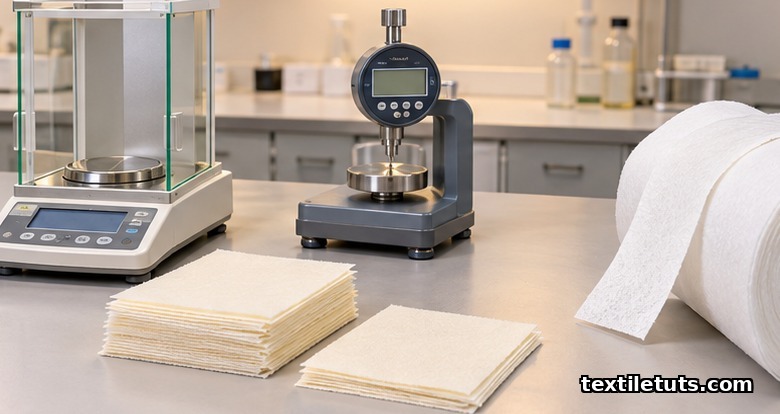
Nonwoven testing follows the ISO 9073 series (parts 1 to 18), which define a 20 degrees Celsius / 65 percent relative humidity conditioning atmosphere, 100 square centimeter specimen sizes, and reporting units of grams per square meter (mass), millimeters at 0.5 kilopascal (thickness), newtons per 5 centimeter (tensile), and cubic centimeters per square centimeter per second (air permeability).
The same properties are also measured under parallel ASTM and AATCC methods, and ISO 9073 is the backbone that ties together mass, thickness, tensile, tear, burst, absorbency, and permeability testing for spunbond, meltblown, needlepunched, spunlace, and wetlaid nonwovens.
This guide walks through the physical, mechanical, and barrier tests that every nonwoven laboratory runs on a routine basis, with the exact method numbers, specimen sizes, and reporting units needed to write a complete test report or audit an incoming fabric certificate.
Why Nonwoven Fabrics Need Their Own Test Methods
Nonwovens behave differently from woven and knitted fabrics in three ways that any test method must address. They have no interlaced yarn geometry, so tensile results depend on fiber orientation rather than weave crimp. They are porous by design, so air and liquid permeability are first-class properties instead of secondary concerns. They are often sold by end-use performance (filtration efficiency, hydrostatic head, liquid strike-through time) rather than just construction.
Because of these differences, generic fabric standards such as ISO 139 for woven conditioning or ISO 7211 for yarn analysis are not enough. The ISO 9073 series was introduced specifically to define how to cut specimens, how long to condition them, what grips and jaw faces to use, and what units to report. INDA and EDANA maintain parallel Worldwide Strategic Partners (WSP) standards for the same properties, and most nonwoven producers accept either family as equivalent for shipment release.
Conditioning and the Reference Atmosphere
Every ISO 9073 method starts with a conditioning step at 20 degrees Celsius plus or minus 2 and 65 percent plus or minus 4 relative humidity for at least 24 hours, per ISO 139. The reason for this tight band is that nonwovens absorb moisture differently based on fiber chemistry (polypropylene, polyester, viscose, cotton, blends), and a tensile or weight reading taken at 80 percent RH can be 3 to 6 percent higher than the same reading at 65 percent RH.
ASTM specifies a tighter 21 degrees Celsius plus or minus 1 and 50 percent plus or minus 2 RH under D1776. When laboratories report under ISO and ASTM side by side, they record both atmosphere codes in the report header so the reader can compare results on the same basis.
Mass Per Unit Area (GSM)
Mass per unit area is the most reported single number for any nonwoven, because it sets the cost per square meter, predicts mechanical behavior, and feeds directly into product specifications like “25 g/m2 spunbond” or “60 g/m2 needlepunch.”
ISO 9073-1 (general) refers to ISO 3801 for the gravimetric method: a 100 cm2 specimen is cut with a calibrated die or razor template, weighed on an analytical balance to 0.001 g, and the result is multiplied to give grams per square meter. Typical specimen count is 5, and the mean is reported to one decimal place, for example 24.8 g/m2.
ASTM D3776 covers the same measurement using a 130 cm2 option, which is preferred in North American mills because it is faster to cut and matches the cutters already used for woven GSM work.
Thickness
Thickness at low pressure (0.5 kPa) is the standard reference reading for nonwovens and is the value most engineers use when calculating porosity, insulation R-value, and compression behavior. ISO 9073-2 specifies a presser foot of 25 cm2 at 0.5 kPa, with a 10-second dwell time, and a reading in millimeters to 0.01 mm.
ASTM D5729 uses a 20 cm2 foot at 0.05 kPa (5 g force) for soft nonwovens and 0.5 kPa for stiffer grades. The same fabric can read 0.4 mm under 0.05 kPa and 0.32 mm under 0.5 kPa, so the pressure must always be reported alongside the thickness value.
Tensile Strength and Elongation
Tensile testing tells you how much load a nonwoven can carry in machine direction (MD) and cross direction (XD) before breaking, and how much it stretches in the process. Because nonwovens are anisotropic (MD properties are typically 1.2x to 3x higher than XD), every result must carry the direction label.
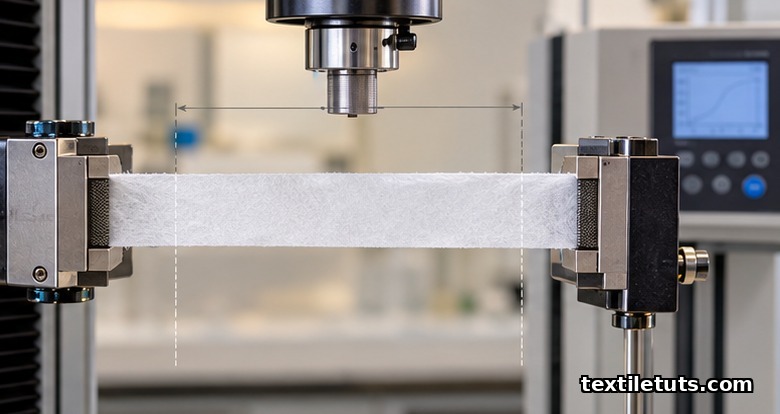
ISO 9073-3 uses a 50 mm wide strip specimen, 200 mm gauge length, and a constant rate of extension (CRE) machine at 100 mm/min. The result is reported as breaking force in N/5 cm and elongation at break as a percentage. Five specimens in MD and five in XD are standard.
ASTM D5035 (strip) and ASTM D5034 (grab) cover the same property for the North American market. Grab tensile uses a 25 mm jaw face and a 100 mm by 100 mm specimen, which captures only the central fiber bundle and tends to read 10 to 25 percent higher than strip tensile on the same fabric.
Tear Resistance
Two tear geometries dominate: trapezoid (ASTM D5587, and ISO 9073-4 via ISO 13937-4) and Elmendorf pendulum (ASTM D1424). Trapezoid is preferred for soft, lightweight nonwovens like 15 to 30 g/m2 spunbond, because the pre-cut slit propagates cleanly through the fiber web without edge-fiber pull-out confusing the result.
Elmendorf works well for heavier, more consolidated nonwovens like 80 to 200 g/m2 needlepunch, where the pendulum’s swinging fall provides a single, fast reading in grams-force per ply. Reported values typically range from 1 N for an ultra-light spunbond to 80 N for a heavy geotextile needlepunch.
Bursting Strength
Bursting strength measures the hydrostatic pressure required to rupture a nonwoven by pushing a circular diaphragm upward through it. ASTM D3786 (Mullen burst) and ISO 3303 cover the property for nonwovens used in packaging, protective apparel, and roofing substrates.
For medical nonwovens such as surgical gowns and drapes, ASTM F1670 and F1671 are the operative barrier tests: F1670 uses synthetic blood, and F1671 uses a bacteriophage suspension to measure penetration under liquid and viral exposure. These are pass or fail methods, with a zero percent penetration threshold at 13.8 kPa for F1670 and a similar threshold for F1671.
Air Permeability
Air permeability is the volume of air that passes through a nonwoven per unit area per unit time under a defined pressure drop, and is the single most important comfort and filtration proxy. ISO 9237 (also referenced as ISO 9073-15 for nonwovens) uses a 20 cm2 test head at 100 Pa pressure drop, with results reported in cm3/cm2/s (or mm/s for some textile forms).
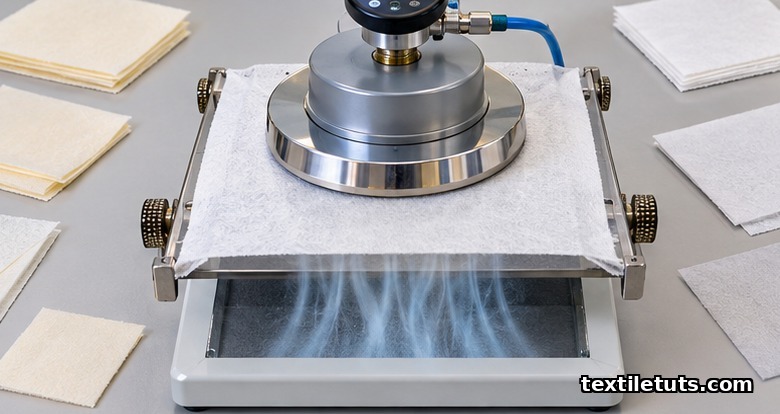
ASTM D737 uses a similar orifice at 125 Pa and reports cubic feet per minute per square foot (cfm/ft2) for the North American market. Conversion: 1 cm3/cm2/s is approximately 0.196 cfm/ft2. A typical 25 g/m2 spunbond reads around 100 to 250 cm3/cm2/s, while a meltblown layer in an N95 mask reads below 5 cm3/cm2/s.
Liquid Barrier and Absorption Tests
Liquid behavior is split into three test families. Hydrostatic head (AATCC TM127, ISO 811) measures the water column pressure in cm H2O at which water penetrates the fabric; surgical gown fabrics typically need 50 cm H2O or higher. Spray rating (AATCC TM22) gives a 0 to 100 visual rating of water beading on the fabric surface under a defined shower.
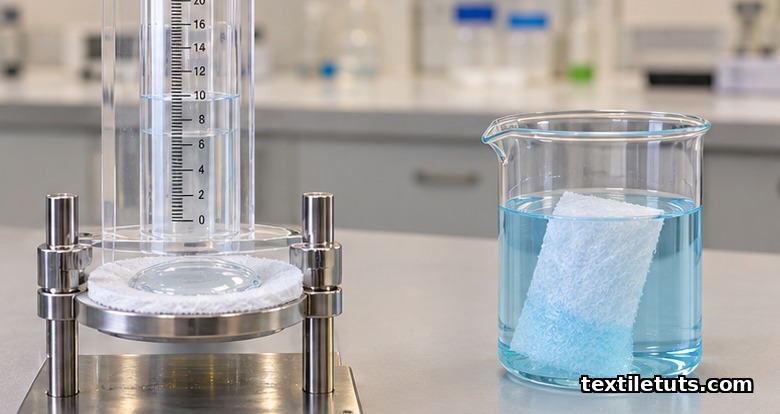
Absorbency is the opposite property. ISO 9073-6 measures the liquid absorption capacity of a nonwoven in percent of original weight after a 60-second immersion; coverstock layers for hygiene products aim for 400 to 800 percent capacity. ISO 9073-8 (liquid breakthrough time) and ISO 9073-13 (repeated strike-through) measure how fast a fluid penetrates from one side under a fixed column height, in seconds, and are used to rate absorbent hygiene cores.
Standard Comparison Table
| Property | ISO Method | ASTM Method | Typical Specimen Size | Reporting Unit |
|---|---|---|---|---|
| Mass per unit area | ISO 3801 (via 9073-1) | ASTM D3776 | 100 cm2 (ISO) / 130 cm2 (ASTM) | g/m2 |
| Thickness (low pressure) | ISO 9073-2 | ASTM D5729 | 25 cm2 foot at 0.5 kPa | mm (0.01) |
| Tensile (strip) | ISO 9073-3 | ASTM D5035 | 50 mm by 200 mm | N/5 cm and % |
| Tensile (grab) | Not applicable | ASTM D5034 | 25 mm jaw, 100 by 100 mm | N and % |
| Tear (trapezoid) | ISO 13937-4 (via 9073-4) | ASTM D5587 | 75 by 150 mm with slit | N |
| Air permeability | ISO 9237 / 9073-15 | ASTM D737 | 20 cm2 head at 100 Pa | cm3/cm2/s |
| Hydrostatic head | ISO 811 | Not applicable | 100 cm2 specimen | cm H2O |
| Liquid strike-through | ISO 9073-8 | Not applicable | 125 by 125 mm | seconds |
| Absorption capacity | ISO 9073-6 | Not applicable | 100 by 100 mm | % weight gain |
| Bursting strength | ISO 3303 | ASTM D3786 | 30 cm2 diaphragm | kPa |
Frequently Asked Questions
What is the difference between ISO 9073 and WSP test methods?
WSP (Worldwide Strategic Partners) standards are jointly maintained by INDA (North America) and EDANA (Europe) as the regional testing reference for nonwovens, with one number per method. ISO 9073 is the international mirror, and a WSP test number (for example WSP 110.4) maps 1:1 to an ISO 9073 part for the same property. Most manufacturers accept either family on a certificate of analysis.
How long does ISO 9073 conditioning take before tensile testing?
Standard conditioning under ISO 139 is 24 hours at 20 degrees Celsius and 65 percent RH. For synthetic nonwovens like polypropylene spunbond this is generally sufficient, but for high-viscose or high-cotton blends, 48 hours is sometimes specified to reach moisture equilibrium, which can shift tensile readings by 2 to 4 percent.
What is the standard specimen size for nonwoven tensile testing?
ISO 9073-3 specifies a 50 mm wide strip and 200 mm gauge length with five specimens in the machine direction and five in the cross direction. ASTM D5035 uses the same strip geometry, while ASTM D5034 grab uses a 25 mm jaw face on a 100 by 100 mm specimen and typically reads 10 to 25 percent higher than strip tensile.
Which air permeability value corresponds to a medical-grade nonwoven?
A 25 g/m2 spunbond typically reports 100 to 250 cm3/cm2/s, while the meltblown layer in an N95 respirator reports below 5 cm3/cm2/s under ASTM D737 at 125 Pa. Medical gowns allow higher permeability for breathability (above 50 cm3/cm2/s) but require the hydrostatic head to clear 50 cm H2O under AATCC TM127.
What is the test that buyers most often ask for first?
Buyers most often ask for liquid barrier performance, not tensile, because barrier failure is what causes rejects in the field. Hydrostatic head under AATCC TM127 (50 cm H2O or higher for surgical gowns) and viral penetration under ASTM F1671 (pass at 13.8 kPa) are the two tests that gate product release for medical and hygiene buyers, and a single failure can stall an entire shipment.
References
- International Organization for Standardization. ISO 9073-1: Nonwovens – Test methods for nonwovens – Part 1: Determination of mass per unit area. iso.org – defines the conditioning atmosphere, 100 cm2 specimen size, and g/m2 reporting unit.
- International Organization for Standardization. ISO 9073-3: Nonwovens – Determination of tensile strength and elongation (strip method). iso.org – 50 mm by 200 mm strip, 100 mm/min CRE, N/5 cm reporting.
- International Organization for Standardization. ISO 9237: Textiles – Determination of permeability of fabrics to air. iso.org – 20 cm2 head at 100 Pa, cm3/cm2/s unit.
- ASTM International. ASTM D737: Standard Test Method for Air Permeability of Textile Fabrics. astm.org – 125 Pa pressure drop, cfm/ft2 reporting for the North American market.
- ASTM International. ASTM D5587: Standard Test Method for Tearing Strength of Fabrics by Trapezoid Procedure. astm.org – preferred tear method for lightweight spunbond nonwovens.
- ASTM International. ASTM F1671: Standard Test Method for Resistance of Materials Used in Protective Clothing to Penetration by Blood-Borne Pathogens. astm.org – viral penetration pass/fail at 13.8 kPa, used to qualify surgical gowns.
- American Association of Textile Chemists and Colorists. AATCC TM127: Water Resistance: Hydrostatic Pressure Test. aatcc.org – hydrostatic head in cm H2O, the standard liquid barrier reference.
- INDA / EDANA Worldwide Strategic Partners. WSP 110.4 to WSP 160.4: Standard Test Methods for the Nonwovens Industry. inda.org – regional mirror of ISO 9073 series for North America and Europe.
Editorial by Md. Asad Ullah (Meem), TextileTuts. Sources: ISO 9073 series, ISO 9237, ISO 811, ISO 3303, ASTM D3776, ASTM D5729, ASTM D5034, ASTM D5035, ASTM D5587, ASTM D737, ASTM F1670, ASTM F1671, AATCC TM127, AATCC TM22, INDA/EDANA WSP standards as cited.


