
Nonwoven for Medical Products

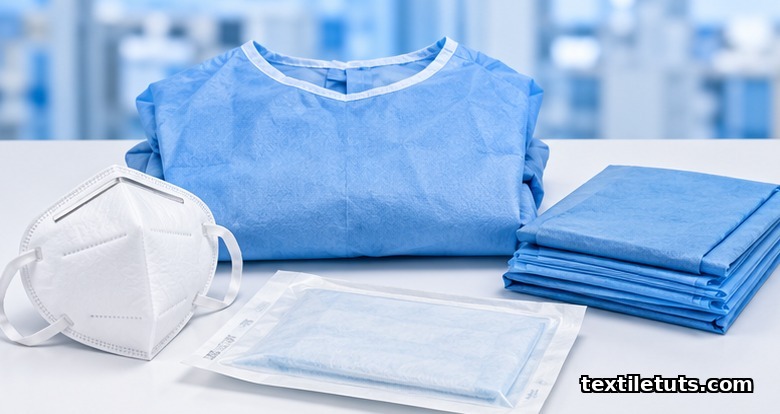
A surgical gown is a single-use nonwoven laminate, most commonly polypropylene SMS (spunbond-meltblown-spunbond) at 35 to 80 g/m² basis weight, that meets AAMI PB70 Level 1 to 4 liquid-barrier performance, with the highest level requiring hydrostatic head resistance of at least 50 cm H₂O (AATCC 127) and zero synthetic-blood penetration at 1 psi (ASTM F1670).
Medical-grade nonwovens are the fastest-growing segment of the technical-textile industry, valued at USD 11.7 billion in 2024 and projected to reach USD 18.4 billion by 2030, a compound annual growth rate of 7.8 percent (Grand View Research, 2024).
This article explains what makes a nonwoven fabric suitable for medical use: the polymer chemistry, the web-forming and bonding technologies, the barrier test methods, and the regulatory standards that determine whether a roll of fabric can be cut into a surgical gown, an N95 respirator, or a sterile wrap.
What “Medical Nonwoven” Actually Means
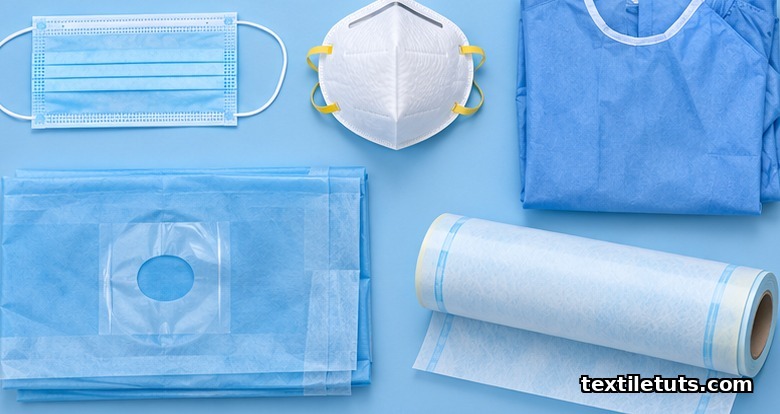
In textile engineering, a nonwoven is any fabric produced by bonding or interlocking fibers without weaving or knitting. For medical applications, the term narrows to a defined set of products: items that contact the patient or the sterile field during diagnosis, treatment, or surgery, and that are intended for single use to prevent cross-contamination.
The four defining properties of a medical nonwoven are (1) a defined liquid or microbial barrier, (2) biocompatibility per ISO 10993, (3) tolerance to a sterilization method (ethylene oxide, gamma irradiation at 25 to 50 kGy, or steam at 121 °C), and (4) lot-to-lot traceability under ISO 13485 quality management. A woven cotton drape does not satisfy these criteria; a polypropylene SMS fabric that passes ASTM F1671 (viral penetration) does.
Fiber Chemistry: Why Polypropylene Dominates
Polypropylene (PP) accounts for roughly 65 percent of medical nonwovens by mass because it is hydrophobic, chemically inert, melt-processable at 230 to 260 °C, and inexpensive at USD 1.10 to 1.50 per kg in 2024 spot prices. Other polymers are used for specific niches:
- Polyester (PET): high-strength surgical mesh, sterilization wrap, and reusable isolation gowns; melt point 260 °C, biocompatible per ISO 10993-1.
- Polyethylene (PE): soft, low-melt layers in trilaminates (for example PE film between two PP spunbond layers, used in AAMI Level 4 drapes).
- Viscose (regenerated cellulose): fluid-management layers in wound dressings and absorbent wipes; hydrophilic by design.
- Polyamide and polyimide: high-temperature filter media for sterilization autoclaves.
For masks and respirators, PP is rarely blended with other polymers because even 5 percent PET contamination can reduce meltblown filtration efficiency by 15 to 20 percent at the 0.3 µm most-penetrating-particle-size (MPPS) range.
Web-Forming Technologies Used in Medical Nonwovens
The properties of a medical nonwoven come from how the polymer is extruded and how the web is bonded. Four web-forming routes dominate.
Spunbond. Continuous filaments are extruded through a spinneret, attenuated by high-velocity air, and laid on a moving belt. The resulting web has high tensile strength, low cost, and basis weights of 10 to 200 g/m². Spunbond PP is the load-bearing layer in SMS gowns and in the inner and outer coverstock of N95 masks.
Meltblown. Polymer melt is extruded through small-diameter nozzles into a converging air stream at 350 °C, producing microfibers of 1 to 5 µm diameter. The web is loosely packed and provides the filtration layer in surgical masks (basis weight 20 to 25 g/m²) and respirators (basis weight 50 to 70 g/m² in N95).
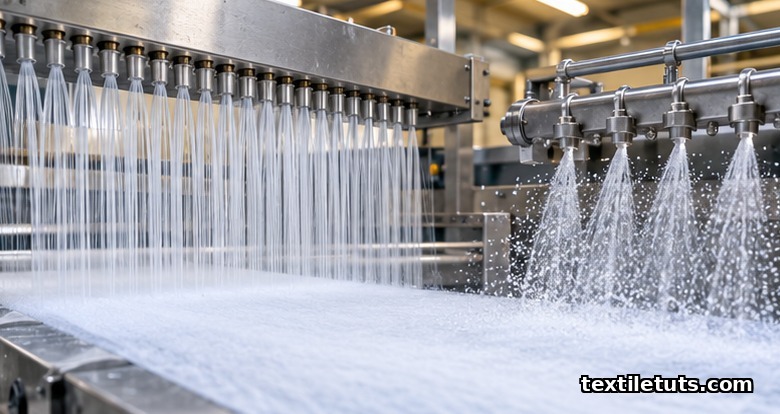
Spunlace (hydroentangled). A dry-laid web of staple fibers is bonded by high-pressure water jets (40 to 600 bar). Spunlace is the dominant technology for medical wipes, because it yields a soft, lint-free, absorbent fabric without chemical binders. Typical composition is 50/50 viscose/polyester at 40 to 70 g/m².
Wetlaid and airlaid. Short fibers are suspended in water or air and deposited on a wire. Wetlaid nonwovens are used in surgical-adhesive backings and in some wound-dressing carriers.
Needlepunching is uncommon in single-use medical products because the through-thickness pores allow fluid strike-through, but it is used in some multilayer wound dressings for loft and cushioning.
Bonding and Laminating
Point-bonding (calender bonding) uses heated patterned rolls at 140 to 165 °C and 30 to 80 N/mm linear pressure to fuse PP fibers at discrete points, giving the soft, dimpled “S-pattern” of mask and gown fabrics. Through-air bonding is used for bicomponent fibers with a lower-melt sheath.
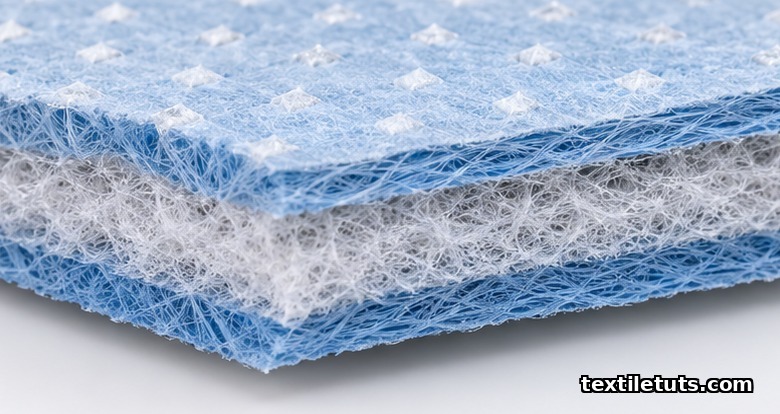
Multilayer laminates extend the property range:
- SMS (Spunbond-Meltblown-Spunbond): the workhorse laminate for surgical gowns (35 to 80 g/m²) and the inner and outer covers of N95 masks (typically 20 g/m² spunbond + 25 to 50 g/m² meltblown + 20 g/m² spunbond).
- SSMMS and SMMS: five-layer versions with higher barrier and strength, used in AAMI Level 3 and 4 gowns.
- PE-film laminates: a thin (15 to 25 µm) polyethylene film bonded to a PP spunbond, achieving AAMI Level 4 liquid barrier with hydrostatic head above 100 cm H₂O.
- SFS (Spunbond-Film-Spunbond): similar to PE-film laminate, common in surgical drapes.
Performance Standards That Define the Medical Nonwoven
A medical nonwoven is not a medical nonwoven until it passes a defined test. The four standards below cover the bulk of products on the market.
AAMI PB70 (ANSI/AAMI PB70:2012) classifies surgical gowns and drapes into four liquid-barrier levels. Level 1 (minimal fluid exposure, for example pathology): AATCC 42 impact penetration ≤ 4.5 g. Level 2: AATCC 42 ≤ 1.0 g and AATCC 127 hydrostatic head ≥ 20 cm. Level 3: AATCC 42 ≤ 1.0 g and AATCC 127 ≥ 50 cm. Level 4 (highest): pass ASTM F1670 (synthetic blood, no penetration at 1 psi) and ASTM F1671 (bacteriophage Phi-X174 viral penetration, no penetration at 1 psi).
ASTM F2100-23 specifies three barrier levels for medical face masks. Level 1 masks must achieve bacterial filtration efficiency (BFE) ≥ 95 percent and differential pressure ≤ 5.0 mm H₂O/cm². Level 2: BFE ≥ 98 percent, PFE ≥ 98 percent, differential pressure ≤ 6.0 mm H₂O/cm². Level 3 (surgical mask, ASTM F2100 Level 3): BFE ≥ 98 percent, PFE ≥ 98 percent, fluid resistance to synthetic blood at 160 mmHg, differential pressure ≤ 6.0 mm H₂O/cm².
EN 13795:2019 is the European equivalent covering surgical drapes, gowns, and clean-air suits. It sets minimum values for microbial penetration (in log₁₀ CFU), liquid penetration (in cm H₂O), tensile strength (in N/50 mm), and linting. Standard performance and high-performance classifications map roughly to AAMI Levels 2 to 4.
NIOSH 42 CFR Part 84 governs N95 and other filtering facepiece respirators. The test uses a neutralized NaCl aerosol at 0.075 µm count median diameter; the filter must capture ≥ 95 percent (N95), ≥ 99 percent (N99), or ≥ 99.97 percent (N100). NIOSH also requires an inhalation resistance ≤ 343 Pa at 85 L/min and exhalation resistance ≤ 245 Pa.
Biocompatibility and Sterilization
Every material that contacts the body must be evaluated under the ISO 10993 series. For surgical gowns, drapes, and masks, the relevant tests are ISO 10993-5 (cytotoxicity, MEM elution), ISO 10993-10 (irritation and skin sensitization), and ISO 10993-23 (irritation). Polypropylene and polyethylene, in their pure forms, are routinely classified as Class VI under USP <88> and pass ISO 10993-5 with no reactivity grade above 1.
Sterilization method shapes the fabric choice. Ethylene oxide (EtO) at 37 to 63 °C and 35 to 65 percent relative humidity is the dominant method for gowns, drapes, and most PP nonwovens because it operates below the 140 to 165 °C PP softening range. Gamma irradiation at 25 to 50 kGy causes a small (3 to 8 percent) loss of tensile strength in PP because of chain scission. Steam sterilization at 121 °C for 20 minutes is incompatible with PP spunbond unless the fibers are stabilized; polyester nonwovens tolerate steam and are used for reusable wraps.
Common Applications and Their Material Specifications
| Product | Construction | Basis weight (g/m²) | Key standard |
|---|---|---|---|
| Surgical mask, ASTM Level 1 | SS (PP spunbond + PP meltblown) | 50 to 70 | ASTM F2100 Level 1 |
| Surgical mask, ASTM Level 3 | SSS or SMS | 80 to 120 | ASTM F2100 Level 3, fluid 160 mmHg |
| N95 respirator | SMS + electret meltblown | 120 to 200 | NIOSH 42 CFR Part 84 |
| Surgical gown, AAMI Level 2 | PP SMS | 35 to 45 | AAMI PB70 Level 2 |
| Surgical gown, AAMI Level 4 | SSMMS or PE-laminated | 60 to 80 | AAMI PB70 Level 4 (ASTM F1670, F1671) |
| Surgical drape | SSMMS or PE film laminate | 50 to 90 | EN 13795 / AAMI Level 3 to 4 |
| Sterilization wrap | Spunbond PP + wetlaid cellulose | 50 to 70 | ISO 11607 (compatibility with EtO / steam) |
| Medical wipe | Spunlace (viscose/PET) | 40 to 70 | EN 16615 (wet wipe microbial) |
| Wound dressing carrier | Airlaid cellulose / needlepunch PET | 80 to 250 | ISO 10993-5 |
Frequently Asked Questions
Is a nonwoven fabric sterile when it leaves the factory?
No. Most medical nonwovens are sold “non-sterile bulk roll” (roll goods) and are sterilized by the converter or the hospital using ethylene oxide or gamma irradiation. Sterilization is the last step before packaging; validated sterilization to a Sterility Assurance Level of 10⁻⁶ is required for products labeled “sterile” under ISO 11135 (EtO) or ISO 11137 (gamma).
Can a reusable woven gown replace a single-use SMS gown?
Reusable woven polyester gowns are used in some European centers and pass EN 13795 high-performance after 75 industrial wash cycles. They are not equivalent to AAMI Level 4 SMS for viral penetration; the ASTM F1671 viral barrier of a woven polyester typically fails after 25 to 30 wash cycles, and the seam sites of woven gowns are a known strike-through path. AAMI Level 3 and 4 protection effectively requires a single-use nonwoven.
What is the difference between ASTM F1670 and ASTM F1671?
ASTM F1670 measures resistance to synthetic blood penetration at 1 psi (used for AAMI Level 4 gowns and ASTM F2100 Level 3 masks at 160 mmHg). ASTM F1671 measures resistance to bacteriophage Phi-X174, a 27 nm virus surrogate, under the same pressure and is the higher bar for Level 4 surgical gowns. Passing F1671 implies passing F1670, but not the reverse.
How is meltblown polypropylene made electret (charged) for N95 filters?
Meltblown webs are passed through a high-voltage corona discharge (10 to 25 kV) or are melt-extruded with electret additives such as tristearyl borate (5 bB) or ammonium sulfonate (ammonium sulfonate). The electrostatic charge, rather than mechanical filtration, is what gives electret meltblown its high efficiency (99+ percent) at low differential pressure (1 to 3 mm H₂O). The charge decays with humidity, alcohol exposure, and time; NIOSH recommends a 5-year shelf life at 23 °C, 50 percent RH.
What is the basis weight of an N95 mask?
A typical N95 respirator uses three to four layers with a total basis weight of 120 to 200 g/m²: an outer spunbond PP cover (20 to 30 g/m²), a needle-punched or spunbond pre-filter (40 to 60 g/m²), an electret meltblown PP filtration layer (50 to 70 g/m²), and an inner spunbond comfort layer (20 to 30 g/m²). The meltblown layer is the performance-limiting layer; reducing it below 40 g/m² typically drops filtration efficiency below the 95 percent NIOSH threshold.
References
- ASTM International. F2100-23 Standard Specification for Performance of Materials Used in Medical Face Masks. ASTM — defines BFE, PFE, fluid resistance, and differential pressure limits for ASTM Level 1, 2, and 3 surgical masks.
- ASTM International. F1670/F1671-22 Standard Test Methods for Resistance of Materials to Penetration by Synthetic Blood and by Blood-Borne Pathogens. ASTM — the viral and synthetic-blood penetration tests required for AAMI PB70 Level 4.
- AAMI. ANSI/AAMI PB70:2012 Liquid Barrier Performance of Surgical Gowns and Drapes. AAMI — the four-level classification cited in U.S. hospital procurement specifications.
- AATCC. AATCC 42 and AATCC 127 Test Methods for Water Resistance. AATCC — the impact penetration and hydrostatic head methods that anchor the lower AAMI Levels.
- ISO. ISO 10993-1:2018 Biological Evaluation of Medical Devices — Part 1: Evaluation and Testing. ISO — the biocompatibility framework for all medical-device materials that contact the body.
- ISO. ISO 13485:2016 Medical Devices — Quality Management Systems. ISO — the QMS standard required for nonwoven fabric converters selling into regulated medical markets.
- NIOSH. 42 CFR Part 84 Respiratory Protective Devices. U.S. Government — the federal regulation for N95, N99, and N100 filtering facepiece respirators.
- European Committee for Standardization. EN 13795:2019 Surgical Drapes, Gowns and Clean Air Suits. CEN — the European standard covering standard- and high-performance surgical fabric specifications.
This article is the working reference for nonwoven fabrics in medical products. Editorial by Md. Asad Ullah (Meem), TextileTuts. Sources: ASTM F2100-23, ASTM F1670/F1671-22, AAMI PB70:2012, AATCC 42 / 127, ISO 10993-1, ISO 13485, 42 CFR Part 84, EN 13795:2019 as cited.


