
Biodegradable Nonwoven (PLA, Jute)

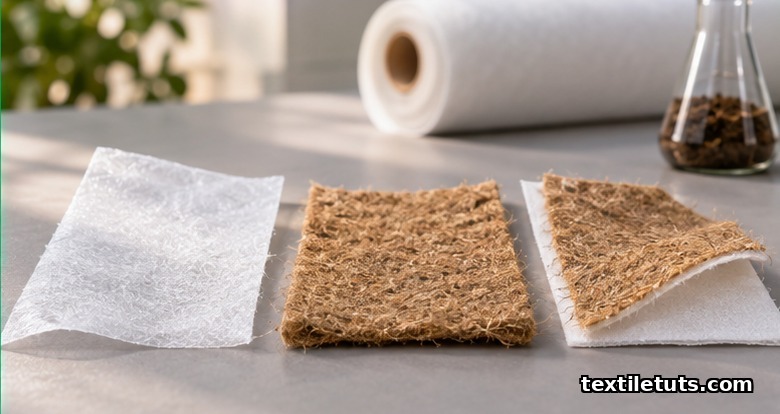
PLA (polylactic acid) nonwovens reach 60 to 90 percent aerobic biodegradation within 180 days under industrial composting at 58 °C and 50 to 55 percent relative humidity per ISO 14855-1:2012, while untreated jute nonwovens achieve about 85 percent mineralization in 90 days in soil burial studies, positioning both fibers as credible substitutes for polypropylene in single-use technical textile applications.
Because PLA runs on standard spunbond and meltblown lines, and jute is compatible with needle-punch and hydroentanglement, the two fibers cover nearly the full range of nonwoven forming methods without abandoning existing converting equipment.
The following sections cover how each fiber is processed, how PLA-jute hybrid nonwovens balance strength and water resistance, and which biodegradation standards and field tests separate compliant compostable products from greenwashing claims.
What Counts as a Biodegradable Nonwoven?
In technical textile practice, a nonwoven is a flat, porous sheet made directly from fibers or filaments without yarn spinning or weaving interlacing. The ISO 9092:2019 definition excludes films, paper, and woven or knitted fabrics, but covers every bonding route used for PLA and jute, from spunbond and meltblown to needle-punch, thermal bond, and hydroentanglement.
A biodegradable nonwoven meets two distinct criteria at once. The first is material origin and structure: the sheet must be made of polymers or fibers that microorganisms can convert into CO2, water, biomass, and mineral residues under defined conditions. The second is certification against an accepted standard, most commonly ASTM D6400 (industrial composting), ASTM D6868 (biodegradable coatings on paper), EN 13432 (European industrial composting), or ISO 17088 (compostable plastics). Without the second, a material that is “bio-based” is not necessarily biodegradable, and a material that is “biodegradable” is not automatically home-compostable or marine-degradable.
For textile engineers, the practical question is not whether a fiber is biodegradable in some abstract sense, but under what temperature, moisture, microbial community, and time window the breakdown actually proceeds, and whether that window matches the product’s end-of-life pathway.
PLA Nonwovens: Properties and Processing
PLA is a linear aliphatic polyester produced by ring-opening polymerization of lactide, the cyclic dimer of lactic acid. Lactic acid is obtained by fermenting dextrose from corn starch or sucrose from sugarcane, which is why PLA is classed as a bio-based polymer. The two commercial stereoisomers, poly(L-lactide) (PLLA) and poly(D,L-lactide) (PDLLA), control crystallinity, melting point, and processing window. PLLA has a glass transition near 60 °C and a melting point around 170 °C, which sits comfortably inside the meltblown and spunbond processing window used for polypropylene.
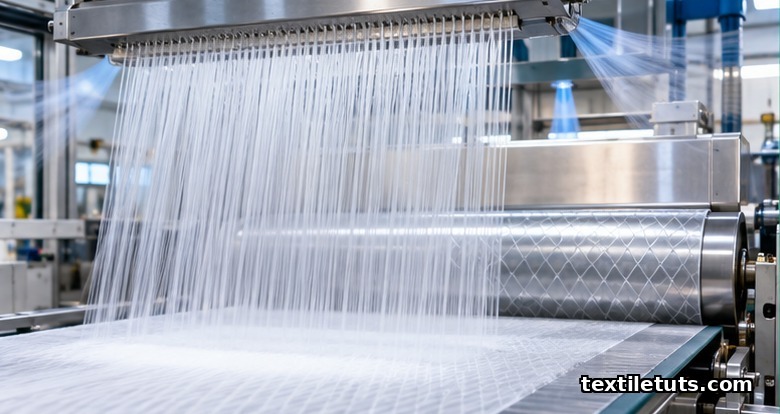
PLA nonwovens are produced by three main routes. Spunbond PLA forms continuous filaments extruded through spinnerets, drawn by air, and laid on a moving belt before thermal point-bonding between 150 °C and 170 °C. Meltblown PLA produces microfibers 1 to 5 µm in diameter attenuated by hot air at the die, giving high surface area webs used in filtration. Electrospinning PLA yields nanofibers under 500 nm that are studied for medical scaffolds and air filtration. For most hygiene and packaging applications, spunbond PLA gives tensile strengths of 20 to 40 N per 15 mm strip at 30 to 100 gsm basis weight and elongations around 20 to 60 percent.
The key properties textile engineers measure on PLA nonwovens include basis weight (ISO 9073-1), thickness (ISO 9073-2), tensile strength and elongation (ISO 9073-3), air permeability (ISO 9237), and hydrostatic head (ISO 811). Compared with PP at the same basis weight, PLA is stiffer, more UV-sensitive, and shows lower impact resistance, which is why it is rarely used alone in load-bearing applications.
Jute Nonwovens: Properties and Processing
Jute (Corchorus capsularis and Corchorus olitorius) is a bast fiber extracted from the stem of plants grown mainly in the Ganges delta. The technical fiber bundle, often 1.5 to 3 m long, is composed of elementary fibers 20 to 200 µm in diameter held together by pectin and lignin. Raw jute is coarse, stiff, and hygroscopic, with moisture regain of about 12.5 percent at 65 percent RH, and tensile strength per fiber bundle of 30 to 50 cN/tex.
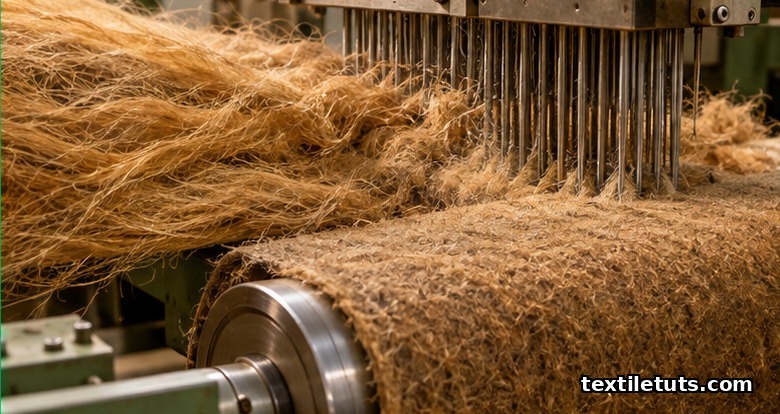
Jute nonwovens are made by dry-laying carded jute fibers and bonding them through needle-punching, hydroentanglement (spunlace), or chemical binder application. Needle-punching is the dominant route for geotextiles, agricultural mulches, and automotive interior substrates, with punch densities of 80 to 400 punches per cm² and depth depending on basis weight. Hydroentanglement gives softer, drapable fabrics used in carpet backing and wipes. Because jute lacks the thermoplastic behavior of synthetic fibers, thermal bonding is not used; instead, low-melt binder fibers (often PLA or bicomponent PET) can be blended in to enable through-air bonding at 130 to 160 °C.
Plain jute nonwovens biodegrade readily in soil because the cellulose and hemicellulose in the fiber are accessible to cellulolytic bacteria and fungi. Soil burial tests reported in the polymer literature show 70 to 90 percent weight loss within 60 to 120 days in active agricultural soil at 25 to 30 °C, without the controlled composting conditions required for PLA.
PLA-Jute Hybrid Nonwovens
Blending PLA with jute combines the thermoplastic processability of PLA with the stiffness, low cost, and high cellulose content of jute. Two routes are common in practice. In the first, PLA fibers or bicomponent PET/PLA sheaths are blended with carded jute at 20 to 50 percent PLA by weight, then through-air bonded at 130 to 160 °C, producing a stiff, soil-degradable web for mulch mats and packaging. In the second, PLA meltblown microfibers are layered with needle-punched jute webs and consolidated by hot-pressing to form composites for technical uses.
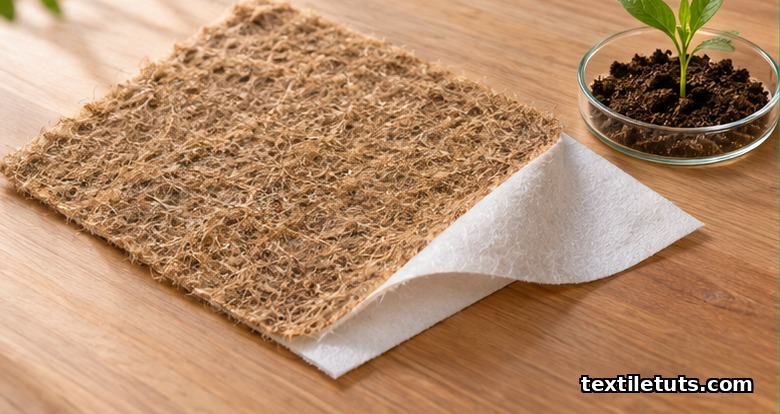
Hybrid nonwovens are useful where neither fiber alone works. Pure jute nonwovens swell and lose wet tensile strength when saturated, limiting their use in wet filtration and hygiene. PLA adds wet strength and dimensional stability but biodegrades more slowly than jute, so the composite mineralizes in a stepped pattern: the jute fraction degrades first in soil, leaving a porous PLA scaffold that breaks down under industrial composting. For end-of-life planning, this means a PLA-jute mat is well suited to industrial composting facilities that meet ASTM D6400 conditions, not to backyard compost heaps.
Biodegradation Standards and Tests
The four standards textile engineers rely on most are ISO 14855-1:2012, ISO 14851:2019, ASTM D6400, and EN 13432. All four share a common logic: measure evolved CO2, consumed O2, or mass loss in a controlled aerobic environment over a fixed period, and require that a defined percentage of the carbon in the test material be converted to CO2 within a fixed time.
ISO 14855-1:2012 specifies a controlled composting test in which the material is mixed with mature compost and held at 58 °C with 50 to 55 percent relative humidity. The CO2 evolved is measured continuously; the pass criterion is at least 90 percent conversion of the carbon in the test material to CO2 within 180 days. ISO 14851:2019 measures aerobic biodegradation in an aqueous medium by oxygen demand in a closed respirometer, and is used where compost is not available, for example in laboratory screening.
ASTM D6400-19 and EN 13432 together cover the same conditions as ISO 14855-1 but add ecotoxicity tests on plant growth and heavy-metal limits to qualify a product as commercially compostable in municipal or industrial facilities. A material that passes only soil burial or aquatic tests but not ASTM D6400 should not be marketed as compostable.
For laboratory quality control, AATCC and ISO test methods cover the nonwoven properties themselves: ISO 9073-1 (mass per unit area), ISO 9073-3 (tensile), ISO 9073-8 (liquid penetration), and AATCC TM 79 (absorbency). These do not measure biodegradation directly, but they are used to confirm that a biodegradable sheet still meets the engineering performance criteria of its application while it is in use.
Comparison: PLA, Jute, and PLA-Jute Nonwovens
| Property | PLA nonwoven | Jute nonwoven | PLA-jute hybrid |
|---|---|---|---|
| Primary bonding route | Spunbond / meltblown | Needle-punch / hydroentangle | Through-air bond / hot-press |
| Typical basis weight (gsm) | 15 to 150 | 80 to 500 | 60 to 300 |
| Wet tensile strength | High (synthetic-like) | Low (swells) | Medium to high |
| UV resistance | Low to medium | Medium | Medium |
| Biodegradation (industrial composting, 58 °C) | 60 to 90% in 180 days | 85% in 90 days | 70 to 90% in 180 days |
| Soil burial degradation | Slow (months to years) | 70 to 90% in 60 to 120 days | Stepped: jute first, then PLA scaffold |
| Standards typically met | ASTM D6400, EN 13432, ISO 17088 | Soil biodegradation (no single ASTM/EN pass) | ASTM D6400 with binder-fiber choice |
| Main applications | Wipes, hygiene, tea bags, packaging | Geotextiles, agrotextiles, automotive | Agrotextiles, packaging, composites |
| Approximate cost vs. PP nonwoven | 1.5x to 2.5x | 1.1x to 1.5x | 1.3x to 2.0x |
Frequently Asked Questions
How long does PLA nonwoven take to biodegrade in real conditions?
Under ASTM D6400 industrial composting at 58 °C and controlled humidity, PLA nonwovens reach the 90 percent CO2 conversion threshold within roughly 120 to 180 days per ISO 14855-1. In cooler soil at 20 to 30 °C, PLA degrades over months to a few years depending on microbial activity, and in marine water the rate drops further because temperatures and microbial populations are lower. PLA does not biodegrade meaningfully in anaerobic landfill.
Is jute nonwoven stronger than PLA nonwoven?
Dry jute nonwoven can match or exceed PLA in tensile strength per unit mass when the jute is needle-punched at high density, but jute loses much of its wet tensile strength on saturation because the cellulose fibers swell and hydrogen bonds in the web weaken. PLA keeps most of its tensile strength when wet because it is a hydrophobic thermoplastic. For load-bearing wet uses, PLA-jute hybrid webs are usually specified.
Can PLA-jute nonwovens be composted at home?
Most PLA-jute hybrids on the market today are certified only for industrial composting under ASTM D6400 or EN 13432 conditions, where the 58 °C temperature is sustained for several weeks. Home compost heaps rarely reach 40 °C for long periods, so the PLA fraction will degrade slowly or only partially. Jute alone composts well at home; PLA alone does not.
What are the main commercial applications of biodegradable PLA and jute nonwovens?
PLA nonwovens dominate single-use wipes, hygiene layers, tea bags, and food packaging where wet strength is required. Jute nonwovens are used in geotextiles for road base separation, agrotextiles for weed control and mulching, automotive interior substrates, and carpet backing. PLA-jute hybrids target agricultural mulch mats, biodegradable planting pots, and packaging foams.
Are biodegradable nonwovens more expensive than polypropylene?
Yes, but the gap varies with feedstock price. PLA nonwovens have historically been 1.5 to 2.5 times the cost of PP nonwovens at the same basis weight, while jute nonwovens have been 1.1 to 1.5 times. Hybrid webs sit between the two. The premium narrows when oil prices rise, because PLA is decoupled from fossil feedstocks, and widens when crop yields fall.
References
- International Organization for Standardization. ISO 14855-1:2012, Determination of the ultimate aerobic biodegradability of plastic materials under controlled composting conditions, Method by analysis of evolved carbon dioxide.
- International Organization for Standardization. ISO 14851:2019, Determination of the ultimate aerobic biodegradability of plastic materials in an aqueous medium, Method by measuring the oxygen demand in a closed respirometer.
- ASTM International. ASTM D6400-19, Standard Specification for Labeling of Plastics Designed to be Aerobically Composted in Municipal or Industrial Facilities.
- International Organization for Standardization. ISO 9073 series, Nonwovens, Test methods (parts 1 to 18).
- Garlotta, D. (2001). A Literature Review of Poly(Lactic Acid). Journal of Polymers and the Environment, 9(2), 63-84. Springer.
- Bledzki, A.K., and Gassan, J. (1999). Composites reinforced with cellulose based fibres. Progress in Polymer Science, 24(2), 221-274. ScienceDirect.
- Mukherjee, T., and Kao, N. (2011). PLA Based Biopolymer Reinforced with Natural Fibre: A Review. Journal of Minerals and Materials Characterization and Engineering, 10(6), 489-505.
This article is the working reference for biodegradable nonwoven fabrics based on PLA and jute. Editorial by Md. Asad Ullah (Meem), TextileTuts. Sources: ISO 14855-1:2012, ISO 14851:2019, ASTM D6400-19, ISO 9073 series, Garlotta 2001, Bledzki and Gassan 1999, Mukherjee and Kao 2011 as cited.


