
Nonwoven for Hygiene Products

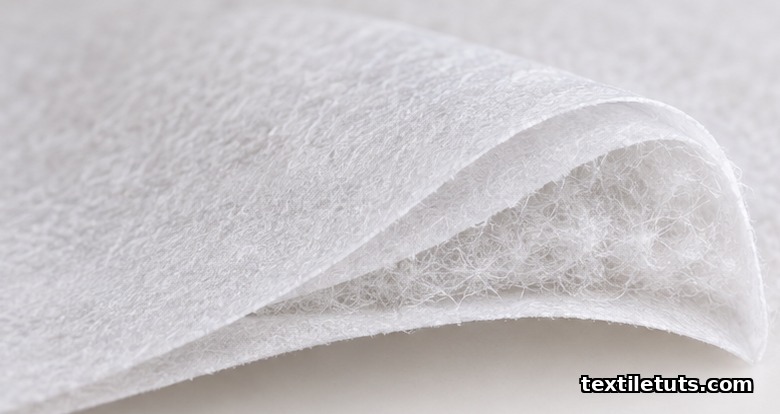
Spunbond-meltblown-spunbond (SMS) nonwoven fabric made from isotactic polypropylene at 15 to 80 g/m² is the standard topsheet, acquisition layer, and back sheet in single-use hygiene products because its meltblown layer of 1 to 10 µm fibers reduces liquid strike-through to below 5 g under ISO 9073-8 hydrostatic pressure while remaining vapor permeable at 1,000 to 3,000 g/m² per 24 h.
Polypropylene accounts for roughly 60% of global nonwoven fiber consumption for hygiene end uses because its melt viscosity range of 50 to 500 Pa·s at 230 °C supports both spunbond and meltblown extrusion on the same production line, lowering per-gram cost versus polyester or bicomponent alternatives.
This article covers what nonwoven fabrics are, how the three dominant web-forming processes work, where each one is placed inside a hygiene product, and which ISO, AATCC, and ASTM methods manufacturers use to verify performance.
What a Nonwoven Fabric Is, and Why It Replaces Woven Textiles in Hygiene
A nonwoven is a sheet of fibers, filaments, or chopped yarns bonded by mechanical, thermal, or chemical means rather than by interlacing (weaving) or interloping (knitting). ISO 9092:2019 defines the category, and ISO 9073-1:2023 governs how the physical properties are measured. In a hygiene product, the nonwoven must achieve three goals at once: pass fluid away from the skin (acquisition), hold the fluid inside the core (absorption and retention), and prevent rewet back to the skin (barrier performance).
Woven and knitted fabrics cannot meet this three-fold requirement at the same basis weight, because their open inter-yarn pores are 100 to 500 µm wide, large enough to let menstrual or urinary fluid pass back through under load. Nonwovens, by contrast, can be engineered with pore sizes below 20 µm through meltblown fiber deposition, which is why global hygiene nonwoven output has grown to an estimated 3 to 4 million tonnes annually according to peer-reviewed market reviews indexed on ResearchGate.
The Three Web-Forming Processes Used in Hygiene Nonwovens
Spunbond (S)
Spunbond extrusion melts polypropylene or polyester pellets at 220 to 260 °C, extrudes the melt through a spinneret with 1,000 to 4,000 holes per meter, draws the filaments with hot air at 1,500 to 4,000 m/min, and lays the continuous filaments on a moving belt. The resulting web has a basis weight of 10 to 200 g/m² and a tensile strength of 20 to 80 N per 5 cm in the machine direction.
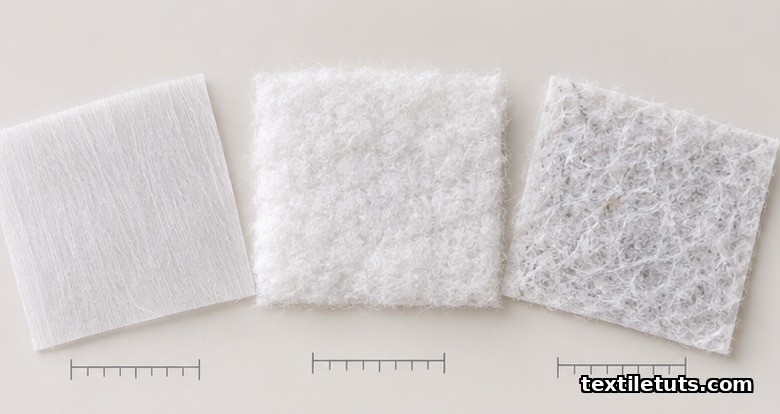
Spunbond contributes the strength layer in a baby diaper back sheet, the leg-cuff barrier, and the outer cover of feminine pads. It cannot, on its own, filter fine particles, because the interfiber pores in spunbond webs typically range from 20 to 80 µm.
Meltblown (M)
Meltblown extrusion uses a higher melt-flow-index polymer (typically 400 to 1,500 MFR polypropylene) and a die-to-collector distance of only 10 to 25 cm, combined with converging hot air at 300 to 400 m/s. The attenuated fibers come out at 1 to 10 µm in diameter and accumulate as a fine, self-bonded web of 5 to 50 g/m².
Meltblown alone is too weak to survive converting machinery, so it is almost always sandwiched between spunbond layers, producing a fabric that resists bacterial and viral penetration under ASTM F1671 viral penetration testing. The same construction is used in surgical drapes and high-barrier surgical gowns under EN 13795.
Spunlace (hydroentangled)
Spunlace does not melt the polymer. Instead, a carded or wet-laid web of staple fibers (polyester, viscose, cotton, or blends) is exposed to high-pressure water jets at 40 to 250 bar that entangle the fibers mechanically. The resulting fabric has a soft hand and a basis weight of 30 to 120 g/m², suitable for wet wipes, facial masks, and the topsheet of premium baby diapers.
How Nonwovens Are Layered Inside a Disposable Diaper
A typical spunbond baby diaper stacks four nonwoven layers around a superabsorbent polymer (SAP) core of crosslinked sodium polyacrylate. From the baby’s skin outward, they are:
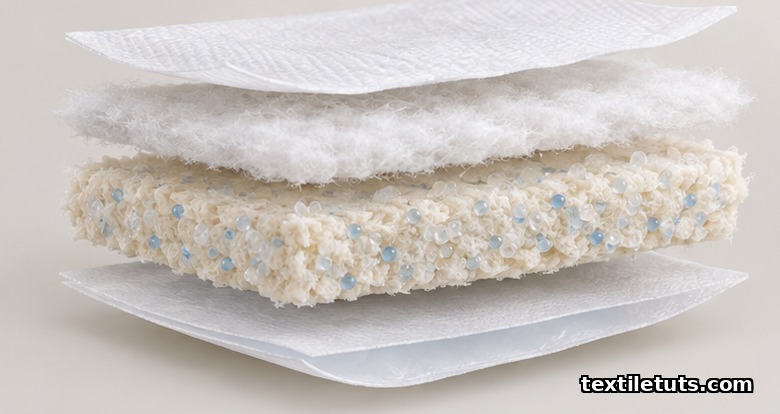
- Topsheet, a 15 to 25 g/m² spunbond polypropylene treated with a hydrophilic surfactant, hydrohead of 30 to 60 mbar under AATCC TM127.
- Acquisition/distribution layer (ADL), a 30 to 50 g/m² resin-bonded or through-air-bonded bicomponent fiber web that moves urine from the insult point to the full SAP surface within 30 s.
- Back sheet outer, a 15 to 25 g/m² spunbond polypropylene that provides the outer cloth-like feel.
- Back sheet film, a 15 to 25 g/m² breathable polyethylene or microporous film laminated to the spunbond, providing the liquid barrier.
The full laminate construction is sometimes called SMS when the back sheet combines spunbond, meltblown, and spunbond; this is the same construction used in surgical gowns under EN 13795 and ASTM F1671. Premium incontinence products add a second meltblown layer, producing SMMS at 40 to 60 g/m² for higher viral-penetration resistance.
Test Methods That Define Hygiene Nonwoven Performance
Buyers of hygiene nonwovens typically specify compliance with a small set of physical, barrier, and biological tests. The table below summarises the most commonly requested ones.
| Property | Standard | Typical Hygiene Range |
|---|---|---|
| Basis weight | ISO 9073-1:2023 | 10 to 200 g/m² |
| Tensile strength (MD/CD) | ISO 9073-3:2023 | 20 to 80 N/5 cm |
| Hydrostatic head | ISO 9073-8:1995 (and AATCC TM127) | 30 to 500 mbar |
| Air permeability | ISO 9237:1995 | 50 to 2,000 mm/s |
| Vapor permeability | ASTM E96 / ISO 15496 | 1,000 to 3,000 g/m²/24 h |
| Liquid strike-through (topsheet) | ISO 9073-8:1995 and EDANA 150.4 | less than 5 g rewet |
| Viral penetration | ASTM F1671 | no penetration at 0 kPa |
| Antimicrobial finish (optional) | AATCC TM100-2019 | 99% or greater reduction vs control |
The hydrostatic-head and liquid strike-through pair is the most frequently cited acceptance criterion, because it directly predicts how the topsheet will behave during a fluid insult. A topsheet that scores below 5 g rewet under EDANA 150.4 will keep the baby’s or adult user’s skin visibly dry, while a topsheet above 10 g rewet will feel damp within minutes of loading.
Where Each Nonwoven Process Wins Inside the Product
| Hygiene Application | Preferred Web Process | Typical Basis Weight |
|---|---|---|
| Baby diaper topsheet | Spunbond PP, hydrophilic finish | 15 to 25 g/m² |
| Baby diaper ADL | Through-air-bonded bicomponent | 30 to 50 g/m² |
| Baby diaper back sheet outer | Spunbond PP / SMS laminate | 15 to 30 g/m² |
| Feminine pad topsheet | Spunbond PP or spunlace | 15 to 40 g/m² |
| Adult incontinence back sheet | SMMS laminate | 40 to 60 g/m² |
| Wet wipes | Spunlace (PET, viscose, cotton blends) | 30 to 80 g/m² |
| Surgical drape | SMS or SMMS | 35 to 60 g/m² |
Sustainability: Polypropylene, Biodegradability, and Recycled Content
Polypropylene’s dominance in hygiene nonwovens is a double-edged finding. Polypropylene is non-biodegradable in soil and marine environments under ISO 17556 and ASTM D6691, with a half-life measured in decades. End-of-life disposal research in peer-reviewed journals, including open-access work on MDPI Polymers, reports that spunbond PP persists in landfill simulation for over 30 years without significant molecular-weight change.
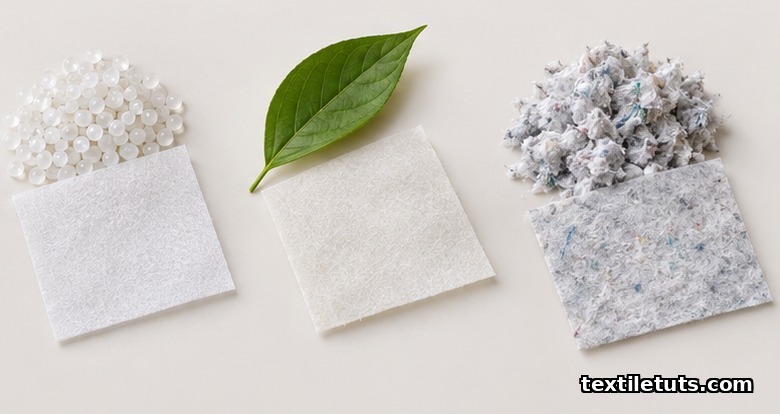
Two responses are moving from research to commercial scale. First, mono-material all-polypropylene laminates with a calcium-carbonate-filled PP film replacing the polyethylene back sheet, which makes the entire diaper recyclable in PP streams. Second, polylactic acid (PLA) and polyhydroxyalkanoate (PHA) spunbond lines from suppliers such as NatureWorks and Danimer Scientific are entering pilot production at 15 to 25 g/m² for flushable wipes and the topsheet of compostable diapers. MDPI peer-reviewed work has documented the mechanical-property gap between PLA spunbond and PP spunbond at the same basis weight; PLA spunbond typically shows 30 to 40% lower tensile strength until bonding conditions are tuned for the lower PLA melt temperature.
Frequently Asked Questions
What is the difference between SMS and SMMS nonwoven?
SMS has one meltblown layer sandwiched between two spunbond layers; SMMS adds a second meltblown layer for higher barrier performance. SMMS at 40 to 60 g/m² passes ASTM F1671 viral penetration testing, which is why surgical drapes, surgical gowns, and high-end incontinence backsheets use SMMS instead of SMS.
Why is polypropylene the dominant fiber in hygiene nonwovens?
Polypropylene melts at 165 °C, has a melt flow rate compatible with both spunbond and meltblown extrusion on the same line, costs roughly 30% less per kilogram than polyester, and is naturally hydrophobic without chemical finishing. These four properties together explain why polypropylene commands around 60% of global hygiene nonwoven fiber consumption.
Can nonwoven hygiene products be recycled?
Single-material polypropylene hygiene products can be mechanically recycled after the SAP core is removed and the cellulose fluff is separated, but the process is still at demonstration scale. Most hygiene nonwovens today end up in landfill or in waste-to-energy incinerators; chemical recycling routes are still in the research stage and are described in peer-reviewed work on polypropylene pyrolysis.
How is the liquid strike-through of a topsheet measured?
Liquid strike-through is the time taken for a fixed volume of synthetic urine (typically 5 mL of 0.9% NaCl solution) to pass through a nonwoven sample. ISO 9073-8:1995 and EDANA 150.4 both describe the procedure; a high-performance topsheet shows strike-through in under 3 s and rewet of less than 5 g.
Are flushable wipes truly flushable?
No. Most wipes labelled “flushable” are made from hydroentangled polyester, viscose, or cotton-polyester blends that pass through household plumbing but do not break apart in municipal sewer systems. The wipes are nonwoven, but the flushing claim is contested by water utilities such as those surveyed by Water UK in 2023, which report that wipes constitute 75 to 95% of the material causing sewer blockages.
References
- ISO. ISO 9073-1:2023, Nonwovens in medicine, Part 1: Test methods for the determination of basis weight. iso.org. Standard for nonwoven mass per unit area.
- ISO. ISO 9073-8:1995, Nonwovens in medicine, Part 8: Determination of liquid strike-through time. iso.org. Standard for topsheet liquid strike-through.
- ASTM International. ASTM F1671/F1671M, Standard Test Method for Resistance of Materials Used in Protective Clothing to Penetration by Blood-Borne Pathogens. astm.org. Method used to qualify SMS and SMMS fabric for surgical and hygiene barrier applications.
- AATCC. AATCC TM100-2019, Test Method for Antibacterial Finishes on Textile Materials. aatcc.org. Quantitative antibacterial test for treated nonwovens.
- AATCC. AATCC TM127, Test Method for Water Resistance: Hydrostatic Pressure. aatcc.org. Method for topsheet and back sheet barrier performance.
- ResearchGate peer-reviewed review: Nonwovens in Hygiene Applications: A Review (researchgate.net). Peer-reviewed coverage of spunbond, meltblown, and spunlace constructions in baby diapers, feminine hygiene, and adult incontinence.
- MDPI. Polymers journal open-access review on biodegradable nonwovens. mdpi.com. Peer-reviewed coverage of PLA and PHA spunbond alternatives and their mechanical-property trade-offs.
Editorial by Md. Asad Ullah (Meem), TextileTuts. Sources: ISO 9073-1:2023, ISO 9073-8:1995, ASTM F1671, AATCC TM100-2019, AATCC TM127, ResearchGate peer-reviewed review, MDPI Polymers open-access review, as cited.


