
Nonwoven for Filtration

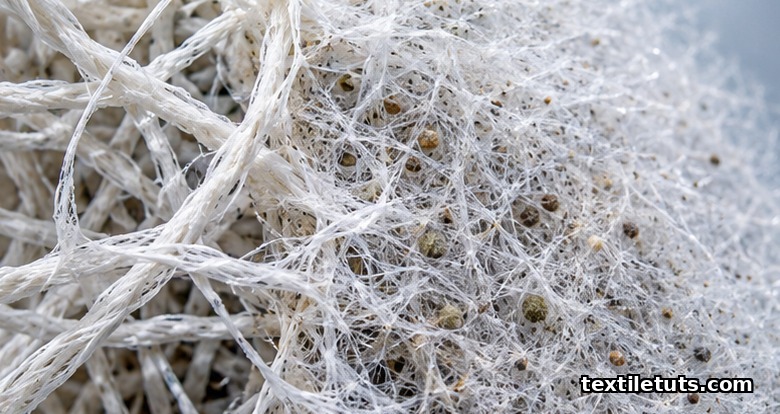
Nonwoven filtration media are engineered webs of randomly arranged fibers (typical diameters 0.5–50 µm, basis weights 10–500 g/m²) that remove 85–99.999% of airborne or liquid-borne particles in the 0.1–100 µm range, with HEPA-grade media capturing 99.97% of the most-penetrating 0.3 µm particles under the US DOE specification adopted by IEST RP-CC001 and ISO 29463. Modern HVAC, automotive cabin, respirator, cleanroom, blood, dairy, and water filters all rely on nonwoven webs because they combine high surface area, controllable pore size, low pressure drop, and formability into pleated, bag, or cartridge formats that woven or knit fabrics cannot match.
This guide walks through the fiber science, the four capture mechanisms, the seven dominant nonweb processes used in filtration, the rating systems (MERV, ISO 16890, HEPA/ULPA, NIOSH, beta ratio), and the practical numbers a textile engineer needs to evaluate or specify a nonwoven filter medium.
What makes nonwovens the dominant filtration medium
A nonwoven is a sheet of fibers bonded mechanically, thermally, or chemically rather than by weaving or knitting. That randomness is the filtration advantage. Woven fabrics have straight, evenly spaced interstices between warp and weft that act like a sieve: the pore size is fixed by thread count, and once a particle matches the gap, it slips through. In a nonwoven, fibers cross at every angle, so the airflow path is tortuous and the effective pore size is governed by the statistical distribution of fiber spacing rather than by any geometric opening.
Three properties follow directly. First, nonwovens can be tuned to very small mean flow pore sizes (often 1–50 µm for liquid filtration and 0.5–20 µm for air) without losing permeability, because increasing fiber surface area by going finer raises capture efficiency faster than it raises pressure drop up to a point. Second, nonwovens can be built in gradient structures, with coarser fibers on the inlet side to catch large debris and finer fibers downstream to polish, mimicking the depth-loading behavior of classic felt. Third, nonwovens are formable. They can be pleated to 100–300 mm height, laminated to spunbond supports, molded into conical cartridges, or stitched into bags without unraveling.
The market reflects this dominance. The global nonwoven filter media market was estimated at USD 7.8 billion in 2024 and is projected to grow at a compound annual rate above 6% through 2030, with meltblown polypropylene, needle-punch polyester, and wet-laid glass each holding distinct positions across air and liquid applications.
The four particle capture mechanisms
Filtration theory describes how a particle transfers from the airstream to a fiber. Four mechanisms contribute, and which one dominates depends on particle size, face velocity, and whether the fiber carries an electrostatic charge.
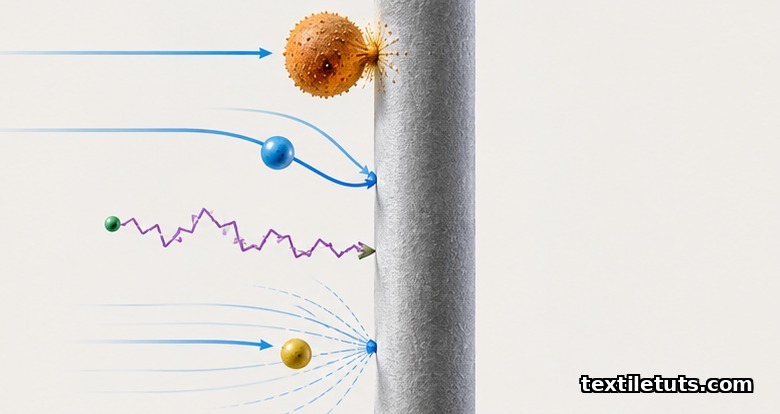
Interception happens when a particle following a streamline passes within one particle radius of a fiber. For a 0.3 µm droplet and a 3 µm fiber, interception is most efficient in the 0.1–1 µm range and typically contributes 25–35% of single-fiber capture in a balanced filter web.
Inertial impaction acts on larger or denser particles, usually above 1 µm at typical face velocities near 0.1 m/s. These particles cannot follow the curving streamlines around a fiber and collide with it instead. Above 5 µm, impaction dominates single-fiber efficiency, which is why dust-laden air clears so quickly when it first enters a filter.
Diffusion (Brownian motion) takes over for ultrafine particles below 0.1 µm. Because thermal motion scales inversely with particle mass, particles in the 0.01–0.1 µm range wander across streamlines, collide with fibers, and are captured. The most-penetrating particle size (MPPS), where capture is weakest, sits at roughly 0.3 µm for uncharged webs because diffusion has tapered off and impaction has not yet engaged.
Electrostatic attraction is the force multiplier. When a polypropylene or polyester web is charged in a corona or hydrocharge field, the fibers become electrets, quasi-permanent dipoles holding a surface potential of 500–1500 V. Charged fibers attract oppositely charged or polarized particles even when the particle is far smaller than the pore, dragging sub-MPPS particles out of the airstream. An electret-charged 25 g/m² meltblown web can match the filtration performance of an uncharged 200 g/m² web at comparable pressure drop, which is why every N95, FFP2, and KN95 respirator built since 2020 uses an electret meltblown layer at its core.
Seven nonwoven processes used for filtration
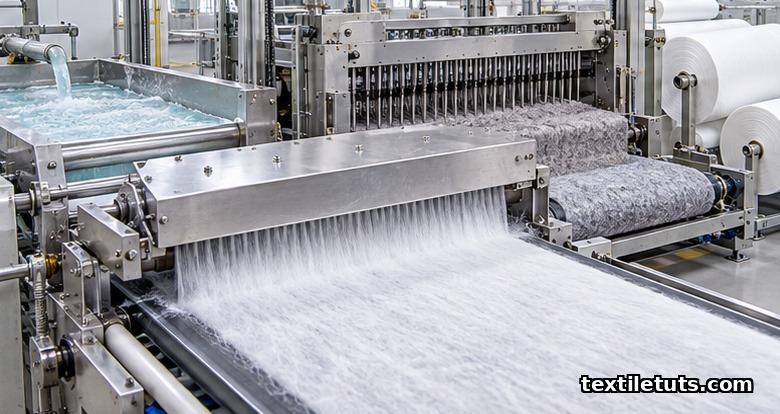
Filtration draws on most nonweb routes, each with its own fiber diameter range, basis weight window, and cost profile. The seven most common processes below account for the great majority of media on the market.
| Process | Fiber diameter | Basis weight | Typical pore size | Common polymer | Filtration role |
|---|---|---|---|---|---|
| Meltblown | 1–5 µm | 15–200 g/m² | 5–25 µm | Polypropylene | Fine air and liquid filter, electret respirator media |
| Spunbond | 15–35 µm | 10–200 g/m² | 80–500 µm | PP, PET, PA | Carrier, cap, drainage layer |
| Needle-punch | 10–50 µm | 100–800 g/m² | 20–200 µm | PET, PP, aramid | Industrial dust, coolant, oil, pool |
| Spunlace (hydroentangled) | 10–25 µm | 30–300 g/m² | 30–150 µm | Viscose, PET, cotton | Wipes, liquid prefilters, biocomposite |
| Wet-laid | 0.5–20 µm | 20–200 g/m² | 1–100 µm | Glass, cellulose, microfiber | HEPA/ULPA, fuel, beverage |
| Thermal-bonded (calendered) | 10–30 µm | 15–100 g/m² | 50–300 µm | PP, PET, bicomponent | Cabin air, HVAC prefilters |
| Electrospun | 0.05–1 µm | 0.5–20 g/m² | 0.1–5 µm | PA, PVDF, PAN, PU | Sub-micron air, N99/N100 boosters |
Meltblown dominates fine air filtration because it is the only high-throughput process that consistently produces sub-5 µm fibers at industrial scale. Spunbond is rarely used alone for fine capture, but it is critical as the carrier layer in SMS (spunbond-meltblown-spunbond) composites, where it provides tensile strength and abrasion resistance without adding pressure drop. Needle-punch is the workhorse of industrial dust collection, where high permeability and depth loading matter more than single-pass capture efficiency. Spunlace is increasingly used in liquid filtration and in cellulose/PP wetlaid hybrids for sustainable filter cartridges.
Wet-laid nonwovens, especially glass microfiber papers, are the only media that can deliver HEPA and ULPA grades economically. A typical HEPA H13 paper (per EN 1822) starts with glass microfibers of 0.2–3 µm diameter laid from an aqueous slurry at basis weights of 60–80 g/m² and pleated to pack 5–10 m² of media into a 600 × 600 × 292 mm filter. Electrospinning is the newest process: a polymer solution is drawn into nanofibers under a 30–80 kV field, producing webs with mean fiber diameters under 500 nm and surface areas above 50 m²/g. It is still costly but increasingly used as a thin coating on a spunbond substrate to upgrade a lower-grade filter into N99 or N100 performance.
Rating systems: from MERV to beta ratio
Filtration grades are governed by separate standards for air and liquid, and a textile engineer must know which test produced which number to compare media fairly.
ASHRAE 52.2 (MERV) rates HVAC filters on a 1–16 scale using particle size ranges from 0.3 to 10 µm. MERV 8 captures >70% of 3–10 µm particles and is the minimum for commercial building air; MERV 13 captures >50% of 0.3–1 µm particles and is the current recommendation for COVID-era indoor air quality.
ISO 16890 replaced EN 779 in 2018 and groups filters into four classes based on capture of PM10, PM2.5, and PM1. A filter rated ePM10 70% must capture at least 70% of the PM10 fraction. ISO 16890 does not test below 1 µm, so HEPA and ULPA grades remain governed separately.
HEPA and ULPA come from the US Department of Energy specification, refined by IEST RP-CC001 and harmonized with EN 1822 and ISO 29463. HEPA H10–H14 capture 85–99.995% of the MPPS; ULPA U15–U17 capture 99.9995–99.999995%. H13 and H14 (capturing ≥99.95% and ≥99.995% respectively) dominate pharmaceutical, semiconductor, and hospital isolation applications.
NIOSH 42 CFR Part 84 certifies respirators in the US. N95 filters must capture ≥95% of a 0.3 µm NaCl aerosol at 85 L/min with inhalation resistance ≤343 Pa and exhalation resistance ≤245 Pa. FFP2 (EN 149) and KN95 (GB 2626) are the equivalent international classes, with FFP2 requiring ≥94% capture at 95 L/min and KN95 following a 95% threshold with a paraffin oil aerosol.
Beta ratio (βx) is the workhorse rating for liquid filtration, particularly hydraulic oil, fuel, and pharmaceutical fluids. It is defined as the ratio of upstream particle count to downstream particle count at a given size x. A filter with β10(c) ≥ 200 captures 99.5% of particles ≥10 µm; β7(c) ≥ 1000 means 99.9% capture of particles ≥7 µm. Multi-pass tests such as ISO 16889 and SAE HS806 (the modern replacement for the older ISO 4572) drive the rating, and a β ratio curve across 4, 6, 10, 14, and 25 µm is reported on every hydraulic filter data sheet.
Application-by-application: how the nonwoven choice changes
Specifying a nonwoven filter starts from the fluid and the particle challenge. HVAC and indoor air call for pleatable electret media with low pressure drop at face velocities of 1.0–2.5 m/s; the dominant choice is a 30–60 g/m² meltblown polypropylene, often laminated to a spunbond PET carrier for pleat stability. Automotive cabin air follows the same logic but with a thin activated-carbon layer bonded to the spunbond to capture volatile organic compounds and odors.
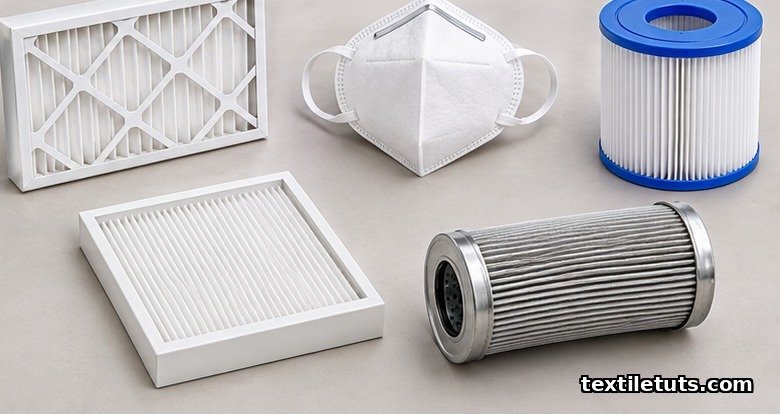
Respirator and surgical mask media rely on SMS composites. A typical N95 mask stacks a 50 g/m² spunbond PP outer, a 25–40 g/m² electret meltblown PP middle layer, and a 25–30 g/m² spunbond PP inner skin, with a 50–250 g/m² polyester or PP needle-punch outer option for industrial N95 variants. The electret layer must be hydrocharged, not corona charged, to survive 121 °C autoclave sterilization; corona-charged media lose 40–60% of their initial charge after one steam cycle.
Liquid filtration uses different tools. Pool and spa cartridges are almost always needle-punched polyester at 300–500 g/m², with a mean flow pore size of 20–50 µm, pleated for surface area and cleaned by backwash. Beverage (beer, wine, juice) clarification uses cellulose wet-laid sheets with diatomaceous earth or perlite loadings of 200–500 g/m², throwing away after a single pass. Hydraulic and lubricant filters use wet-laid glass or meltblown PP at 100–200 g/m², pleated into canister cartridges with metal end caps, rated by β ratio and multi-pass dirt-holding tests.
Pharmaceutical and biotech clarification is the most demanding liquid application. Sterile filtration of injectables uses 0.22 µm or 0.45 µm membrane filters (usually polyvinylidene fluoride or polyethersulfone cast as a nonwoven-like flat sheet) validated by ASTM F838 for bacterial retention. The membrane is supported on a nonwoven PET or PP substrate that contributes mechanical strength without adding extractables.
Designing a filter medium: how the numbers move together
Four dial-up variables define the performance of a nonwoven filter medium: fiber diameter, basis weight, web structure, and electrostatic charge. Each affects filtration efficiency, pressure drop, and dirt-holding capacity in different directions.
Reducing mean fiber diameter from 5 µm to 2 µm roughly doubles single-fiber capture efficiency at constant basis weight, because the number of fibers per unit area scales with the inverse square of the diameter. Pressure drop, however, rises with the inverse of fiber diameter at constant basis weight, because finer fibers present more surface friction. The trade-off is captured by the quality factor QF, defined as -ln(1 – E)/ΔP, where E is single-pass filtration efficiency and ΔP is pressure drop. High-quality media reach QF values of 0.02–0.05 Pa⁻¹ at the MPPS; an electret meltblown N95 layer lands near 0.05 Pa⁻¹, while an uncharged needle-punch lands near 0.005 Pa⁻¹.
Increasing basis weight from 25 g/m² to 100 g/m² at constant fiber diameter raises single-pass efficiency from roughly 80% to 99% for a 0.3 µm challenge, but also raises pressure drop by a factor of about 4. Gradient structures solve this: a 100 g/m² web with 10 µm fibers on the inlet side and 2 µm fibers on the outlet can deliver 99.5% efficiency at the pressure drop of a uniform 60 g/m² web.
Web structure (fiber orientation, bonding, pleatability) is the silent variable. A calendared thermal-bonded web is stiff and pleatable but presents a flat, low-tortuosity path that sacrifices capture; a high-loft needle-punch presents a tortuous, three-dimensional path that captures more per unit pressure drop but cannot be pleated tightly. SMS composites combine the two by sandwiching a tortuous meltblown between two calendered spunbond facers, allowing aggressive pleating without losing filtration.
Electrostatic charging adds 30–60 percentage points of capture efficiency at the MPPS without changing pressure drop, which is why it is the single largest performance lever in modern air filtration. The trade-off is charge decay: under high humidity, high temperature, or exposure to organic aerosols (such as diesel exhaust), electret charge bleeds away, and the filter reverts to mechanical-only capture. Hydrocharging produces more thermally stable charge storage than corona charging and is now standard for medical-grade meltblown.
Sustainability and the end-of-life challenge
Most nonwoven filter media are designed for single use and end up in incineration or landfill. A 2023 study from the International Solid Waste Association estimated that disposable face masks alone generated 1.6 million tonnes of plastic waste globally during 2020–2021, virtually all of it polypropylene SMS. The same polymers dominate HVAC prefiltration. Needle-punch polyester is the most readily recyclable, because PET can be melt-extruded back into fiber, and many HVAC manufacturers now run take-back schemes on PET media. Cellulose wet-laid sheets are compostable and dominate beverage and edible-oil filtration for that reason. Biodegradable PLA spunbond is emerging in tea-bag and coffee-filter applications where the entire pad is composted with the contents.
Reusability is also returning. Washable electrostatic nonwovens, typically a 200–400 g/m² needle-punch of acrylic or polyester treated with a permanent charge-stable finish, are now rated for 20–50 laundry cycles before capture falls below the MERV 8 threshold. The trade-off is that initial filtration efficiency is lower (typically MERV 8–10 versus MERV 13–14 for a disposable electret), and reusability only pays off where the consumer-side cost of replacement exceeds the higher upfront media cost.
Frequently Asked Questions
What is the most common nonwoven fabric used for air filtration?
Meltblown polypropylene is the most common nonwoven for fine air filtration, with fiber diameters of 1–5 µm and basis weights of 15–200 g/m². It captures 95–99.97% of 0.3 µm particles once electret-charged and forms the filtration layer in N95, FFP2, KN95, and surgical masks, in HVAC and cabin air filters, and in cleanroom supply filters. Spunbond polypropylene is rarely used alone for fine filtration, but it is the carrier layer in SMS composites that contain the meltblown.
What is the difference between HEPA and MERV 13?
HEPA captures at least 99.97% of 0.3 µm particles under the US DOE specification, while MERV 13 captures at least 50% of 0.3–1 µm particles under ASHRAE 52.2. HEPA is roughly 100 times more efficient at the MPPS and is mandatory for pharmaceutical, semiconductor, and hospital isolation applications. MERV 13 is the practical ceiling for residential and commercial HVAC because reaching true HEPA efficiency in a building HVAC system requires 5–10× the fan energy and dedicated filter housings.
How long does an electret nonwoven filter last?
An electret-charged nonwoven filter typically loses 20–40% of its initial charge over 6–12 months in HVAC service, with the rate governed by temperature, humidity, and the chemical load of the airstream. Once charge drops below a threshold equivalent to roughly 200–300 V of surface potential, mechanical capture remains and efficiency falls back to the uncharged baseline. Hydrocharged media last longer than corona-charged media, and storing filters in sealed plastic (away from ozone, heat, and organic vapors) extends shelf life to 24 months.
Can nonwoven filters remove viruses from air?
Yes, but only at the high end of filtration efficiency. An H13 or H14 HEPA filter (per EN 1822 / ISO 29463) removes 99.95–99.995% of 0.3 µm particles and effectively clears the 0.02–0.3 µm range that includes individual virions and aerosol clusters. A N95 respirator with electret meltblown achieves 95% capture of the MPPS and protects the wearer against inhalation of virus-laden aerosols. Surgical masks with BFE ≥98% (per ASTM F2101) block exhaled droplets but are not designed to protect the wearer from inhalation.
What is the difference between depth filtration and surface filtration?
Surface filtration captures particles on the upstream face of the media, like a sieve, and is typical of membranes and very fine nonwovens with sub-micron mean flow pore sizes. Depth filtration captures particles throughout the thickness of the web, with the tortuous fiber network trapping particles in the body of the media. Depth filters hold 3–10× more dirt per unit area before reaching terminal pressure drop, which is why needle-punch and high-loft spunlace dominate industrial dust and coolant filtration, while cleanroom HEPA filters are designed as surface filters and replaced before they load heavily.
References
- ASHRAE. ANSI/ASHRAE Standard 52.2-2017: Method of Testing General Ventilation Air-Cleaning Devices for Removal Efficiency by Particle Size. ASHRAE, the MERV rating methodology.
- ISO. ISO 16890:2016: Air filters for general ventilation. International Organization for Standardization, the global replacement for EN 779.
- IEST. IEST RP-CC001: HEPA and ULPA Filters. Institute of Environmental Sciences and Technology, the operating definition of HEPA/ULPA grades.
- CDC/NIOSH. 42 CFR Part 84: Approval of Respiratory Protective Devices. U.S. Government, the certification standard for N95, N99, and N100 respirators.
- ASTM International. ASTM F2101-23: Standard Test Method for Evaluating the Bacterial Filtration Efficiency (BFE) of Medical Face Mask Materials. ASTM, the bacterial filtration test for surgical mask media.
- ISO. ISO 29463:2017: High-efficiency filters and filter media for removing particles in air. International Organization for Standardization, harmonized HEPA/ULPA classification.
- ISO. ISO 16889:2008: Hydraulic fluid power, Multi-pass method for evaluating filtration performance. International Organization for Standardization, the beta ratio test for hydraulic filters.
- Barhate, R. S., and Ramakrishna, S. (2007). Nanofibrous filtering media: Filtration problems and solutions. Journal of Membrane Science, 296(1-2), 1-8. ScienceDirect, a foundational review of electrospun and submicron fiber filtration.
This article is the working reference for nonwoven filtration media. Editorial by Md. Asad Ullah (Meem), TextileTuts. Sources: ASHRAE 52.2-2017, ISO 16890:2016, IEST RP-CC001, 42 CFR Part 84, ASTM F2101-23, ISO 29463:2017, ISO 16889:2008, and Barhate & Ramakrishna (2007) as cited.


