
Nonwoven for Geotextiles

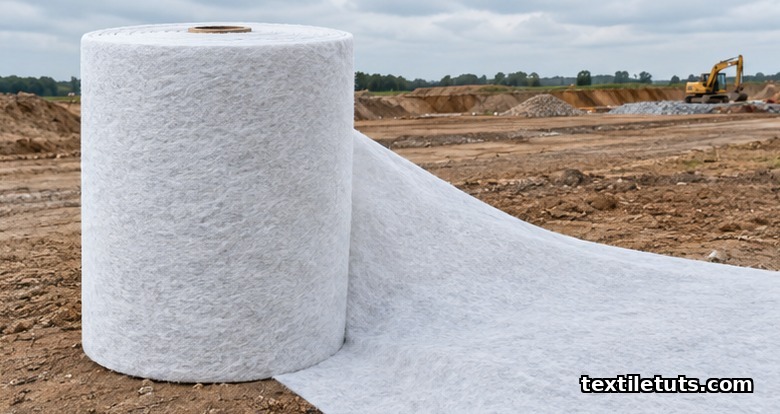
Nonwoven geotextiles are engineered textile sheets made from polypropylene or polyester fibers bonded mechanically (needle-punching), thermally, or chemically, and produced in mass-per-unit-area grades typically from 100 to 600 g/m² with grab tensile strengths ranging from 5 to 30 kN/m. Nonwoven geotextiles now account for roughly 70% of global geotextile consumption by volume, and they are the dominant geosynthetic used for separation, filtration, drainage, and protection in civil-engineering works.
What separates a nonwoven geotextile from a woven one is fiber arrangement: in a nonwoven, short staple fibers or continuous filaments are laid into a random web and bonded together, so the fabric behaves like a felt rather than a grid. That isotropic, porous structure is the reason nonwovens dominate any function that depends on water passing through the textile while soil particles are kept out.
What you will learn below: how nonwoven geotextiles are made, which ISO and ASTM standards govern finished-product performance, the four primary engineering functions they perform on a construction site, how to read a manufacturer data sheet, and where nonwoven geotextiles fail if specified incorrectly.
What Is a Nonwoven Geotextile?
A nonwoven geotextile is a planar, permeable textile structure made from synthetic fibers that are not woven or knitted. ISO 10318-1:2017 (Geosynthetics, Part 1: Terms and definitions) classifies geotextiles as a subset of geosynthetics along with geogrids, geomembranes, and geocomposites. Under that definition, a nonwoven geotextile must be (a) made from fibers, (b) formed into a sheet without yarn interlacing, and (c) bonded by mechanical, thermal, or chemical means.
Polypropylene (PP) is the most common polymer, accounting for roughly 80% of needle-punched nonwoven geotextile production, with polyester (PET) used where higher creep resistance or UV stability is required. Polyethylene and polyamide are specialty options. Fibers are typically 1.7 to 6.7 dtex (1.5 to 6 denier) for staple products and 2 to 5 denier for spunbond filaments.
How Nonwoven Geotextiles Are Manufactured
Four bonding routes dominate commercial production, and each produces a fabric with a characteristic handle, strength, and pore structure.
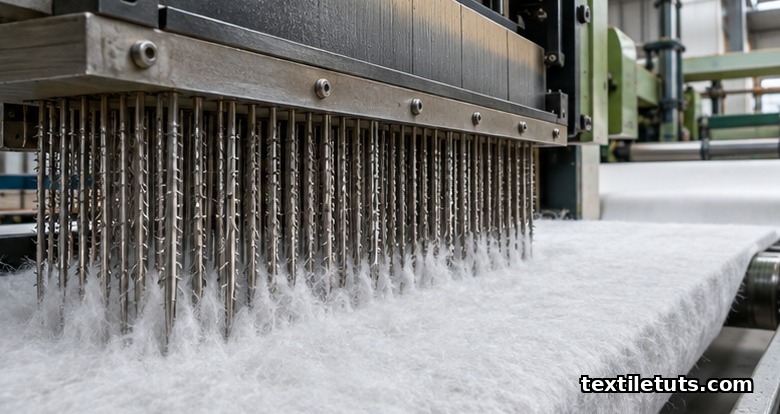
Needle-punching (mechanical bonding). A carded or air-laid web of staple fibers passes through a needle loom fitted with thousands of barbed needles. Each needle penetrates the web and reorients a fraction of fibers into the vertical (Z) direction, locking the structure through fiber friction. Needlepunched nonwovens dominate the geotextile market because they accept high mass per unit area (up to and beyond 1,000 g/m²), deliver isotropic tensile behavior, and have open, three-dimensional pore networks suitable for filtration and drainage.
Spunbonding (thermal bonding with continuous filaments). Extruded polymer filaments are laid on a moving belt and thermally bonded at their crossover points by calender rolls (point-bonding) or by hot air through-bonding. Spunbond nonwovens have higher tensile strength per unit mass than needlepunched fabrics but smaller, more uniform pores, which makes them the preferred choice for separation and some filtration functions.
Meltblown. Very fine filaments (1 to 5 micrometers) are extruded at high throughput and collected as a low-strength web. Meltblown alone is rarely used as a finished geotextile; it is more often combined with spunbond layers to make an SMS (spunbond-meltblown-spunbond) composite.
Chemical bonding. A latex or acrylic binder is applied to the fiber web and cured in an oven. Chemically bonded nonwovens have lower mechanical performance than needlepunched equivalents at the same mass, and they are typically reserved for lighter-weight applications such as erosion-control blankets and landscape fabrics.
The Four Engineering Functions of Nonwoven Geotextiles
ISO 10318-1:2017 recognizes five primary functions for geosynthetics: separation, filtration, drainage, reinforcement, and protection (the sixth, barrier, applies to geomembranes). Nonwoven geotextiles commercially deliver four of these.
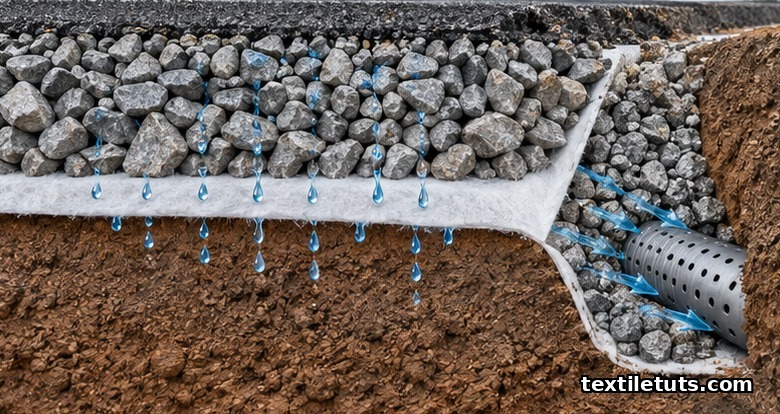
Separation. A nonwoven placed between two dissimilar soils (for example, soft clay subgrade and granular roadbase) prevents the aggregate from pumping down into the subgrade and the fines from migrating up. The result is a longer-lasting, rut-free pavement structure. ASTM D4439 (Standard Terminology for Geosynthetics) describes separation as preventing the mixing of adjacent soils.
Filtration. When placed against a soil, the geotextile must let water pass while holding back particles finer than a defined size. The critical performance parameter is the Apparent Opening Size (AOS), measured per ASTM D4751. AOS is expressed as O95, the sieve size (in mm) at which 5% of fabric openings are smaller; common geotextile O95 values fall between 0.06 and 0.60 mm.
Drainage (in-plane flow). Within the plane of the fabric, a thick needlepunched nonwoven can transmit water at transmissivity values from roughly 1 × 10⁻⁴ to 5 × 10⁻³ m²/s under a 100 kPa normal load (per ASTM D4716, the standard test for determining the (in-plane) flow rate per unit width and hydraulic transmissivity of a geosynthetic). This in-plane flow is what makes a nonwoven geotextile usable as a drainage core in edge drains, landfill leachate collection layers, and capillary barriers beneath embankments.
Protection. When placed against a geomembrane, a heavy nonwoven geotextile (typically 400 to 600 g/m²) cushions the puncture load from drainage aggregate above. ASTM D4833 (Standard Test Method for Index Puncture Resistance of Geomembranes and Related Products) and ASTM D5514 (Standard Test Method for Large-Scale Hydrostatic Puncture Testing of Geosynthetics) quantify the protective performance.
Reinforcement is the function that nonwoven geotextiles deliver poorly. Because nonwoven webs have low in-plane stiffness, geogrids or high-modulus woven geotextiles are specified when the design needs tensile load transfer (for example, in reinforced soil walls). A nonwoven used as reinforcement is, in most design codes, a misuse of the product.
Reading a Nonwoven Geotextile Data Sheet
Three numbers tell you almost everything you need to know about a candidate product: mass per unit area (GSM), grab tensile strength, and AOS.
| Property | Standard test | Typical range for road/rail nonwovens |
|---|---|---|
| Mass per unit area | ISO 9864 / ASTM D5261 | 150 to 400 g/m² |
| Grab tensile strength (MD / XD) | ASTM D4632 | 700 to 1800 N |
| Grab elongation | ASTM D4632 | 50 to 130 % |
| Trapezoid tear strength | ASTM D4533 | 250 to 700 N |
| Puncture resistance (CBR) | ASTM D6241 | 2000 to 5000 N |
| Apparent Opening Size (AOS, O95) | ASTM D4751 | 0.07 to 0.30 mm (No. 70 to No. 30 sieve) |
| Permittivity | ASTM D4491 | 0.5 to 2.0 s⁻¹ |
| UV resistance (retained strength after 500 h Xenon) | ASTM D4355 | ≥ 70 % |
Two design notes are worth restating. First, ASTM D4632 (grab tensile) and ASTM D4533 (trapezoid tear) are index tests, not design-allowable values; the design strength requires applying reduction factors for installation damage, creep, durability, and seam efficiency per ISO 20432 or AASHTO R69-20. Second, ISO 10320:2016 (Geotextiles and geotextile-related products — Identification on site) requires every roll delivered to site to carry a label with the manufacturer, product name, polymer, mass per unit area, and product type code.
Where Nonwoven Geotextiles Fail in the Field
Most in-service failures trace back to one of three errors. The first is wrong AOS for the soil: too coarse and fines migrate through (clogging downstream drains); too fine and the fabric itself clogs with biological fouling or calcium carbonate precipitation. A general rule is that AOS (O95) should be at least 2 to 3 times the D85 of the protected soil, but the design choice should always be confirmed by a soil-geotextile filtration trial or by the FHWA/NHI geosynthetics design guidelines.
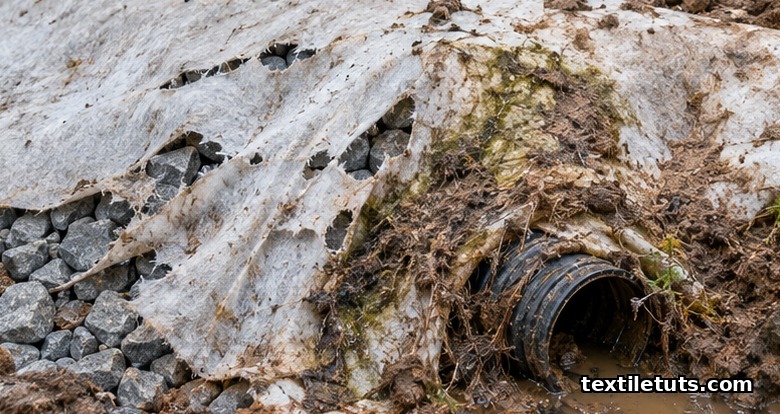
The second is under-specifying mass per unit area. A 100 g/m² fabric may pass a laboratory grab-strength test but cannot survive installation over a rough subgrade with 50 to 150 mm drainage aggregate; ASTM D5818 (Standard Practice for Exposure and Retrieval of Samples to Evaluate Installation Damage of Geosynthetics) and installation-damage reduction factors exist precisely because thin fabrics get cut by angular aggregate during placement.
The third is UV degradation. Polypropylene is especially sensitive to ultraviolet light; ASTM D4355 (Standard Test Method for Deterioration of Geotextiles by Exposure to Light, Moisture, and Heat in a Xenon Arc-Type Apparatus) reports that unprotected PP geotextiles can lose 50% of their strength after six months of direct sunlight. Rolls stored on site should remain wrapped until placement.
How Nonwoven Geotextiles Compare to Woven and Knitted Geotextiles
For applications where water flow through the fabric is critical (filtration, drainage, protection), nonwoven geotextiles outperform woven geotextiles because their pore structure is orders of magnitude more open. Woven geotextiles, made from flat tapes or monofilament yarns on a loom, deliver higher tensile strength per unit mass and therefore dominate reinforcement applications. Hybrid products (woven + nonwoven composites, sometimes called “double-layer geotextiles”) combine the high tensile modulus of one with the filtration and drainage behavior of the other.
Frequently Asked Questions
What is the difference between a nonwoven and a woven geotextile?
A nonwoven geotextile is made from randomly oriented fibers that are bonded together mechanically, thermally, or chemically, producing an isotropic felt-like sheet with high permeability and elongation. A woven geotextile is made by interlacing flat tapes or monofilament yarns on a loom, giving an anisotropic sheet with high tensile modulus but low permeability. The two are not interchangeable: wovens are used for reinforcement, nonwovens for separation, filtration, drainage, and protection.
Which polymer is best for nonwoven geotextiles?
Polypropylene (PP) is the most widely used because it is inexpensive, hydrophobic, and resistant to most soil chemicals, and it processes easily on needlepunch lines. Polyester (PET) is preferred where higher modulus, lower creep, or better UV resistance is required. ASTM D4873 (Standard Guide for Identification, Storage, and Handling of Geotextiles) recommends PET for permanent installations above 40 °C where PP would creep excessively.
How long does a nonwoven geotextile last underground?
With proper specification and installation, nonwoven geotextiles have projected service lives of 75 to 100+ years in typical soil-covering applications where UV exposure is minimal. Oxidation resistance is typically characterized by ASTM D794 (Standard Practice for Determining Permanence of Geotextile Materials by Exposure to Air or Simulated Weathering); most commercial products include 2 to 4% carbon black masterbatch to slow oxidative degradation.
What does the AOS value (O95) actually mean?
AOS, determined per ASTM D4751, is the sieve opening size in millimetres at which 5% of the fabric’s pores are smaller. An AOS of 0.212 mm (US Standard Sieve No. 70) means that 95% of the fabric’s pores are larger than 0.212 mm. The filter design rule is that O95 should be 1 to 3 times D85 of the protected soil (where D85 is the sieve size at which 85% of the soil grains are finer), though project specifications often tighten this to 2 to 3 times.
Can nonwoven geotextiles be reused after excavation?
Generally no. Nonwoven geotextiles that have been in service become contaminated with soil fines, biological growth, and chemical precipitates that clog the pore structure. Reuse would require full re-testing of AOS, permittivity, and mechanical strength against the original data sheet, which is rarely cost-effective. Most project specifications therefore treat excavated nonwoven geotextile as a single-use material.
References
- ISO 10318-1:2017. Geosynthetics, Part 1: Terms and definitions. International Organization for Standardization. The terminology basis for all ISO geosynthetic standards.
- ISO 10320:2016. Geosynthetics — Identification on site. International Organization for Standardization. Mandatory roll-label content for delivery, storage, and traceability.
- ISO 9864:2005. Geosynthetics — Test method for the determination of mass per unit area of geotextiles and geotextile-related products. International Organization for Standardization.
- ASTM D4632 / D4632M-15a. Standard Test Method for Grab Breaking Load and Elongation of Geotextiles. ASTM International.
- ASTM D4751-20. Standard Test Methods for Determining Apparent Opening Size of a Geotextile. ASTM International.
- ASTM D4491 / D4491M-21. Standard Test Methods for Water Permeability of Geotextiles by Permittivity. ASTM International.
- ASTM D4833 / D4833M-07(2020). Standard Test Method for Index Puncture Resistance of Geomembranes and Related Products. ASTM International.
- Koerner, R. M. (2012). Designing with Geosynthetics. 6th edition, Xlibris. The standard textbook reference for geosynthetic engineering practice.
- Shukla, S. K. (2017). Geosynthetics and Their Applications. Thomas Telford. Peer-reviewed industry reference.
This article is the working reference for nonwoven geotextile selection and specification. Editorial by Md. Asad Ullah (Meem), TextileTuts. Sources: ISO 10318-1:2017, ISO 10320:2016, ISO 9864:2005, ASTM D4632, ASTM D4751, ASTM D4491, ASTM D4833, Koerner 2012, Shukla 2017 as cited.


