
Nonwoven for Automotive

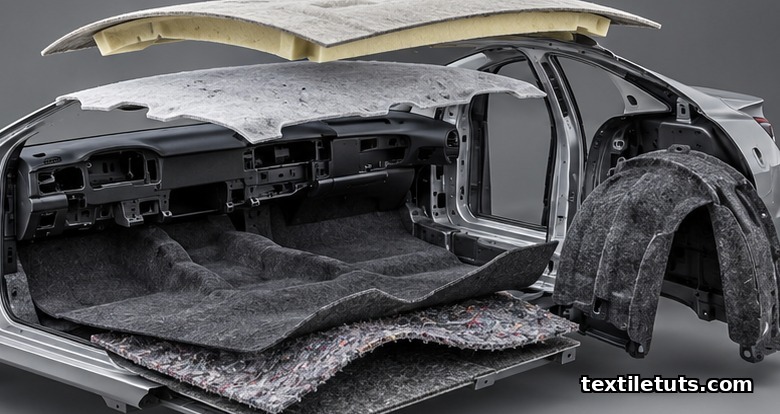
A modern passenger car contains between 20 kg and 40 kg of nonwoven fabric, roughly 35 m² to 45 m² of material spread across more than 40 individual components, ranging from the headliner and dashboard backing to wheel-arch liners and battery insulation in electric vehicles. This figure has climbed steadily for two decades because nonwovens combine low mass per unit area, predictable acoustic damping, and a wide range of fiber blends that engineers can tune for stiffness, breathability, or fire behavior. The automotive sector is now one of the largest single outlets for technical nonwovens, and a growing share of that volume sits in electric drivetrains rather than combustion-engine bays.
This article walks through where nonwovens go inside a vehicle, which fiber blends and bonding processes dominate, which ISO and ASTM methods are used to qualify them, and how the material mix is shifting with electrification and end-of-life recyclability rules.
What Is Nonwoven Fabric in an Automotive Context
A nonwoven is an engineered textile sheet made from fibers bonded together by mechanical, thermal, or chemical means, without the interlacing of weaving or the interlooping of knitting. The relevant ISO definition, ISO 9092:2019, describes a nonwoven as a sheet of directionally or randomly oriented fibers, bonded by friction, cohesion, or adhesion. For automotive buyers, this definition matters because the absence of a yarn structure changes the way the fabric absorbs sound, distributes load, and recovers its shape after compression.
Automotive nonwovens are typically characterized by:
- Areal density between 60 g/m² and 2000 g/m², with most cabin applications sitting in the 100 g/m² to 800 g/m² band.
- Fiber composition dominated by polyester (PET), polypropylene (PP), and increasingly natural fibers such as kenaf, jute, hemp, or recycled cotton shoddy.
- A thickness under 10 mm, even for acoustic pads, because of trim-pack space constraints inside door cavities and headliners.
For a typical mid-size sedan, the resulting nonwoven inventory breaks down roughly into 11 kg to 15 kg in floor and acoustic systems, 4 kg to 6 kg in the interior trim, 2 kg to 4 kg in filtration media, and 3 kg to 15 kg in the engine bay and underbody, depending on whether the vehicle has a combustion engine, a hybrid drivetrain, or a battery-electric powertrain.
Where Nonwovens Go Inside a Vehicle
Automotive nonwovens are functionally diverse, so a single fabric rarely serves more than one location. The main end uses are:
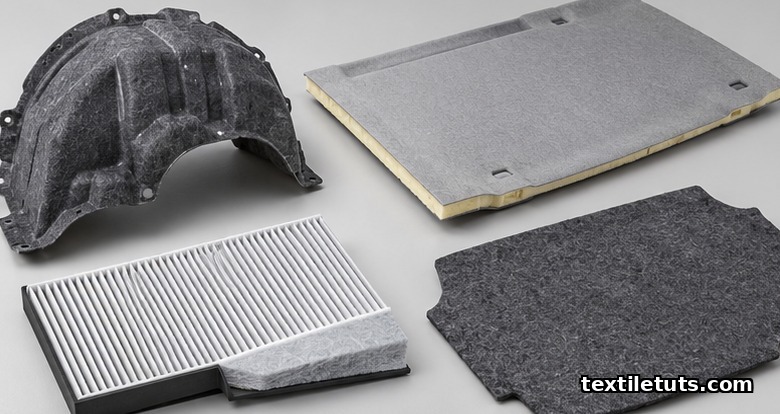
Floor and acoustic insulation
Tufted or needle-punched PET carpet, typically 400 g/m² to 800 g/m², is paired with a heavier felt pad (800 g/m² to 1500 g/m²) made from recycled fibers. The pad layer absorbs mid-frequency road noise, while a separate underbody shield, often 1000 g/m² to 2000 g/m² needle-punched PP with a mass-loaded vinyl backing, suppresses tire and powertrain noise reaching the cabin.
Headliner and pillar trim
Headliners use lightweight spunbond or spunbond-meltblown-spunbond (SMS) nonwovens, laminated to a polyurethane foam or a natural-fiber shoddy pad. The visible surface is usually a tricot or woven knit, but the structural backing is nonwoven.
Seat and backrest components
Nonwovens appear as the scrim layer that holds foam in shape, as a face fabric on entry-level seats, and increasingly as the only upholstery on commercial vehicles. Spunbond PET with a hydroentangled surface is common because the entangled fiber network resists pilling under repeated loading.
Wheel-arch and engine-bay liners
Wheel-arch liners are typically molded needle-punched PET or PP in the 600 g/m² to 1200 g/m² range, pressed into a 3D shape. Their role is stone-chip protection, splash management, and a measurable reduction in road-noise transmission through the wheel well.
Filtration media
Cabin air filters, engine air filters, and oil filters all rely on nonwoven webs, mostly meltblown PP for fine particulate capture and spunbond PP for structural support.
Trunk and luggage compartment liners
Trunk liners are normally a heavier needle-punched PET/PET shoddy blend at 500 g/m² to 900 g/m², with a fiber blend that balances abrasion resistance with low cost.
Materials, Fiber Blends, and Bonding Technologies
Automotive nonwovens are built from a relatively narrow palette of polymers. Polyester, often recycled PET from bottle flake, dominates because of its thermal stability (glass transition around 70 °C to 80 °C), recovery after compression, and compatibility with needle-punching, thermal bonding, and hydroentangling. Polypropylene is used where lower cost and chemical resistance matter more than heat tolerance, especially in wheel-arch liners and air-filter media. Natural fibers, including kenaf, jute, hemp, flax, and recycled cotton, are added to PP or PET blends to reduce part weight, lower polymer content, and meet recyclability targets.
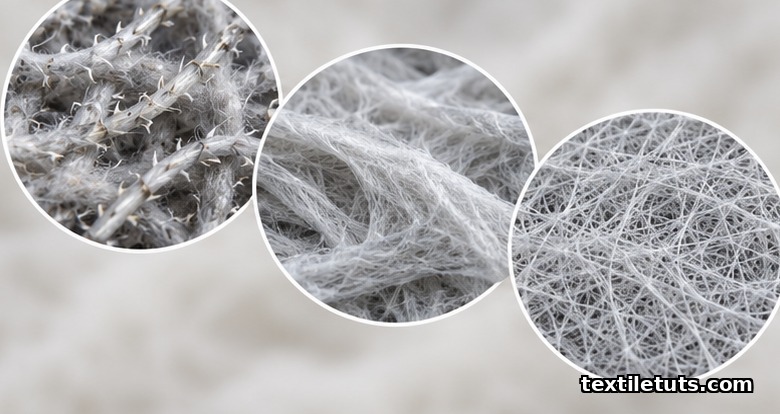
Bonding is what defines performance. The dominant processes are:
- Needle punching: barbed needles push fibers through the web to entangle them mechanically; this is the standard process for carpet, trunk liners, and wheel-arch shields, and produces fabrics with high tensile strength and good dimensional stability.
- Thermal bonding: calendar rolls or through-air ovens fuse thermoplastic fibers (such as PP or bicomponent PET/PE) to bond the web; this gives a smoother surface suited to face fabrics.
- Hydroentangling (spunlace): high-pressure water jets entangle the fibers, producing soft, drapable, lint-free fabrics used in cabin air filter media and some headliner backings.
- Chemical bonding: a latex or acrylic binder locks the web together, common in low-cost shoddy pads.
Performance Standards: ISO and ASTM Test Methods
Automotive nonwovens are qualified against a defined set of mechanical, durability, and safety tests. The most commonly referenced standards are:
- ISO 9073-1 to ISO 9073-18: a multi-part standard covering nonwovens test methods, including mass per unit area, thickness, tensile strength, tear resistance, and burst strength.
- ISO 13934-1 and ISO 13934-2: tensile properties of fabrics using the strip and grab methods, applied to nonwovens for upholstery and trim.
- ISO 13937 series: tear properties, with the trapezoid method most relevant to nonwoven trim.
- ISO 105-B series: color fastness to light, relevant for cabin components exposed to solar load.
- ISO 3795: burning behavior of materials used in vehicles, used to classify interior components by horizontal burn rate.
- ASTM D3776: mass per unit area (weight) of fabric, used widely for production-acceptance testing.
- ASTM D5034: breaking strength and elongation of textile fabrics, grab method.
- ASTM D5587: tearing strength by the trapezoid procedure.
- ASTM D5736: permanent deformation of fabrics under tensile load, applied to seat scrims.
OEMs typically apply tighter acceptance bands than the standard itself. A common automotive specification is a tensile strength of 150 N to 400 N per 50 mm strip, depending on the component, and a tear strength above 30 N. For visible cabin parts, color fastness is specified against ISO 105-B02 at exposure levels of 5 to 7 on the blue-wool scale, simulating several years of dashboard sunlight.
Acoustic, Thermal, and Safety Performance
The acoustic benefit of nonwovens comes from a combination of fiber absorption and surface damping. A 1.5 kg/m² needle-punched PET pad can absorb 3 dB to 6 dB of mid-frequency road noise (500 Hz to 2000 Hz), and a multi-layer underbody system combining a heavy nonwoven with a mass-loaded vinyl can reach 10 dB of insertion loss in the same band. These figures are typical of published NVH data for mid-segment sedans.
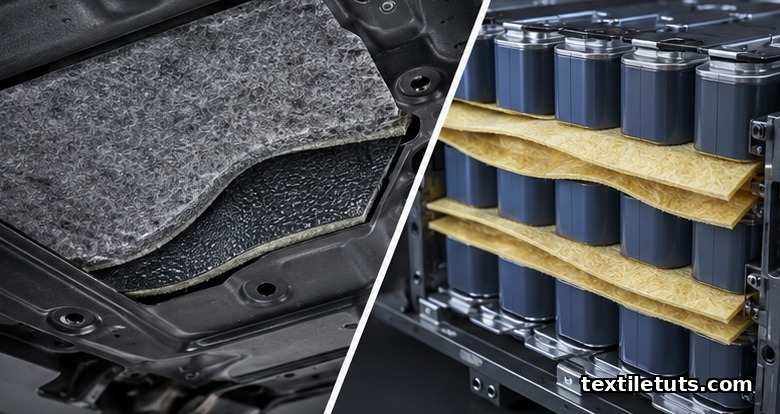
Thermal performance is most visible in EV battery packs, where nonwovens serve as thermal-runaway barriers between cells. High-temperature-resistant aramid or melamine-fiber nonwovens can withstand 300 °C to 400 °C short-term exposure, slowing cell-to-cell propagation. In combustion vehicles, the same role is filled by basalt- or polyimide-fiber felts around the exhaust and turbocharger.
Safety is governed by ISO 3795 for horizontal burn rate and by OEM-specific vertical burn tests. Most cabin nonwovens are required to self-extinguish within 100 mm/min in the horizontal burn test, and the use of halogen-free flame retardants is now standard in European OEM specifications.
Sustainability and End-of-Life Recycling
Nonwovens present a recycling challenge because PET/PP blends are difficult to separate at end-of-life. The current state of the art includes:
- Mono-material PET pads, which can be reintroduced into the fiber-to-fiber recycling stream.
- Natural-fiber-reinforced PP composites for door panels and rear shelves, which are compatible with mechanical recycling.
- Take-back programs at OEMs, where end-of-life trim is collected and processed into shoddy for reintroduction into trunk liners and underbody pads.
The direction of travel is clear: higher recycled content, lower part weight, and easier disassembly. The European Union End-of-Life Vehicles regulation, last revised in 2025, has set a 25% recycled-content target for selected vehicle materials, and nonwovens are explicitly in scope for the textile portion of that target.
Frequently Asked Questions
What is the difference between woven and nonwoven automotive textiles?
Woven automotive textiles are made by interlacing two yarn sets at right angles; they offer high tensile strength and a stable surface, but are heavier per unit area and less efficient at absorbing sound. Nonwovens are made by bonding fibers directly, without yarn formation, which gives them lower mass per unit area, better acoustic damping for the same weight, and the ability to be molded into 3D shapes such as wheel-arch liners and door trim.
Why do car manufacturers prefer nonwoven fabrics over woven alternatives in many components?
Nonwovens offer a better strength-to-weight ratio for acoustic and filtration parts, lower part cost at scale, moldability into complex 3D shapes, and easier blending of recycled or natural fibers. For visible trim where surface aesthetics matter, woven or knit fabrics still dominate, but the structural layers behind them are almost always nonwoven.
Are automotive nonwovens recyclable?
Mono-material PET nonwovens are recyclable through established fiber-to-fiber streams, and natural-fiber/PP composites are mechanically recyclable. Mixed-fiber and latex-bonded shoddy pads are more difficult to recycle and are commonly downcycled into lower-grade underbody insulation rather than re-introduced into face fabrics.
How long do nonwoven automotive components last?
Most cabin nonwovens are designed for the full service life of the vehicle, typically 10 to 15 years. Components exposed to high thermal load, such as engine-bay wheel-arch liners and turbocharger wraps, are specified for 8 to 12 years under continuous heat exposure of 100 °C to 150 °C. UV exposure, humidity, and chemical contact (such as battery electrolyte in EV underbody pads) are the main end-of-life drivers rather than mechanical wear.
What role do nonwovens play in electric vehicle battery packs?
Nonwovens in EV battery packs serve as thermal-runaway barriers between cells or modules, as compression pads to maintain stack pressure during cycling, and as acoustic absorbers behind the underbody shield. The dominant materials are aramid, melamine, and high-temperature PET felts, with areal densities from 200 g/m² to 1500 g/m² depending on the cell chemistry and pack architecture.
References
- ISO. ISO 9092:2019, Textiles — Nonwovens — Definition. iso.org — defines a nonwoven and the criteria for distinguishing nonwovens from woven, knitted, and paper structures.
- ISO. ISO 9073 (all parts), Textiles — Test methods for nonwovens. iso.org — multi-part standard covering mass per unit area, thickness, tensile, tear, and burst properties.
- ISO. ISO 13934-1:2013, Textiles — Tensile properties of fabrics — Part 1: Determination of maximum force and elongation at maximum force using the strip method. iso.org — strip tensile method applicable to nonwoven trim.
- ISO. ISO 3795:1989, Road vehicles, and tractors and machinery for agriculture and forestry — Determination of burning behaviour of interior materials. iso.org — burn-rate classification for automotive interior materials.
- ASTM International. ASTM D5034-21, Standard Test Method for Breaking Strength and Elongation of Textile Fabrics (Grab Test). astm.org — grab tensile method widely used for automotive nonwoven acceptance testing.
- ASTM International. ASTM D3776/D3776M-20, Standard Test Methods for Mass Per Unit Area (Weight) of Fabric. astm.org — basis-weight test for production-acceptance of nonwovens.
- Mao, N., and Russell, S. J. (2015). Nonwoven fabric filters. In: Handbook of Nonwovens, Woodhead Publishing (peer-reviewed academic reference on nonwoven filter media for automotive cabin and engine filtration).
- Journal of Industrial Textiles (SAGE). Acoustic absorption of recycled polyester nonwovens for automotive applications. journals.sagepub.com — peer-reviewed study on the acoustic performance of recycled PET needle-punched felts.
This article is the working reference for nonwoven fabrics in automotive applications. Editorial by Md. Asad Ullah (Meem), TextileTuts. Sources: ISO 9092:2019, ISO 9073 series, ISO 13934-1, ISO 3795, ASTM D5034, ASTM D3776, Woodhead Handbook of Nonwovens, and the Journal of Industrial Textiles as cited.


