
Nonwoven for Furniture and Bedding

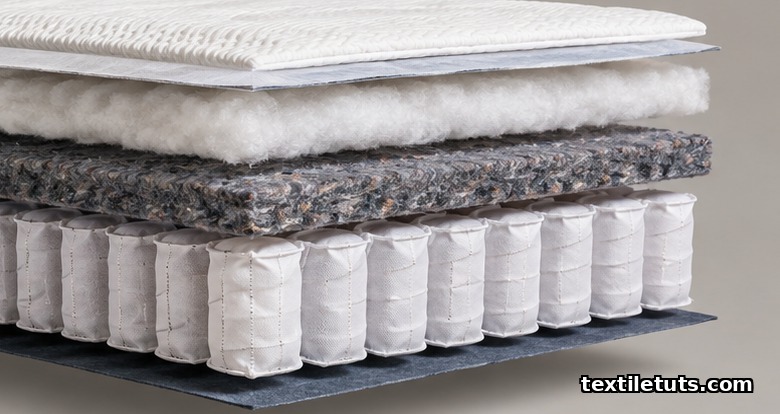
Nonwoven fabrics used in mattresses and upholstered furniture typically weigh between 10 and 200 g/m² and replace 30–60% of the woven textile mass in a finished mattress, supplying spring-pocket encasement, dust covers, ticking, quilt backing, and pillow shells. The same engineered bonded-fiber webs also serve as cushion backing, headboard panels, and under-sofa dust covers, where they deliver tear resistance, dimensional stability, and barrier performance at lower mass than equivalent woven constructions.
The specifications below cover the nonwoven layers inside a typical innerspring mattress, an upholstered sofa, and a quilted bedding set, plus the ISO and ASTM test methods used to qualify each layer for production.
Why Furniture and Bedding Use Nonwoven Textiles
Nonwovens are flat, flexible sheets made directly from a fiber web without weaving or knitting. The fibers are held together by mechanical entanglement, thermal bonding, chemical binder, or a combination of these routes, which gives manufacturers a precise handle on weight, porosity, and strength without the yarn-preparation cost of woven or knitted equivalents.
Three structural advantages explain why nonwovens dominate the inside of a modern mattress and upholstered frame:
- Weight savings: a 70 g/m² spunbond polypropylene spring-pocket fabric can carry the same load as a 180 g/m² woven equivalent, cutting component mass by roughly 60%.
- Dimensional stability: needlepunched and thermally bonded webs recover more than 90% of original thickness after a 24-hour compression recovery test, compared with 70–80% for woven laminates.
- Process flexibility: producers can tune GSM, fiber blend, and bonding route on a single production line, switching from a 25 g/m² hygiene-grade web to a 150 g/m² upholstery backing without retooling.
For bedding and furniture, where a finished product combines 8–14 different textile layers in one mattress, this flexibility translates into lower cost per square meter, simpler supply chains, and consistent mechanical performance between production runs.
Bonding Routes Used in Furniture and Bedding
The nonwoven layers in furniture and bedding are produced by one of six bonding routes. Each route produces a different balance of softness, strength, and porosity, so the choice depends on which layer the fabric will become.
| Bonding Route | Typical Fiber | Typical GSM Range | Main Furniture or Bedding Use |
|---|---|---|---|
| Spunbond | Polypropylene (PP), Polyester (PET) | 15–150 g/m² | Spring pocket fabric, mattress ticking, dust covers |
| Meltblown | Polypropylene | 10–50 g/m² | Barrier layer in premium mattresses (paired with spunbond) |
| Spunlace (hydroentangled) | Polyester, viscose, cotton blends | 40–120 g/m² | Quilt backing, pillow face fabric, mattress top panels |
| Needlepunched | Polyester, polypropylene, recycled fiber | 80–400 g/m² | Cushion backing, carpet underlay, headboard panels |
| Thermal bond (calender or through-air) | Bicomponent PET/PP, low-melt polyester | 15–80 g/m² | Quilted wadding, pillow cores, mattress insulator pads |
| Chemical bond (acrylic binder) | Polyester, cellulose | 30–120 g/m² | Spring insulator pads, dust covers, low-cost mattress pads |
For spring pocket encasement and dust covers, spunbond polypropylene is the dominant route because it is fast to produce, dimensionally stable, and compatible with ultrasonic or thermal welding during mattress assembly. For components that sit close to the sleeper, spunlace polyester or cotton blends are preferred because hydroentanglement produces a softer hand and higher air permeability.
Mattress Layer Architecture
A finished innerspring mattress typically contains 4–7 nonwoven layers. Each layer has a different specification and a different test method to pass.
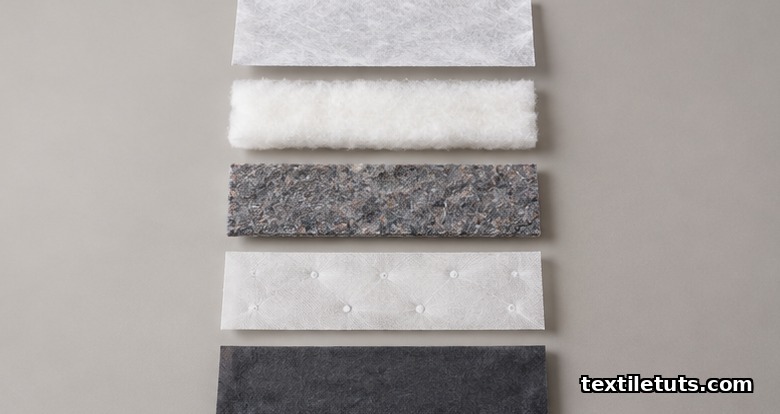
- Ticking layer (top cover): often a knitted or woven fabric, but laminated with a 30–60 g/m² spunbond PP or spunlace backing to add tear strength and prevent foam migration. Tested to ISO 9073-3 for tensile strength and ISO 9073-4 for trapezoid tear.
- Quilt backing: a 20–40 g/m² thermally bonded polyester or bicomponent web that holds wadding fibers in place. Tested to ISO 9073-1 for mass per unit area and ISO 9073-2 for thickness.
- Insulator pad: a 60–120 g/m² needlepunched or chemically bonded polyester that separates the comfort layers from the spring unit and prevents coil feel-through. Tested to ISO 9073-8 for penetration resistance.
- Spring pocket fabric (pocket-spring units only): a 70–100 g/m² spunbond PP, often spunbond-meltblown-spunbond (SMS) for premium units, that wraps each coil. Tested to ASTM D5034 for grab tensile and ASTM D5733 for trapezoid tear.
- Border fabric reinforcement: a 100–150 g/m² spunbond PP band sewn or welded around the mattress perimeter to carry handle loads. Tested to ISO 9073-3 for tensile strength.
- Dust cover (bottom): a 30–60 g/m² spunbond PP or spunbond PET that protects the spring unit from dust and moisture during transport and use. Tested to ISO 9073-1 for mass uniformity.
For non-pocket (Bonnell or continuous-coil) mattresses, the spring pocket fabric is replaced by a single 80–150 g/m² needlepunched pad that sits above the coil unit. For all-foam mattresses, the insulator and pocket layers are removed, but the quilt backing, ticking laminate, and dust cover remain.
Upholstery, Cushioning, and Dust-Cover Applications
Upholstered furniture uses nonwovens in three structural positions: as a backing fabric, as a cushion cover, and as a dust cover underneath the frame.
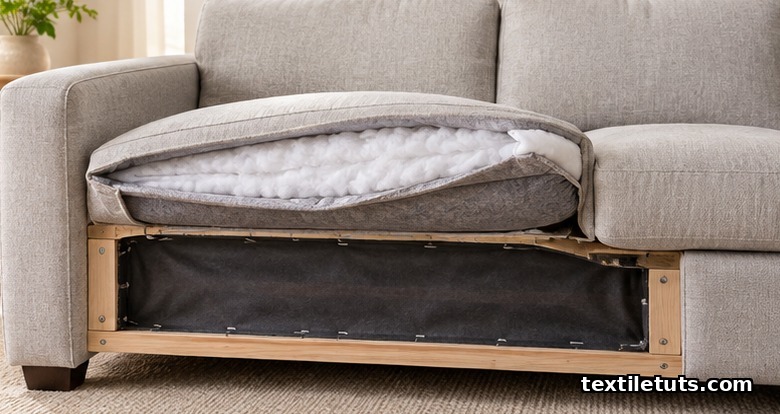
Upholstery backing: a 50–120 g/m² needlepunched polyester or polypropylene is laminated to the back of woven or knitted face fabric to add tear strength and prevent seam slippage. The backing layer is tested to ISO 9073-3 for tensile and ASTM D5733 for trapezoid tear, with minimum values typically set at 40 N/5 cm warp and 30 N/5 cm weft for residential upholstery.
Cushion covers and inner liners: spunbond PP at 25–60 g/m² is used inside cushion covers to keep fiberfill or shredded foam from migrating. The liner is tested for air permeability under ISO 9073-15, with values typically above 1500 L/m²/s to avoid trapping heat and moisture.
Dust covers (under-frame): a 30–80 g/m² spunbond PP or spunbond PET is stapled or velcroed to the underside of sofas, chairs, and bed frames. The cover prevents dust ingress into the frame and is tested for blocking strength under ISO 9073-5, with a minimum of 5 N to survive installation handling.
Pillow, Duvet, and Quilted Bedding Applications
Nonwovens appear in three positions inside finished bedding products: as the outer shell (pillow or duvet cover), as the internal wadding (pillow fill or duvet fill carrier), and as the scrim that holds wadding fibers together during quilting.
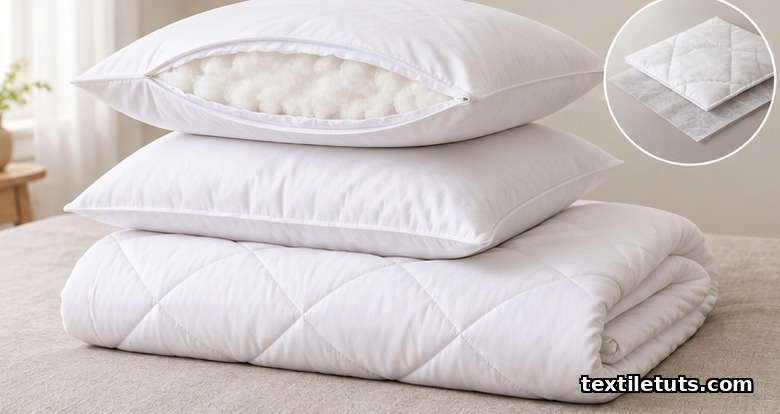
- Pillow and duvet shell: a 40–80 g/m² spunlace polyester or polyester-cellulose blend, chosen for soft hand and air permeability above 1000 L/m²/s (tested to ISO 9073-15). Premium shells often use a 30–50 g/m² spunbond PP laminated to the spunlace layer for added dimensional stability.
- Wadding carrier (for fiberfill pillows and duvets): a 15–30 g/m² thermal-bond or chemical-bond polyester web that holds polyester fiberfill in place during quilting and use. Tested for fiber adhesion under ISO 9073-11.
- Quilt scrim (the backing fabric under quilted comfort layers): a 20–50 g/m² spunbond PP or spunlace polyester. The scrim is tested for stiffness under ISO 9073-7, with a target cantilever length of 30–50 mm to balance drape and stability.
For mattress protectors and pillow protectors, a thin laminate of spunbond PP (top layer), meltblown PP (middle barrier), and spunbond PP (bottom layer) – an SMS fabric at 40–80 g/m² total – is used to block liquid and dust-mite allergens while still allowing air to pass at 800 L/m²/s or higher.
Performance Properties and Test Methods
Every nonwoven used in furniture or bedding is qualified against a defined specification. The table below summarizes the test methods and typical target values.
| Property | Test Method | Typical Target for Furniture and Bedding |
|---|---|---|
| Mass per unit area | ISO 9073-1 | ±5% of nominal GSM |
| Thickness | ISO 9073-2 | 0.3–4.0 mm (route dependent) |
| Tensile strength (grab) | ISO 9073-3 or ASTM D5034 | ≥40 N/5 cm warp, ≥30 N/5 cm weft |
| Trapezoid tear | ISO 9073-4 or ASTM D5733 | ≥20 N warp and weft |
| Air permeability | ISO 9073-15 | 800–3000 L/m²/s for bedding; lower for barrier layers |
| Bursting strength | ISO 9073-5 | ≥150 kPa for spring pocket fabric |
| Conditioning atmosphere | ISO 139 | 20 °C, 65% RH |
Conditioning under ISO 139 (20 °C and 65% relative humidity) is mandatory before any mechanical test, because nonwoven tensile and tear values can shift 10–20% between bone-dry and standard conditions.
Sustainability, Recyclability, and Certifications
Furniture and bedding nonwovens are increasingly specified to recycled or bio-based content. Recycled polyester (rPET) at 50–100% substitution is common in needlepunched cushion backing and quilt scrim, with mass-per-unit-area tolerances of ±5% maintained when the recycled feedstock meets ISO 9073-1.
Three certifications are routinely required by European and US furniture buyers:
- OEKO-TEX Standard 100, Class II (direct skin contact) for any nonwoven that touches the sleeper, including pillow shells, quilt backing, and mattress protectors.
- Global Recycled Standard (GRS) for rPET content claims on cushion backing and headboard panels.
- Furniture Fire Safety compliance, where applicable, by reference to BS 7177 (UK) or TB 117 (California) for the finished assembly, with the nonwoven components contributing via a flame-retardant finish or inherent fiber choice.
End-of-life recyclability is route-dependent. Pure PP spunbond webs can be re-melted into new fiber at 160–170 °C with 5–10% property loss per cycle. Needlepunched PET webs can be shredded and processed back into staple fiber. Blended webs containing cellulose, bicomponent fibers, or chemical binders require separation before recycling and are usually routed to energy recovery.
Frequently Asked Questions
What GSM should a nonwoven mattress cover be?
A spunbond polypropylene mattress ticking laminate is typically 30–60 g/m², while a premium mattress protector SMS laminate is 40–80 g/m². Below 25 g/m², the laminate fails ISO 9073-3 tensile targets for residential use; above 100 g/m², the laminate becomes too stiff for quilting.
Are nonwoven fabrics safe for direct skin contact in bedding?
Yes, provided the nonwoven is certified to OEKO-TEX Standard 100 Class II and is produced under ISO 139 conditioning. Spunlace polyester and polyester-cellulose blends at 40–80 g/m² are the standard pillow and duvet shell choice because hydroentanglement leaves no chemical binder residue.
Do nonwoven mattress components off-gas or contain formaldehyde?
Chemically bonded nonwovens with acrylic binder can off-gas residual formaldehyde at 20–75 ppm in untreated product, which is why OEKO-TEX Class II limits formaldehyde to 75 ppm for direct-skin products and 300 ppm for outer-layer products. Thermally bonded and spunbond webs contain no chemical binder and have negligible off-gas.
How long does a nonwoven mattress component last?
A spring pocket fabric, dust cover, or quilt backing is designed for the full service life of the mattress, which is typically 8–10 years. Needlepunched cushion backing on upholstered furniture is rated to the same 8–10 year service window when paired with a foam density above 25 kg/m³.
Can nonwoven furniture textiles be recycled?
Pure PP spunbond and pure PET needlepunched webs can be re-melted or shredded and re-spun into new fiber. Blended webs containing cellulose or chemical binders require separation before recycling and are usually routed to energy recovery. OEKO-TEX and GRS certifications document recycled content for downstream buyers.
References
- International Organization for Standardization. ISO 9073-1:1989, Textiles – Test methods for nonwovens – Part 1: Determination of mass per unit area. ISO. Reference standard for nonwoven weight verification.
- International Organization for Standardization. ISO 9073-3:1989, Textiles – Test methods for nonwovens – Part 3: Determination of tensile strength and elongation. ISO. Mechanical test standard for nonwoven furniture and bedding layers.
- International Organization for Standardization. ISO 9073-4:1997, Textiles – Test methods for nonwovens – Part 4: Determination of tear resistance (trapezoid method). ISO. Trapezoid tear test for nonwoven upholstery backing.
- International Organization for Standardization. ISO 139:2005, Textiles – Standard atmospheres for conditioning and testing. ISO. Conditioning standard applied before every ISO 9073 mechanical test.
- ASTM International. ASTM D5034-21, Standard Test Method for Breaking Strength and Elongation of Textile Fabrics (Grab Test). ASTM. Reference test for spring pocket fabric and upholstery backing.
- ASTM International. ASTM D5733-22, Standard Test Method for Trapezoid Tearing Strength of Nonwoven Fabrics. ASTM. Trapezoid tear test for nonwoven furniture and bedding layers.
- The Textile Institute. Technical Textiles: Nonwoven Applications in Furniture and Bedding. textileinstitute.org. Industry reference for bonded-fiber web selection in mattress and upholstery manufacture.
This article is the working reference for nonwoven selection in mattresses, upholstery, and bedding. Editorial by Md. Asad Ullah (Meem), TextileTuts. Sources: ISO 9073 series, ISO 139, ASTM D5034, ASTM D5733, and The Textile Institute as cited.


