
Needle-Punch Nonwoven: Carpets

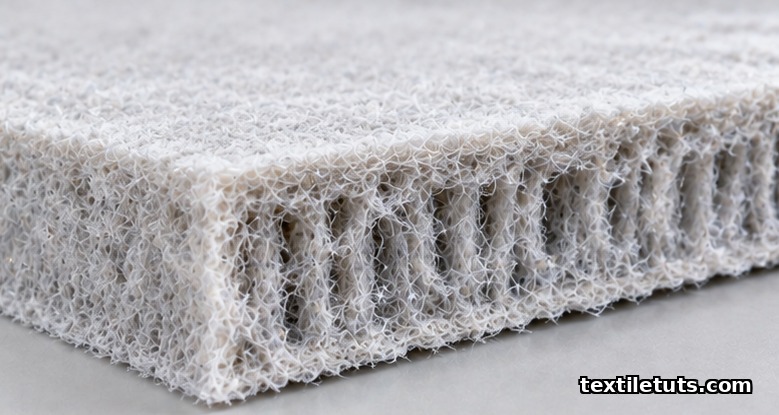
Needle-punch nonwoven carpets are formed when 1.5 to 25 denier staple fibers are mechanically entangled by 30 to 46 gauge barbed needles penetrating a fiber web 100 to 400 times per square centimeter, producing a felt-like structure with basis weights from 100 to 1,200 grams per square meter (gsm) at line speeds of 5 to 30 meters per minute.
This purely mechanical bonding route accounts for roughly 30% of global nonwoven carpet output by volume, with polypropylene and recycled polyethylene terephthalate (rPET) making up more than 80% of the fiber feed according to industry data published by EDANA (the European Disposables and Nonwovens Association) and INDA (the Association of the Nonwoven Fabrics Industry).
This guide explains how needle-punching interlocks loose fibers into a usable carpet, how the process compares with tufted and woven alternatives, which production variables control performance, and which ISO and ASTM standards govern carpet testing.
What Needle-Punch Bonding Is and How It Works
Needle-punching, also called needle-felting, is a dry, mechanical web-bonding process. A batt of carded or air-laid fibers passes over a stationary porous bed while a needle board fitted with hundreds of barbed needles moves up and down through the batt at 800 to 2,000 strokes per minute.
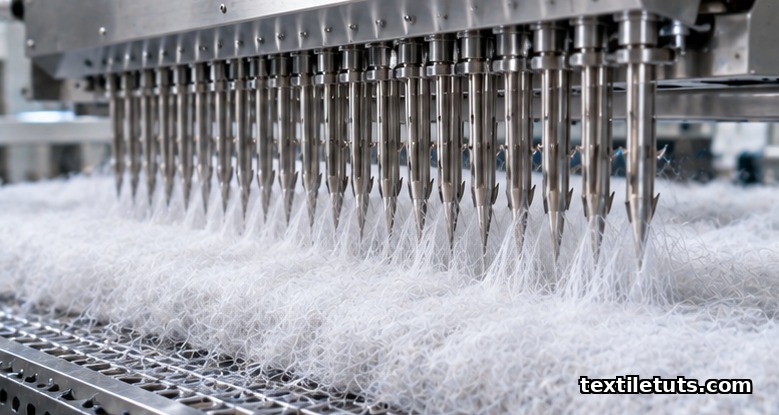
Each needle has one or more barbs cut into its shaft. As the needle descends, the barbs catch loose fibers and pull them downward through the web thickness. When the needle retracts, the displaced fibers remain reoriented in the vertical (Z) direction, mechanically locking the horizontal layers together.
Bond strength scales with three variables: needling density (punches per square centimeter), penetration depth (how far the needle enters the batt), and barb geometry. Increasing any of these raises tensile and tear strength but can also roughen the surface and reduce softness, so carpet producers tune the trio to each end use rather than maximizing any single parameter.
From Fiber Bale to Carpet Batt
Most needle-punch carpet starts with staple fibers 40 to 120 mm long, opened from bales, blended in a hopper feeder, then carded on a roller card or random card to form a uniform web. For heavier carpets above 400 gsm, two or more webs are cross-lapped to build the target mass before needling.
Polypropylene (PP) dominates the low-cost residential and exhibition carpet segment because of its low density (0.91 g/cm³) and resistance to water-borne stains. Polyester (PET) and recycled PET (rPET) are chosen where higher resilience, color fastness, or sustainability messaging matters. Nylon 6 and Nylon 6,6 appear in premium automotive and contract carpet applications where abrasion resistance is the deciding factor.
Wool and wool blends can also be needle-punched, particularly for felted floor coverings and acoustic underlay, but the share is small compared with synthetics.
Production Variables That Control Carpet Performance
Five production variables determine the feel, strength, and dimensional stability of a needle-punch carpet. The list below mirrors the parameters tracked on a typical mill production sheet.
- Needle type and gauge. Standard felting needles are specified by barb depth (typically 0.05 to 0.2 mm), barb angle (5° to 18°), shaft gauge (30 to 46), and number of barbs per needle (1 to 9). Coarser gauges (30 to 36) carry more fiber per stroke and suit heavy carpets; finer gauges (40 to 46) deliver smoother surfaces for carpet tiles.
- Penetration depth. Common settings run 7 to 20 mm. Deeper penetration lifts more fiber through the web, raising Z-direction strength but increasing surface pilling risk.
- Needling density. Total punches per square centimeter, the product of strokes per minute, needle board density, and web advance speed. Carpet producers typically target 100 to 400 punches per cm².
- Stroke frequency. Industrial looms run 800 to 2,000 strokes per minute, with modern high-speed lines exceeding 2,500 strokes per minute.
- Draft (advance rate). The line speed of the web through the machine, usually 1 to 30 meters per minute for carpet lines.
Tuning these five variables is the core art of needle-punch carpet engineering. Each shift of one variable changes the others, so experienced process engineers adjust them together rather than in isolation.
Finishing and Backing Operations
Raw needle-punch fabric is dimensionally unstable on its own. Carpet producers therefore add one or more finishing steps to lock the structure, add mass, and provide functional properties such as slip resistance and moisture blocking.
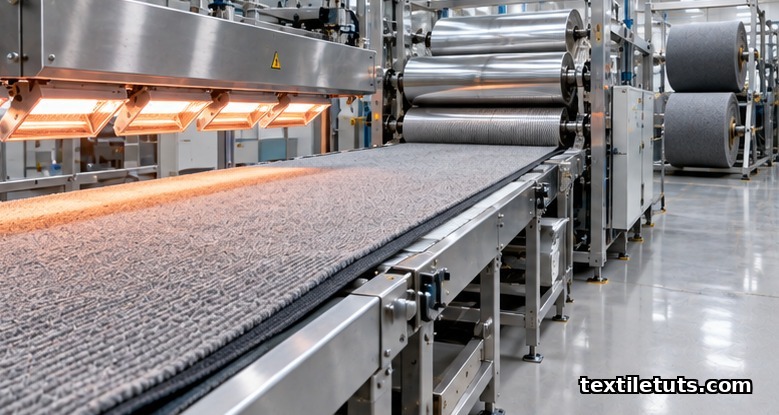
- Thermal bonding. When the fiber blend includes low-melt polyester or bi-component fibers, the needled web passes through a heated calendar or oven at 160 to 200 °C. The low-melt sheath fuses at fiber crossover points, locking the structure without latex.
- Latex backing. A styrene-butadiene rubber (SBR) or carboxylated SBR latex is coated on the back at 100 to 300 gsm wet add-on, then cured at 140 to 160 °C. This adds dimensional stability, tuft-binding properties, and slip resistance.
- Thermoplastic backing. A 100 to 250 gsm layer of polyethylene or polypropylene extrusion coating creates a moisture barrier for carpet tile and prevents adhesive bleed-through on raised access floors.
- Stenter setting. A pin or clip stenter dries, heat-sets, and straightens the carpet at 130 to 180 °C with controlled overfeed, usually 5% to 15% overfeed in the length direction.
Carpet tile is then die-cut into 50 × 50 cm or 60 × 60 cm squares; wall-to-wall rolls are wound at widths up to 5 m.
Where Needle-Punch Carpets Are Used
The mechanical route suits high-volume, value-engineered flooring rather than premium aesthetics. Major end uses include:
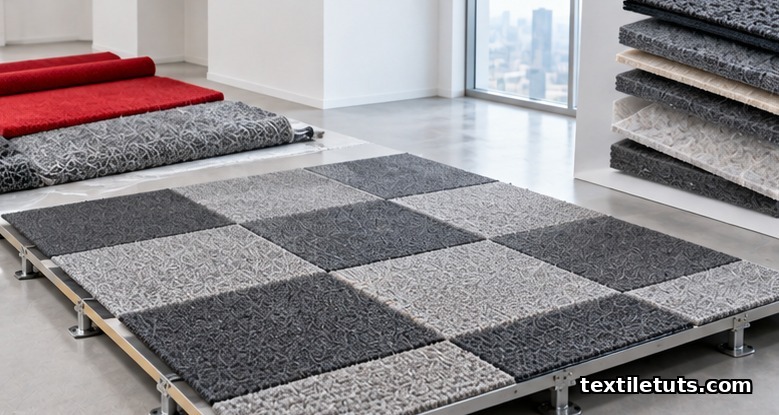
- Carpet tiles for commercial offices, retail, and education. The flat, dimensionally stable surface tolerates repeated lifting and relaying during office churn.
- Automotive flooring, trunk liners, and parcel shelves. Needle-punch absorbs cabin noise (typical noise reduction coefficients of 0.20 to 0.45 for 600 gsm grades) and resists crushing under foot load.
- Exhibition and event carpet. Low cost, fast lead time, and the ability to print custom patterns by inline color-blending.
- Residential indoor-outdoor or utility carpet. UV-stabilized polypropylene grades for garages, basements, and boats.
- Acoustic and insulation underlay. Heavier grades of 800 to 1,200 gsm act as sound-deadening layers beneath hard flooring.
The same mechanical process also produces geotextiles, filtration media, and roofing substrates, but those fall outside the scope of flooring.
Needle-Punch vs. Tufted vs. Woven Carpet
The three constructions differ in yarn orientation, surface durability, and production cost. The table below summarizes the structural differences that matter most to specifiers.
| Property | Needle-Punch Nonwoven | Tufted | Woven |
|---|---|---|---|
| Primary yarn orientation | Random (X, Y, Z) | Vertical tufts in primary backing | Warp and weft interlaced |
| Typical basis weight (gsm) | 100 to 1,200 | 700 to 2,500 (with secondary backing) | 1,000 to 3,500 |
| Surface texture | Flat, felt-like | Cut pile, loop pile, or cut-and-loop | Velvet, Wilton, Axminster patterns |
| Line speed (m/min) | 5 to 30 | 30 to 80 | 2 to 10 |
| Common fiber | PP, rPET, nylon | Nylon 6, PP, wool blends | Wool, nylon, PP |
| Cost per m² (relative) | Low | Medium | High |
| Best suited to | Carpet tile, automotive, event | Residential, commercial broadloom | Premium hospitality, luxury residential |
The takeaway: needle-punch is the high-throughput, low-cost path; tufted is the mainstream middle market; woven is the craft and luxury tier. Each construction earns its slot when the spec matches the use case.
Test Methods and Standards
Carpet performance is verified against published standards. The most relevant for needle-punch nonwoven carpet are:
- ISO 9073-1:2022. Determination of mass per unit area of nonwovens.
- ISO 9073-3:2023. Determination of tensile strength and elongation using the strip method.
- ISO 17608:2014. Determination of needle penetration density, which measures how many needle punches per unit area the fabric actually received during production.
- ASTM D1117. Standard guide for evaluating nonwoven fabrics, covering sampling, conditioning, and selection of the relevant physical property tests.
These four standards form the backbone of any needle-punch carpet performance specification. Industry data published by EDANA and INDA, plus reference texts such as the Handbook of Nonwovens, supply the broader production and process context.
Frequently Asked Questions
What does “needle-punch” mean in carpet?
Needle-punch is a mechanical bonding process in which barbed needles repeatedly punch through a loose fiber web, reorienting fibers into the vertical (Z) direction and locking the horizontal layers together without heat, water, or chemical binder. The result is a felt-like, dimensionally stable nonwoven carpet.
Is needle-punch carpet durable enough for homes?
Yes for light to medium traffic (bedrooms, rental units, basements), but not for main living areas of a long-term owner-occupied home. Its flat surface lacks the pile recovery of a tufted carpet, so heavy foot traffic eventually crushes the surface. For traffic lanes and stairs, a tufted or woven carpet is the better choice.
How is needle-punch carpet different from felt?
Traditional wool felt relies on the natural scales of wool fiber, plus moisture, heat, and agitation, to mat fibers together. Needle-punch uses needles to mechanically reorient fibers in any fiber type, including synthetics that lack scales. A wool felted underlay may use both mechanisms; a synthetic needle-punch carpet uses only mechanical bonding.
Can needle-punch carpet be recycled?
Single-polymer needle-punch carpet, for example 100% polypropylene with a polypropylene backing, can be shredded and re-extruded into new fiber. Mixed-fiber carpets with latex backing are harder to recycle because the latex must be separated first. EDANA and INDA publish recyclability guidelines that classify common constructions by end-of-life route.
What GSM is best for needle-punch carpet tile?
Most commercial carpet tile falls between 400 and 700 gsm finished weight, including backing. Light residential needle-punch carpet often runs 250 to 400 gsm; automotive flooring 350 to 600 gsm; acoustic underlay 800 to 1,200 gsm. Higher gsm within a given construction usually means better recovery and longer service life.
References
- International Organization for Standardization. ISO 9073-1:2022, Textiles — Test methods for nonwovens — Part 1: Determination of mass per unit area. Mass per unit area test method for nonwoven fabrics.
- International Organization for Standardization. ISO 9073-3:2023, Textiles — Test methods for nonwovens — Part 3: Determination of tensile strength and elongation (strip method). Strip tensile test method for nonwovens.
- International Organization for Standardization. ISO 17608:2014, Textiles — Needle-punched nonwovens — Determination of needle penetration density. Measures how many needle punches per unit area the fabric actually received during production.
- ASTM International. ASTM D1117, Standard Guide for Evaluating Nonwoven Fabrics. Sampling, conditioning, and physical property test selection for nonwovens.
- Russell, S. J. (Ed.). Handbook of Nonwovens. Woodhead Publishing, 2007. Reference textbook on nonwoven processes including needle-punch bonding.
- EDANA. European Nonwovens Statistics, annual edition. European Disposables and Nonwovens Association. Production volumes and fiber-split data for the nonwovens sector.
- INDA. North American Nonwovens Industry Outlook, annual report. Association of the Nonwoven Fabrics Industry. Production and fiber-use data for the North American nonwovens sector.
This article is the working reference for needle-punch nonwoven carpet. Editorial by Md. Asad Ullah (Meem), TextileTuts. Sources: ISO 9073 series, ISO 17608, ASTM D1117, EDANA statistics, INDA outlook, and the Handbook of Nonwovens (Russell, 2007) as cited.


