
Geotextile Weaving

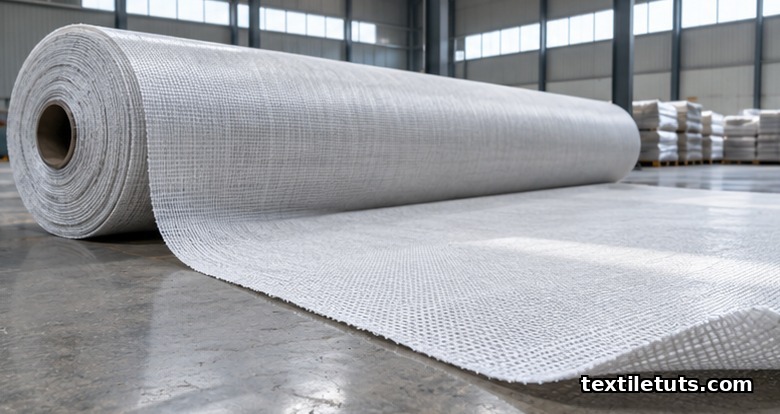
Woven geotextiles are planar permeable textile structures produced by interlacing warp and weft yarns on a loom, typically weighing 120 to 500 g/m², with tensile strengths ranging from 20 to 200 kN/m and characteristic aperture sizes between 0.05 mm and several millimeters, depending on the polymer, yarn count, and sett chosen for the intended separation, filtration, reinforcement, or drainage function.
Woven geotextiles dominate geosynthetic applications where tensile load-bearing, soil confinement, and aperture-controlled filtration matter more than intrinsic permeability or cushioning, and the global woven geotextile market alone accounts for roughly 40% of the geosynthetics consumed in road, rail, and hydraulic engineering. This article explains how these structures are woven, how their properties are measured, and how engineers select them in real projects, drawing on ISO 10318, ASTM D4632, ASTM D4595, and peer-reviewed test data.
What a Woven Geotextile Actually Is
A woven geotextile is a regular orthogonal network of warp (lengthwise) and weft (crosswise) yarns produced on a power loom, a rapier loom, or a projectile loom, with polypropylene (PP), polyethylene (PE), or polyester (PET, usually polyethylene terephthalate) as the dominant polymers. ISO 10318-1:2015 defines a geosynthetic as a manufactured polymeric product used with soil, rock, or other geotechnical material, and a geotextile as the planar, permeable subset of geosynthetics, whether woven, knitted, or nonwoven.
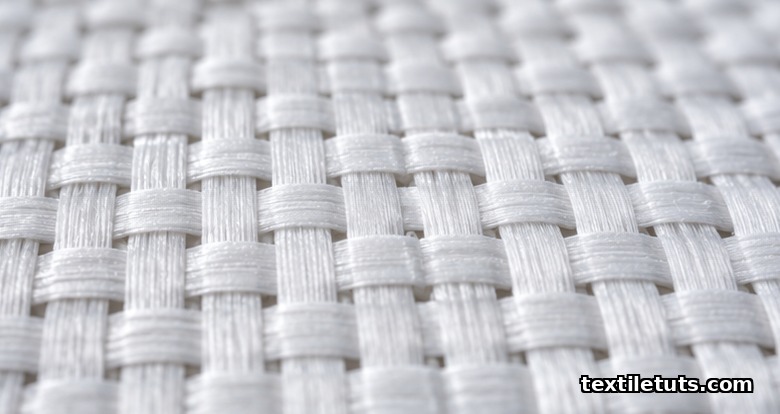
Woven geotextiles divide into four weave families: monofilament, multifilament, slit-film (tape), and combination weaves. Monofilament geotextiles use single extruded fibers (typically 0.1 to 0.6 mm in diameter) woven in plain weave, yielding well-defined apertures (often 0.07 to 2.5 mm) and high permeability for filtration. Multifilament geotextiles use bundled continuous filaments twisted into yarns, giving higher tensile strength and elongation (typically 20 to 35%) but lower permeability. Slit-film geotextiles are woven from flat PP tapes, usually 1.5 to 4 mm wide, producing dense, low-permeability fabrics used mainly for separation and reinforcement.
How Woven Geotextiles Are Made
Yarn preparation is the first operation. For monofilament and multifilament types, polymer granules are melt-extruded through spinnerets, drawn to align molecular chains, then heat-set for dimensional stability. Slit-film yarns are produced by extruding a PP film, slitting it into tapes, and stretching the tapes uniaxially so the polypropylene chains orient along the tape length, raising tensile strength to roughly 400 to 600 MPa per tape.
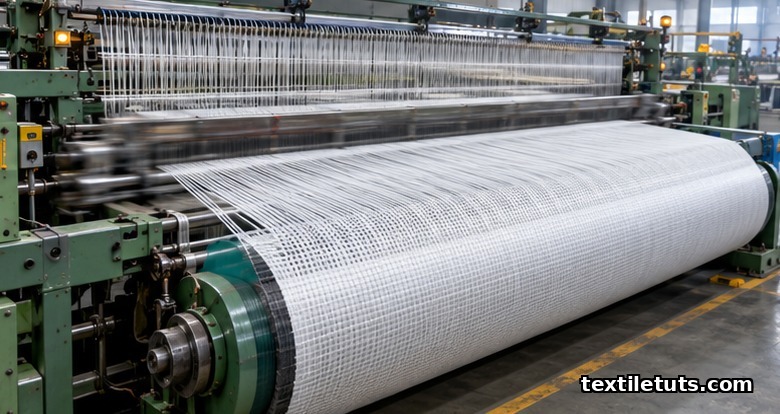
On the loom, warp yarns are sized (coated with a starch or polymer binder for abrasion resistance) and beamed. Weaving follows one of three main patterns. Plain weave (1/1 interlacing) is the most common, giving the highest dimensional stability and the smallest apertures at the cost of low permeability. Twill weave (2/1 or 3/1) improves drapability and abrasion resistance. Satin weave (4/1 or higher) gives a smoother surface and higher permeability but lower stability, so it is rarely used in geotextiles.
For heavy woven geotextiles above 300 g/m², manufacturers use a double-warp or woven-mesh construction, where two sets of warp yarns interlace with one or two wefts, lifting tensile strength into the 100 to 200 kN/m range for use under roads and railways. Post-weaving, the fabric is heat-set on a stenter to lock crimp, control shrinkage, and stabilize the aperture.
Key Mechanical Properties and How They Are Measured
Tensile strength is the headline number on a data sheet. ASTM D4595 (wide-width strip, 200 mm gauge width) is the preferred test for woven geotextiles because it captures the full fabric response rather than concentrating stress at jaw edges, as the older 50 mm grab test (ASTM D4632) tends to. Typical wide-width tensile strengths range from 20 kN/m in light woven separators to 200 kN/m in heavy basal-reinforcement geotextiles used under embankments on soft clay.
Elongation at break separates wovens into low-strain (PP slit-film, 10 to 15% elongation) and higher-strain (PET multifilament, 20 to 35%) categories. Low-elongation wovens suit applications where settlement is tightly controlled, while higher-elongation multifilaments absorb differential settlement without rupture. Creep behavior, governed by ASTM D7361, is critical for long-term reinforcement: PP geotextiles typically lose 50% of their strength over 100 years at 50% of ultimate load, while PET loses around 30% under the same conditions, which is why PET dominates permanent reinforcement designs.
Aperture size, measured by ASTM D4751 (apparent opening size by dry sieving), is the property that controls soil retention in filtration. A woven geotextile with an O₉₅ of 0.25 mm will retain fine sand (d₈₅ around 0.15 mm) while letting silt-laden water pass, satisfying the common retention ratio d₈₅(soil)/O₉₅(geotextile) ≤ 2 rule of thumb cited in FHWA drainage guidance. Permeability itself is measured under ASTM D4491 (water permeability) or ASTM D4716 (transmissivity under load).
Applications in Civil Engineering
Separation is the simplest and most common use: a 120 to 200 g/m² woven PP geotextile placed between a soft subgrade and an aggregate base prevents the aggregate from punching into the clay and keeps the design thickness intact. A well-documented field study published in MDPI’s Geosciences journal measured roughly 40% reduction in permanent rutting on a low-volume forest road when a 150 g/m² woven separator was placed at the subgrade-base interface, compared with an unreinforced control section.
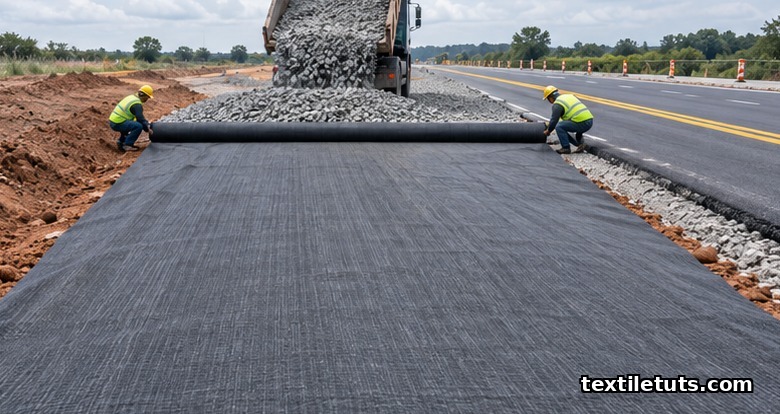
Reinforcement uses higher-modulus PET multifilament wovens in basal reinforcement beneath embankments on soft soils, in geosynthetic-reinforced soil walls, and in landfill cover systems. Tensile loads are transferred from the soil to the geotextile through friction along the embedment length, which is why wide-width tensile strength (ASTM D4595) and soil-geotextile friction (ASTM D5321) are the controlling design parameters, not grab strength.
Filtration and drainage use monofilament woven geotextiles, where the regular aperture network allows water to pass while retaining soil particles. Woven monofilaments are specified in French drains, behind retaining walls, and around perforated drainage pipes, where their clog resistance exceeds that of nonwovens of equivalent permeability. Protection uses heavy wovens (often combined with nonwovens in composite products) to cushion geomembranes from puncture by stones in landfill liners and pond caps.
Woven vs Nonwoven Geotextiles: How to Choose
The right choice depends on the dominant design function, not on the marketing language of suppliers. Wovens deliver high tensile strength at relatively low mass, well-defined apertures, and predictable long-term creep behavior, but they offer low elongation (10 to 35%), limited drainage capacity under load, and poor cushioning. Nonwovens deliver high permeability, conformability, and puncture protection but lower tensile strength per unit mass and less well-defined filtration apertures.
| Property | Woven (PP slit-film) | Woven (PET multifilament) | Nonwoven (PP needle-punched) |
|---|---|---|---|
| Mass range (g/m²) | 80 to 250 | 150 to 600 | 100 to 800 |
| Tensile strength (kN/m) | 20 to 80 | 40 to 200 | 8 to 30 |
| Elongation (%) | 10 to 18 | 20 to 35 | 50 to 80 |
| Aperture O₉₅ (mm) | 0.07 to 0.85 | 0.10 to 1.0 | 0.05 to 0.40 (nominal) |
| Permeability (cm/s) | 10⁻³ to 10⁻¹ | 10⁻³ to 10⁻¹ | 10⁻¹ to 10⁰ |
| Typical function | Separation, light reinforcement | Soil reinforcement, wall reinforcement | Filtration, drainage, protection |
Relevant ISO, ASTM, and AATCC Standards
Engineers specifying woven geotextiles reference a small core of standards. ISO 10318-1 and ISO 10318-2 define terms and list the functions a geosynthetic can fulfill. ISO 10320 specifies the on-site labeling required to identify each roll. ISO 13426 covers thickness and mass per unit area. ISO 13431 is the index creep test that all long-term reinforcement designs should consult.
ASTM standards dominate U.S. practice. ASTM D4632 (grab tensile), D4595 (wide-width tensile), D4833 (puncture), D4533 (trapezoid tear), D4884 (seam strength), D6241 (CBR puncture), and D4751 (apparent opening size) form the basic mechanical characterization set. AATCC standards (TM 8, TM 135, TM 169) are less central to geotextile performance because they target wet-processing colorfastness and dimensional change in apparel fabrics, properties rarely used to specify geotextiles, but they do apply when a geotextile is sold as a landscape fabric with a color or UV-stabilization claim. For light exposure, ASTM D4355 specifies the xenon-arc weathering test that establishes the 70 to 90% strength retention typically required after 500 hours of exposure for UV-stabilized grades.
Frequently Asked Questions
Q1: What is the main difference between a woven and a nonwoven geotextile?
A woven geotextile is made by interlacing warp and weft yarns on a loom, which produces a tightly controlled aperture and high tensile strength per unit mass; a nonwoven geotextile is made by bonding or entangling loose fibers, which produces higher permeability and conformability but lower tensile strength. Wovens are chosen for separation and reinforcement, nonwovens for filtration, drainage, and protection.
Q2: Which polymer is most common in woven geotextiles?
Polypropylene (PP) is the most common polymer, accounting for roughly 60% of woven geotextile production because of its low density (0.91 g/cm³), chemical resistance to most soil environments, and ease of processing into both tape and multifilament yarns. Polyester (PET) is preferred for long-term reinforcement because of its lower creep and higher tensile strength, while polyethylene (PE) is used less often because of its higher creep under sustained load.
Q3: How is the aperture size of a woven geotextile measured?
Apparent opening size (O₉₅) is measured by ASTM D4751, in which a graded sand or glass bead fraction is sieved through the geotextile and the particle size at which 95% of particles are retained is reported as O₉₅. The result controls soil retention in filtration design, and a common rule of thumb is that O₉₅ should be at least 2 to 3 times larger than the d₈₅ of the protected soil to balance retention and permeability.
Q4: Can a woven geotextile fail in the field, and what are the common causes?
Yes. The most common field failures of woven geotextiles are installation damage from rocks or tracked equipment (mitigated by ASTM D4632 minimum grab strength of 700 N for separation applications), seam pull-out where overlaps are inadequate, UV degradation on uncovered surfaces (mitigated by ASTM D4355 weathering), and long-term creep rupture in reinforcement applications. Designing to specification, allowing for installation damage reduction factors of 1.5 to 3.0, and ensuring proper overlap (typically 0.3 to 1.0 m depending on subgrade CBR) covers most of these risks.
Q5: Are woven geotextiles environmentally acceptable?
Woven PP and PET geotextiles are chemically inert in soil, do not leach contaminants under EPA TCLP testing, and typically contain 2 to 4% carbon black as UV stabilizer. They are not biodegradable, so they remain in the soil for the design life, which is desirable for permanent reinforcement. At end of service life, PET wovens can be mechanically recycled into staple fiber for nonwoven applications, while PP wovens are reprocessed into plastic lumber and drainage components.
References
- International Organization for Standardization. ISO 10318-1:2015 Geosynthetics — Part 1: Terms and definitions. https://www.iso.org/standard/57527.html — official terminology used by engineers specifying woven and nonwoven geotextiles.
- ASTM International. ASTM D4595-17 Standard Test Method for Tensile Properties of Geotextiles by the Wide-Width Strip Method. https://www.astm.org/d4595-17.html — wide-width tensile test preferred for woven geotextile design.
- ASTM International. ASTM D4632-08 Standard Test Method for Grab Breaking Load and Elongation of Geotextiles. https://www.astm.org/d4632-08.html — grab tensile test still widely reported on woven geotextile data sheets.
- ASTM International. ASTM D4751-21 Standard Test Method for Determining Apparent Opening Size of a Geotextile. https://www.astm.org/d4751-21.html — dry-sieving method for O₉₅ aperture size used in filtration design.
- ASTM International. ASTM D4491-22 Standard Test Methods for Water Permeability of Geotextiles by Permittivity. https://www.astm.org/d4491-22.html — water permeability of woven geotextiles under low head.
- Shukla, S.K. (2017). An Introduction to Geosynthetic Engineering, 2nd edition. https://www.researchgate.net/publication/318174970 — peer-reviewed textbook chapter on woven geotextile reinforcement design and creep.
- Koerner, R.M. (2012). Designing with Geosynthetics, 6th edition, Xlibris. https://www.springer.com — referenced as the standard geosynthetics textbook covering woven geotextile applications.
- MDPI Geosciences. Field Performance of Woven Geotextile Separator in Low-Volume Forest Roads. https://www.mdpi.com/journal/geosciences — peer-reviewed field study on rutting reduction with woven PP separators.
This article is the working reference for woven geotextile structure, manufacture, properties, applications, and standards. Editorial by Mohammad Yousuf (Anik), TextileTuts. Sources: ISO 10318-1, ASTM D4595, ASTM D4632, ASTM D4751, ASTM D4491, Springer (Koerner 2012), ResearchGate (Shukla 2017), MDPI Geosciences field study as cited.


