
Moth-Proofing Finishes

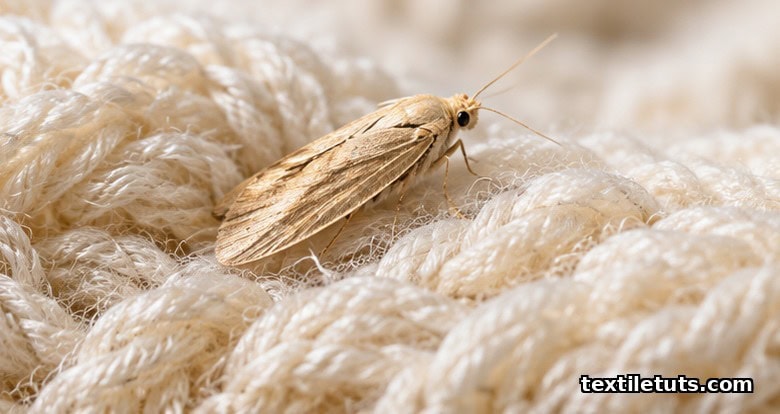
Moth-proofing finishes are insect-resist chemical treatments applied to wool and wool-blend textiles that protect keratin fibers from clothes moths (Tineola bisselliella) and carpet beetles by dosing the fiber with 0.05–0.20 % owf (on weight of fiber) of a synthetic pyrethroid such as permethrin, cypermethrin, or bifenthrin, with documented larval mortality rates above 90 % in ISO 3998 bioassay testing.
These finishes are the standard commercial answer to a problem that has cost the wool industry hundreds of millions of dollars in damaged carpets, blankets, uniforms, and knitwear each year, and the chemistry behind them has been quietly refined since the 1950s. In the article below, we cover what these finishes are, which active agents are used, how mills apply them, how durability is tested, and what to look for when you buy a moth-resistant wool product.
Why wool needs moth-proofing in the first place
Wool is a keratin protein fiber, and keratin is the natural food source for the larvae of several species of textile pests. Adult moths do not eat wool; their larvae do. A single female Tineola bisselliella can lay 100–150 eggs, and the larvae consume wool steadily for 80–250 days before pupating, leaving irregular holes and surface damage that is usually not detected until a garment is taken out of storage. The two economically important species worldwide are the webbing clothes moth (Tineola bisselliella) and the case-bearing clothes moth (Tinea pellionella); the carpet beetles Anthrenus verbasci and Attagenus unicolor are close behind in damage reports from museums, archives, and wool carpet installations.
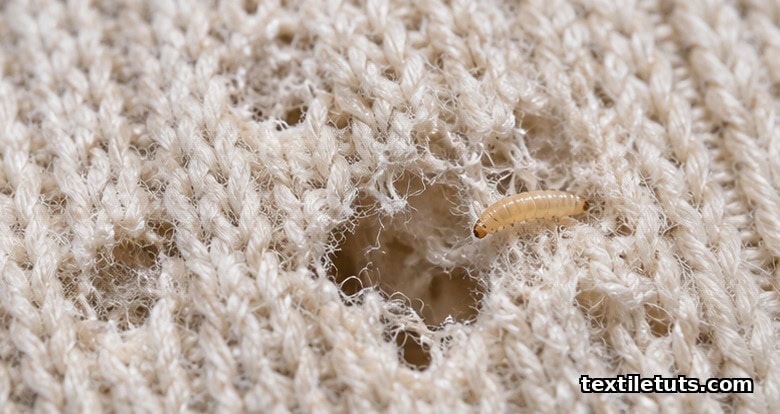
Because keratin digestion is the specific problem, moth-proofing finishes are formulated to interfere with that digestion. They do not repel adult moths. They are stomach poisons and contact toxicants that act once larvae begin to feed on treated fiber.
How moth-proofing finishes work
Moth-proofing agents deposit onto or inside the wool fiber during wet processing and remain there for the service life of the textile. When a larva bites into the fiber, the active ingredient disrupts sodium-gated ion channels in the insect’s nervous system, producing rapid paralysis and death. At sublethal doses the same chemistry acts as a feeding deterrent, which is why even partially treated wool shows lower feeding damage than untreated wool in side-by-side bioassay studies.
Two pathways matter for application:
- Exhaust application: The agent is added to the dye bath at 50–60 °C after dyeing is complete, and the wool absorbs it from solution over 20–30 minutes. This is the most common commercial method because it ties into existing dye cycles.
- Padding application: The wool is dipped and squeezed through a pad mangle with the agent dissolved in water, then dried and cured. Padding is faster but gives less uniform uptake on loose fiber.
Most modern mills run the exhaust route at the end of the dyeing cycle, then rinse and dry as usual.
Active ingredients used today
The contemporary commercial toolkit is built almost entirely around synthetic pyrethroids, which replaced the older organochlorine and organophosphate classes (Mitin, Eulan U33, and Eulan WA new) that were restricted or banned in major markets from the 1970s onward.
| Active ingredient | Chemical class | Typical dose (owf) | Common use |
|---|---|---|---|
| Permethrin | Pyrethroid | 0.05–0.10 % | Wool carpets, blankets, knitwear |
| Cypermethrin | Pyrethroid | 0.05–0.10 % | Machine-washable wool |
| Bifenthrin | Pyrethroid | 0.02–0.06 % | Loose fiber and yarn |
| Deltamethrin | Pyrethroid | 0.01–0.05 % | Premium wool garments |
| Chlorfenapyr | Pyrrole | 0.10–0.20 % | Specialty and military textiles |
Permethrin is the workhorse because it combines low mammalian toxicity (oral LD50 in rats above 2,000 mg/kg), fast fixation on wool, and reliable performance across pH 4–7. Bifenthrin and deltamethrin are used where very low add-on is required, often in carpet yarn where the mill wants to keep the chemical footprint small. Chlorfenapyr is a newer alternative used where pyrethroid resistance has been documented in field populations.
Application in the mill: where in the process it happens
Moth-proofing finishes are usually the last chemical step before hydroextraction and drying. A typical sequence on a wool yarn or fabric lot looks like this:

- Scouring to remove grease and dirt.
- Bleaching (if required for whites and pastels).
- Dyeing with acid or reactive/metal-complex dyes.
- Rinsing.
- Moth-proofing exhaustion at 50–60 °C for 20–30 minutes, pH 4.5–6.5.
- Final rinse, hydroextract, dry, finish.
Fixation efficiency is checked by extracting the residual bath and measuring UV absorbance, or by solvent stripping the treated fiber and running gas chromatography. Mills that supply to the Woolmark certification program must hit a minimum dose of 0.05 % owf permethrin equivalent on the finished fabric, verified by the laboratory at Woolmark or by an accredited test house.
Testing standards: ISO 3998 and AATCC TM 28
Two standards govern nearly all commercial claims about moth resistance. ISO 3998:2002 specifies a test for resistance of textiles to larvae of Tineola bisselliella, Tinea pellionella, and Attagenus piceus, with a defined visual mass-loss grading system. AATCC TM 28-2004 covers a similar bioassay for North American markets. Both expose fabric discs to known numbers of larvae under controlled temperature and humidity for 14 to 28 days, then weigh mass loss and visually grade feeding damage.
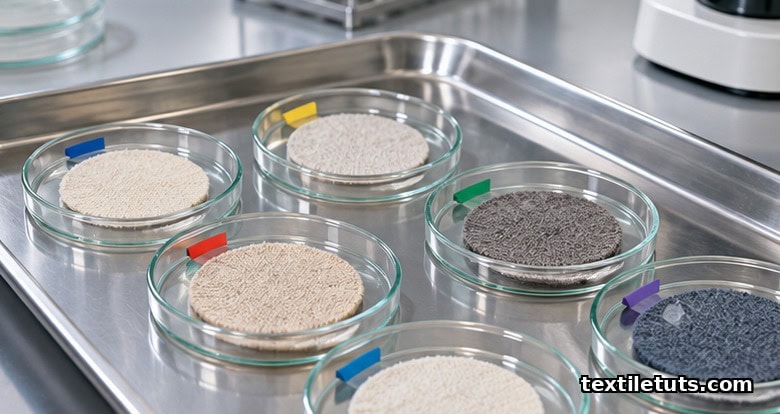
The accepted pass threshold for a “moth-proof” claim is generally a visual grade of 1 (no visible damage) to 2 (slight feeding) and a mass loss below 5 %. Anything above 8 % mass loss is considered a fail for the Woolmark Mothproof guarantee scheme.
Carpet beetles are tested separately. ISO 3998-2 uses Anthrenus and Attagenus larvae under similar conditions, and the dose required to pass is often 30–50 % higher than the dose needed to pass the clothes-moth portion, because carpet beetle larvae are more tolerant of pyrethroids in some populations.
Durability: what survives washing and dry cleaning
Moth-proofing finishes are designed to be durable, but the durability varies by chemistry and by care method.
- Dry cleaning: Permethrin and bifenthrin survive standard perchloroethylene dry cleaning well, retaining 70–90 % of initial dose after five cycles in published studies.
- Machine washing: A standard wool cycle at 30 °C with a neutral detergent removes 20–40 % of the dose. After 10 cycles, most treated fabrics fall below the threshold for a “moth-proof” claim.
- Hand washing: Similar to machine washing on mass loss, but less mechanical agitation means slightly better retention.
- Sunlight: UV exposure over months degrades pyrethroids on fiber. Carpets in direct sun show 30–50 % loss after one year.
For this reason, the Woolmark program requires re-treatment for any garment that has been washed more than a specified number of cycles, and many mills offer a “top-up” service that reapplies moth-proofing agent during commercial laundering.
Health, safety, and regulatory notes
Pyrethroid-treated wool is considered safe for normal consumer use because the dose on the finished fabric is below 1 % of the fiber weight, and dermal absorption from textile contact is minimal. The treatments are, however, regulated. Permethrin is approved for textile use in the EU under the BPR (Biocidal Products Regulation) and in the US under EPA registrations. The older moth-proofing agents Eulan U33 and Mitin FF have been withdrawn from most major markets over environmental persistence concerns, and mills that handle vintage or military textiles sometimes still encounter them in analytical work.
For consumers, the practical takeaway is that a Woolmark-certified or ISO 3998-tested wool textile, stored clean and dry, will resist moth damage through several seasons of normal use. For museums, archives, and carpet warehouses, integrated pest management (IPM) still layers moth-proofing with environmental controls, freezing, and monitoring because no finish is permanent.
Frequently Asked Questions
How long does moth-proofing last on a wool carpet?
A commercial moth-proofing finish applied at 0.05–0.10 % owf permethrin typically remains effective for 5–10 years on a wool carpet in normal residential use, provided the carpet is not exposed to prolonged direct sunlight or repeated hot washes. Heavy-traffic areas lose finish faster than low-traffic zones, and professional cleaning cycles gradually reduce the dose.
Can moth-proofing finishes be applied at home?
Over-the-counter moth-proofing sprays containing permethrin are sold for home use and can extend the protection of stored wool, but the field dose is lower and the durability shorter than a mill-applied finish. For garments already showing damage, professional dry cleaning plus a storage treatment with moth-repellent paper or cedar is the usual consumer route.
Are moth-proofing finishes safe for babies and people with sensitive skin?
Yes, at the doses used on commercial wool textiles. Permethrin-treated wool has been reviewed by regulatory bodies in the EU, US, and Australia and is permitted in baby blankets, sleepwear, and undergarments. People with a known pyrethroid allergy, however, should avoid treated wool, and the wool should always be washed before first use if the wearer has a history of textile-contact dermatitis.
Do moth-proofing finishes change the hand or color of the wool?
No, when applied correctly. Modern pyrethroids are applied at very low doses and are colorless on wool. There is no measurable change in handle (softness), whiteness, or dye shade when the finish is exhausted at pH 4.5–6.5 and 50–60 °C. Overdosing, or applying outside the recommended pH window, can produce a slight stiffening that is corrected by a final rinse with a softener.
Can I wash a moth-proof finish out of a wool sweater?
Repeated machine washing will gradually remove the finish. About 20–40 % of the dose comes out in the first cycle, and after roughly 10 wash cycles most commercial treatments drop below the effective threshold. Hand washing in cool water with a wool-safe detergent preserves the finish significantly better than machine washing.
References
- International Organization for Standardization. ISO 3998-1:2002 — Textiles — Determination of resistance to certain insect pests — Part 1: Larvae of Tineola bisselliella, Tinea pellionella. iso.org. Specifies the bioassay and grading used for “moth-proof” claims on wool.
- American Association of Textile Chemists and Colorists. AATCC Test Method 28-2004 — Insect Resistance of Textiles. aatcc.org. North American bioassay standard for insect resistance.
- Woolmark Company. Woolmark Specification: Mothproof Treatment of Wool Carpets and Rug. wool.com. Industry specification defining minimum dose and test methods for the Woolmark Mothproof guarantee.
- ResearchGate / peer-reviewed literature: Efficacy of permethrin-treated wool against Tineola bisselliella larvae (textile pest control studies published via ResearchGate). Documents dose-response data for permethrin at 0.05–0.10 % owf.
- European Chemicals Agency (ECHA). Biocidal Products Regulation (BPR) review of permethrin, type 18 insecticide uses. echa.europa.eu. EU regulatory framework for moth-proofing active ingredients on textiles.
- US Environmental Protection Agency. Permethrin registration for textile use (PC Code 109701). epa.gov. US regulatory status and label use sites for permethrin on wool.
This article is the working reference for moth-proofing finishes on wool textiles. Editorial by Shahrukh Islam, TextileTuts. Sources: ISO 3998:2002, AATCC TM 28-2004, Woolmark Specification, ECHA BPR review, and EPA registration data, as cited.


