
AQL (Acceptable Quality Level): Sampling


Acceptable Quality Level (AQL) is the maximum percentage of defective units in a production lot that a sampling plan accepts as a process average, and in apparel and textile inspection the most widely applied AQL values under ISO 2859-1 and ANSI/ASQ Z1.4 are 1.0 for critical defects, 2.5 for major defects, and 4.0 for minor defects.
This second sentence matters: every garment shipment that passes inspection under an AQL system has, by definition, been judged acceptable even though it contains some defects. The AQL is the threshold that separates acceptable from rejectable, and the sampling plan is the rule that determines when the lot crosses that threshold.
This guide walks through how AQL sampling actually works on a textile or garment floor: how lot size drives sample size, how inspectors classify defects into critical, major, and minor categories, how to read the Ac/Re numbers in the sampling tables, and where the system breaks down. By the end you will know which AQL to pick, how many pieces to pull, and how to defend an accept or reject decision to a buyer.
What AQL Means in Garment and Textile Inspection
AQL is a statistical concept, not a measurement. It defines the worst tolerable quality level that a lot can show on average and still be accepted most of the time by the chosen sampling plan. The value is expressed as a percentage of defective items per hundred units, so an AQL of 2.5 means the buyer tolerates up to 2.5 defective items per 100 units in a long run of lots, provided the supplier’s process average stays at or below that number.
In garment inspection, AQL is almost always paired with the attribute sampling plans in ISO 2859-1, the international standard also adopted in the United States as ANSI/ASQ Z1.4. These plans tell the inspector how many pieces to pull from a lot, how to count defects, and how many defective pieces are allowed before the lot fails. The plan does not guarantee zero defects; it guarantees a known statistical risk for both buyer and supplier, known as the Producer’s Risk (alpha, usually 5%) and Consumer’s Risk (beta, usually 10%).
How the AQL System Works Step by Step
An AQL inspection follows a fixed sequence. The buyer or third-party inspector first classifies every defect they expect to find into one of three severity buckets: critical (a safety, legal, or functional failure such as a needle or sharp accessory that could injure the wearer), major (a visible functional or cosmetic defect that affects saleability such as a broken seam or measurable size偏差), or minor (a slight cosmetic defect that does not affect wear such as a loose thread or small stain under a set size limit).
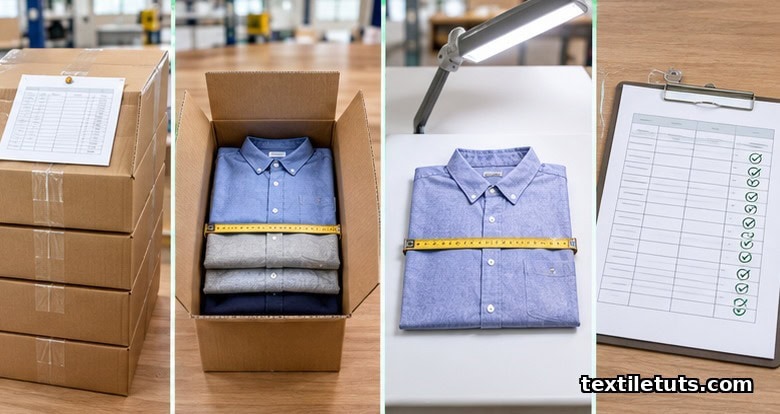
Next, the lot size is recorded and matched to a sample size code letter. ISO 2859-1 provides seven general inspection levels (I, II, III, plus four special levels S-1 to S-4) and three tightened or reduced variants. Level II is the default for general inspection; Level III is used when the buyer wants tighter discrimination, and Level I is used when destructive or expensive testing makes smaller samples necessary. Special levels S-1 through S-4 are reserved for tests where sample cost matters more than discrimination power, such as fiber content verification by chemical dissolution.
Once the code letter is set, the inspector draws a fixed number of units from the lot at random, performs the inspection, and counts defects by severity. The Ac (Accept) and Re (Reject) numbers in the table tell the inspector whether to accept or reject the lot for that AQL. For a lot of 5,001 to 10,000 units at general inspection Level II, the sample size is 200 pieces; at the common 2.5 AQL for major defects the Ac/Re split is 10/11, meaning 10 defective pieces pass and 11 fail the lot.
Choosing the Right AQL Level
The AQL is not chosen by the supplier; it is set by the buyer in the technical specification or quality assurance manual. Three values dominate the apparel industry for adult garments:
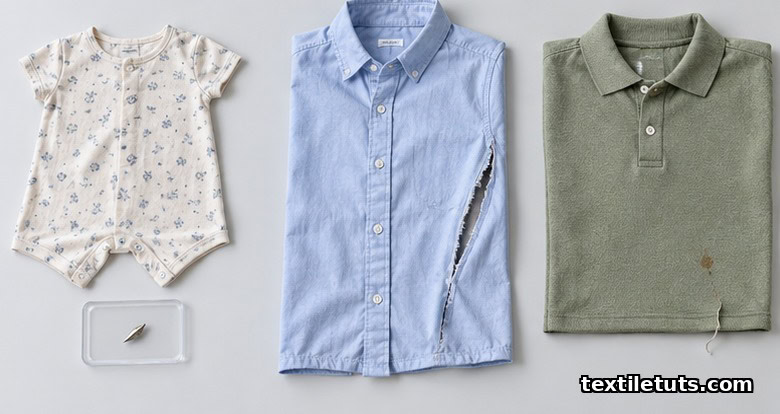
- AQL 1.0 for critical defects. Anything that fails a legal safety rule, such as sharp metal fragments, flammability issues, or choking hazards in children’s wear, is set at the strictest level. Most buyers set critical at 0 or zero acceptance, meaning any critical defect rejects the lot outright.
- AQL 2.5 for major defects. This is the most common AQL for adult woven and knit garments. It allows roughly two and a half major defects per 100 units on a long-run average, which most production lines can hit consistently.
- AQL 4.0 for minor defects. Loose threads, small stains, slight shade variation within the approved lab-dip tolerance, and similar cosmetic-only items are usually accepted up to 4.0 in apparel.
Children’s wear, intimate apparel, and protective or technical garments usually run tighter. Buyers of babywear commonly set AQL 1.0 on critical, 2.5 on major, and 4.0 on minor, while some European buyers require AQL 1.0 for both critical and major. Always check the buyer-specific AQL sheet before inspecting; do not assume industry defaults apply.
Reading the Sampling Tables
ISO 2859-1 and ANSI/ASQ Z1.4 organize their inspection tables by lot size and inspection level. The lot size row determines the code letter (A through R); the code letter column gives the sample size; the AQL cell inside that column gives the Ac and Re numbers. A simplified worked example for a lot of 800 pieces at general inspection Level II and an AQL of 2.5 for major defects: the code letter is H, the sample size is 50, and Ac/Re is 3/4. The inspector pulls 50 pieces, finds defects, counts defective units, and accepts the lot if three or fewer have a major defect, rejects if four or more do.
The same tables contain three inspection regimes: normal, tightened, and reduced. Inspection starts at normal. If two out of five consecutive lots are rejected on normal inspection, the rule automatically switches to tightened, which roughly halves the Ac number for the same sample size. If the supplier’s process proves itself with five accepted lots in a row, the buyer may switch to reduced inspection, which increases the Ac number and lowers inspection cost. These switches are tracked in the inspector’s record and reset whenever a rejected lot is found.
Single, Double, and Multiple Sampling Plans
The default table most inspectors use is the single sampling plan, where one sample is taken and the lot is judged on its result alone. ISO 2859-1 also publishes double and multiple sampling plans that take a second, smaller sample only when the first sample is inconclusive. A double plan starts with, for example, a sample of 32 pieces; if the inspector finds between 1 and 3 defective units, a second sample of 32 is drawn, and the lot is judged on the combined result. Multiple plans extend this pattern to up to seven samples.
Double and multiple plans reduce average inspection effort when most lots are clearly good or clearly bad, which is common in mature supplier relationships with stable quality. They are less common in third-party inspection reports, where the single plan gives a clearer accept/reject verdict to the buyer. For first-article inspection or new supplier trials, single sampling is the practical choice.
Common AQL Levels Used in Apparel by Product Type
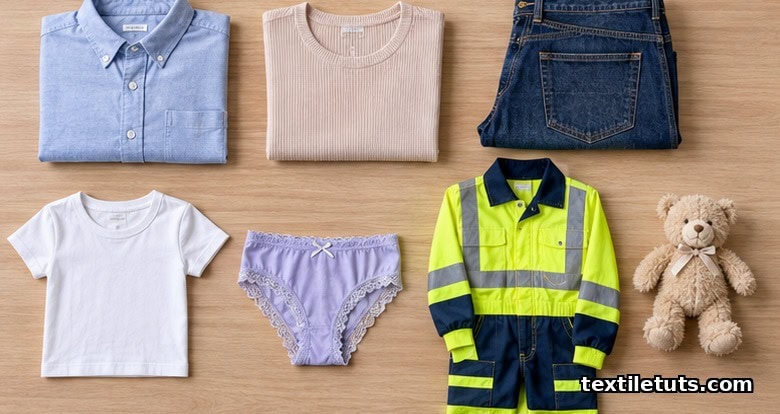
| Product category | Critical AQL | Major AQL | Minor AQL |
|---|---|---|---|
| Men’s woven shirts | 0 or 1.0 | 2.5 | 4.0 |
| Ladies’ knit tops and dresses | 0 or 1.0 | 2.5 | 4.0 |
| Denim jeans (adult) | 1.0 | 2.5 | 4.0 |
| Children’s wear (under 14) | 1.0 | 2.5 | 4.0 |
| Intimate apparel and underwear | 1.0 | 2.5 | 4.0 |
| Workwear and protective garments | 1.0 | 1.0 | 2.5 |
| Soft toys and baby accessories | 1.0 | 1.0 | 2.5 |
The numbers in this table reflect common buyer practice in 2026. Specific retailers and brands publish stricter or looser values in their own technical manuals; the buyer’s specification always overrides the default.
Limitations and Common Mistakes with AQL Sampling
AQL sampling has three limits every inspector should know. First, the plan accepts a known percentage of lots that contain more defects than the AQL, so a single passed lot is not proof that the shipment is defect-free. Second, AQL is set per lot and assumes the supplier’s quality is stable over time; a sudden process breakdown can pass inspection if the bad production happened to be diluted across many lots. Third, the system depends on consistent defect classification. If the supplier and the buyer’s inspector classify the same fault differently, the same physical garment can shift between major and minor buckets.
The most common field mistake is sampling at the top of the carton stack instead of at random. ISO 2859-1 and ANSI/ASQ Z1.4 require a random draw from the lot; pulling only the topmost, most accessible, or “best-looking” cartons biases the sample toward fewer defects and inflates the apparent quality. The second most common mistake is forgetting to count critical defects separately; critical defects usually have a zero-acceptance rule that rejects the lot on a single occurrence, regardless of the Ac/Re split shown for the major AQL.
Frequently Asked Questions
What is the most common AQL used in garment inspection?
For adult apparel, AQL 2.5 for major defects and AQL 4.0 for minor defects is the most common combination under ISO 2859-1, with critical defects usually set at zero acceptance. This is the default applied by most third-party inspection bodies when the buyer’s specification does not state otherwise.
What sample size do inspectors pull for a 1,000-piece lot?
Under ISO 2859-1 general inspection Level II, a lot of 501 to 1,200 pieces corresponds to code letter H with a sample size of 50 pieces. At AQL 2.5 the Ac is 3 and Re is 4. If the inspector uses Level III instead, the code letter jumps to J and the sample size doubles to 80 pieces.
Can a buyer change the AQL mid-season?
Yes, but the change must be communicated in writing before the next inspection and applied to a fresh sequence of lots. Switching to tightened inspection after a bad lot, for example, follows the rules in ISO 2859-1 Table II-A. Switching to a stricter AQL value (say from 2.5 to 1.0) is a contract change and should be agreed by both parties, not imposed unilaterally.
How do I count defects when one garment has multiple problems?
Each defective garment is counted once under the highest-severity defect it contains for the purpose of the lot accept/reject decision, but every individual defect should still be recorded on the inspection sheet. A shirt with one major seam defect and one minor loose thread is one defective unit, classified as major; the minor issue is logged but does not push the unit to a second rejection category.
Does AQL apply to fabric rolls and yarn shipments too?
Yes. The same ISO 2859-1 framework is used for fabric inspection at piece-goods stage, often with special inspection levels S-1 to S-4 when tests are destructive (such as tensile strength per ASTM D5034 or colorfastness to washing per AATCC TM61). Yarn shipments can use AQL sampling on cones, although some yarn contracts still use count-based rather than defect-based criteria.
References
- International Organization for Standardization. ISO 2859-1:1999 Sampling procedures for inspection by attributes, Part 1: Sampling schemes indexed by acceptance quality limit (AQL) for lot-by-lot inspection. https://www.iso.org/standard/1141.html — the foundational attribute-sampling standard behind AQL inspection in textile and apparel.
- American National Standards Institute / American Society for Quality. ANSI/ASQ Z1.4-2003 (R2018) Sampling Procedures and Tables for Inspection by Attributes. https://webstore.ansi.org — the U.S. adoption of ISO 2859-1, used directly by most U.S. retail buyers.
- ASTM International. ASTM D3777 Standard Practice for Writing Specifications for Textiles. https://www.astm.org/d3777 — defines how AQL and sample size appear inside a textile specification.
- AATCC. AATCC Technical Manual, current edition. https://www.aatcc.org — published reference for colorfastness and dimensional-stability test methods cited alongside AQL inspection.
- Montgomery, D. C. Introduction to Statistical Quality Control. Wiley, 7th edition. https://www.wiley.com — academic textbook on attribute sampling plans and the operating-characteristic curves behind ISO 2859-1.
- Chowdhury, M. M. R., and S. M. A. Iqbal. Statistical Quality Control in Apparel Manufacturing. ResearchGate, peer-reviewed conference paper. https://www.researchgate.net — applied treatment of AQL implementation in Bangladesh and South Asia garment production.
Editorial by Sabbir Ahmed, TextileTuts. Sources: ISO 2859-1:1999, ANSI/ASQ Z1.4-2003 (R2018), ASTM D3777, AATCC Technical Manual, Montgomery (Wiley), and the cited ResearchGate paper on statistical quality control in apparel manufacturing as cited.


