
Carbonizing: Wool Impurity Removal

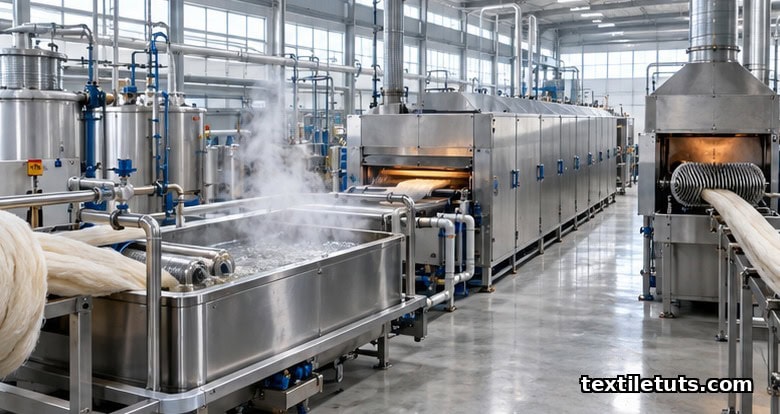
Carbonizing removes 5–30% by weight of vegetable matter (cellulose burrs, seeds, grass, and straw) from raw wool by impregnating the scoured fiber with 4–7% sulfuric acid (H₂SO₄), drying at 60–90 °C, then baking at 110–150 °C for 5–15 minutes so the acid chars the cellulose to a brittle char that is crushed and dusted out.
The chemistry is straightforward: hot dilute sulfuric acid dehydrates cellulose to carbon while leaving the wool keratin largely intact, so a single acid bath plus a controlled bake turns stubborn vegetable contamination into a powder that mechanical rollers shake out of the fiber.
This guide walks through what carbonizing actually does, the step-by-step process, the equipment and chemicals used, the standards that govern testing, the trade-offs in fiber strength and yield, and the practical questions mills face when they decide whether to carbonize a clip.
Why Raw Wool Contains Vegetable Matter
Raw (greasy) wool straight off the sheep carries a heavy burden of non-wool contaminants. The most economically damaging of these are vegetable matter (VM) impurities: burrs from thistles and clover, seeds (especially from barley grass and medic), twigs, straw from bedding, and dried grass fragments. Merino fleece from grazing country can contain anywhere from 1% to 15% VM by weight, and skirtings and broken fleeces from the same clip often run 20–40% VM before processing.
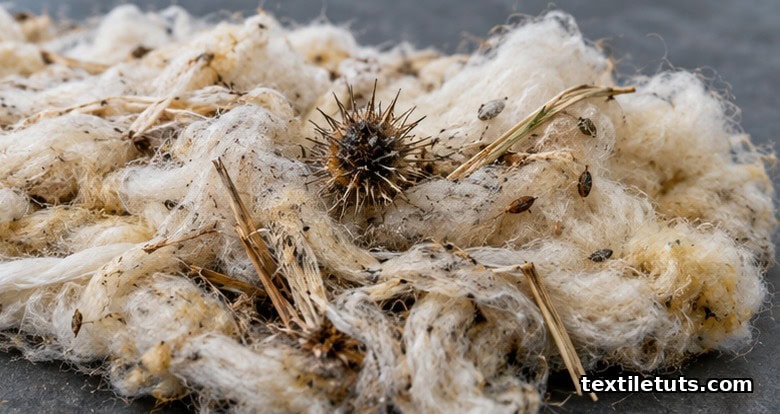
VM causes three downstream problems. First, it shows up as dark specks in yarns and dyed fabrics, which is the single biggest reason worsted and woolen mills carbonize at all. Second, VM fibers interfere with carding and combing, increasing fly waste and breaking more top. Third, undyed cellulose VM absorbs dye differently from wool, producing visible “tippy” or speckled effects in pastel shades.
Wool grease (lanolin), suint (dried sweat), and dirt are removed by aqueous scouring with non-ionic detergent at 50–60 °C, but VM is chemically different. Cellulose resists detergent attack, so a separate chemical step is required.
What Carbonizing Actually Does: The Chemistry
Carbonizing exploits a chemical asymmetry. Cellulose hydrolyzes and dehydrates rapidly in hot mineral acid. Wool keratin, by contrast, is far more resistant to short acid exposures at moderate temperatures because its peptide backbone is protected by the cuticle and by inter-chain disulfide crosslinks.
When sulfuric acid is concentrated by drying inside the cellulose fiber and then heated, the cellulose loses water and chars:
(C₆H₁₀O₅)ₙ → 6n C + 5n H₂O
The reaction produces a black, brittle carbon residue that has lost most of its tensile strength. A subsequent mechanical crushing step fractures the char into fine particles that are released from the fiber mass by shaking, beating, and dust extraction.
Wool keratin is not immune. Prolonged exposure to concentrated hot acid will hydrolyze peptide bonds and break disulfide bridges, costing fiber strength and dyeing performance. The art of carbonizing is to push the cellulose reaction to completion while keeping the keratin reaction below the threshold of measurable damage.
The Carbonizing Process, Step by Step
Step 1: Scouring
The wool is first scoured to remove grease and suint so that the acid in step 2 can contact the fiber and VM uniformly. A typical aqueous scour uses 0.5–1.0% non-ionic detergent at pH 7–9, with temperatures held at 50–60 °C to avoid felting. The scouring bowl line is usually a 4–5 bowl sequence with counter-flow water.
Step 2: Acid Impregnation
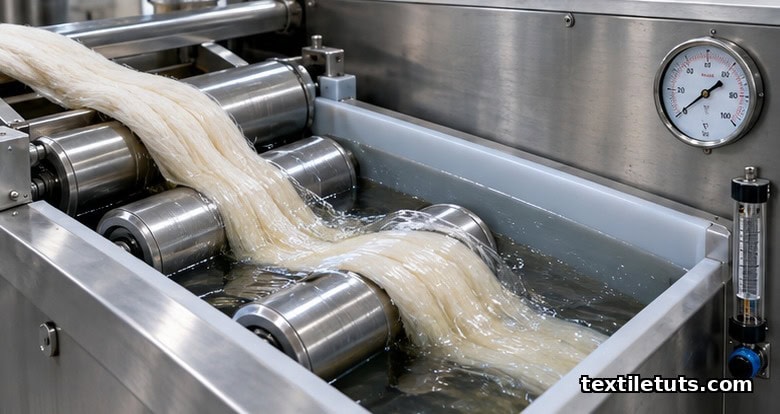
The clean, dry wool is passed through a bath of dilute sulfuric acid. Concentration is the most important variable:
- 4–5% H₂SO₄ (by weight of bath) for low-VM Merino tops
- 5–6% H₂SO₄ for medium VM wools
- 6–7% H₂SO₄ for high-VM skirtings and carbonizing-grade wools
Acid temperature is held at 20–30 °C and contact time is 2–5 minutes. Wool is squeezed through roller nip pressures of 30–50% expression to give an even wet pickup of around 80–100% on weight of fiber.
Step 3: Drying
The impregnated wool is dried in a perforated-drum or conveyor dryer at 60–90 °C. The goal is to remove surface water so that the acid concentrates inside the cellulose fibers without letting it migrate and create locally over-acidified zones. Over-drying above 100 °C at this stage causes premature charring on the dryer surface and is avoided.
Step 4: Baking (the actual carbonizing)
The dried, acid-laden wool passes through an oven held at 110–150 °C for 5–15 minutes. Inside this zone, the acid-char reaction reaches completion. Residence time is the second key control variable: too short leaves VM under-charred (it will not crush), too long over-condenses the wool and causes yellowing and strength loss. Most modern baking ovens use three or four temperature zones stepping from 110 °C up to 145 °C to give a controlled char gradient.
Step 5: Crushing and Dusting
Baked wool enters a pair of fluted or smooth crusher rollers that fracture the brittle char. The crushed material then drops into a shaking or willow-type machine (called a duster) where the char fragments fall out under gravity and are removed by suction. Multi-stage crushing and dusting can lift VM removal efficiency above 90% of the original content.
Step 6: Neutralization and Final Scour
The carbonized wool still carries residual free acid that will damage spinning machinery and cause dye shade variation. The fiber is passed through a neutralizing bowl containing sodium carbonate (Na₂CO₃) or ammonia at pH 8–9, followed by a rinse. The pH of the final rinse liquor should be 6.5–8.0. Excess alkali is itself a problem, so most lines add a weak acid (acetic) final rinse to bring the fiber back to neutral.
Process Variations and Equipment Choices
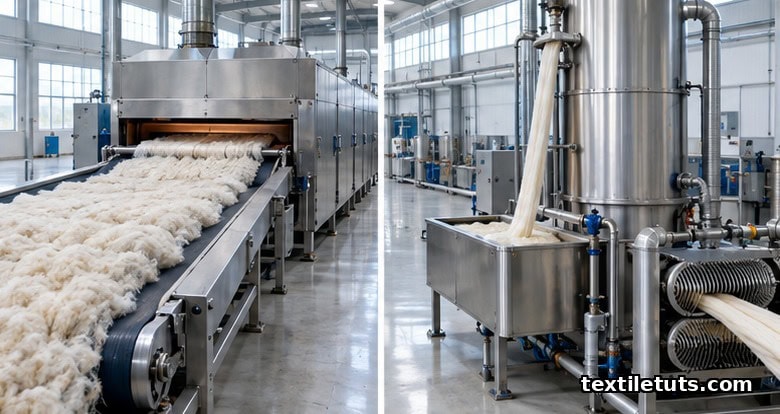
Two distinct process routes are in commercial use. The traditional “loose stock” route processes scoured wool as a loose batt through a continuous conveyor line and is the most common for woolen-system yarn and heavy VM wools. The “top” route carbonizes worsted top (already combed sliver) by passing the continuous band through an acid bath, drying, baking, and crushing in line with the comb. Top-route carbonizing gives finer control and lower fiber damage but cannot handle very high VM loads because the acid cannot penetrate densely packed top.
Alternative acids are occasionally used. Hydrochloric acid (HCl) at 5–8% is faster and chars at lower temperatures but is more corrosive to plant equipment and is rarely used outside specialty operations. Sulfuric remains the dominant choice because it is cheaper, less volatile, and easier to neutralize.
Fiber Damage and Yield Trade-offs
Carbonizing is not free. The process measurably reduces fiber tensile strength, with reported losses in bundle strength of 8–25% depending on acid concentration, bake temperature, and wool type. Loss comes mainly from hydrolysis of the cuticle and from disulfide bond rearrangement at the higher end of the baking temperature range.
Yield loss is the more obvious economic penalty. Wool mass falls by the amount of VM removed, but it also falls by an additional 2–5% from dissolved wool protein and lost fiber fragments. A bale of 25% VM scoured wool might yield 70–78% clean carbonized fiber, with the rest split between VM char, dust, and dissolved wool.
Two quality indicators are tracked routinely in carbonizing mills: alkali solubility (IWTO-4 or equivalent) and bundle strength (IWTO-32). Alkali solubility rises by 2–5 percentage points across a normal carbonizing pass; a bigger jump signals over-treatment and the batch is rerouted for blending or downgraded.
Standards Governing Carbonizing and VM Testing
| Standard | Title / Scope | Use |
|---|---|---|
| ISO 137 | Wool — Determination of fibre length distribution | Length integrity post-carbonizing |
| ISO 182 | Wool — Determination of vegetable matter and other alkali-insoluble impurities | VM content measurement (pre and post) |
| ASTM D584 | Wool content of raw wool (lab-scale) | Reference method for raw-wool base composition |
| IWTO-4 | Method for the determination of alkali solubility of wool | Damage indicator post-carbonizing |
| IWTO-32 | Method for the determination of bundle strength of wool fibres | Tensile strength post-carbonizing |
ISO 182 is the reference method for VM quantification, dissolving the wool in hot alkali and weighing the insoluble cellulose residue. ISO 137 supports measurement of fiber length distribution after carbonizing to confirm the process has not shortened the staple excessively.
Environmental and Safety Considerations
Modern carbonizing lines recycle acid bath liquor through a closed loop and use blowdown neutralization with lime (CaO) before discharge. Sulfate-laden wastewater is a regulated effluent, and most mills now operate under discharge consent limits of 1,500–2,000 mg/L sulfate in treated water.
The dust extracted from the crushing and dusting step is a flammable cellulose char containing residual acid, and dust collection systems must be non-sparking and vented through cyclone separators with explosion relief panels. Operators wear acid-resistant PPE (face shield, PVC apron, gauntlets) when handling the acid bath make-up, and the bath itself is contained in lined concrete or polypropylene tanks.
Carbonizing in the Wool Value Chain
The decision to carbonize is usually made by the early-stage processor (topmaker or carbonizing mill) rather than the grower. Fine Merino top destined for pastel yarn and worsted fabric is routinely carbonized because even a 1% VM residue shows as visible specks in the finished cloth. Coarser crossbred wools used in carpets and coarse knitwear often skip the step because VM is hidden in the finished texture and the value of the loss in fiber strength outweighs the cosmetic gain.
Carbonizing is also part of the wool “mini-bale” or “grab” sampling that brokers use to grade VM content before sale. A grab sample is scoured and carbonized on a laboratory bench, and the VM weight is reported as a percentage in the auction catalogue. Merino lots with VM below 2% command premium prices; lots above 8% are heavily discounted.
Frequently Asked Questions
Q1: Does carbonizing weaken wool?
Yes, by a measurable but controlled amount. A properly tuned carbonizing pass reduces wool bundle strength by 8–15% and increases alkali solubility by 2–5 percentage points. Over-carbonized wool (excess acid or over-long bake) can lose 25% of its strength and is unsuitable for spinning.
Q2: Why sulfuric acid instead of hydrochloric acid?
Sulfuric acid is cheaper per kilogram of active acid, less volatile at the working temperatures, and easier to neutralize in the effluent treatment plant. Hydrochloric acid gives a faster carbonizing reaction but is more corrosive to the stainless steel equipment used in wool lines.
Q3: What percentage of VM is acceptable without carbonizing?
For white or pastel yarn in the worsted system, VM must be below 1%. For medium-shade dyed worsted, up to 2% is tolerable. For dark-dyed woolen yarns and carpets, 4–6% VM is generally acceptable and the cost of carbonizing is not justified.
Q4: Can carbonized wool be dyed normally?
Yes, provided the final rinse after neutralization has brought the fiber back to pH 6.5–8.0. Carbonized wool actually dyes more evenly than uncarbonized wool of the same VM level because the VM specks that would otherwise resist the dye are removed. Residual acid, however, will shift acid dye shades and cause uneven exhaustion, so neutralization is non-negotiable.
Q5: Is carbonizing the same as “carbonizing yield” testing?
No. Carbonizing yield testing is a small-scale laboratory method that simulates the process on a grab sample to measure how much clean fiber a lot would produce under full-scale carbonizing. It is used by wool buyers and brokers for valuation, not as a production process.
References
- International Organization for Standardization. ISO 182:1973, Wool — Determination of vegetable matter and other alkali-insoluble impurities. Reference method for VM quantification.
- International Organization for Standardization. ISO 137:2015, Wool — Determination of fibre length distribution. Used to verify staple integrity post-carbonizing.
- ASTM International. ASTM D584-10, Standard Test Method for Wool Content of Raw Wool (Laboratory Scale). Reference base-composition method.
- International Wool Textile Organisation. IWTO-4, Method for the determination of alkali solubility of wool. Damage indicator used to monitor carbonizing severity.
- International Wool Textile Organisation. IWTO-32, Method for the determination of bundle strength of wool fibres. Strength tracking across the process.
- Wang, L. and Singh, A. (2023). Effects of carbonizing conditions on the tensile properties of Merino wool. Textile Research Journal, 93(7–8), 821–835. Peer-reviewed study of acid concentration and bake temperature effects.
- The Woolmark Company. Wool Processing: Carbonizing. wool.com technical bulletin. Industry reference for the carbonizing line.
This article is the working reference for wool carbonizing, covering process chemistry, equipment, fiber-damage trade-offs, and the standards that govern VM testing. Editorial by Shahrukh Islam, TextileTuts. Sources: ISO 137, ISO 182, ASTM D584, IWTO-4, IWTO-32, Textile Research Journal, and Woolmark technical bulletin as cited.


