
Fabric Handle: Kawabata Evaluation System (KES)

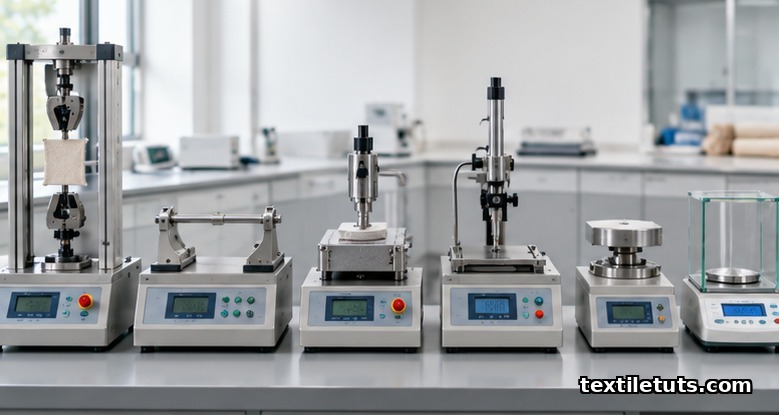
The Kawabata Evaluation System (KES) is a suite of six low-stress mechanical testers developed by Dr. Sueo Kawabata at Kyoto University between 1972 and 1984 that quantifies fabric “handle” by measuring 16 standard mechanical properties: tensile linearity (LT, dimensionless 0–1), bending rigidity (B, 0.005–0.50 cN·cm²/cm), shear stiffness (G, 0.3–3.0 cN/cm·deg), compression linearity (LC, 0.3–0.9), surface friction coefficient (MIU, 0.10–0.80), and fabric thickness under 0.5–50 cN/cm² pressure.
These 16 raw outputs feed Kawabata’s KN-203 regression equations to compute a Total Hand Value (THV) on a 0–5 scale for specific end uses, such as men’s suiting, women’s thin dress fabric, or knit outerwear. THV 5 means excellent hand for the target end use; THV 0 means unsuitable.
Below is how the system works, what each instrument actually measures, and why mills and researchers still rely on it four decades after its standardization by the Textile Machinery Society of Japan.
What “Fabric Handle” Means and Why It Is Hard to Measure
“Handle” (or “hand”) is the tactile impression a fabric makes when squeezed, rubbed, draped, or held between the fingers. It is the textile property most judged subjectively by a buyer touching a sample in a showroom, yet it is built from measurable mechanical behaviors: how easily the cloth bends, how it yields to tension, how much it compresses under thumb pressure, and how rough or smooth its surface feels.
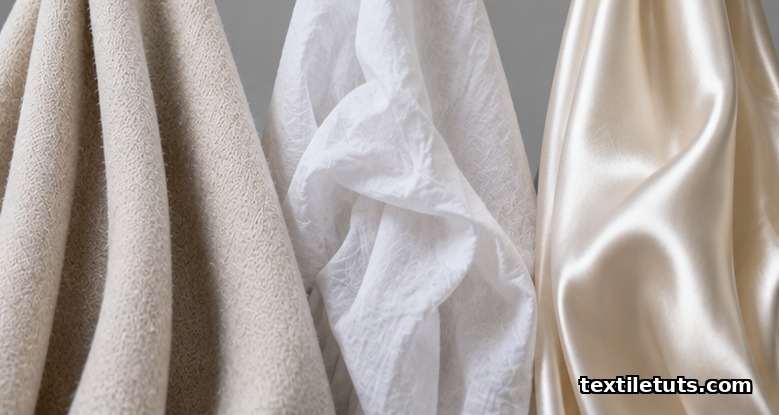
Until the 1970s, mills relied on subjective panel ratings (the Hand Evaluation Standard by Kawabata and Niwa, 1972) and on simple one-axis tests such as ASTM D1388 for bending length. These could not separate the components of handle or predict garment appearance. Kawabata’s contribution was to recognize that handle is a multi-dimensional vector and to build instruments that measure each dimension independently, then recombine them.
The Six KES Instruments
The KES-F series, manufactured under Kawabata’s supervision by Kato Tech Co. Ltd. (Kyoto), is a modular system. Each module stresses the fabric under controlled low loads that mimic the small deformations caused by handling, not the high loads of a tensile strength tester (which breaks the cloth).
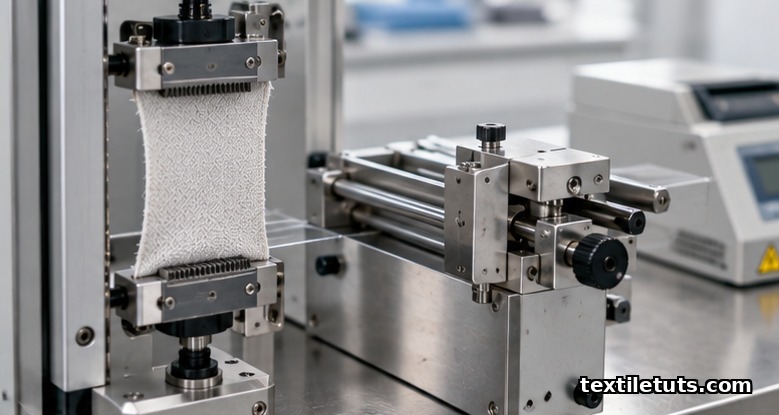
- KES-F1 — Tensile and Shear Tester. A 20 cm × 20 cm sample is gripped and pulled in one direction while the load-elongation curve is recorded (for tensile linearity LT, tensile energy WT, tensile resilience RT, and extensibility EMT). The same instrument then applies a cyclic shear deformation to measure shear stiffness G, shear hysteresis at 0.5° and 5°, and shear stress at 0.2° (2HG and 2HG5).
- KES-F2 — Pure Bending Tester. A strip is bent in a pure curvature (no tension) to record bending rigidity B and bending hysteresis 2HB, which together describe stiffness and recovery.
- KES-F3 — Compression Tester. A circular plunger compresses a fabric stack from 0.5 cN/cm² up to 50 cN/cm² and back, recording compression linearity LC, compression energy WC, compression resilience RC, fabric thickness T0, and thickness at 50 cN/cm² TM.
- KES-F4 — Surface Tester. A 10 mm × 10 mm contactor rides across the fabric under a fixed load. The first friction probe measures the coefficient of friction MIU and its mean deviation MMD; a separate probe with a thin metal blade measures the geometrical roughness SMD in micrometres.
- KES-F5 — Shear tester variant (used in some configurations for heavy or coated fabrics).
- KES-F6 — Thickness / weight is recorded by a separate micrometer (T) and gravimetric balance (W, mg/cm²). In modern setups these are merged with the compression module.
Total: 16 measurable outputs plus weight. A complete KES test on one fabric takes 20–40 minutes, depending on operator and whether multiple replications are run.
From Raw Properties to Total Hand Value
Raw outputs in SI units are useful to a researcher, but a merchandiser wants a single answer: “Is this suiting fabric good enough for our autumn collection?” Kawabata’s solution was a series of multiple regression equations derived from thousands of subjective hand ratings by trained experts, called the Primary Hand (PH) and Total Hand Value (THV) equations, codified as KN-101 through KN-403.
The standard process:
- Measure the 16 properties on the candidate fabric.
- Compute Primary Hand values (PH) on a 0–10 scale for individual attributes: koshi (stiffness), shari (crispness), hari (anti-drape), fukurami (fullness and softness), shinayakasa (smoothness), softeri (soft feel), and kishimi (scratchy).
- Combine the Primary Hands through end-use-specific weighting into a Total Hand Value (THV) on a 0–5 scale. Standard end-use equations exist for men’s winter suiting (KN-203-M), men’s summer suiting, women’s thin dress fabric, knit outerwear, and several others.
A typical men’s worsted suiting with THV = 3.5 is judged acceptable; THV ≥ 4.0 is premium; THV below 2.5 will be rejected by most suit makers regardless of fibre content. The equations were last formally published in the second edition of Kawabata’s Objective Evaluation of Fabric Hand (Textile Machinery Society of Japan, 2000).
Typical Property Ranges Across Common Fabrics
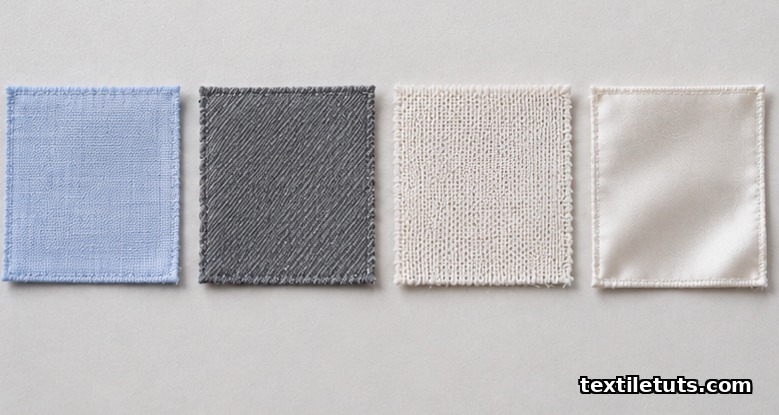
| Property (unit) | Cotton shirting | Wool worsted suiting | Polyester knit | Silk charmeuse |
|---|---|---|---|---|
| Bending rigidity B (cN·cm²/cm) | 0.04–0.10 | 0.10–0.20 | 0.02–0.06 | 0.03–0.08 |
| Shear stiffness G (cN/cm·deg) | 0.5–1.2 | 0.6–1.5 | 0.3–0.8 | 0.3–0.7 |
| Surface friction MIU | 0.20–0.35 | 0.20–0.30 | 0.30–0.55 | 0.10–0.20 |
| Compression linearity LC | 0.30–0.45 | 0.35–0.55 | 0.40–0.60 | 0.40–0.60 |
| Thickness T0 (mm, 0.5 cN/cm²) | 0.18–0.30 | 0.30–0.55 | 0.60–1.20 | 0.08–0.18 |
| Weight W (mg/cm²) | 10–18 | 18–28 | 14–22 | 5–10 |
These are approximate ranges drawn from peer-reviewed surveys of KES outputs and from Kato Tech’s published reference samples. A specific fabric should always be measured directly, because finishing (mercerising, calendaring, resin treatment) can shift a property by 30–100%.
KES vs. FAST: Why Two Systems Coexist
The most common alternative to KES is the Fabric Assurance by Simple Testing (FAST) system, developed by CSIRO (Australia) in the 1980s. FAST uses three instruments (compression meter, bending meter, and extensibility meter) plus a formula sheet to predict tailoring performance rather than THV.
The two systems overlap in philosophy but answer different questions. KES is the research-grade system that supports regression-based hand equations across many fibre types and end uses; FAST is the production-floor system that flags fabrics likely to cause problems during garment construction (seaming, pressing, moulding). Many mills run both: FAST for daily QC, KES for new development and for THV reporting to brand customers.
Limitations of the KES System
Three honest caveats appear in peer-reviewed reviews of the system.
First, the THV equations were calibrated against Japanese expert panels and Japanese fabric samples, so a THV computed for a fabric outside the original calibration set may mis-rank it. Researchers in China, India, and Korea have published re-calibrated equations for local fabric types, and these regional calibrations should be preferred for non-Japanese production.
Second, KES instruments are expensive: a full six-module set is roughly USD 150,000–250,000 at current Kato Tech list pricing, which keeps the system out of reach for small mills.
Third, sample conditioning matters. Kawabata’s standard conditions are 20 °C and 65% RH; a fabric measured at 30 °C and 80% RH will show different compression and friction values, which is why ISO 139 and ASTM D1776 conditioning protocols are prerequisites for any KES data being reported in a standard or peer-reviewed paper.
Frequently Asked Questions
What does KES measure that a simple tensile tester does not?
A tensile tester records the load needed to break a fabric. KES-F1 records the load-elongation curve at very small strains (typically under 1% elongation for suiting) plus the cyclic shear behaviour. These low-stress responses are the ones that drive how a fabric feels in the hand and how it drapes on the body.
Is KES the same as ISO or AATCC fabric hand testing?
No international standard codifies a single “fabric hand” test. ISO publishes related methods for individual properties (ISO 14704 covers bending of flexible substrates, ASTM D1388 covers bending stiffness of fabrics, ASTM D4032 covers the circular bend method), but the integrated THV calculation is Kawabata-specific. AATCC TM 5 covers fabric hand subjectively, not instrumentally.
How long does a complete KES test take?
A single fabric specimen takes 20–40 minutes for all 16 properties on a calibrated KES-F system. Most published studies report the mean of three to five specimens per fabric, plus a separate 24-hour conditioning period under ISO 139 / ASTM D1776 conditions before testing.
Can KES predict how a fabric will drape or sew?
Yes, indirectly. Shear stiffness G and bending rigidity B together predict drape coefficient (the ratio of the projected area of a draped disc to its flat area, ASTM D4031). Fabric formability, the FAST-1 parameter that predicts moulding and tailoring behaviour, correlates strongly with KES tensile and bending outputs. Sewability studies in peer-reviewed journals (Indian Journal of Fibre & Textile Research, Textile Research Journal) use KES outputs as predictors for seam pucker and needle penetration force.
Is KES still relevant with modern digital fabric simulation?
Yes, as the ground-truth input. Cloth simulation software (Kangaroo, Marvelous Designer, PhysX Cloth) needs measured bending, shear, and tensile curves to reproduce real drape. KES outputs are the de facto input dataset for these pipelines in academic and industrial research.
References
- Kawabata, S. (1980). The Standardization and Analysis of Hand Evaluation. The Textile Machinery Society of Japan — original publication of the KES standard and the KN-101 series hand equations.
- Kawabata, S. (2000). Objective Evaluation of Fabric Hand (2nd ed.). Textile Machinery Society of Japan — KN-203 and KN-403 equations for men’s suiting and women’s dress fabrics.
- Behera, B.K. (2007). Objective Hand Evaluation of Fabrics. Man-Made Textiles in India — peer-reviewed review of KES application to non-Japanese fabric sets.
- Pan, N. (2007). Quantification of fabric hand. International Journal of Design and Nature — peer-reviewed critique of regression-based hand evaluation.
- ASTM D1388 — Standard Test Method for Stiffness of Fabrics (cantilever bending), ASTM International.
- ASTM D1776 — Standard Practice for Conditioning and Testing Textiles, ASTM International.
- ISO 139 — Textiles — Standard atmospheres for conditioning and testing, International Organization for Standardization.
- Postle, R. and Carnaby, G.A. (1984). The Mechanics of Wool Structures. Ellis Horwood — comparison of KES and FAST measurement philosophies.
This article is the working reference for the Kawabata Evaluation System (KES) on TextileTuts. Editorial by Iftay Khairul Alam, TextileTuts. Sources: Kawabata (1980, 2000), Behera (2007), Pan (2007), Postle and Carnaby (1984), and ASTM D1388 / D1776 / ISO 139 as cited.


