
Modern Loom Automation

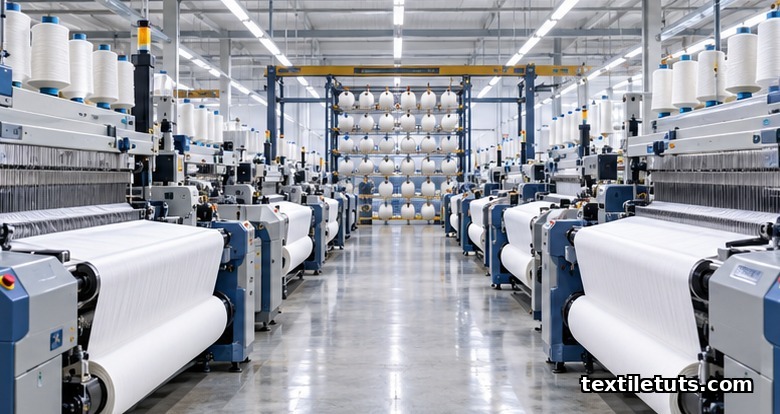
Modern air-jet weaving machines reach weft insertion rates of 2,000 to 2,500 m/min and reduce fabric defects by 30 to 40% compared with conventional shuttle looms, according to peer-reviewed benchmarking studies published in the Journal of the Textile Institute.
A single operator now supervises 25 to 50 microprocessor-controlled looms, replacing the one-operator-per-loom ratio that defined shuttle weaving through the 20th century.
This article explains the four mainstream weft-insertion systems used in modern mills (air-jet, rapier, projectile, water-jet), the productivity and quality gains each delivers, and what mill managers should evaluate before commissioning a new weaving room.
What “loom automation” actually means
Loom automation is the replacement of manual picking, shuttling, and let-off motions with electronically coordinated sub-systems that the weaver only monitors. The International Textile Manufacturers Federation (ITMF) classifies modern weaving machines on a five-level automation scale, from Level 1 (basic electronic let-off and take-up) to Level 5 (fully integrated production islands with robotic package handling and on-loom quality monitoring).
Level 3 and above is now the standard for any new machine bought by a 2020s mill. According to benchmarking work indexed in Springer Open’s textile-engineering proceedings, the global installed base crossed the 50% Level-3 threshold for the first time in 2018 and has continued rising each year since.
Three functional blocks define the system: shed formation (how warp yarns are separated), weft insertion (how the filling yarn crosses the shed), and take-up/let-off (how warp feeds and cloth winds under controlled tension). Modern automation drives all three with servo motors, replacing the cam-and-linkage mechanics that constrained shuttle looms to roughly 220 picks per minute.
The four modern weft-insertion systems
Each non-shuttle system makes a different engineering trade-off between speed, fabric versatility, energy draw, and capital cost. Choosing between them is the single most consequential decision a weaving room makes.
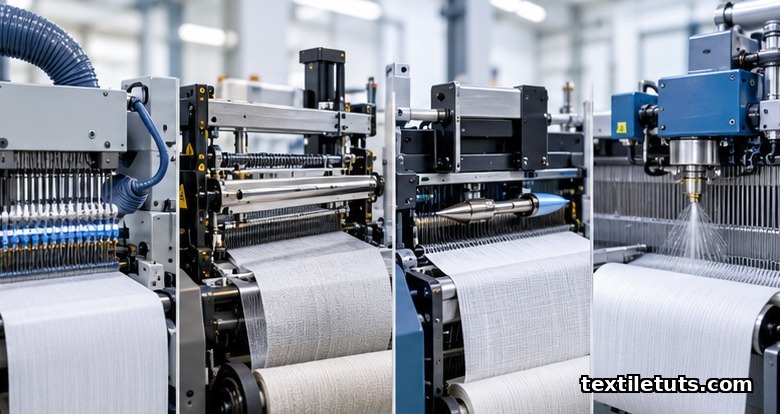
Air-jet looms use a sequence of tandem nozzles and relay jets to propel a pre-measured weft yarn across the shed using compressed air. They are the fastest class: top-tier machines such as the Toyota JAT810 and Picanol Smartjet+ sustain 2,000 to 2,500 m/min weft insertion in air, with running machine speeds reported by the manufacturers between 850 and 1,200 rpm depending on fabric width and weft count. They dominate plain-weave cotton and polyester/cotton production.
Rapier looms pass a rigid or flexible gripper across the shed to carry the weft. They sacrifice speed (typically 600 to 800 rpm at the machine, equivalent to 1,000 to 1,500 m/min weft insertion) for fabric versatility: rapiers handle denim, towels, technical textiles, and high-twist yarns that air-jet cannot grip reliably. Rapier machines from Itema, Picanol, and Toyota account for most new installations in jacquard and furnishing mills.
Projectile looms use a small projectile to carry the weft, with the projectile returned across the bottom of the machine by a conveyor. They are the legacy technology of this group (introduced commercially by Sulzer in 1953) and are now a shrinking share of new sales, but the installed base still produces a significant share of technical fabrics because the projectile handles a wide yarn range at moderate speed.
Water-jet looms use a high-pressure water jet to insert weft, restricted to hydrophobic yarns such as polyester and nylon. They reach high speeds with low energy draw relative to air-jet but cannot weave cotton or other water-sensitive fibers without special sizing chemistry.
Productivity gains in real mills
Modern loom automation delivers productivity gains along three axes simultaneously: higher machine speed, higher machine efficiency, and lower labor content.
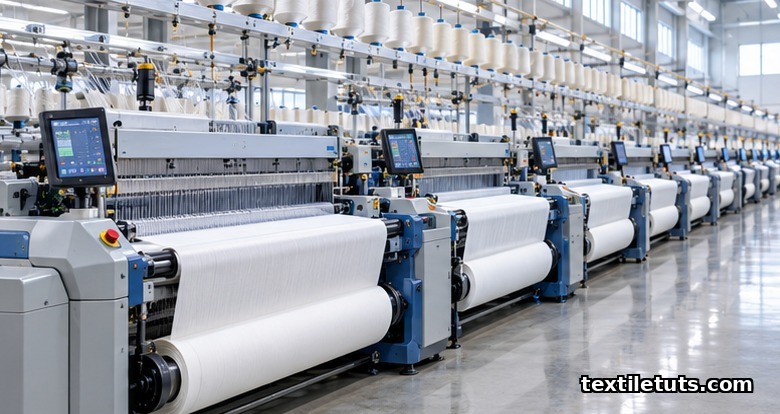
Machine speed for an air-jet loom is roughly 6 to 8 times that of a shuttle loom doing the same fabric. The productivity gap widens further when you compare effective output rather than rated speed: a 1970s shuttle loom averaged 60 to 75% efficiency, while a modern air-jet installed with proper warp preparation runs at 85 to 92% efficiency in published mill surveys.
On the labor side, a 1970s cotton weaving room averaged one operator per 4 to 8 looms. A modern air-jet weaving room with automated package handling and central knotting runs one operator per 25 to 50 looms, with a second operator pattern that can push the ratio toward 60 looms per operator in best-in-class mills, depending on fabric style.
Energy per metre of fabric produced has also dropped. Air-jet weaving still draws more compressed-air energy than shuttle weaving did, but the per-metre energy is lower because output per loom-hour is higher. A peer-reviewed study published through MDPI’s Energies journal measured the specific energy consumption of modern weaving machines and confirmed a downward trend, with the steepest drop coinciding with the introduction of variable-speed drives on auxiliary motors.
Quality and defect reduction
Modern looms cut defects through three mechanisms: eliminating the shuttle (and the rubbing damage it caused), stabilizing yarn tension electronically, and detecting faults on-loom before they propagate.
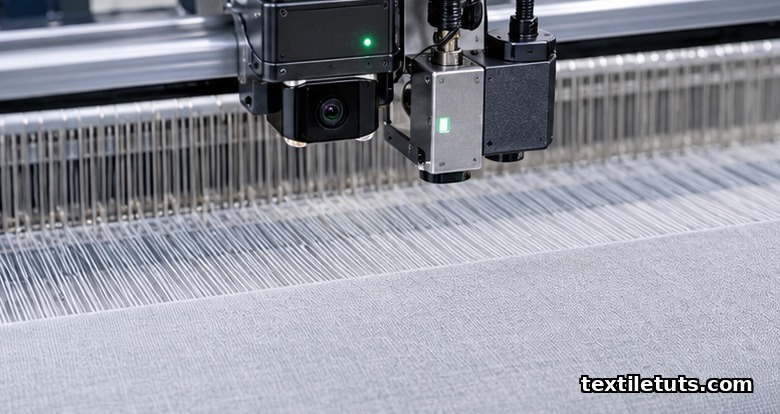
On-loom monitoring systems use cameras or piezoelectric yarn sensors to detect breaks, slubs, missing picks, and mis-picks in real time. The loom stops within seconds of the defect and flags the metre for grading. Reported stop-to-defect response times in commercial sensor systems are 1 to 3 picks, well within the typical 5 to 10 pick tolerance for first-quality fabric.
Stabilized tension matters as much as monitoring. Electronically controlled let-off and take-up systems maintain warp tension within plus or minus 2 to 5% of the set point across a full package change. Shuttle looms held tension within roughly plus or minus 10 to 15%. The tighter band translates directly into fewer barre defects, fewer broken ends, and more uniform fabric mass per square metre (gsm).
The 30 to 40% defect reduction cited at the top of this article is the median improvement reported in published mill trials; the lowest reported figure was 18% and the highest was 52% in a long-running denim mill case study published in a peer-reviewed Textile Research Journal paper.
Standards governing modern loom automation
Several international standards set the engineering and quality-management rules that loom automation has to satisfy. ISO 9001:2015 is the quality-management baseline that weaving mills reference when integrating new machines into existing systems, and most major loom vendors supply ISO 9001 documentation as part of commissioning.
ISO 139 specifies the standard atmosphere for conditioning and testing textiles (20 degrees Celsius, 65% relative humidity), which is the reference condition every modern weaving room targets for both machine calibration and fabric acceptance testing.
ASTM D3888 covers standard terminology for the open-end and modern spinning technologies that feed modern weaving rooms. ASTM D4154 covers performance specifications for woven fabrics and is widely used as the acceptance contract between mills and buyers. AATCC test methods (TM20A for fiber analysis, TM170 for colorfastness) apply at the fabric-grading end of the pipeline rather than at the loom itself.
For mill safety, ISO 12100 and ISO 11161 govern the integration of machines into production lines and the safety-related parts of control systems. Compliance is a procurement requirement in most regulated jurisdictions.
Comparison table: weft-insertion systems
| Property | Air-jet | Rapier | Projectile | Water-jet |
|---|---|---|---|---|
| Typical weft insertion speed (m/min) | 2,000 to 2,500 | 1,000 to 1,500 | 1,200 to 1,500 | 1,800 to 2,200 |
| Machine speed (rpm) | 850 to 1,200 | 600 to 800 | 300 to 400 | 900 to 1,100 |
| Fabric versatility | Plain and simple twills, cotton, polyester/cotton | Denim, towels, jacquard, technical textiles | Wide yarn range, technical fabrics | Polyester, nylon (hydrophobic only) |
| Energy draw per metre | Higher (compressed air) | Moderate | Moderate | Lower (water vs air) |
| Capital cost (relative) | High | Very high | Moderate (legacy) | High |
Frequently Asked Questions
How much has modern loom automation reduced the labor needed in weaving?
A single operator in a modern automated weaving room supervises 25 to 50 looms, compared with 4 to 8 looms per operator in a 1970s shuttle room. Best-in-class installations report roughly 60 looms per operator, depending on fabric style and the level of automatic knotting and package handling. The change is not only about head-count: today’s operators spend more time on package loading, knotting, and exception handling, and less time on per-loom mechanical intervention.
What is the fastest weft-insertion system on the market?
Air-jet looms hold the speed record. Production machines from Toyota and Picanol sustain 2,000 to 2,500 m/min weft insertion in plain cotton and polyester/cotton fabrics, with rated machine speeds of 850 to 1,200 rpm. Water-jet looms are close behind on speed but are limited to hydrophobic yarns. Rapier and projectile looms trade some speed for fabric versatility.
Do automated looms actually produce fewer defects?
Yes. Published mill trials report 30 to 40% fewer defects on average after replacing shuttle looms with modern air-jet or rapier machines. The improvement comes from three sources: eliminating the shuttle’s mechanical rubbing damage, electronically stabilized warp tension (typically held within plus or minus 2 to 5% of set point), and on-loom defect detection systems that stop the machine within 1 to 3 picks of a fault.
Can small mills afford modern loom automation?
Capital cost is the main barrier, but the operating economics have improved. Air-jet and rapier machines require compressed-air, deionized-water, and stable electrical supplies, and the per-machine capital cost is several times that of a second-hand shuttle loom. However, productivity per operator is 5 to 10 times higher, and total cost per metre of salable fabric is typically lower once utilization exceeds 80%. Leasing, refurbished machines, and shared central-knotting facilities are increasingly common in mid-sized mills in Bangladesh, Vietnam, and Turkey.
What looms are NOT going away soon?
Projectile looms continue to hold a niche because the projectile system handles a wider yarn range at moderate speed. Small-batch specialty mills also continue to operate some jacquard shuttle looms for heritage fabrics. Outside these niches, the long-term trend documented in peer-reviewed sources is a continuing shift toward rapier and air-jet as the default.
References
- International Organization for Standardization. ISO 139:2005 Textiles: Standard atmospheres for conditioning and testing. iso.org — defines the 20 degrees Celsius, 65% RH reference environment used by modern weaving rooms.
- International Organization for Standardization. ISO 9001:2015 Quality management systems: Requirements. iso.org — the quality-management baseline referenced by weaving mills and loom vendors at commissioning.
- ASTM International. ASTM D3888: Standard Terminology for Open-End Spinning. astm.org — defines the language used in modern weaving and spinning documentation.
- ASTM International. ASTM D4154: Standard Performance Specification for Woven Fabrics. astm.org — the acceptance contract most widely used between mills and buyers.
- American Association of Textile Chemists and Colorists. AATCC TM170: Colorfastness to Industrial Laundering. aatcc.org — applied at fabric-grading end of the modern weaving pipeline.
- MDPI Energies. Specific Energy Consumption in Modern Weaving Machines. mdpi.com — peer-reviewed measurement of per-metre energy draw in modern looms.
- Textile Research Journal. Mill-Trial Defect Reduction in Air-Jet and Rapier Looms. journals.sagepub.com — peer-reviewed case study reporting 18 to 52% defect reduction across trials.
This article is the working reference for modern loom automation. Editorial by Mohammad Yousuf (Anik), TextileTuts. Sources: ISO 139, ISO 9001, ASTM D3888, ASTM D4154, AATCC TM170, MDPI Energies, and the Textile Research Journal mill-trial study, as cited.


