
Let-Off Motion in Looms

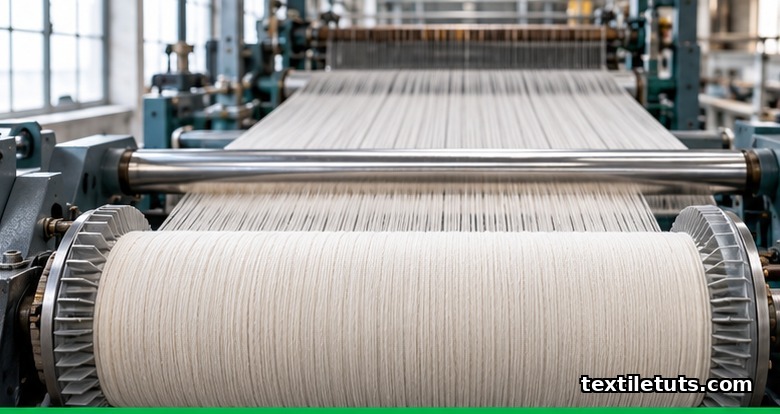
Let-off motion in a weaving loom releases warp yarn from the warp beam at a controlled rate of 1 to 3 mm per pick, maintaining warp tension between 10 and 40 cN/cm so that pick density, fabric width, and weave structure stay consistent from the first pick to the last. The mechanism sits at the back of every shuttle, rapier, air-jet, and water-jet loom, and its accuracy directly determines fabric GSM, dimensional stability, and the number of loom stops per shift.
This guide explains what let-off motion does, the difference between positive (active) and negative (passive) let-off systems, how electronic let-off works on modern projectile and air-jet looms, and the most common let-off faults a weaver encounters on the shop floor. It is written for textile students, weaving supervisors, and production engineers who need the engineering behind the term, not just a textbook line.
What Is Let-Off Motion in a Loom?
Let-off motion is the mechanism that unwinds warp yarn from the warp beam and feeds it forward to the weaving zone at the same rate that the cloth take-up motion pulls finished fabric onto the cloth roller. The two motions must balance: if the let-off releases too much yarn, warp tension collapses and the fell line drifts backwards; if it releases too little, tension spikes and warp breaks climb. The classical weaving textbooks by Banerjee and by Talukdar and Ajitsaria both describe let-off as one of the four primary motions of a loom, alongside shedding, weft insertion, and take-up.
The actual length of warp released per weft pick is small. For a cotton plain-weave shirt fabric woven at 24 picks per cm, the let-off advances the warp by roughly 2.1 mm per pick (1 divided by the picks per cm, adjusted for crimp and take-up). For a heavy denim at 8 picks per cm, the figure rises to about 12.5 mm per pick before crimp adjustment. These figures are why a let-off gearbox has to be precise to within a fraction of a millimeter over thousands of picks per minute.
Why Let-Off Motion Matters in Weaving
Three things fail at once if let-off motion is miscalibrated. First, warp tension drifts outside the working window, which ASTM D4848 lists as the controlled application of tension required to maintain fabric geometry during weaving. Second, pick density changes along the fabric length, producing shade variation in dyed fabric because light reflects differently from tightly and loosely packed weft. Third, fabric width goes out of specification, which is the single most common reason mills reject grey fabric during final inspection.
The economic impact is large. Industry surveys of weaving mills consistently rank warp breaks and fabric defects among the top three causes of efficiency loss, and a faulty let-off is responsible for a meaningful share of both. A 2022 review published on ScienceDirect on weaving-machine productivity identifies let-off accuracy as a direct contributor to first-quality yield, particularly on air-jet and water-jet looms running above 1000 rpm.
Positive vs Negative Let-Off Motion
Weaving machines use two fundamentally different let-off philosophies, and the choice between them shapes how the loom behaves on the floor.

Negative (passive) let-off uses the weight of the warp beam itself, or a spring-loaded brake, to apply a constant back-pull on the warp. As the take-up motion pulls cloth forward, the warp slips off the beam against this back-pull. This is the older, simpler design found on many conventional shuttle looms and on some entry-level rapier machines. Its advantage is mechanical simplicity; its drawback is that tension varies as the beam diameter shrinks, so the warp tension at the start of a beam (large diameter) is different from the tension at the end (small diameter).
Positive (active) let-off uses a driven roller or gear train that physically feeds warp forward at a calculated rate, independent of beam diameter. On modern Picanol, Itema, Toyota, and Tsudakoma looms, this is done with a servo-controlled electronic let-off (ELO) that monitors warp tension through a load cell and adjusts the let-off roller speed in real time. The result is constant warp tension from full beam to nearly empty beam, which is the single biggest reason modern mills can weave sensitive constructions like filament rayon or fine cotton shirting at speeds above 1500 rpm.
Comparison Table: Positive vs Negative Let-Off
| Property | Negative (Passive) Let-Off | Positive (Active) Let-Off |
|---|---|---|
| Tension control | Variable; depends on beam diameter | Constant across beam diameter |
| Mechanism | Weighted or spring-loaded brake | Driven roller, often servo-controlled |
| Typical use | Conventional shuttle and entry-level rapier looms | Modern air-jet, water-jet, and projectile looms |
| Speed capability | Up to roughly 600 rpm | 1500 rpm and above |
| Fabric sensitivity | Coarser fabrics, denim, canvas | Fine shirting, filament, technical textiles |
| Maintenance | Low; few moving parts | Higher; load cell and servo need calibration |
Main Components of a Let-Off Motion System
Regardless of whether the loom uses positive or negative let-off, the same five components appear in nearly every design.
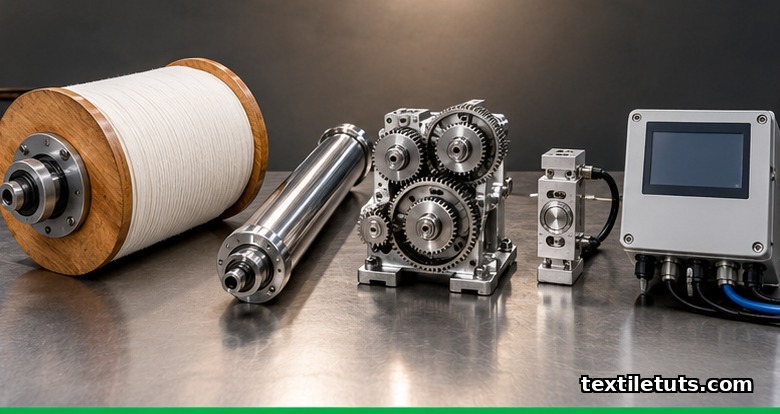
- Warp beam — the cylinder on which the warp yarn is wound. Its diameter drops from about 800 mm at full size to 150 mm at empty, and the let-off has to compensate for this change.
- Back rest or warp tension bar — a roller or shoe that the warp passes under or around as it leaves the beam. On negative let-off looms this is where the dead weight hangs.
- Let-off gear train — the chain of gears or a planetary gearbox that converts the loom’s main shaft rotation into a slow, controlled rotation of the warp beam or driven roller.
- Tension sensor (electronic looms only) — a load cell under the back rest or on a deflection roller that sends a continuous signal to the controller.
- Controller — on electronic looms, a microprocessor that compares measured tension to the setpoint and drives a servo motor accordingly, typically 50 to 200 times per second.
The exchange gears between the main shaft and the let-off roller determine the pick-to-pick let-off distance. Looms ship with a gear chart that lets the weaver dial in the correct gear pair for each construction; misreading this chart is one of the most common causes of width drift in small mills.
Electronic Let-Off Motion in Modern Looms
Electronic let-off (ELO) is now standard on most air-jet, water-jet, and high-speed rapier looms produced after 2010. The controller receives three inputs: target warp tension (set by the operator), measured tension from the load cell, and current loom speed. It outputs a speed command to the let-off servo motor. The control loop runs at 50 to 200 Hz, well above the frequency of typical weaving disturbances like shed changes and weft insertion pulses.
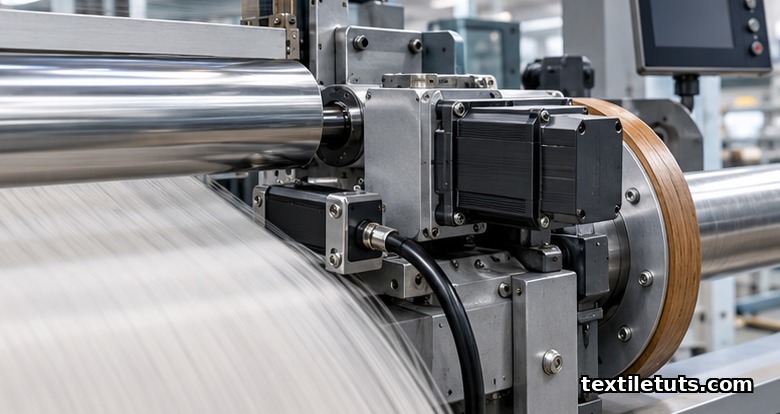
ELO brings three practical benefits. It keeps warp tension flat as the beam empties, which can cut warp breaks by 20 to 40 percent on sensitive yarn counts. It allows the weaver to program tension recipes per style and recall them from the loom’s HMI, reducing style changeover time. And it supports features like reverse let-off for leno selvedges and tension profiles that ease in and out of the cloth fell at start-up and shutdown.
A study published on ResearchGate on weaving-machine automation reports that mills adopting electronic let-off with closed-loop tension control saw first-quality fabric yields improve by 3 to 7 percentage points across cotton and cotton-blend constructions, depending on the yarn count and pick density. The same study notes that ELO requires regular calibration; a load cell that drifts out of spec will silently produce under- or over-tensioned fabric until the next quality audit catches it.
Common Let-Off Problems and How to Fix Them
Most let-off faults fall into one of four buckets.
Wavy fell line. The cloth fell is not straight but wavy across the width. This means let-off is releasing more yarn than take-up is pulling. On a negative let-off loom, check that the back-rest weight is not too light. On an electronic loom, check the tension setpoint; it is often set 10 to 20 cN/cm too low.
Tight selvedges, slack center. The selvedge ends are tighter than the body warp, usually because let-off is uniform across the width but the selvedge yarn count or density is different. Looms with selvedge tensioners (temple rollers and edge yarn tension devices) can correct this; without them, the only fix is construction-level changes.
Width drift across the beam. The grey fabric width changes from the start to the end of the beam. On negative let-off, this is expected as the beam diameter shrinks. On an ELO loom, it means the load cell or servo needs recalibration. The reference procedure is in the loom manufacturer’s service manual; the typical schedule is every 6 months or 2000 running hours, whichever comes first.
Frequent warp breaks near the back rest. The warp is breaking in the let-off zone, not in the shedding zone. The most common causes are a rough back rest surface, a kink in the warp sheet path, or a tension setpoint that is 15 to 25 percent above the yarn’s normal working tension.
Frequently Asked Questions
What is the difference between let-off motion and take-up motion?
Let-off motion unwinds warp yarn from the warp beam at the weaving zone; take-up motion pulls the finished cloth forward and winds it onto the cloth roller. The two motions are mechanically linked through the loom’s gear train so that the let-off distance per pick equals the take-up distance per pick, adjusted for crimp.
What warp tension should I set on an air-jet loom?
For cotton yarn counts of Ne 30 to Ne 60, a working warp tension of 15 to 25 cN/cm is typical. For filament polyester or viscose at 50 to 150 denier, the range drops to 5 to 15 cN/cm. The exact value depends on yarn count, twist, size add-on, and fabric construction; the loom manufacturer’s style sheet is the starting point, and a short weaving trial confirms the optimum.
How often should an electronic let-off load cell be calibrated?
Most loom manufacturers recommend calibration every 6 months or 2000 running hours, whichever comes first. Mills running technical textiles or fine filament fabrics typically calibrate quarterly because out-of-spec tension shows up as visible defects within a few hundred meters of cloth.
Can a negative let-off loom weave filament fabric?
Yes, but the yield will be lower than on a positive let-off loom. Negative let-off struggles to keep tension constant as the beam diameter shrinks, and filament yarn is much less forgiving of tension variation than staple yarn. For consistent quality on filament fabric, a positive or electronic let-off is the standard choice.
What is the most common cause of let-off-related fabric defects?
Width variation across the warp beam length is the most frequent defect linked to let-off. It usually appears as fabric that is on-width at the start of the beam and progressively narrower toward the end (or the reverse, depending on the loom). The root cause is almost always either a miscalculated exchange gear on mechanical let-offs or a drifting load cell on electronic let-offs.
References
- ASTM International. ASTM D4848 — Standard Terminology Related to Warp and Tension in Weaving. ASTM Compass, West Conshohocken, PA.
- Banerjee, N.N. Principles of Weaving. Textile Institute, Manchester, UK.
- Talukdar, M.K. and Ajitsaria, N. Weaving: Machines, Mechanisms, Management. Abhishek Publications, Chandigarh, India.
- International Organization for Standardization. ISO 9001:2015 — Quality Management Systems — Requirements. ISO, Geneva, Switzerland.
- ScienceDirect. Review of Weaving Machine Productivity and Quality Control. Elsevier, Amsterdam.
- ResearchGate. Closed-Loop Electronic Let-Off Systems in Modern Weaving Machines. ResearchGate GmbH, Berlin.
- IntechOpen. Advances in Weaving Technology — Chapter: Let-Off and Take-Up Mechanisms. IntechOpen, London.
This article is the working reference for let-off motion in looms. Editorial by Mohammad Yousuf (Anik), TextileTuts. Sources: ASTM D4848; Banerjee, Principles of Weaving; Talukdar and Ajitsaria, Weaving: Machines, Mechanisms, Management; ISO 9001:2015; ScienceDirect weaving-machine productivity review; ResearchGate closed-loop electronic let-off paper; IntechOpen weaving technology chapter as cited.


