
Milling: Wool Fabric Compacting

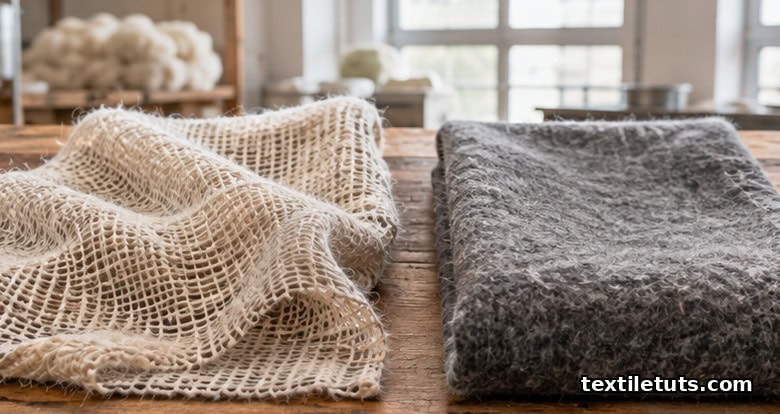
Wool milling, also called fulling, is a controlled wet finishing process that compacts woven or knitted wool fabric by 10–50% in area through the combined action of moisture at 30–50 °C, applied soap or dilute acid, and sustained mechanical agitation, exploiting the directional friction of wool’s epicuticle scales to drive progressive felting shrinkage.
The result is a denser, more cohesive fabric with the hand, loft, and surface character that defines melton, loden, duffel, and many traditional worsted flannels. This article covers the fiber science behind milling, the process variables that control shrinkage rate, the acid and alkaline process routes, machinery options, and the testing standards used to certify dimensional stability in finished wool cloth.
Why wool mills: the purpose of compacting
Milling is not simply shrinkage control. It is a deliberate restructuring of the fabric. The fibers ratchet past each other and consolidate into a tighter, fuller structure, raising mass per unit area, improving thermal insulation, and producing the matte, lofty surface that defines wool overcoating and uniform melton. A square meter of lightly milled wool suiting typically weighs 250–320 g/m² before finishing; the same cloth after fulling can exceed 450 g/m² without adding any fiber.
The compacting also masks yarn irregularities, softens the surface, and gives the cloth better recovery from creasing. For knitwear, milling closes up the stitch gauge, transforming an open-gauge yarn into the dense, felted fabric used for sweaters, scarves, and pea coats.
The fiber science: why wool felts and other fibers do not
Wool’s felting behavior comes from its cuticle, the outermost layer of each fiber. Each cuticle cell overlaps the next in the direction of fiber growth, creating a ratchet-like surface. When wool is wet, the scales swell and lift slightly, and under agitation the differential friction (higher friction against the scale direction than with it) causes the fibers to migrate preferentially in one direction. Once locked in their new position, the scales resist any return movement, producing irreversible dimensional change.
This is why cellulosic fibers (cotton, linen) and synthetic fibers (polyester, acrylic, nylon) do not mill under the same conditions. They lack scales and directional friction. Modern machine-washable wool is produced by either removing the scales chemically (the chlorine-Hercosett anti-shrink treatment specified in ISO 2646) or by coating the fiber with a thin polymer film that masks the scale edges, reducing the differential frictional effect (DFFE) that drives felting shrinkage.
Process variables that control the milling rate
Five variables interact to determine how fast and how far a wool fabric mills:
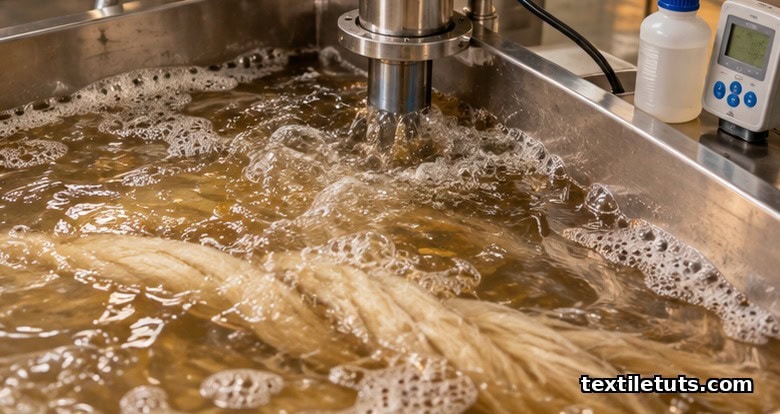
- Moisture: Wool fibers must be thoroughly wetted. The water swells the cuticle and lifts the scales. Dry milling produces almost no shrinkage.
- Temperature: Typical milling baths run at 30–50 °C. Above 60 °C, fiber damage and yellowing increase; below 25 °C, the process slows significantly.
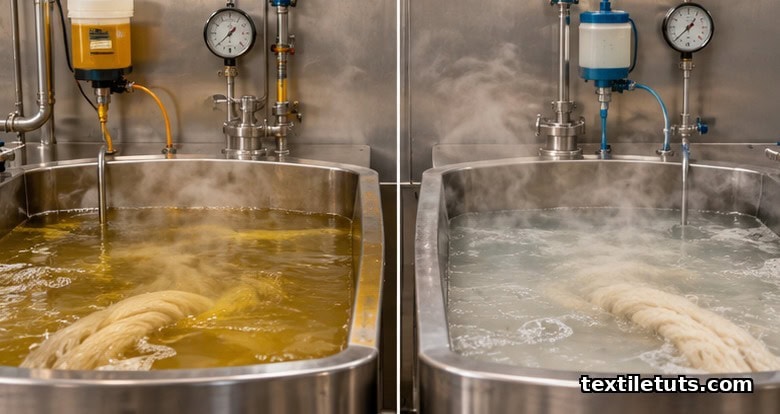
- pH: Acid (pH 2–3 with sulfuric acid) and alkaline (pH 9–10 with soda ash or ammonia) routes are both used. Acid conditions open the scales more aggressively and produce faster shrinkage with less fiber damage, which is why most industrial milling runs on the acid side.
- Mechanical action: Compression, pounding, or rotary agitation supplies the energy that moves fibers past each other. Rotary drum mills, hammer mills, and stocking mills all rely on this variable.
- Surfactant: A wetting agent (typically 1–3 g/L of olive-oil soap or an anionic surfactant) lowers the bath surface tension so the water reaches the fiber surface quickly.
The combined effect is nonlinear. Doubling mechanical agitation while keeping the bath cold produces only a modest increase in shrinkage. Warming the same bath by 10 °C can double the rate.
Acid versus alkaline milling
The choice between acid and alkaline milling depends on fiber blend, color, and the degree of shrinkage required. Acid milling is the industrial standard for piece dyeing after milling because the acid bath does not interfere with most acid or chrome dyes. Alkaline milling, while gentler on the scales and slower, can yellow whites and pale shades and is therefore usually reserved for pre-scoured greys or specific fiber blends.
| Parameter | Acid milling | Alkaline milling |
|---|---|---|
| Bath pH | 2.0–3.5 (sulfuric acid) | 9.0–10.5 (soda ash or ammonia) |
| Temperature | 30–45 °C | 35–50 °C |
| Time to 25% area shrinkage | 20–40 minutes | 60–120 minutes |
| Effect on white shade | Minimal | Yellowing possible |
| Fiber damage | Low at controlled pH | Higher at sustained high pH |
| Typical end-use | Melton, duffel, blanket cloth | Pre-scoured worsted flannel |
Milling machinery in practice
Three machine classes dominate industrial wool milling.
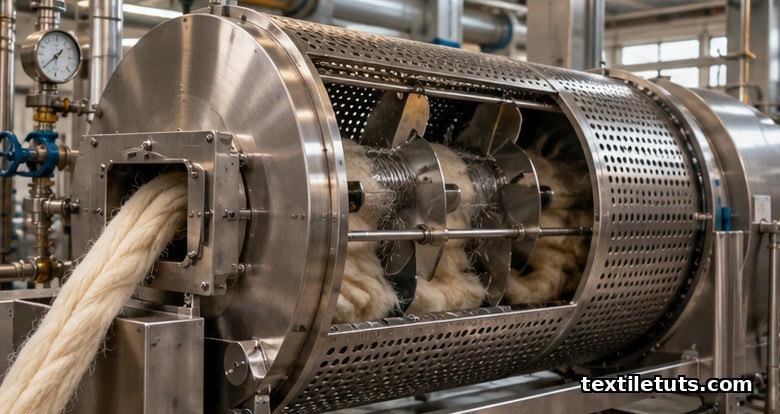
Stocking mills are the oldest design. The fabric is stitched end-to-end into a continuous tube (rope form) and tumbled inside a large rectangular box with beaters or hammers. Pound for pound they produce the softest hand, which is why many premium overcoatings and knitwear fabrics are still stocking-milled.
Rotary drum mills feed the rope of fabric through a large perforated drum rotating at 5–30 rpm. These machines offer high throughput and uniform action across the fabric length.
Continuous milling ranges, used for piece-goods, pass the open-width fabric through a sequence of compression rollers, sponging stations, and vibrating platens. They are easier to integrate with continuous scouring and dyeing ranges and dominate the production of melton, loden, and technical wool fabrics.
How milling changes measurable fabric properties
After fulling, the following measurable changes occur:
- Mass per unit area (GSM): increases 20–80% depending on starting construction.
- Thickness: rises 30–60% as the loftier fabric traps more air.
- Abrasion resistance: improves because locked fibers resist pull-out.
- Air permeability: drops sharply because the inter-yarn pores close up.
- Thermal resistance (clo value): rises measurably, which is why milled wool remains the standard for cold-weather uniform cloth.
Dimensional stability after milling is verified per AATCC TM 135 or ISO 6330, both of which prescribe accelerated home-laundering cycles designed to expose any residual felting tendency. Mass per unit area is verified per ASTM D3776/D3776M.
Common defects and how to prevent them
Uneven shrinkage across a piece, called shade bars or milling marks, comes from uneven wetting, soap streaks, or temperature variation in the bath. Consistent pre-scouring, accurate bath loading, and continuous circulation of the liquor prevent this. Over-milling cracks the fabric and damages the wool scales; in severe cases the cloth tears under its own weight when lifted from the machine. The mitigation is to track shrinkage rate by measuring wet-on-wet dimensions every 15 minutes and stopping the run when the target shrinkage is reached.
Frequently Asked Questions
Is milling the same as felting?
Milling is the controlled industrial version of felting. Hand-felting is an uncontrolled process that produces uneven shrinkage. Industrial milling controls moisture, temperature, pH, and mechanical action to deliver a specific, repeatable amount of area shrinkage across an entire production lot.
Can you mill wool-polyester blends?
You can, but the polyester does not shrink. The wool component mills around the polyester, and the blend ends up softer and more drape-friendly than 100% wool, but with less dense surface loft. Blends above 50% polyester typically need longer milling times because the synthetic fibers cushion the mechanical action.
Does milling weaken the fabric?
Mildly, yes. Each pass through the milling cycle shortens and reorients some wool fibers. Tensile strength drops 5–15% depending on intensity, but the gain in mass per unit area and the closed-up construction usually compensate, so the finished fabric feels stronger and more substantial to the consumer.
How is milling different from decating?
Milling compacts the fabric by felting. Decating sets the finish and stabilizes dimensions using heat and moisture under pressure in a decating machine, without the directional agitation that drives shrinkage. Most wool cloths are decated after milling, never instead of milling.
Will a milled wool garment shrink further when washed?
A properly milled and decated wool cloth should exhibit no more than 3% dimensional change in either direction after five home-laundering cycles per AATCC TM 135, provided it is washed in cool water on a gentle cycle and dried flat. Hand-washable wools achieve this only after the anti-shrink treatment specified in ISO 2646.
References
- International Organization for Standardization. ISO 6330:2021 Textiles — Domestic washing and drying procedures for textile testing. iso.org — covers accelerated laundering cycles used to verify dimensional stability after milling.
- American Association of Textile Chemists and Colorists. AATCC TM 135 Dimensional Changes of Fabrics After Home Laundering. aatcc.org — the reference method for measuring residual shrinkage after milling.
- ASTM International. ASTM D3776/D3776M Standard Test Methods for Mass Per Unit Area (Weight) of Fabric. astm.org — used to confirm GSM gains from milling.
- International Organization for Standardization. ISO 2646:2014 Wool — Determination of the Dimensional Change Due to Felting of a Single Fabric Specimen Using a Wash Bottle. iso.org — the lab-scale felting test that models how a wool fabric will behave in industrial milling.
- McPhee, J. R. Felting and Milling of Wool Fabrics — A Review. Textile Research Journal (peer-reviewed). Available via researchgate.net — covers the underlying fiber-scale mechanics of directional friction felting.
- Rippon, J. A. The Structure of Wool and Its Influence on Textile Properties. In: Handbook of Textile Fibre Structure, Woodhead Publishing (peer-reviewed academic reference). Available via sciencedirect.com — fiber morphology and scale structure that drive felting shrinkage.
Editorial by Shahrukh Islam, TextileTuts. Sources: ISO 6330, ISO 2646, AATCC TM 135, ASTM D3776/D3776M, Textile Research Journal (McPhee), and Woodhead Publishing (Rippon) as cited.


